
Project chaos often begins with a simple assumption. You think everyone’s on the same page, until the client adds a few “small” features midstream, the budget starts soaring, and deadlines disappear.
According to PMI’s 2023 Pulse of the Profession report, poor requirements gathering and unclear scope are among the top reasons projects fail. Without a clearly defined scope of work (SoW), even the best teams can lose direction, waste time, and clash with stakeholders. On the flip side, a strong SoW sets expectations, defines boundaries, and ensures everyone knows what’s being done, by whom, and by when.
In this article, you’ll learn exactly how to write a scope of work that works, from crafting clear objectives and identifying deliverables to setting constraints and preventing scope creep, all with practical examples you can apply right away.
Decoding the scope of work
Has your team ever argued over who should be doing what in a project? That’s why having a clear scope of work matters.
What is the scope of work?
The scope of work (SoW) is a document that answers four simple but powerful questions:
- What needs to be done?
- Who will do it?
- When will it be done?
- How will we know it’s successful?
Why does it matter?
When you decode and understand your SoW, you can:
- Give everyone a shared goal: nobody works in different directions
- Prevent scope creep: Make sure that extra work doesn’t sneak in and delay the project
- Stay on time and budget: you’ve already planned what needs to be done
- Set realistic expectations: clients or stakeholders know what to expect and when
Moreover, a well-written SoW saves time by guiding your team’s effort and energy in the right direction.
A simple scope of work example
Suppose you’re redesigning your company’s website. Your SoW might include:
- Objective: Improve mobile experience and update branding
- Deliverables: New website design, mobile version, content updates
- Timeline: 8 weeks, with weekly check-ins
- Inclusions: UI/UX design, mobile responsiveness, SEO setup
- Exclusions: Ongoing site maintenance after launch
- Team: Project manager, designer, developer
This gives everyone involved the same understanding of what’s expected, and that’s the whole point of decoding your scope of work. If you have never worked on your project’s SoW before, understanding its key components will be a great starting point.
Unveiling the importance of project objectives and deliverables
Objectives and deliverables are two important building blocks of any successful project. If they’re not clear, everything else can fall apart quickly.
Why project objectives matter
Project objectives provide your team with a clear sense of purpose and direction so that they can work with the required focus and confidence. Without clear objectives, teams lose momentum.
It’s like asking them to ‘create a fitness app’ without any more context. They will start to throw everything against the wall and hope some of it sticks.
Now compare that with:
Launch a mobile app that helps users track daily habits and gain 10,000 downloads in the first 3 months.
Suddenly, the fog lifts. Everyone understands the mission, the user, and the target.
Remember, a good objective is always clear, specific, and achievable.
Why deliverables are just as important
While objectives explain why you’re doing the project, deliverables explain what you will produce.
Let’s go back to the app example. Your list of deliverables might include:
- A fully functional mobile app
- A user guide or onboarding experience
- A marketing landing page
- Weekly progress reports
Each of these is a visible, trackable outcome and something concrete to expect.
Moreover, clear deliverables help you avoid last-minute “oh, we thought you were doing that too” moments as well.
It is not a wise call for project managers to define great objectives and deliverables alone. They should seek out diverse perspectives from everyone involved in the project. Once your goals and deliverables are locked in, the next big step is to set clear boundaries.
Navigating inclusions and exclusions in your scope
Your SoW shows not only what’s being built but also what’s not. This is where inclusions and exclusions come in.
What are inclusions?
Inclusions refer to the tasks, features, or responsibilities that are part of the project. They tell your team exactly what work is expected.
For example, if you’re leading a website redesign, your inclusions might be:
- Designing a new homepage layout
- Updating the website content
- Making the site mobile-friendly
- Running basic quality checks
In short, inclusions are the “We have to complete these milestones” items of your project.
What are exclusions?
Exclusions are the polar opposite of inclusions. They define what the project will not cover.
In the same website redesign example, exclusions could be:
- Creating new blog posts
- Managing social media
- Providing future site updates
- Buying new hosting or domain services
These are your “not included” statements. This makes it easier to say no when off-track requests come up.
Why they matter
No organization wants to blow its budget on overworked teams just because a small misunderstanding between the client and its team snowballed into misaligned tasks.
That’s why inclusions and exclusions are important to save you from situations where clients might expect work beyond your SoW.
With transparent scope boundaries, teams feel confident to reject additional work that might lead to scope creep in the first place.
However, determining inclusions and exclusions should be a collaborative effort, involving clients and key stakeholders. Use tools like Jira to track changes and flag any new requests that might affect your SoW. Alternatively, use a simple scope of work example as a starting point and build from there.
Once the list is complete, the next big thing is to figure out the limits up to which you’re willing to stretch your resources.
Setting boundaries and constraints for project success
These are the real-world limits that shape how far your project can go. If your scope of work doesn’t set clear limits, you’ll likely face delays, confusion, or budget problems down the road.
What are project boundaries?
As the name suggests, project boundaries specify clear limits for the project. They articulate the start and end of a project, resulting in clear expectations from clients.
It also adds other benefits to the project process, such as:
- Reducing the chances of scope creep
- Saving resources on unrelated work
- Creating a functional project environment with shared responsibilities
- Clarifying accountability for individual work
- Helping the team adhere to the defined project scope statement
Let’s say you’ve closed a big deal to build a mobile app for a reputed MNC. A mobile app can be for Android and iOS. Your boundary might be that only the Android version will be developed within this project. If the MNC wants to additionally develop an iOS version, that may require an additional project.
What are project constraints?
Constraints are the limits you must work within. These are usually about money, time, or resources. They are fixed conditions that you must respect.
For example:
- Budget: $10,000
- Timeline: 8 weeks
- Resources: One developer, one designer, and one content writer
- Tools: Company’s current software and branding guidelines
They affect how much work you can take on, how fast you move, and what kind of outcomes are possible.
Note: If your team uses Confluence or Jira, you can link your budget and resource planning pages right inside your SoW so everyone stays aligned.
Maximizing the benefits of a well-defined scope
Once your scope of work is clearly laid out, you’ll notice how it quietly becomes the backbone of your project. When done right, it removes confusion, builds stronger teams, and keeps your project on track, even when things get tough.
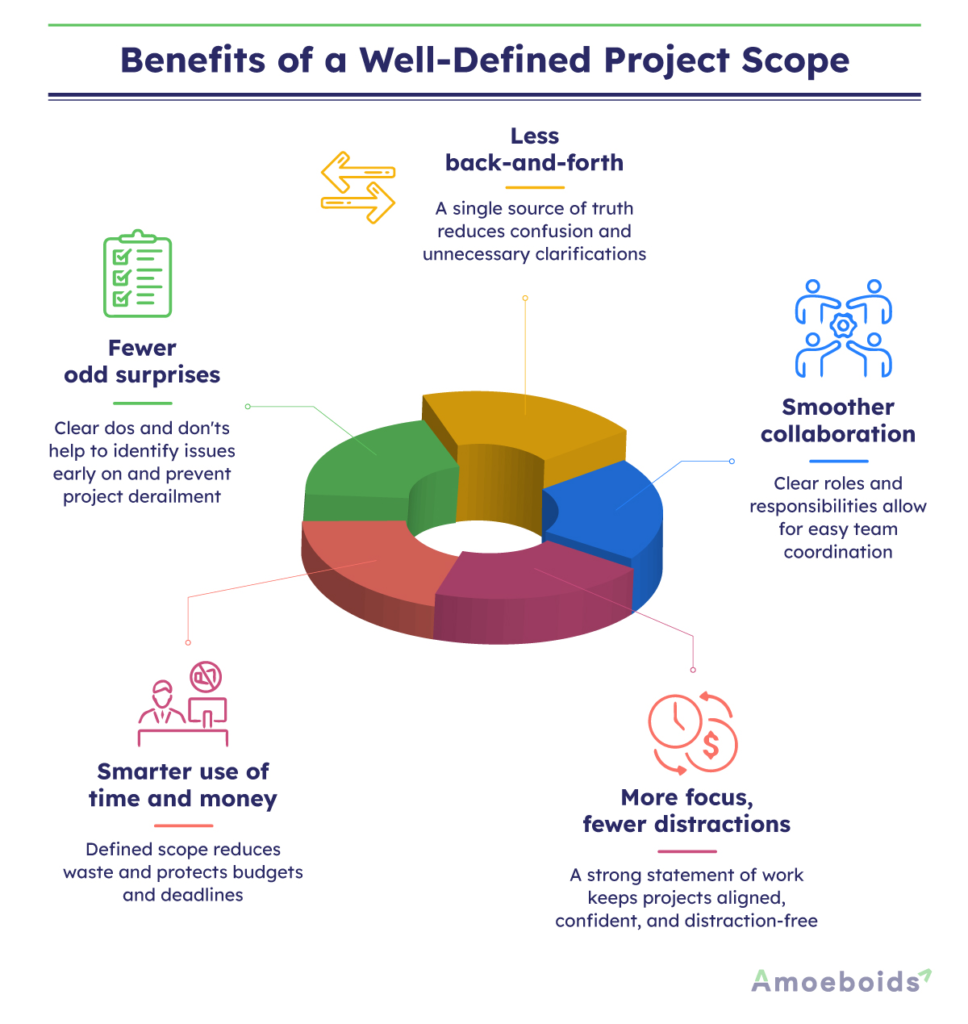
- Fewer odd surprises: The clarity of dos and don’ts helps you spot potential issues early and resolve them before they derail the project.
- Less back-and-forth: With a single source of truth about project scope, there is less room for confusion.
- Smoother collaboration: Teams coordinate more naturally when they are clear about individual roles and responsibilities.
- Smarter use of time and money: With clarity on scope, constraints, and deadlines, you can avoid wasted time and keep the budget focused on what really matters.
- More focus, fewer distractions: A strong SoW gives you the language and the confidence to keep your project moving without distractions or unnecessary detours.
Exploring real-life scope of work samples
These real-life cases will help you see how everything fits together and show you how to write a scope of work in a clear, effective way. Let’s start with a simple scope of work example of developing a website.
1. Website development project
Objective: Build a responsive company website to improve online presence
Deliverables:
- A homepage, About page, Services page, and Contact form
- Mobile-friendly layout
- Basic SEO setup
- Content upload and basic functionality testing
Timeline:
- Week 1: Finalize sitemap and design mockup
- Weeks 2–3: Develop page layouts and set up mobile responsiveness
- Week 4: Upload content and apply SEO basics
- Week 5: Run internal tests and bug fixes
- Week 6: Client review and final tweaks
Milestones:
- Completion of design mockups
- Full mobile layout implementation
- Successful internal testing and bug fixes
- Client sign-off
Reports:
- Weekly status updates with design and development progress
- Feedback tracking during the client review phase
- Final handover checklist
Inclusions: Design, development, content upload, and basic testing
Exclusions: Ongoing website maintenance, blog setup, third-party app integrations
Budget: $8,000
Duration: 6 weeks
This example keeps the scope focused. It avoids confusion by stating exactly what is included and what isn’t. The team and client can refer to this any time there’s a question or a change request.
2. Marketing campaign for product launch
Objective: Create and launch a digital marketing campaign to increase product awareness
Deliverables:
- 3 promotional emailers
- 5 social media creatives
- One product landing page
- Campaign scheduling and setup
Timeline:
- Week 1: Finalize campaign goals and brand message
- Week 2: Write emails and social copies
- Week 3: Design assets and build landing pages
- Week 4: Schedule and launch campaign
Milestones:
- Approval of email and social media content
- Completion of design assets
- Launch of campaign across platforms
Reports:
- Weekly updates on content creation and design progress
- Review of engagement metrics post-launch
- Summary report at campaign close
Inclusions: Copywriting, graphic design, and campaign scheduling
Exclusions: Long-term marketing support, influencer partnerships
Budget: $5,000
Duration: 4 weeks
This scope of work document gives the marketing team a clear plan. Everyone knows what’s expected, so there’s no guesswork or delays.
Conclusion
The scope of work document is an agreement on the work you’re going to deliver in a project. At the least, it includes deliverables, a timeline, milestones, and reports. Before writing a SoW, clarify your project goals and break them down into work packages and individual tasks to determine deliverables, timelines, and other key aspects.
If you still wonder how to write a scope of work document for your project, consider gathering insights from everyone, including your stakeholders, to clarify the schedule, deliverables, and effort. Use modern apps and technology, like those offered by Amoeboids, to streamline collaboration so your team can spend more time brainstorming and less time sorting through feedback.
FAQs
1. What should the scope of work include?
A scope of work should include the project’s purpose and objectives, the specific deliverables to be produced and the tasks and activities required. It should also define the timelines for completion, roles and responsibilities for each party involved, list any exclusions, and establish boundaries to prevent misunderstanding later.
2. How do you ask for the scope of work?
If you’re a client, you can request your service provider to prepare a comprehensive SoW before the project begins. It should clearly state the project goals, timelines, responsibilities, and limitations in writing.
3. Why is it important to know the scope of work?
As it lists a clear goal with shared responsibilities, your teams collaborate to finish the project on time without any distractions or silly mistakes. It also reduces the chances of scope creep when extra tasks are added without proper approval.
4. What does the scope of work contain?
The scope of work explains goals, tasks, deliverables, schedule, roles, and limitations. It should also highlight any rules of your project that the client should be aware of to avoid scope creep.