
Agile teams often get caught up in the sprint cycle between fixing bugs and delivering products. But sometimes losing track of your work is easy in the rush. That’s where backlog grooming has emerged as a key strategy for staying productive and tackling work in a stress-free manner.
A survey by the Scrum Institute revealed that teams that consistently hold grooming meetings see 50% fewer defects in their software releases compared to those that skip this essential practice. Backlog grooming enhances your team’s productivity and prepares them for consistent and reliable delivery, sprint after sprint.
This article outlines the definition, process, and best practices for effective backlog grooming, as well as additional information.
Understanding backlog grooming
So, what is backlog grooming? It is when the team meets regularly to review and modify the product backlog. Generally, you remove completed tasks and outdated backlog items, keeping backlogs up to date with new items. You’ll groom top-priority items that are understood and ready to move into the sprint for work.
Backlog grooming can help the team stay focused on managing the product roadmap and other key priorities. It ensures that the delivery meets business objectives and aligns with stakeholder expectations.
There is an ideal time for backlog grooming, generally about three-quarters of the way through a sprint. But, if skipped altogether, it leads to confusion, misaligned priorities and wasted time.
The importance of backlog grooming in the Agile process
Why should teams look at backlog items that may or may not be taken up in the future and groom them? Let’s see.
- Successful sprint planning: With backlogs already filtered from a backlog grooming session, planning your upcoming sprints becomes significantly quicker, simpler, and more effective.
- Improves team collaboration: Through regular grooming sessions, team members can communicate and align on the project’s direction and priorities, resulting in successful cooperation and effective communication.
- Improved outcomes: By dividing larger user stories into smaller components, teams can release new software updates to customers more frequently.
Backlog grooming vs. sprint planning: What’s the difference?
Backlog grooming and sprint planning might sound similar, but they play very different roles in the Agile process. Here’s a simple breakdown to help you understand how they differ:
| Aspect | Backlog Grooming | Sprint Planning |
|---|---|---|
| Purpose | Keeps the product backlog clean, prioritized, and ready for future sprints. | Prepares and commits to the work for the upcoming sprint. |
| Timing | Happens regularly (once or twice per sprint). | Happens once at the beginning of each sprint. |
| Focus | Looks at the entire backlog—short-term and long-term items. | Focuses only on immediate, high-priority tasks for the next sprint. |
| Participants | Typically includes a product owner, a scrum master, and relevant team members. | The entire Agile team, especially developers and the product owner. |
| Output | A refined, prioritized, and well-understood product backlog. | A sprint backlog (a clear set of tasks/user stories to be completed in the sprint). |
| Nature of Work | Ongoing, collaborative, and less structured. | Structured, goal-oriented meeting with clear deliverables. |
| Decision-Making | Helps in deciding what could be worked on in future sprints. | Decides what will be worked on in the current sprint. |
How to conduct a successful backlog grooming session
Backlog grooming brings the product owner, project manager, and team together to review and prioritize tasks that align with business goals and customer needs. Let’s break it down step by step.
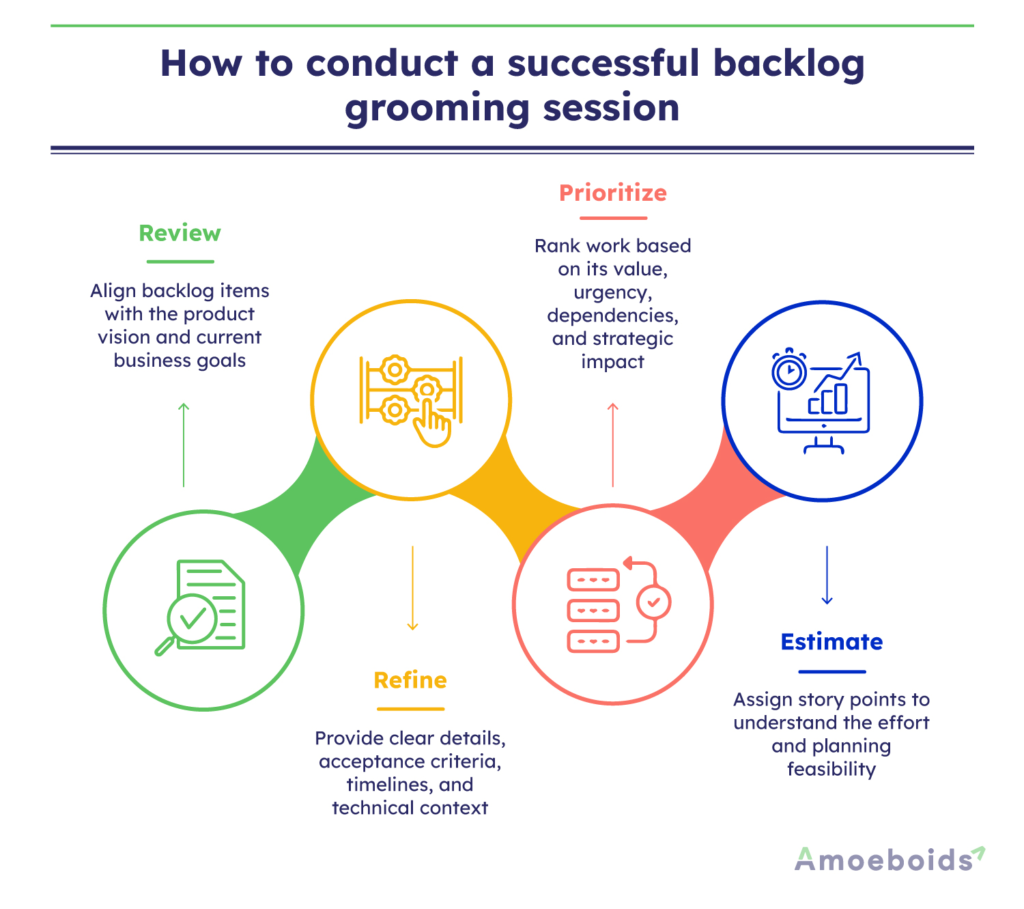
1. Review
Begin by reviewing the product vision and the current business objectives. Ask yourself: Are the things in the backlog still aligned with the product? Don’t let your backlog get stuck with features or work intended for distant sprints. It should be lean, on-point, and strategic.
2. Refine
Make the user stories more specific. This involves including deliverables, acceptance criteria, due dates, and any tech requirements as information. The more precise the context, the better your team will understand the work to be done.
3. Prioritize
Next, rank the items. Priorities must be set based on business value, urgency, dependencies, stakeholders’ requirements, and strategic goals. This helps determine which work can be included in sprint planning and which can be postponed.
4. Estimate
Lastly, add estimates to backlog items. Adding estimates or story points to give “weight” to tasks is a crucial step when grooming your backlog. This will help the team know the effort required.
Together, these steps help create a clear, prioritized, and realistic backlog. However, a great grooming session also depends on the people in the room and their contributions to it. Let’s have a look at it.
Roles and responsibilities in a backlog grooming session
A successful backlog grooming example involves the collaboration of key team members who take on different roles to create a clean, prioritized, and actionable backlog.
Let’s look at the people involved in the process:
- The product owner facilitates the session. They prepare the backlog, determine which stories to review, define business objectives, and ensure items align with the product strategy. They have the final say on whether a story is ready for the upcoming sprint.
- The development team is the source of technical expertise. They review the stories for feasibility and clarity, break down larger tasks into smaller ones, estimate the story points or hours of work required, and identify any risks or dependencies. This makes sure the job is realistically doable within a sprint.
- The scrum master is the facilitator. They ensure that the session stays on target and is time-boxed. They can also help the product owner prepare for the session and assist in eliminating blockers that arise during the conversation.
Common challenges and solutions in backlog grooming sessions
Teams typically face common backlog challenges that can impact progress or lead to miscommunication during backlog grooming sessions. Here’s how you can recognize and overcome them:
1. Incomplete or unclear user stories
Poorly written or poorly told stories are one of the problems. It leads to confusion and takes up unnecessary time during the session.
Solution: The product owner must pre-write stories, acceptance criteria, and required context in good detail. Utilize a “Definition of Ready” checklist for consistency.
2. Overloaded backlog
A backlog with too many items, some of which are outdated or of low priority, can cause problems.
Solution: Refine and clean up the backlog on a regular basis. Archive old, merge duplicates, and groom only those that can be used in future sprints.
3. Estimation disagreements
There will be disagreements over the estimations made, which can delay product delivery.
Solution: Use estimation techniques like the Three-Point Estimation (PERT) method. Discuss it then and there to avoid significant discrepancies.
4. Ineffective time management
When sessions get long or off-topic without proper planning or time management, it results in a loss of team members’ concentration and time waste.
Solution: Ensure the session lasts between 30 to 60 minutes, following a concise agenda. The scrum master needs to keep the discussion on point and postpone unnecessary discussions.
5. Misaligned priorities
Sometimes, the backlog items don’t align with new business goals, resulting in missed priorities and discrepancies between teams and stakeholders.
Solution: The product owner needs to regularly revisit priorities based on customer feedback and product roadmap changes, and communicate those changes effectively.
Backlog grooming vs refinement: Are they the same?
Yes, backlog grooming and backlog refinement are essentially the same Agile practice. “Grooming” had originally been used very widely in Scrum teams to refer to keeping the product backlog in a clean, ordered, and ready-to-go state for future sprints. But over time, it changed as most Agile teams and organizations replaced it with the word “refinement” because it is thought to sound more professional and neutral.
Regardless of the name, the purpose remains the same: keeping your backlog healthy, organized, and actionable.
Best practices for backlog grooming
Backlog grooming is most effective when it’s consistent and collaborative. A few best practices can help you make the best out of it. Here’s what to focus on:
- Engage appropriate people during your backlog grooming session so that all the decisions you make are transparent and comprehensible
- Divide complicated tasks that involve several development activities into manageable work units for better workload management
- Prioritize high-priority items with sufficient information to give context and clarity
- Add new work or future work to the backlog as tasks and groom them subsequently
- Phase out outdated products that are no longer relevant to the business plan and goals
- Estimate things by talking about the work’s weight with every member of the team
- Utilize a grooming tool to help improve the grooming process if necessary
Now that you’ve seen the best practices, let’s explore a few techniques to prioritize the backlogs.
Effective techniques for prioritizing backlogs
There’s no one-size-fits-all approach to backlog prioritization — what works for one team might not work for another. The trick is to find a method that clicks with your team. Here are some well-known backlog grooming techniques to consider to prioritize your product backlog:
| Model | What It’s About |
|---|---|
| Kano Model | Is customer satisfaction oriented by classifying features as what users need, love, or don’t care about? Ideal when you aim to delight users. |
| Stack Ranking | Ranks tasks from highest to lowest priority. Best when time, budget, or resources are constrained and prioritization is explicit. |
| MoSCoW Technique | Splits tasks into “Must Have,” “Should Have,” “Could Have,” and “Won’t Have.” Ideal for prioritizing essential needs and accommodating flexible or nice-to-have functionalities. |
Your backlog grooming checklist: A step-by-step guide
To run a productive grooming session every time, it helps to follow a clear structure. This checklist guides you through each step, from preparing the backlog to finalizing estimates, so nothing important slips through the cracks.
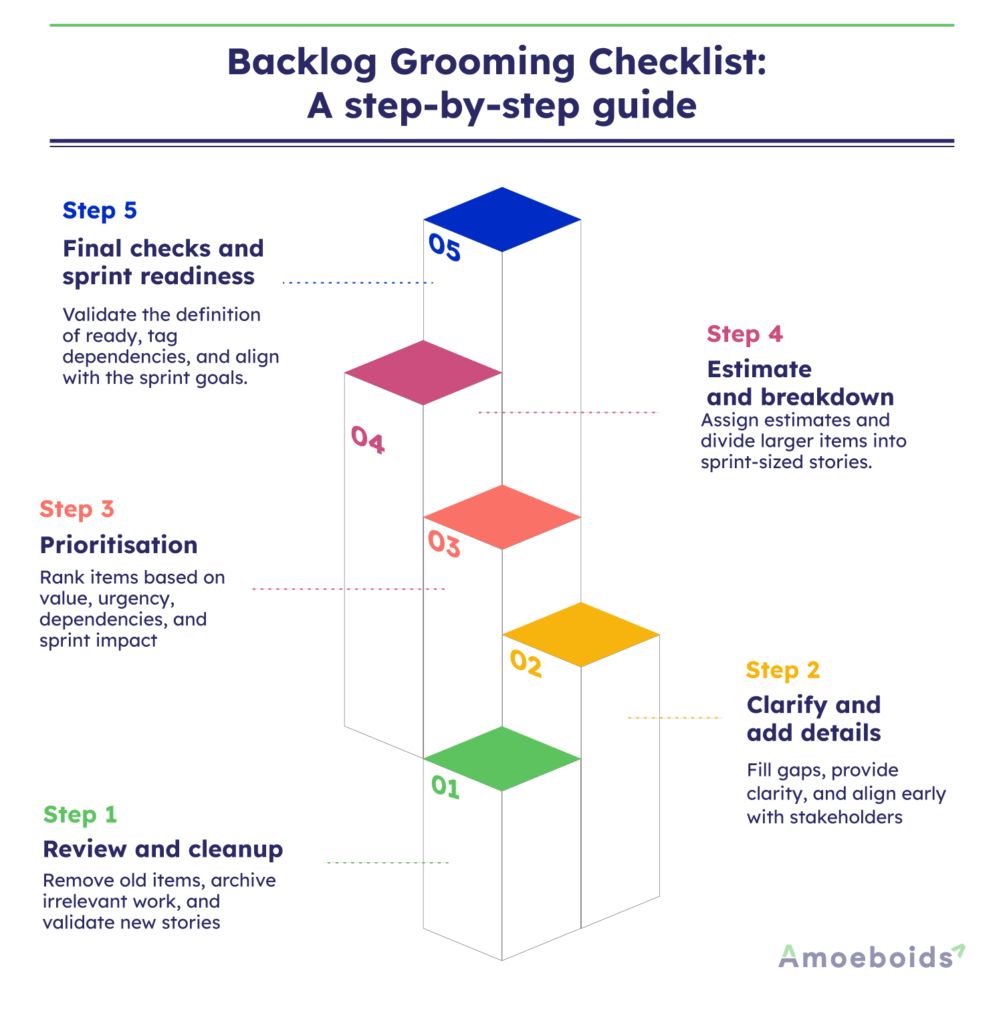
Step 1: Review and cleanup
Review the backlog for both new and outdated and irrelevant entries. For those no longer needed, archive them. Regarding newly incoming stories, verify if they remain relevant.
Step 2: Clarify and add details
A backlog must always be clearly defined. Check regularly and add any missing details that clarify any confusion. This is a great time to loop in the product owner or stakeholders for clarity — the goal is to avoid surprises during development.
Step 3: Prioritization
Rank the backlog based on business value, urgency, or dependency. Apply any of the ranking techniques, like MoSCoW. Therefore, the item at the top of the backlog must be the most valuable and actionable work to be taken up in the next sprint.
Step 4: Estimate and breakdown
Together with the team, assign estimates – either story points or hours – to estimate the effort. Break down large topics into smaller, manageable stories that can be addressed within a sprint. This keeps delivery uninterrupted and feasible.
Step 5: Final checks and sprint readiness
Ensure that user stories with high priority adhere to your Definition of Ready (DoR). Label or tag items appropriately, define dependencies, and ensure that top items align with your following sprint objectives.
Conclusion
In an Agile team, your product backlog should be a powerful asset; however, without constant grooming and proper prioritization, it can hinder your team’s progress. In such situations, the right tool can make all the difference.
Amoeboids’ suite of apps helps teams enhance backlog grooming by improving collaboration, closing feedback loops, and maintaining transparent product communication. Whether it’s gathering stakeholder input or sharing release updates, it supports a cleaner, more actionable backlog.
Start using Amoeboids’ product management tools to make backlog grooming simpler, smarter, and more efficient for your team.
FAQs
Who is responsible for the backlog grooming process?
The product owner is primarily responsible. However, grooming works best as a team effort with input from developers, the Scrum Master, and sometimes designers or testers.
Who typically attends backlog grooming sessions?
Everyone on the cross-functional team should be involved in backlog grooming. When different perspectives come together, it leads to clearer, stronger user stories. Ensure the session includes a leader to facilitate the discussion, typically the product owner, Scrum Master, or project manager, along with the core development team.
What are the differences between backlog grooming and sprint planning?
Backlog grooming involves maintaining a clean, clear, and prioritized backlog. In sprint planning, the development team selects work from the backlog and commits to delivering it within the upcoming sprint.
How long are backlog grooming sessions?
They usually last 30 to 60 minutes. Some teams prefer shorter, weekly sessions, while others opt for one extended session per sprint.