
When planning a dinner party, you start by preparing a list, budget, and tick-tock—planning everything within the limited time you have. You want everything to go off without a hitch, but you can’t buy filet mignon for 30 people on a hotdog budget!
The solution?
Resource allocation.
In project management, the stakes are much higher.
However, the principle is the same—carefully distributing people, time, and money to get the job done without burning out the team or breaking the bank.
Let’s understand this in depth.
What is Resource allocation?
Resource allocation means aligning your resources with project goals most economically yet effectively. Studies suggest that nearly 20% of projects fail due to resource mismanagement alone, which often leads to missed deadlines, budget overruns, and even team burnout.
Just like a chef needs to manage ingredients, a project manager needs to balance skills, schedules, and budgetary limits, ensuring that each “ingredient” is used to its fullest potential.
But what does this look like in action for you?
Consider that you lead a startup team developing an AI chatbot.
You have created the project scope based on your budget, your machine learning (ML) engineer is handling the AI, your developer crafts the conversation flow, and your QA specialist is taking care of the testing. Based on their feedback, you have set up a reasonable timeline.
Everyone is doing their best, the workload is balanced, and deadlines are met without stress. This isn’t just delegation–it is smart resource allocation.
If resource allocation is done right, it can help you:
- Prevent project overrun and delays
- Boost productivity and morale
- Streamline decision making
- Improve end-project outcomes
- Achieve higher customer satisfaction
By effectively using every resource, your projects can sail smoothly and efficiently toward success without delays.
Who’s responsible for resource allocation?
In most projects, the burden of resource allocation rests on the project manager’s shoulders, but you’re not working solo. You rely on input from your team leads and department heads, who understand team members’ strengths, availability, and capacity.
Other stakeholders also play a role by setting priorities and approving resource adjustments, especially if the scope changes.
Key components of Resource allocation
For effective resource allocation, you should strategically combine the right elements, such as people, budget, tools, data, and time. When done poorly, this can result in project delays or failures. Studies show that only 2.5% of companies successfully complete projects to their full potential.
To improve your chances of success, here’s a breakdown of the key components for keeping a project on track.

1. People
Resource allocation starts with identifying the right people for each task based on their skills, experience, and availability. Think of it like casting for a film—assigning roles thoughtfully makes all the difference.
2. Time
Projects thrive when timelines are realistic and well-organized. Accurate time tracking allows you to estimate how long each task should take and align project deadlines accordingly.
Automated time-tracking tools simplify the process, reducing guesswork and giving insight into the actual time spent on each task. Breaking the project into milestones ensures the team stays focused and on pace.
3. Budget
Strategic budget allocation means focusing funds on priority tasks while managing costs for non-essentials. With tools that track budget allocation against real-time spending, you can keep the funds on target, preventing budget overruns and allowing for adjustments when priorities shift.
4. Tools and technology
Incorporating project management software, collaboration platforms, and analytics dashboards into your workflows allows your team to work seamlessly, regardless of location. With features like goal and performance tracking, you can also ensure that each task aligns with project objectives.
5. Data and information
Access to accurate data—such as workload, time, and budget insights—helps you make informed choices and pivot as needed.
Common challenges in Resource allocation
Imagine a construction crew with five builders working on a single task while another key area is left unattended—it’s a recipe for disaster. Here are some common obstacles in resource allocation and ways to handle them.
Over or underutilization of resources
Have you ever had one of your best people burn out because they had too much to do while the others idled around because they had too little? Tools made to help project managers balance workloads can help ensure every team member has the right amount of work, preventing burnout and resource wastage.
Unclear project scope or changing priorities
Without a clear project scope, priorities are constantly shifting, the goal isn’t clear, and no one knows what they’re working toward. Setting clear, realistic goals, creating a roadmap to achieve them, and reviewing everything periodically to ensure your team is on track will set you up for success.
Lack of real-time visibility into resource usage
Without live data on who’s working on what, knowing where resources are used or needed is tough. Project management tools with real-time reporting provide visibility, allowing for quick resource reallocation if priorities shift or bottlenecks arise.
Addressing these challenges helps you keep resources balanced, priorities clear, and productivity high. The following steps can help you do this.
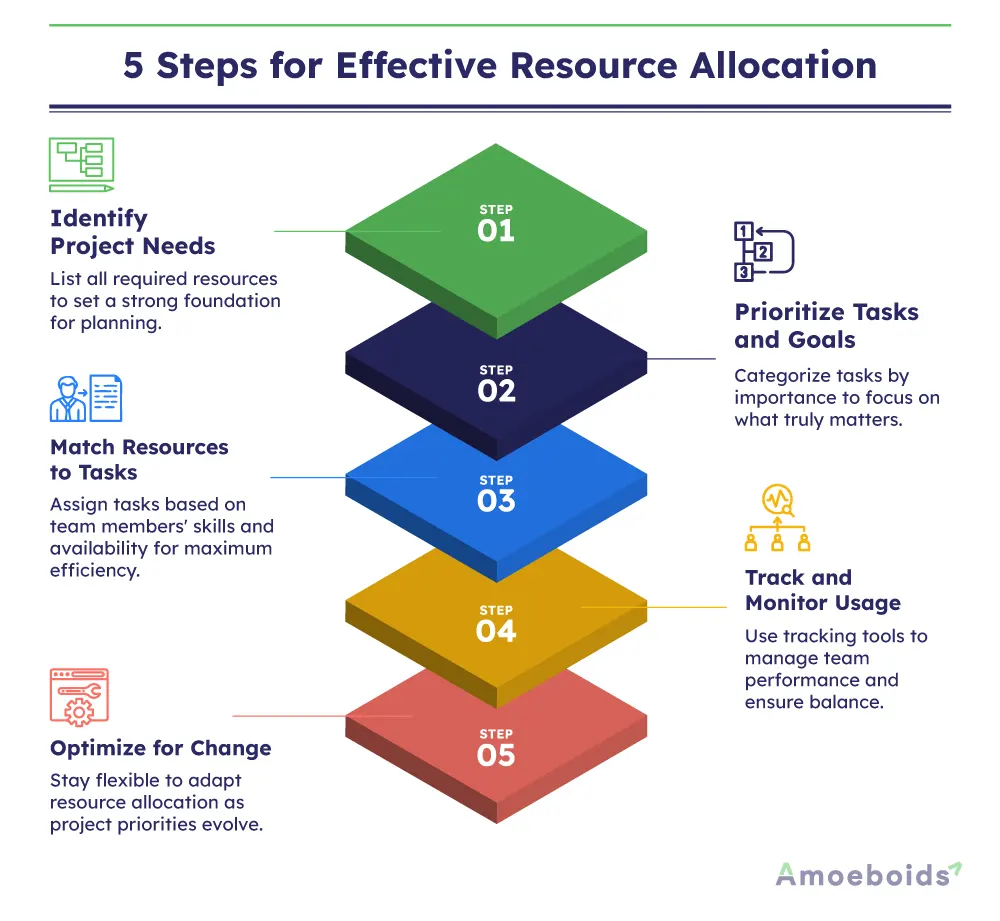
5 Steps for effective resource allocation
Let’s understand how to allocate resources, with an example to implement these steps.
1. Identify project needs
Start by listing every resource your project requires—people, tools, budget, and time. This inventory provides a clear picture of what you need for the project. Better planning means better resource allocation, which means better project outcomes!
2. Prioritize tasks and goals
Rank tasks by importance and urgency. For example, in a mobile app development project, the team could be divided into features, design, development, and testing. Within the features category, tasks can be further categorized as “must have,” “could have,” and “good to have.”
Using such prioritization frameworks, you can pick up tasks and establish each one’s goal on the list.
3. Match resources to tasks
Assign tasks to each team member based on skills, experience, and availability. For example, assign a skilled designer to critical design tasks while a junior designer handles simpler items. This maintains productivity and balance.
4. Track and monitor usage
Use real-time tracking tools to monitor your team’s performance throughout the project. These tools help you identify over- or underutilized team members, allowing you to make adjustments as needed.
5. Optimize for change
Projects often evolve, so stay flexible. Be ready to reallocate time on tasks as priorities shift or if tasks take more (or less) time than expected. This will help avoid delays and keep the project on target.
Let’s understand this with an example of a team building an application.
| Step | Action item | Example/Notes |
|---|---|---|
| Identify project needs | List required resources (developers, designers, tools, etc.) | Developers (backend, frontend), UX/UI designers, testing tools (Appium, Selenium), project management software (Jira), and project budget. |
| Prioritize tasks | Rank tasks based on urgency and importance | High: Develop authentication system and design basic UI; Medium: Integrate payment gateway; Low: Add social media share options. |
| Match resources to tasks | Assign team members based on skills and availability | Senior backend developer on authentication and API integration; junior developer on frontend styling; UX designer for initial wireframes. |
| Track and monitor usage | Use tools to track resource allocation and usage | Jira for task tracking with developers logging hours on assigned tasks and designers providing updates on design completion. |
| Optimize for change | Adjust resources as the project needs to evolve | Shift resources to testing if bugs are found in core features; add extra developers if app features expand beyond original scope. |
Following these steps and using project management tools can help you stay organized, allocate resources effectively, and keep the project on track.
Tools for resource allocation in project management
Here are three different ways to allocate resources effectively with the right tools:
Streamline workflows with Jira
Ideal for agile teams, Jira offers customizable workflows, time tracking, and real-time dashboards to track progress and balance workloads.
Simplify task management with Asana and Trello
These intuitive tools make assigning tasks, prioritizing work, and tracking progress easy—perfect for smaller teams or projects.
Enhance resource management with Amoeboids
Our apps integrate seamlessly with Jira to add vacation tracking, goal-setting, release management, and budget management for a complete view of resource usage.
With the right tools and resource allocation strategies, you’re well on your way to leading a successful project!
Mastering resource allocation for project success
Mastering the allocation and reallocation of resources is the differentiating factor between successful and failed projects. Using the right tools and strategies, you can optimize your team’s performance, balance workloads, and stay flexible.