

Clear, reliable documentation is often the hidden engine behind a great product experience. When users move through a workflow effortlessly, understand a feature instantly, or troubleshoot an issue without raising a support ticket, it’s because someone translated complexity into clarity. That someone is the technical writer.
As modern SaaS products evolve rapidly, the need for accurate, helpful, and consistently updated documentation is more critical than ever. Technical writers reduce friction, build user confidence, and ensure that every release – from the smallest enhancement to the most complex feature – is accompanied by the right knowledge to make it usable.
This guide explains what technical writers do, the core responsibilities they hold, the skills that make them effective, and why the role has become indispensable in today’s product lifecycle.
What Is a Technical Writer?
A technical writer is a specialist who communicates complex information in a simple, structured, and user-friendly way. They create the assets that help users understand how a product works – whether it’s a detailed user guide, API reference, onboarding sequence, knowledge base article, or in-app microcopy.
Great technical writers immerse themselves deeply into the product. They explore features, understand the underlying technical decisions, study user workflows, and identify friction points long before a customer encounters them. Their purpose is not merely to explain a feature but to help users succeed with it – consistently and without confusion.
Why Technical Writers Matter in Modern SaaS
In an environment where product cycles are short, releases are continuous, and new capabilities (often AI-driven) appear every few weeks, users need clear guidance more than ever. Poor documentation quickly turns into onboarding failures, unnecessary support tickets, incorrect workflows, and eventually… churn.
Good documentation, on the other hand, strengthens the product behind the scene:
- It accelerates onboarding and activation
- It deflects support tickets by answering common questions
- It improves adoption by reducing cognitive load
- It builds trust because the product feels well thought out and easy to understand
Even the most intuitive product becomes frustrating without clear explanations. Technical writers ensure that users never face that frustration.
Core Roles and Responsibilities of a Technical Writer
Technical writers take on responsibilities that extend across research, writing, user experience, and continuous improvement. Their work touches nearly every part of the product.
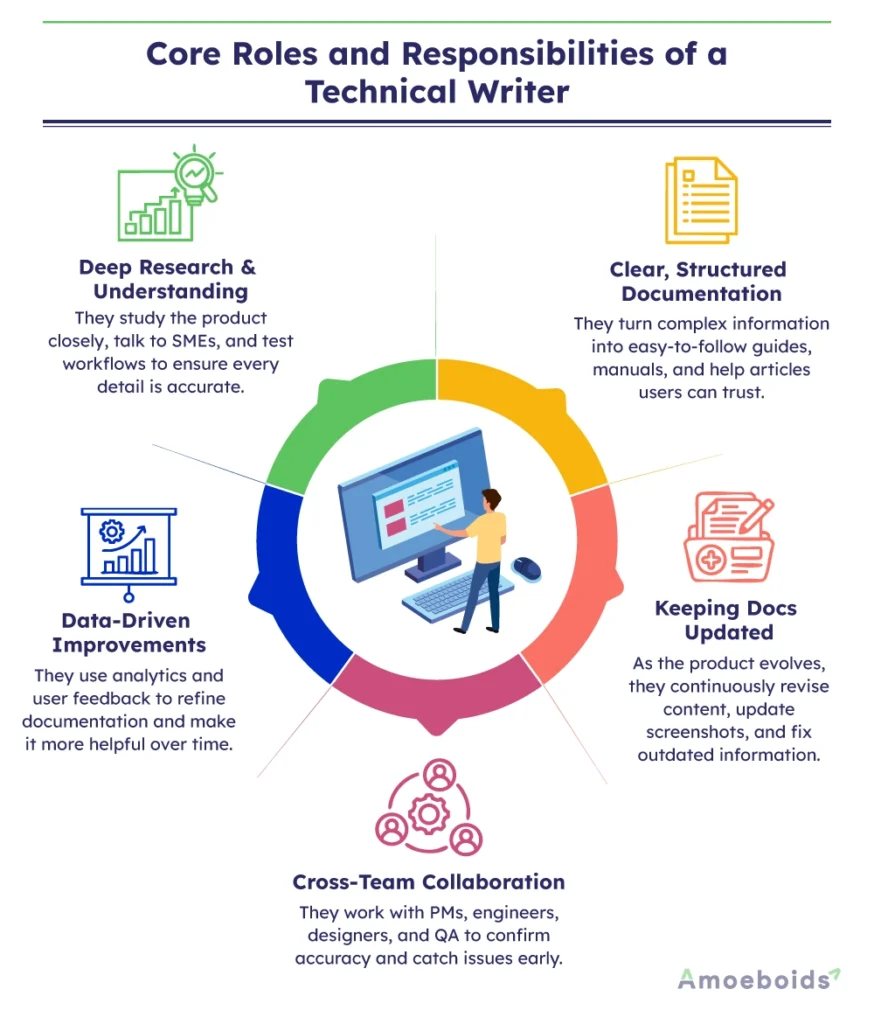
Deep Research and Understanding
Before writing anything, technical writers spend significant time understanding the product itself. They speak with product managers, engineers, QA teams, and designers. They review specifications, explore prototypes, test features firsthand, and trace a workflow end-to-end. This depth is essential – documentation that is inaccurate or incomplete harms user trust more than having no documentation at all.
Creating Clear, Structured Documentation
Once they understand the problem space, technical writers translate that learning into content users can rely on. This includes everything from detailed manuals and API references to onboarding flows, release notes, troubleshooting sections, and knowledge base articles. Their writing is structured, consistent, and easy to scan. Users should never struggle to find the information they need – and this clarity comes from deliberate thought, not chance.
Maintaining Accuracy as Products Evolve
Documentation is a living system. With every new feature, change in UI, or update to behavior, technical writers revisit existing content to ensure it remains accurate. They review drafts with SMEs, update screenshots, adjust workflows, and remove outdated material. This ongoing maintenance sustains user trust and ensures the product and documentation evolve together.
Collaborating Across Teams
Technical writers rarely work in isolation. They collaborate closely with product managers to understand intent, with engineers to confirm technical accuracy, with designers to align terminology and UI microcopy, and with QA teams to validate workflows. Their perspective often uncovers usability issues or ambiguous interactions long before users encounter them.
Learning From Data and Improving Continuously
Modern documentation is not guesswork – it’s supported by analytics. Technical writers study how users search, which pages receive the most views, where users drop off, which topics trigger repeated support tickets, and what feedback users share. These insights shape how content should be reorganized, expanded, or simplified. Documentation becomes stronger not by writing more, but by understanding user needs more deeply.
Skills and Qualifications That Define an Effective Technical Writer
Technical writers combine strong communication skills with the ability to understand technical systems. Their writing reads effortlessly, but only because they’ve done the hard thinking beforehand.
They excel at simplifying complex concepts without stripping away essential detail. They understand the basics of how SaaS products, APIs, cloud systems, and DevOps pipelines operate, enabling them to write with authority rather than abstraction. They’re fluent with documentation tools such as Confluence, GitBook, Markdown editors, and design tools like Figma, which allow them to produce content that is both structured and polished.
Equally important is their ability to design information architecture – the craft of structuring content in a way that is logical, intuitive, and easy to navigate. Great technical writers think not only about the words on a page but about how readers move across pages, find related information, and make sense of the product as a whole.
Tools Technical Writers Commonly Use
Technical writers rely on a modern documentation stack to create, organize, and maintain content at scale. They use platforms like Confluence, Notion, or GitBook for structured writing; GitHub or Bitbucket for version control; Jira for tracking documentation tasks; and design tools like Figma or Canva to incorporate visuals.
For formatting and portability, Markdown and HTML remain core skills. And for video walkthroughs or guided tours, tools like Loom, Scribe, or in-app guidance platforms play an important role.
Automation is increasingly valuable as well. Tools such as Automated Release Notes & Reports for Jira (ARNR) ensure documentation remains accurate after every release, freeing writers to focus on content quality rather than manual updates.
Technical Writer Job Description Example
A strong job description communicates expectations clearly and attracts candidates who understand both technology and communication.
A technical writer is responsible for producing clear, accurate documentation that supports users across their journey. They work closely with product managers, developers, designers, and QA teams to understand how features work and why they matter. They research workflows, test features themselves, and translate this understanding into documentation that users can trust. They maintain consistency across documents through templates, style guides, and version control practices, ensuring that documentation remains aligned with product changes.
Candidates should have strong communication skills, familiarity with SaaS and API concepts, proficiency with documentation and collaboration tools, and the ability to manage several projects simultaneously. Experience working with developer-facing features, UX writing, or AI-assisted workflows is increasingly valuable.
Career Progression for Technical Writers
The career path for technical writers is typically defined by increasing levels of ownership and influence.
A junior technical writer focuses on learning product fundamentals and writing content with close guidance. As they progress to a mid-level role, they begin to own major documentation areas, work directly with engineering teams, and take responsibility for organizing content structures. Senior technical writers shape documentation strategy, define standards, mentor junior writers, and often influence product decisions by identifying gaps in workflows or unclear interactions.
Technical writers grow not only by improving their writing but by deepening their understanding of technology, user experience, and the broader product ecosystem.
Measuring the Performance of a Technical Writer
The impact of a technical writer is best measured through outcomes – not word count. Accuracy, clarity, and user impact matter most.
High-performing technical writers produce content that requires minimal SME corrections, aligns perfectly with product behavior, and is consistently praised for clarity. Their documentation reduces support tickets by answering the right questions at the right time. User engagement metrics – such as time spent on a page or successful search behavior – show whether users are finding the information they need. And their ability to update content quickly ensures the documentation always reflects the current state of the product.
Documentation that grows stale is a liability. Documentation that stays current is a competitive advantage.
Conclusion
As products become more sophisticated and user expectations for clarity accelerate, the role of the technical writer has become central to product success. They reduce confusion, ease onboarding, strengthen adoption, and ultimately shape how users perceive the value of a product.
Documentation is not an accessory. It is a foundational part of the product experience. Investing in strong technical writers – and giving them the tools and autonomy they need – is one of the most reliable ways to improve user satisfaction at scale.
Tools like Automated Release Notes & Reports for Jira & Olvy amplify their impact by ensuring documentation such as Release notes & changelogs remains accurate and up-to-date automatically, allowing writers to focus on the strategic work of crafting clarity.
If your team is committed to building products that feel effortless for users, a strong technical writing practice is non-negotiable.
FAQs
Do I need to know coding to be a technical writer?
You don’t have to be a coder, but having a basic understanding of APIs, software behavior, and technical workflows will help. Many technical writer job descriptions mention familiarity, not expertise, with coding concepts. It simply facilitates communication with developers and enhances documentation details.
Which industries hire technical writers most?
The industries that hire the most technical writers are SaaS, fintech, healthcare technology, AI, cybersecurity, manufacturing, and cloud services. As the demand for clear documentation, onboarding flows, and user-friendly product communication grows in 2026, so will the number of technical writers.
What tools do technical writers use in documentation?
Technical writers use Confluence, Notion, GitHub, Jira, MadCap Flare, Figma, CMS tools, and Markdown editors. Technical writers use various tools to manage their duties within modern documentation workflows. These tools are important for content creation, collaboration, version control, and structured authoring.