
Project delivery can be viewed as an art. It involves matching strokes of what you want to achieve with how you actually get there. It’s the canvas where big ideas meet careful execution. Thus, slippage, failure to meet deadlines, and even project failure are quite common.
In most cases, projects don’t fail because the people lack the necessary skills or commitment. The major reason behind their failure is systems that can’t keep up with change, and because plans stay static while reality moves ahead. Research shows that over 17% of large-scale projects go over budget simply because of weak planning and scattered delivery practices.
Situations like these necessitate having a strong project delivery plan and the right project delivery method. Get ready to learn what project delivery truly means in this guide. Also get to explore the key stages that keep it structured, and walk through the different methods teams use to stay focused, efficient, and ready for change. Companies aiming for effective project delivery often combine structured planning with adaptable workflows.
What is project delivery?
The complete process of taking an idea from inception to completion is referred to as project delivery. Groups plan, implement, supervise, and complete projects while adhering to budgets and schedules.
It’s not solely about completing tasks or marking items off a list. Project delivery focuses on the effectiveness of individuals, methods, and tools collaborating to produce significant outcomes. It combines strategy with action, providing each stakeholder a clear understanding of direction and advancement. It’s important to note that:
- The aim is to achieve your objectives while optimizing time, resources, and energy.
- The main components consist of planning, coordination, choosing methods, and ongoing monitoring.
Strong project management and delivery practices help teams stay aligned from project launch to completion.
What is a project delivery plan?
A project delivery plan can be defined as a roadmap that shows the project’s final destination and the path to get there. It outlines each step, also listing the responsible parties, necessary materials, and what can be attributed to success.
It works as a dynamic reference that describes the workflow and how teams adjust to shift in situations. It encompasses the reasons, details, and methods of the initiative, providing organization to creativity and consistency to unpredictability. An effective strategy typically comprises:
- Defined objectives and scope, outlining what the project will provide.
- A schedule that emphasizes key achievements and due dates.
- Duties and obligations, ensuring everyone is informed.
- Allocation of budget and resources for personnel, tools, and expenses
- A risk management section that keeps surprises in check
- A communication plan that keeps everyone aligned
- A change management protocol to handle shifting priorities
It’s worth noting that as new requirements emerge or timelines shift, you should revisit your project delivery plan in response. This will help keep your plan relevant and transparent, especially in agile project delivery environments. Modern teams also use project delivery software to improve visibility and collaboration throughout the execution process.
Stages of Project Delivery
Project delivery encompasses a series of stages that transform ideas into tangible outcomes. This framework applies to organizations across different sizes or industries. Let’s decode the stages one by one:
| Stage | Description | Best Practice Highlight |
| Initiation | Define project purpose, scope, and feasibility | Involve all key stakeholders early |
| Planning | Develop roadmaps, assign tasks, allocate resources | Use tools for visibility and coordination |
| Execution | Teams carry out planned work | Enable real-time feedback and adaptation |
| Monitoring/Control | Track progress, manage risks, resolve issues | Continuous review and reporting |
| Closing | Deliver final product, review outcomes, document learnings | Capture lessons in post-mortem |
Each stage builds on the one before it. The initiation phase is where goals are set and everyone agrees on the “why.” The planning stage shapes the “how.”
It’s during the execution stage that the momentum begins to build. Next comes the control and monitoring stage to make sure that you’re still heading in the right direction. Finally, when you arrive at the closing stage, it’s time to assess what has worked and what hasn’t.
Understanding the complete project delivery process helps companies maintain continuity across every stage.
5 Project Delivery Methods You Can Use
There’s no one single cookie-cutter approach to project delivery. Every project has its own pace, risks, and goals. That’s why different project delivery types exist to give teams the flexibility to choose what fits best. Let’s look at some of the most widely used methods:
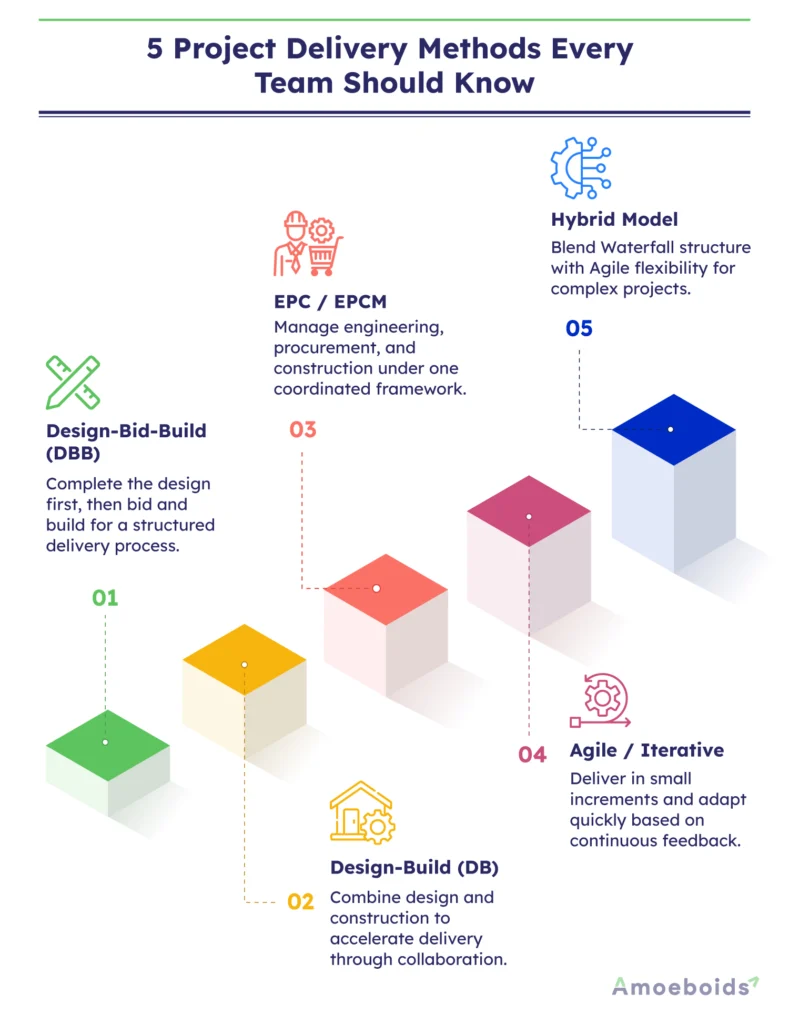
Design-Bid-Build (DBB):
This is the classic approach. First, the design is completed. Next, bids are invited for construction. It’s a clear and structured approach, but it’s important to note that it may not work best for complex projects or project stages, as it can slow the progress. This method is commonly used in construction project delivery because of its clear separation between design and execution phases.
Design-Build (DB):
This is a method where design and construction happen together. What makes this method tick is its ability to speed things up through collaboration. But one needs to keep in mind that this approach has the potential to limit client oversight.
EPC/EPCM:
It stands for Engineering, Procurement, and Construction (or Construction Management). The best use case for this method is large-scale infrastructure projects that often need strict coordination and oversight.
Agile/Iterative:
This method is best for project managers who seek flexibility. Herein, teams deliver work in smaller chunks, gather feedback, and adjust quickly. It’s a great fit for software or fast-evolving industries.
Hybrid models:
This is a mix of Agile and traditional methods. Herein, you teams will get the structure of Waterfall along with the adaptability of Agile. One can say that it’s a good fit for complex, high-stakes projects.
Take a quick look at how these methods compare:
| Method | Best Use | Pros | Cons |
| DBB | Construction, fixed scope | Transparency | Slow adaptation |
| DB | Fast-moving, collaborative | Speed, collaboration | Lower client control |
| EPC/EPCM | Large-scale, complex projects | Cost control, single accountability | Less flexibility, high planning effort |
| Agile | Software, dynamic scope | Flexibility, feedback | May lack upfront planning |
| Hybrid | Complex, shifting needs | Custom fit | Management complexity |
Modern teams rarely stick to just one method. They mix and adapt based on context. For instance, you might use Agile sprints for development but a Waterfall-style rollout for deployment.
When you experiment with these methods, focus less on what’s “right” and more on what’s right for your team. The best approach is the one that adapts with you. Different project delivery types support different business goals, timelines, and collaboration styles.
Key Challenges in Project Delivery
Even with the best approach, Agile, traditional, or integrated, project delivery teams frequently encounter a few common challenges. Identifying these early on can help you improve project delivery and ensure a smoother, end-to-end project delivery experience.
- Unclear scope and changing requirements: Constant changes can slow progress, particularly in dynamic environments like software and construction projects.
- Gaps in communication and collaboration: Misalignment between teams causes delays, even when structured delivery models are in place.
- Weak project delivery planning: Different types of project delivery methods without a solid plan can fail to meet deadlines and expectations.
- Limited visibility and tracking: Lack of proper tools and tracking systems makes it difficult to monitor progress and make informed decisions.
- Resource and risk management challenges: Balancing time, budget, and team capacity is important to achieving successful outcomes.
Many organisations use project delivery software to reduce delays and streamline decisions across distributed teams.
Best Practices for Successful Project Delivery
Successful project delivery is more than just planning, it is also about remaining aligned, flexible, and consistent throughout the process.
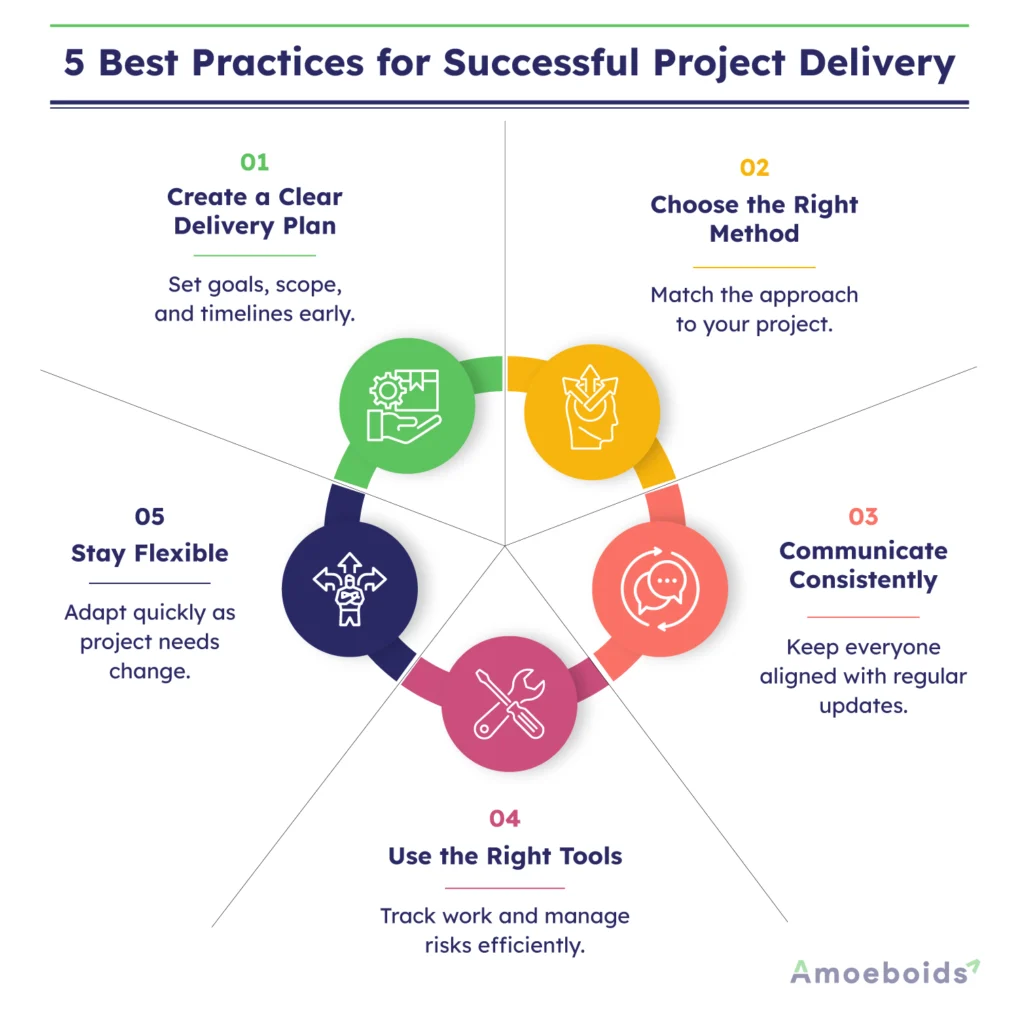
Clear delivery plan:
Define goals, scope, timelines, and responsibilities early so you can plan for seamless project delivery and avoid confusion later on.
Right method choice:
Choose the right project delivery methods such as Agile, Hybrid, or integrated project delivery for your team and project needs.
Strong communication:
Maintain regular updates and feedback to enhance collaboration, project management and delivery.
Use the right tools:
Use project management software to monitor progress, manage risks, and improve visibility across tasks.
Stay flexible:
Adapt quickly to changes, especially in agile or lean project delivery environments, to ensure project success.
Consistent collaboration and adaptability are essential for effective project delivery in modern teams.
Project Manager vs Delivery Manager: Key Differences
While the names seem similar, the two have different functions. Let’s examine the differences in detail.
A project manager oversees the plan. They set the timelines and manage resources. As the project progresses, they monitor risks and keep the stakeholders informed. They concentrate on what must be achieved and the manner in which it is done.
A delivery manager, conversely, ensures that the plan is realized. They work towards eliminating obstacles. Further, they align the team’s activities with business objectives. Their core focus is to ensure that delivery occurs as planned and expected. Consider them as the link connecting strategy and implementation.
| Role | Key tasks | Goals |
| Project Manager | Planning, tracking, budgeting | Project delivery |
| Delivery Manager | Team enablement, execution, stakeholder assurance | On-time, quality execution |
A simple analogy can help explain the difference between the two. Consider it from the perspective of a traveling group with designated roles. A project manager is the equivalent of someone who charts the planned route for the group, while the delivery manager is the one responsible for overseeing the group members during the journey. Both roles are crucial. While one keeps the vision on track, the other keeps the plan moving.
When teams need to work at a fast pace, both roles need to work hand in hand. This alignment becomes even more important in end to end project delivery environments where execution and coordination happen simultaneously.
Conclusion: The Smart Way to Deliver Projects
Completing projects on schedule and within scope isn’t a matter of luck or extended hours. It requires both structuring and teamwork. It also necessitates the ability to adapt when situations change. The truth is that delivering a project is not just one milestone. It’s an ongoing cycle of planning, testing, comprehending, and improving with every iteration.
Project success hinges fundamentally on three key elements. The first one is possessing a clearly articulated project delivery strategy. Next comes choosing the right project delivery method. Ultimately, it comes down to understanding the stages of project delivery that guide progress from start to finish.
When tools and methods work together, everything changes. Groups progress quickly. Objectives remain in sight. Responsibility seems instinctive. Agile project delivery evolves from being just a trend to transforming into your daily working method. Teams handling construction project delivery and software initiatives alike benefit from flexible planning and clear communication.
A clear project delivery process helps companies scale activities while maintaining quality and accountability.
FAQs
What are the considerations of delivering a project?
Knowing what the project is supposed to accomplish and who is involved is the first step towards a successful project delivery. It also entails selecting a project delivery method that suits the abilities and speed of your team. One also needs to look at managing risks early and maintaining stakeholder engagement.
What is the delivery process of a project?
Most projects adhere to the five phases of project delivery. These are planning, execution, monitoring, closing, and initiation. The key here is to stay adaptable at all times. For this, it’s essential to maintain open lines of communication and control risks.
What is a project delivery workflow?
The daily course of work is mapped out in a project delivery workflow. It defines responsibilities, as well as feedback loops. It also includes approvals, so tasks move smoothly from planning to completion. These workflows depend on short cycles and regular feedback. Furthermore, complete team transparency is important in agile project delivery.