

Imagine leading a team struggling with missed deadlines and inefficient operations. You are not alone. Studies show that 70% of projects face these challenges due to poor planning and unclear requirements. The Waterfall methodology, established in the 1970s, offers a solution.
This method provides a clear, step-by-step framework that helps teams plan everything upfront, from user requirements to final testing. Each phase is laid out consecutively with no overlapping stages. This ensures clarity and direction, helping to keep your project on track and deliver exactly what was promised.
Applying the Waterfall methodology can be the solution to conflicting demands and priorities, as well as inefficient operations, in the workplace. It can organize your workflows and streamline your processes. Let’s explore how this method can help you overcome common project challenges and learn why it’s crucial to apply this framework correctly.
What is the Waterfall methodology?
The Waterfall methodology is a traditional linear project management approach. The process comprises sequentially solving multiple tasks in a linear flow. The method was named after the phenomenon of water cascading down in a waterfall.
The method was first introduced in Winston Royce’s 1970 research paper on software development. While Royce didn’t give it the “Waterfall” moniker, his structured model became the blueprint for this linear, highly organized way of managing projects.
The Waterfall model works best when project goals, timelines and deliverables are clearly defined from the start. It provides clarity, predictability and a sense of order. However, its rigid structure can be challenging if priorities shift or unexpected issues arise mid-project.
The method involves running your strategy through five different stages, proceeding to the next stage only after the current one is completed. Let’s examine these stages in greater detail.
What are the stages of the Waterfall project methodology?
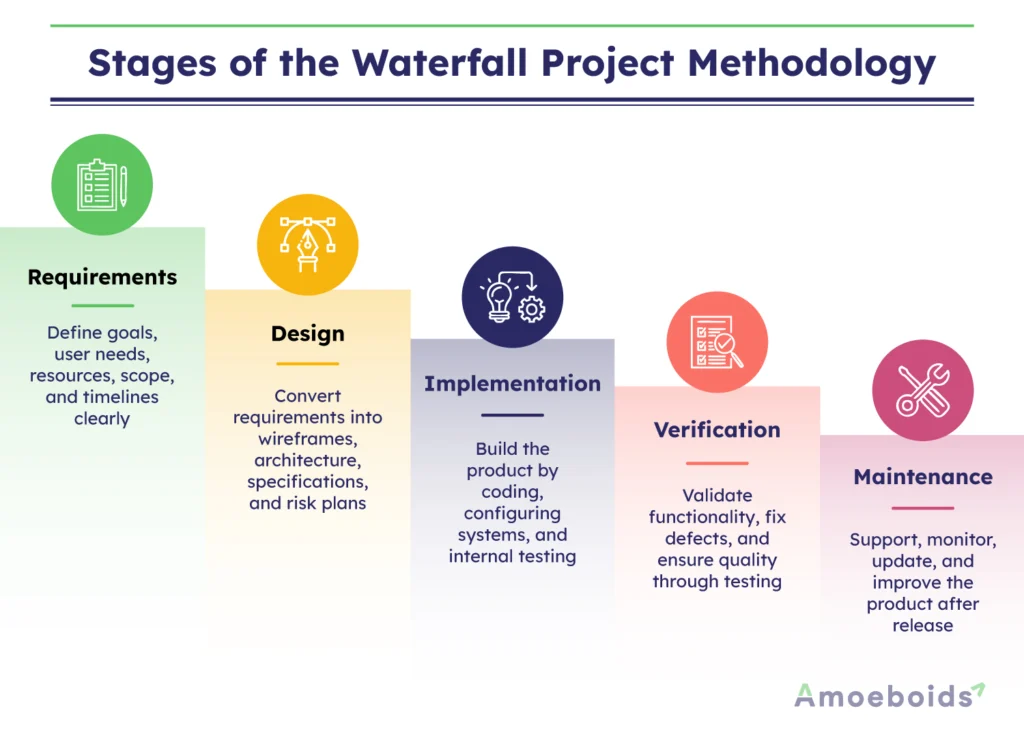
The Waterfall methodology goes through five sequential phases — requirement, design, implementation, verification and maintenance. Each stage acts as a foundation for the next and your workflow proceeds sequentially through them in a particular order. Let’s break down how each phase works and how you, as a project manager, can utilize them wisely:
1. Requirements
In this phase, you gather requirements that create the blueprint of your entire project. At this stage, you’ll:
- Identify business goals and user expectations
- List resources needed (people, tools, technology)
- Break down tasks by team members
- Set a timeline for each phase
This stage is often considered the most critical part of the process. It requires you to gather all data, analyze the information and plan out multiple sequential scenarios.
Let’s say you’re designing a customer service app. In the requirements phase, you would gather all relevant data related to response time benchmarks, user interface preferences and security protocols.
2. Design
Once the requirements are clear, it’s time to translate ideas into concrete plans that explain how the final product will be. In the design phase, you’ll:
- Create wireframes or mockups for digital products
- Define technical specifications
- Set milestones and delivery schedules
- Identify potential risks and how to mitigate them
For an e-commerce website, the design phase would include creating wireframes for product pages, planning payment gateways and deciding the site’s navigation flow. The more thorough your design, the smoother the next stages will go.
3. Implementation
Now, you’re all set to build the product based on the blueprint designed in the last stage. The requirement and design phase teams will hand off their work to those who will put their plans into action. Here, you will:
- Assign tasks to team members
- Set up project tracking systems
- Write code or build prototypes
- Conduct internal testing before moving forward
For example, if you’re developing a mobile app based on your design blueprint, developers and UI designers will start designing the initial wireframe. This is where you and your team might experience a lot of challenges.
4. Verification
After the designed plan has been implemented, the verification phase follows. During this step, your team will carry out extensive testing to check that everything works as expected. This step is also called carrying out quality assurance (QA) tests of the product and finding bugs and fixing them. In this phase, your team will:
- Create test cases
- Simulate real-world user scenarios
- Fix bugs and errors
- Get stakeholder approvals
Continuing with the scenario of designing an app, this phase would involve rigorous testing of the code, processes and algorithm you’ve developed while simulating real-world conditions.
5. Maintenance
This stage involves adjusting your product after it has been released. As a project manager, you must monitor the product’s performance and gather feedback through user reviews, social media mentions and other channels. If any bugs are identified, have your team fix them and roll out updates and patches as needed. This stage involves the following practices:
- Respond to user feedback
- Release patch updates
- Track performance metrics
- Provide technical support
The Waterfall structure provides clarity, helps you stay organized and meet deadlines. There are many other benefits to this approach, which we will discuss next.
Benefits of the Waterfall methodology approach
We understood how the Waterfall methodology works. It has multiple benefits in project management, which makes it a popular approach to handle workflows and tasks. Here are some more hard-to-ignore benefits of this framework for your reference:
1. Clear project structure
The framework follows a step-by-step process and leaves little room for confusion to execute an ideal product lifecycle. It provides a guideline for teams, which improves efficiency and transparency, making keeping track of progress easy.
2. Set costs and timelines
With a pre-planned blueprint, you can estimate project costs and timelines before the project begins. This also allows you to plan the budgets of multiple projects and decide how to allocate resources for maximum efficiency and to gain the most value.
3. Repeat success
If a project succeeds, you have clear records of the entire process. You can replicate this for future projects with similar requirements. Think of releasing multiple successful mobile apps into the market with minor feature variations by following the same core workflow.
4. Easy risk management
With advanced product road mapping, you can easily foresee and identify potential risks early on. This will allow you to plan for overcoming major roadblocks the project might face. For instance, you can identify and address security vulnerabilities during the design phase of your app’s payment gateway to avoid costly re-development charges.
However, if you want to truly leverage the Waterfall methodology framework, you should be aware of its limitations. Understanding the weaknesses of this process will help you develop plans to compensate for them.
Limitations of the Waterfall methodology approach
The Waterfall methodology might offer structure and predictability which improve clarity and transparency. However, an inflexible framework is not always the best fit for projects that require fluid thinking and ongoing changes.
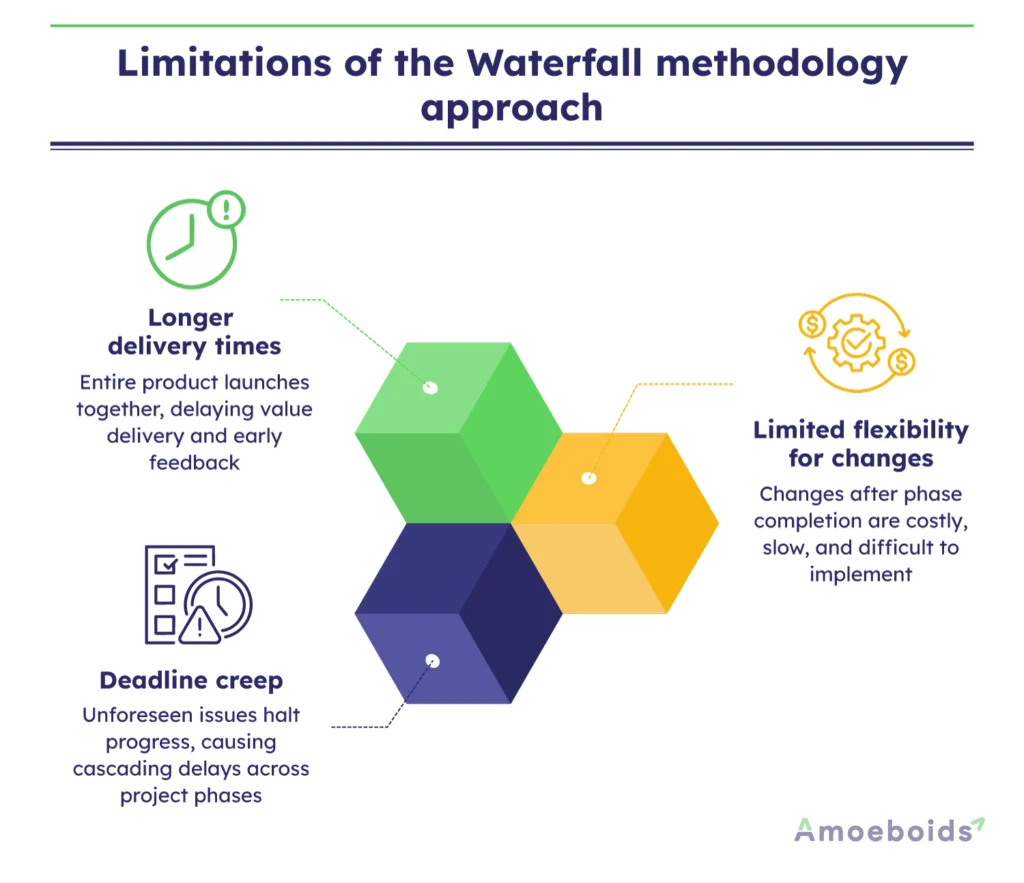
Here are some weaknesses of the Waterfall approach that might hold your project back:
1. Longer delivery times
Unlike in the iterative method, you can’t release smaller features gradually or have a partial launch. You must wait until the final product is delivered. This can prove to be a waste of time and resources that might lead to the entire project being scrapped.
For instance, if you’re building an internal employee portal using the Waterfall method, your team will likely not be able to launch even basic features like login pages until the entire project is done.
2. Limited flexibility for changes
With this approach, once you progress to the next stage, there is very limited flexibility to roll back to the previous stage if required. Doing so will slow down the entire project and may increase costs.
Say you need to revisit the design phase while the project is in the verification phase in order to integrate a payment gateway into an e-commerce app. It will be an expensive and time-consuming process.
3. Deadline creep
No matter how much you plan, there is no way to eliminate all uncertainties. The Waterfall methodology fails to consider delays that unforeseen complications might cause. If an issue crops up during one of the phases of the process, the entire project will be stuck until it is resolved. There is no provision for parallel progress, which will cause delays across the entire timeline.
For instance, if your QA team identifies a security vulnerability during testing, the project must revert to the design phase until the bug is fixed. This will almost certainly compromise the initial deadline and cause a delay.
Following the Waterfall method means a project will likely experience one or more of these issues. In that case, you might find it better to switch to Agile methods, which were developed as a response to the limitations and challenges posed by traditional linear methodologies.
We’re comparing the two processes, identifying their respective strengths and weaknesses, next
When to Use the Waterfall Methodology?
The Waterfall method works best when the project’s needs are clear and aren’t likely to change. It works well for software projects in construction, government, banking, and compliance. When teams need documentation, approvals, and set deadlines, they prefer the waterfall method.
The Waterfall project management method is a reliable and easy way to plan projects if stakeholders want to know when things will be done and how things are going step by step.
How is the Waterfall Methodology Used Across Different Industries?
Many companies use the waterfall method because it gives them structure, approvals, and results that are easy to predict. Here’s how it fits into real-life work environments.
- Construction Projects: Builders follow safety standards and architectural plans that have already been set. Before moving on to the next stage, you must finish the one you are on. Changes later on can be expensive and dangerous.
- Government Systems: Software for the public sector needs a lot of approvals and paperwork. Teams break things down into steps and check them at each stage. Waterfall makes sure that everyone follows the rules, talks to each other, and does their homework.
- Healthcare Technology: Medical software must adhere to legal and patient safety guidelines. Testing and validation are carefully carried out following the development phases. A structured process prevents dangerous errors and ensures certification approval.
- Manufacturing Industry: There are certain engineering standards that must be followed when designing, prototyping, and making a product. You can’t keep creating new parts for factories. Waterfall keeps production stable and avoids expensive operational problems.
- IT B2B SaaS Platforms: Enterprise SaaS for big clients usually comes with set contracts and a set amount of work. Waterfall makes it easier for stakeholders to get the promised features, documentation, and predictable releases.
Best Practices for Waterfall Project Management
Waterfall works best when each step is meticulously planned before work begins. Follow these simple steps to ensure that your project runs smoothly, predictably, and stress-free.
- Clear Requirements: Before beginning development, clearly document the requirements. Early communication with stakeholders is critical for meeting expectations. A concise requirement document reduces confusion and saves money on future rework.
- Defined Phases: Divide the project into defined stages with specific outcomes. Complete one phase before proceeding to the next. This keeps teams focused and enables managers to easily track progress.
- Realistic Timeline: Create a realistic project timeline that includes buffer time. Delays happen in almost every project. Extra time protects deadlines and keeps team pressure in check.
- Proper Documentation: Maintain thorough documentation throughout the lifecycle. Keep clear records of decisions and approvals so that new team members can quickly grasp the project’s context.
- Phase Reviews: Conduct formal reviews after each phase is completed. Collect stakeholder feedback early and clearly. Fixing issues now is cheaper than discovering problems during testing or delivery.
- Change Control: Manage scope changes with an appropriate approval process. Avoid adding random features during development. Stable scope makes the Waterfall method predictable and organised.
- Early Testing Planning: Plan testing ahead of time and prepare test cases while working on requirements. Early preparation identifies problems faster and prevents last-minute surprises.
Who Typically Uses the Waterfall Model?
The Waterfall model is widely used in industries where requirements are fixed and well-defined from the start. It is suitable for construction projects, manufacturing, government systems, banking software, and healthcare applications.
Companies that require strict documentation, approvals, and predictable timelines prefer this method. Teams working in regulated environments prefer the Waterfall model because changes are limited and each phase must be completed before moving forward.
Waterfall project management vs Agile project management
Both frameworks promise you a structured project execution, but they take very different routes to get there.
A quick comparison
| Feature | Waterfall | Agile |
|---|---|---|
| Structure | Sequential phases | Iterative cycles (Sprints) |
| Flexibility | Fixed scope | Adaptive scope |
| Client involvement | Minimal after requirements | Continuous feedback |
| Delivery timeline | One final product at the end | Frequent smaller deliverables |
| Documentation | Comprehensive upfront | Lightweight, ongoing |
| Risk management | Addressed early | Managed throughout |
How Agile Works
Unlike Waterfall, Agile breaks the project into small, progressive milestones so that your teams can work in short cycles called sprints. That opens the window for continuous improvements based on client feedback.
Let’s say you’re building a mobile app. The Agile workflow allows you to launch the login feature first, gather feedback and then move on to other features like payment integration without waiting for the beta product launch. The other characteristics of Agile methods include:
- Collaboration takes priority over rigid workflows
- Deliver small, functional pieces instead of waiting for a complete product
- Clients are involved at every stage, not just at the beginning
- Allows changing requirements even late in development
Which approach is better
Context matters, as does the exact nature and circumstances surrounding your project. Certain situations call for a rigid, structured approach; others need your teams to stay flexible and respond to abrupt changes. Most projects require a combination of the two strategies.
Choose Waterfall if your project has:
- Well-defined requirements that won’t change.
- Fixed timelines and budgets.
- A predictable outcome, like manufacturing hardware.
Choose Agile if your project:
- Involves innovation and evolving requirements.
- Needs quick releases and ongoing updates.
- Requires constant client feedback, like software products.
Conclusion
There is no doubt that the Waterfall methodology has many plus points. It provides stability, transparency and efficiency. It gives you a step-by-step process to execute a project and lays down a semi-permanent path to repeat your process when it works right.
However, following this rigid framework is not free from process challenges. You might require frequent changes and updates to your process, or face unforeseen hurdles. In such cases, it’s better to switch to the Agile methodology.
However, irrespective of the framework you choose, you need the right automated tools and support to make your role as a project manager more efficient and impactful. Amoeboids offers a range of innovative IT solutions tailored to boost organizational productivity and operations. Explore their specialized tools for project managers to see how they can help with projects across various methodologies.
FAQs
Is Waterfall a framework or methodology?
Waterfall is a project management methodology for projects with fixed requirements and clear outcomes. It provides a linear, step-by-step process blueprint for project execution. Unlike the Agile method, each phase leads to the next in the Waterfall framework.
What are the characteristics of the Waterfall software development methodology?
The Waterfall methodology is linear, sequential, and structured. You can progress with the framework, but one stage at a time. For instance, you can only execute the design phase after completing the requirements phase.
When is the Waterfall methodology used?
The Waterfall methodology works if you have clear project requirements and fixed outcomes with little to no probability of future changes. It is ideal for construction or manufacturing projects where changes during execution are unlikely.
Which companies use the Waterfall methodology?
This Waterfall methodology is applied across a wide variety of industries. It can be used where there is little scope for frequent revisions, like the construction, healthcare and manufacturing sectors.
Who invented the Waterfall methodology?
The Waterfall methodology was first cited by Winston W. Royce, a computer scientist, in his 1970 research paper on software development. However, he never explicitly mentioned it as “Waterfall.” It was later developed across the software development industry.
Can we use Jira in the Waterfall methodology?
Yes, Jira is extremely useful for Waterfall projects, as you can use it to set up Gantt charts, timelines and custom workflows. You can also use Jira to track milestones, assign responsibilities and monitor project progress in a structured, phase-by-phase manner.