In this fast-moving digital world, delivering value to customers quickly, consistently, and at scale is no longer just a competitive advantage – it’s the foundation of sustainable growth. The Value Stream Management definition centers on mapping, monitoring, and optimizing the entire flow of value, from the initial idea to customer delivery.
Rather than focusing only on individual tasks or departmental efficiency, VSM provides a holistic view of how work moves through the organization. It helps you identify bottlenecks, eliminate waste, and connect strategy to execution, ensuring every effort contributes directly to business outcomes. When applied effectively, it not only accelerates time-to-market but also improves collaboration, transparency, and customer satisfaction.
This article explores what value stream management is, why it has become essential for modern organizations, the best practices for implementing it, and how the right value stream management platform or tools can help you build a truly value-driven delivery system.
Why is value stream management important?
Value stream management (VSM) is important because it shifts the way organizations think about work – from focusing on isolated outputs to understanding how value actually flows to the customer. In traditional setups, teams often operate in silos, measuring success by local productivity rather than collective impact. This creates bottlenecks, delays, and disconnects between business goals and delivery outcomes.
VSM bridges that gap. It provides leaders and teams with visibility into the entire delivery process, enabling them to identify where time, effort, and resources are being wasted. By connecting business strategy with execution, value stream management enables teams to make data-driven decisions that eliminate waste, improve collaboration, and accelerate time-to-market.
The real importance of VSM lies in its ability to transform culture and foster alignment. Instead of optimizing for speed within individual teams, organizations begin to optimize for flow across the whole system. This means every improvement directly supports customer outcomes and business value. In a landscape where responsiveness and efficiency define success, VSM ensures your teams are building the right things, not just building things right.
What are the benefits of value stream management?
When implemented effectively, value stream management transforms the way organizations deliver products, services, and value to their customers. Instead of focusing solely on team-level productivity, VSM examines the end-to-end system, ensuring that every activity, tool, and decision contributes directly to business outcomes. By creating transparency across the entire value flow, organizations can not only identify where work slows down but also take action to continuously optimize it.
Here’s how value stream management delivers measurable impact:
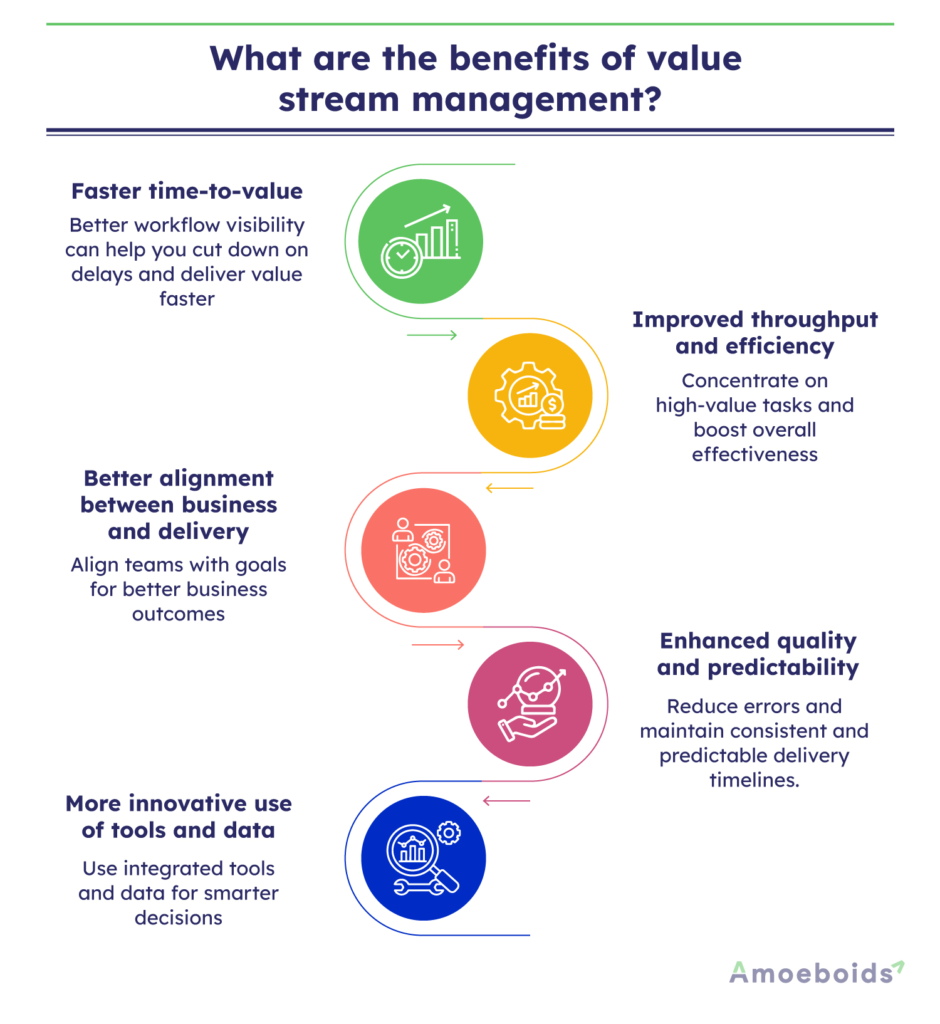
Faster time-to-value
VSM eliminates unnecessary hand-offs, rework, and dependencies that slow delivery. With clearer visibility into bottlenecks, teams can prioritize what truly drives value, helping organizations respond faster to market changes and customer needs. In fact, a 2024 Forbes Technology Council study found that 96% of organizations using VSM reported measurable improvements in delivery speed and business performance.
Improved throughput and efficiency
By exposing hidden delays and redundant steps, VSM helps teams focus on high-value work. Continuous monitoring of flow metrics ensures that every unit of effort moves the product closer to the customer, improving overall operational efficiency.
Better alignment between business and delivery
When the flow of value is visible, strategy, product, and engineering teams can align around common objectives. This alignment ensures that delivery priorities directly support broader business goals and upcoming go-to-market strategies, creating a seamless connection between product development and market success.
Enhanced quality and predictability
Streamlined workflows mean fewer errors, less rework, and more predictable delivery timelines. Over time, this consistency builds stakeholder confidence, enabling teams to plan releases with greater certainty.
More innovative use of tools and data
A value stream approach integrates tools and data sources across the organization. This unified view provides real-time insights, enabling leaders to make proactive decisions based on actual performance rather than assumptions.
The growing business adoption of these practices reflects their impact – the global value stream management market was valued at USD 480.5 million in 2024 and is projected to grow at a CAGR of 9.8% through 2030, according to Grand View Research. This rapid growth underscores how organizations are recognizing VSM not just as a process optimization method, but as a strategic framework for driving digital transformation and enterprise agility.
Common value stream metrics
Knowing the appropriate metrics is important to implementing a strong value stream management definition into practice. These metrics are calculated using specialised software and cutting-edge tools to evaluate flow, performance, and delivery results.
Here are some commonly used value stream metrics:
Lead Time:
The total time from idea to final delivery, helping teams understand overall speed and efficiency.
Cycle Time:
The time required to complete a task once work has begun, which is useful for identifying delays in the process.
Flow Efficiency:
The ratio of active working time to total elapsed time, which shows where work is waiting and where it is moving forward.
Throughput:
The amount of work completed within a specific period, indicating team productivity and delivery capacity.
Defect Rate:
The number of defects or errors found, helping teams maintain quality and improve outcomes.
Deployment Frequency:
The frequency of releases reflects the flexibility and effectiveness of modern value stream management solutions.
These metrics are frequently used in value stream management training to help teams gain a practical understanding. They are also supported by value stream management services, which help to drive continuous delivery performance improvement.
How to monitor and measure VSM process success
To effectively track progress, teams require clear visibility into performance via the appropriate value stream management software and practical VSM tools. The focus should be on measuring outcomes, streamlining processes, and ensuring continuous value delivery.
Define Clear Objectives:
Start by matching metrics to business goals to ensure meaningful tracking.
Track Flow Metrics:
Monitor lead time, cycle time, and throughput to understand delivery speed and efficiency.
Measure Flow Efficiency:
Identify bottlenecks by looking at the difference between the time spent working and the time spent waiting.
Monitor Quality Metrics:
Keep track of defect rates and rework to make sure that the quality of your work stays the same.
Analyze Deployment Trends:
Evaluate release frequency to measure agility and improvement over time.
Use Real-Time Dashboards:
Implement value stream management software to see things more clearly and make decisions more quickly.
Continuously Improve:
Use what you learn from services and training to make processes better and get better results overall.
Best Practices for Value Stream Management
To make value stream management truly effective, organizations must adopt practices that go beyond process mapping. This involves integrating mindset, metrics, tools, and culture into a single, continuous improvement system. Successful VSM implementation isn’t about isolated optimization; it’s about building visibility and flow across every part of your delivery pipeline. These best practices will help you lay that foundation and maximize results.
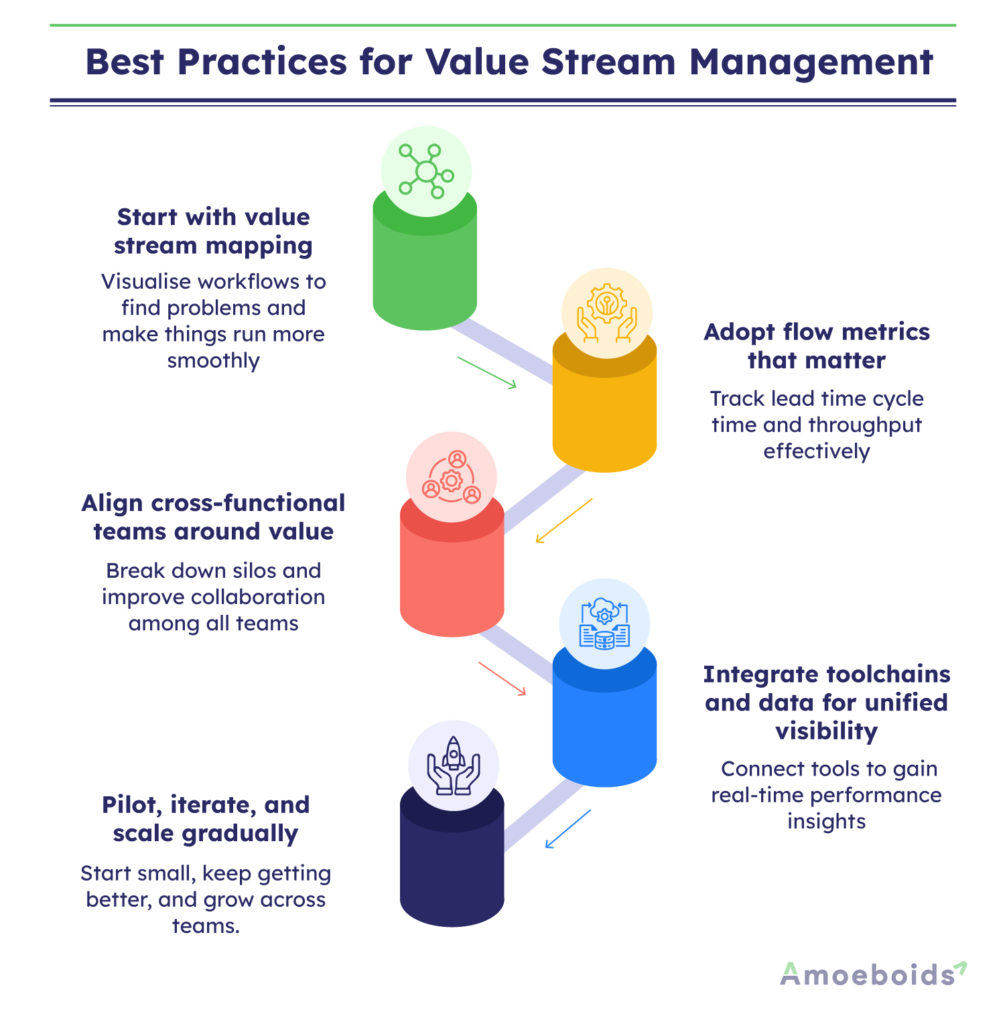
Start with value stream mapping
Every transformation begins with clarity. Start by identifying your value streams – the end-to-end sequence of activities that create value for your customer. Through value stream mapping, you can visualize how work flows through your organization, where it slows down, and where waste or rework accumulates. A simple value stream management example is tracking how a software feature moves from planning to deployment while identifying delays between development and testing stages. This exercise reveals lead time, touch time, and idle time, giving you quantifiable insight into efficiency. Once your current state is mapped, use that baseline to design an improved future state.
Adopt flow metrics that matter
Traditional delivery metrics like story points or sprint velocity don’t capture the real flow of value. Instead, adopt flow-based metrics such as lead time, cycle time, flow load, flow efficiency, and throughput. These KPIs provide a more holistic picture of delivery performance and reveal how long it truly takes for value to move from concept to customer. Leveraging value stream management tools or dashboards can help visualize these metrics in real time, enabling better prioritization and resource allocation. Tracking flow also supports data-driven retrospectives.
Align cross-functional teams around value
Effective value stream management depends on breaking down silos between product, engineering, operations, and business teams. As modern collaboration trends shape how teams work together, shared visibility into goals and metrics helps them make faster, better-aligned decisions. This alignment fosters shared ownership, where collective outcomes serve as a measure of success. Encourage joint reviews, shared dashboards, and open discussions on flow metrics to keep everyone focused on delivering customer value.
Integrate toolchains and data for unified visibility
A significant barrier to effective VSM is the fragmentation of toolchains. When development, operations, and business tools operate in isolation, visibility is lost and decision-making is slowed down. By integrating your ecosystem into a cohesive value stream management platform, you create an end-to-end view of how value flows across systems and teams. This integration also enables real-time monitoring and predictive insights, empowering teams to identify bottlenecks before they become blockers. Whether you’re using Jira, Jenkins, or other DevOps and project management tools, linking them under one platform enables transparency and consistent reporting.
Pilot, iterate, and scale gradually
Transforming into a value-driven organization takes time and effort. Instead of overhauling everything at once, start with one well-defined value stream where you can measure progress and demonstrate tangible outcomes. Use value stream management solutions to capture baseline metrics, implement improvements, and compare before-and-after results. Once successful, expand these practices incrementally across other areas of the business. Scaling VSM requires not just tools but a cultural shift toward experimentation and continuous improvement. Celebrate wins, learn from failures, and make iteration a permanent part of your delivery DNA.
By combining these best practices with the right mindset and tooling, value stream management evolves from a theoretical framework into a powerful operating model.
How can a value stream management solution help?
A dedicated value stream management solution or platform can support your VSM efforts by providing. Another practical value stream management example is using dashboards to monitor bottlenecks, deployment frequency, and team delivery performance.
1. End-to-end visibility:
A robust VSM solution gives you complete visibility into how value flows from idea to delivery. It maps every stage, from early product roadmaps to release execution, highlighting dependencies, wait states, and rework loops. This transparency helps you identify systemic bottlenecks and understand how each function contributes to (or delays) the overall flow of value.
2. Real-time flow metrics and analytics
By tracking flow metrics such as lead time, cycle time, throughput, and flow efficiency in real-time, you can monitor progress and identify emerging issues early. Many value stream management tools offer interactive dashboards that transform raw data into actionable insights, enabling leaders to make informed, data-driven decisions that strike a balance between speed, quality, and efficiency.
3. Toolchain integration and data consolidation
Modern delivery environments rely on multiple systems, including Jira for backlog management, Jenkins for CI/CD, ServiceNow for ITSM, and others. A comprehensive value stream management solution integrates these tools seamlessly, consolidating data into a unified view. This ensures teams don’t waste time reconciling metrics manually and can instead focus on improving flow.
4. Bottleneck detection and intelligent insights
Advanced value stream management platforms utilize AI-driven analytics to identify where work accumulates or slows down. Automated alerts highlight process inefficiencies, excessive queue times, or quality regressions, allowing teams to take corrective action proactively rather than reactively. Over time, these insights drive measurable gains in throughput and reliability.
5. Continuous improvement and scenario modeling
Beyond tracking, VSM tools support sustained improvement by helping teams visualize value stream maps, simulate potential changes, and compare current versus target states. You can model how adjustments in staffing, process, or tooling will impact flow metrics before implementing them.
In today’s software-delivery context, many organizations use value stream management tools, part of a broader value stream management platform, to accelerate adoption and maturity. As you evaluate solutions, ask: How well does this integrate with our existing tool-chain? What flow metrics are available out-of-the-box? Can it visualize value streams and generate insights rather than just dashboards?
Driving better flow, delivery and outcomes
When you put the pieces together – mindset, practices, metrics, tools – you enable the transformation of your delivery engine into a value-centric system. Value stream management isn’t just a methodology or a set of tools: it’s a strategic way of organizing your work around customer value and flow.
By choosing to invest in the right value stream management solutions, mapping your value flows, tracking flow metrics and aligning teams, you will be better positioned to deliver faster, with higher quality, and with clearer alignment to business goals.
FAQs
What is the difference between value stream mapping and value stream management?
Value stream mapping is the visualization practice that identifies work steps, hand-offs, delays, and waste in a process. In contrast, value stream management is the ongoing discipline of managing, measuring and optimizing those value streams – not just mapping them once, but continually improving them.
Why is value stream management necessary?
Because in complex delivery and software environments, value often gets stuck in hand-offs, re-work loops and team silos. VSM gives you end-to-end visibility, aligns business and delivery, tracks flow metrics and enables continuous improvement – all of which make your delivery faster, more predictable and more aligned to value.
How are enterprise agility and value streams connected?
Enterprise agility depends on your ability to respond quickly to change, deliver value continuously, and adapt processes and tools. Value stream management supports this by focusing on flow, removing waste and enabling cross-functional collaboration, which are key to agile, responsive organizations.