
You’ve just kicked off a new product launch with a solid plan in hand. But two weeks in, customer feedback reveals unexpected needs. Suddenly, your carefully crafted roadmap no longer fits. Do you stick to the plan or adapt? That’s where the adaptive project framework (also called the adaptive project management framework) becomes relevant.
When your rigid project models often fall short due to customer feedback or shifting goals, APF helps you quickly adapt to these changes rather than routinely follow yesterday’s recipe. However, success will not come unless you know how to apply the key principle of APF by overcoming some common yet critical challenges. Keep reading this article to learn more.
What is an adaptive project framework (APF)?
Change is constant and unpredictable in the business world. The adaptive project management framework is a flexible way to manage the class of projects whose solution is not evident or whose goal is just vaguely defined. APF helps you work with what’s known now and change direction as you learn more. The idea is simple: plan, act, learn, and adjust.
In traditional models, everything is fixed at the beginning. When you adopt APF, you accept that change is constant. You work in short cycles or phases. After each iteration, you review the results, see what worked and what didn’t, and adjust your plan for the next phase. This loop continues until your goals are achieved.
Let’s say you’re rolling out a new digital product. Instead of spending six months building the whole thing only to find users don’t like it, adaptive project framework methodology helps you deliver parts of it quickly, get real feedback, and improve along the way. This method not only saves time but also reduces risk and keeps your team aligned.
To understand the framework better, let’s break down its core principles next.
Key principles of APF
Let’s discuss the major building blocks of an adaptive project framework methodology. We’ll see how they can help your organization manage uncertainty and drive your project forward in dynamic situations.
1. Iterative development
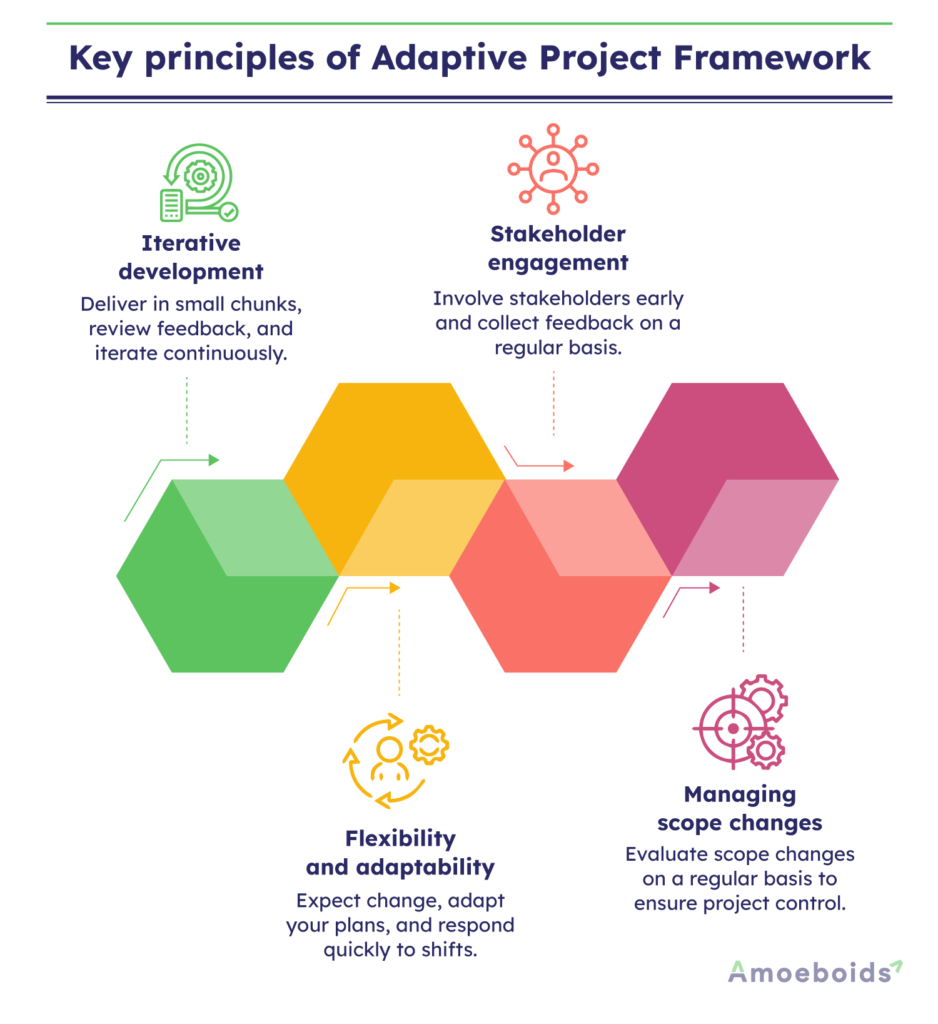
Instead of delivering the entire project at once, APF works in small, manageable cycles. You plan, build, and review in phases. This is called iterative development. For example, if you’re launching a new customer support tool, you might release just the ticketing system first. Based on feedback, you then improve it or move on to the next feature. Small release cycles come with small risks and help your team quickly adapt to changes.
2. Flexibility and adaptability
In the adaptive project management framework, plans are meant to change. You start with what you know, but you’re always ready to shift gears. Let’s say mid-project, your client decides they need a mobile version instead of a desktop one. In traditional project management, this could throw everything off. But with APF, change is expected and built into your process. APF is necessary for industries where innovation, feedback, and market trends shift quickly.
3. Stakeholder engagement
One of the strongest principles of the adaptive project framework is involving stakeholders from day one and keeping them engaged throughout. During each development cycle, you might share a working demo with clients and gather their thoughts. This helps avoid surprises at the end and ensures that your final product delivers value from their point of view.
4. Managing scope changes
Scope creep, when projects slowly balloon beyond the original plan, is one of the biggest risks in project management. APF tackles this head-on. Instead of treating scope changes as setbacks, you treat them as learning moments. In APF, scope changes are reviewed at the end of every cycle, not just tacked on. This gives you a clear, structured way to assess what’s worth changing and what’s not without losing control or blowing up your timeline.
Together, these four principles help you and your team stay grounded in reality, react to change with confidence and keep your project moving in the right direction, even when the path isn’t fully visible.
Now that you’ve seen the core principles of the adaptive project framework, let’s compare it with traditional project management.
Differences between APF and traditional project management
The table below compares the adaptive project management framework with a traditional one. It focuses on showing how both models adopt different approaches to handling uncertainty and change:
| Aspect | Traditional Project Management | Adaptive Project Framework (APF) |
|---|---|---|
| Approach to Planning | Fixed plan with set scope, time, and cost. Works best with clear goals. | Plans in short cycles. Adapts as new info comes in. |
| Example | Building a bridge where all specifications are known beforehand. | Developing custom software where user needs evolve. |
| Handling Change | Change is a problem and often causes delays | Change is normal. Teams adjust after each cycle. |
| Best for | Stable projects with few surprises | Fast-moving or uncertain projects that need flexibility. |
| Stakeholder role | Mostly involved at the beginning and end. | Involved throughout. Feedback shapes each cycle. |
| Response to change | Hard to adjust if the market or needs shift. | Easy to pivot based on new inputs or feedback. |
| Success metric | Success = sticking to the original plan. | Success = solving the right problem at the right time. |
| Focus | Output-focused: “Did we deliver what we planned?” | Outcome-focused: “Did we deliver what users needed?” |
| Risk Management | Avoid risks by locking plans early. | Manage risks by staying flexible and learning as you go. |
Next, you should learn to apply APF under different scenarios.
When to use the adaptive project framework
Some projects don’t work smoothly, even if you have a clear blueprint from the start, because external situations change dynamically. This is where APF shines. However, that doesn’t make APF a standalone solution for every such project. Let’s look at the types of situations where this method is really helpful.
1. When project requirements are unclear or likely to change
Sometimes, goals or requirements are not clear at the start of a project. For instance, you’ve been asked to create a customer portal, but the client is unsure about the required features. Here, the adaptive project management framework is the best option. It gives your team enough space to rethink and move forward without locking everything in on day one.
2. When innovation or experimentation is key
APF is useful in industries like tech, R&D, software, and design, where uncertainty is part of the process. If you’re building a brand-new feature no one in the industry has tried before, each testing cycle can bring user feedback that can change the direction. By following APF, instead of having to start over, you get the freedom to tweak the current version.
3. When stakeholder feedback is ongoing
When the deadline is tight, the stakeholder wants to share ongoing feedback to avoid unwanted revisions. APF projects have such an elevated level of stakeholder involvement. They get to look at intermediate deliverables early in the project and have an opportunity to adjust them. This continuous feedback helps the team improve the outcome before it’s too late.
4. When speed and value matter more than perfection
The continual adjustment and redirection of an APF project means you can deliver fast and improve as you do instead of waiting for a perfect product. Thus, an adaptive project framework works well in startups, product launches, or B2C projects where delays can cost more than imperfection.
Now that you’ve seen how the adaptive project framework methodology compares with traditional models, let’s explore what makes it truly valuable.
Benefits of using APF
APF brings a lot of business value to the table as compared to other approaches. Some of its benefits include:
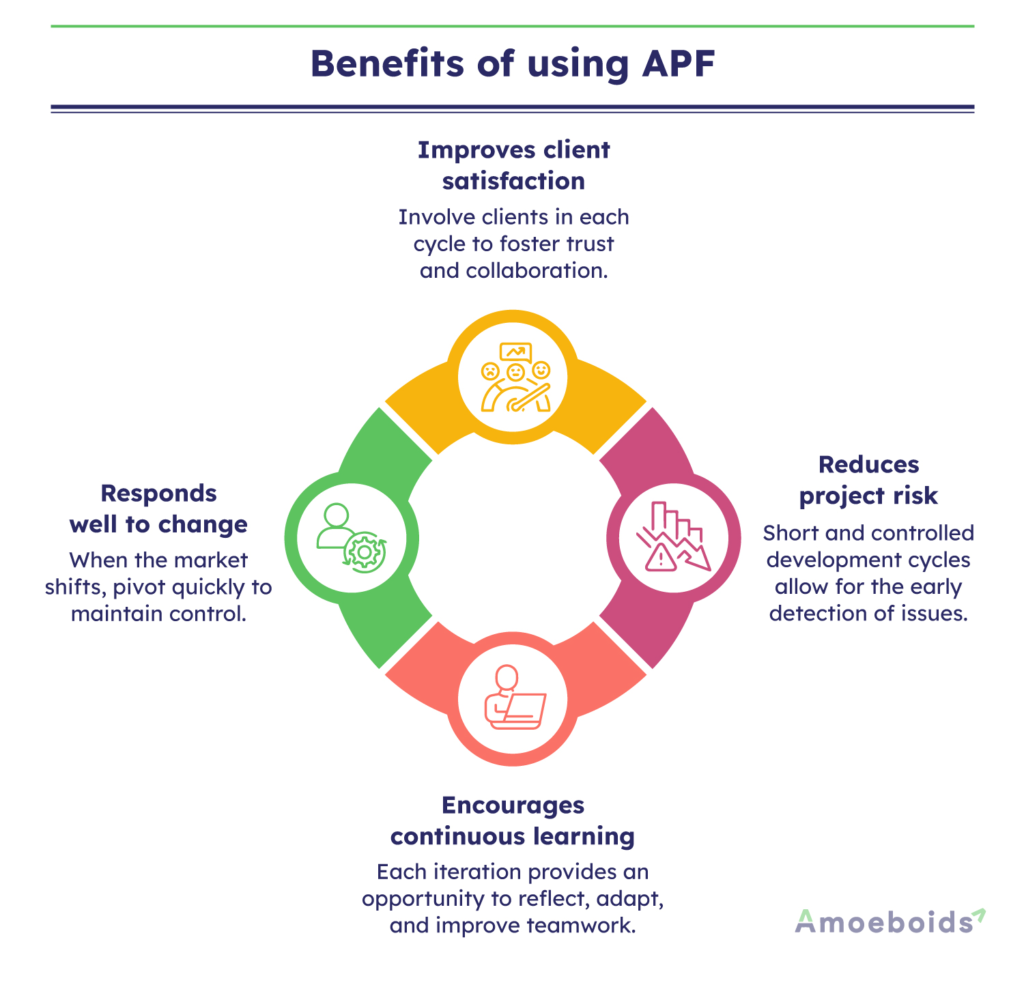
1. Responds well to change: If you’re halfway through developing a new service, and the competitor launches something similar, APF holds the scope to pivot quickly without losing control of the project.
2. Improves client satisfaction: The client, in collaboration with you, decides what goes into the solution at every iteration. That means that the client is kept in the loop for the project, which improves efficiency and reduces waste. It also builds up the client’s confidence in your work and allows them to deliver timely feedback.
3. Reduces project risk: APF significantly reduces project risks as it works in short cycles. For instance, if, in the first review cycle, your product team discovers a usability problem, they can fix it early. You save budget and time on unwanted revisions.
4. Encourages continuous learning: Each APF cycle gives your team a chance to reflect, adjust, and improve, not just the product, but how you work together. For instance, a sprint review following an APF cycle can help team members gain clarity and experience about individual roles and responsibilities for future iterations.
Once you’re clear about the benefits, you need to learn about the associated challenges of the process.
Challenges in implementing APF
Let’s explore a few common challenges that can come up when you start using the adaptive project framework methodology.
1. Difficulty letting go of fixed plans
If your teams are used to traditional project plans, where everything is fixed upfront, switching to an adaptive approach can feel uncomfortable. They might prefer to work with previous goals, even when requirements keep changing.
How to handle it: Start small. Try APF on one project first. Allow your team to get used to the idea that change isn’t a failure; it’s part of growth. As you see progress, gradually implement the framework for projects as and when required.
2. Teams and stakeholders may resist the change
APF projects prompt teams to work on frequent changes under a continuous feedback model. While that’s a strength, it can also overwhelm teams who aren’t used to working this way, resulting in confusion or slow decisions. Similarly, stakeholders used to predictable timelines and outcomes might not feel comfortable with a flexible framework like APF.
How to handle it: Automate the system through tools like the Roadmap and Idea Portal for JSM from Amoeboids. It can centralize disorganized and scattered product feedback within Jira to help your team build a dynamic product roadmap. You can easily modify it in response to real-time feedback. Plus, it allows you to collect votes from stakeholders on important feature requests (or changes).
3. Repeatedly working on release notes may feel overwhelming
Release notes are a tedious task for product managers and developers. The adaptive project framework methodology relies heavily on dynamic changes. Writing detailed release notes and getting them approved and translated into dozens of languages can demand significant productive hours.
How to handle it: Amoeboids’ Automated Release Notes & Reports app for Jira can help your team streamline the process of writing release notes. It can collect relevant Jira issues and use a template to generate the notes during the continuous integration process. This saves you time to focus more on writing style and creativity instead of gathering information.
Conclusion
An adaptive project framework gives you a flexible, smart way to manage workflow, especially when things are unclear or change often. APF works in small, manageable cycles so that the team gets enough scope for changes by actively involving stakeholders from the beginning. That’s why this framework reduces project risks, ensures high client satisfaction, and encourages continuous learning in team members. Like any method, it comes with certain challenges, such as initial resistance from the team and release note management. However, leveraging Amoeboids’ suite of apps ensures you streamline APF into your project management without any friction.
Try Amoeboids solutions for free!
FAQs
1. How is the adaptive project framework different from agile?
Agile helps teams follow a set of steps with short cycles, but adaptive project frameworks go further. It lets you change the project goal itself based on results. So, while Agile improves how you work, APF changes what you work toward.
2. Can small teams use adaptive project frameworks effectively?
Yes, small teams can use APF without any trouble. It is easy to understand and does not need a big structure. Small teams can learn quickly, adjust fast, and manage change better with this method.
3. What industries benefit most from the adaptive project framework?
If your work changes often or if plans are not always clear, APF helps you stay flexible and ready. Industries that face fast changes, like technology, healthcare, or startups, benefit the most.
4. Is certification available for the adaptive project framework?
There is no single official APF certificate. However, some training programs include APF in their course. You can search for courses that teach adaptive or flexible project methods to learn more.