Every successful software product you use, from banking apps to social media platforms, has gone through a structured development process before reaching your hands. This structured process is called the Software Development Life Cycle (SDLC). It helps teams plan, build, test, and launch software efficiently while ensuring security, quality, and alignment with user needs. Whether you’re building a simple app or a complex enterprise system, following a strong SDLC process helps prevent critical issues, reduces development risks, and ensures a smoother path to success.
When you can identify and address vulnerabilities during the development phase, you can proactively prevent such exploits, ensuring system reliability and data protection. Moreover, if your teams use tools like Jira and Confluence, integrating thorough testing protocols within the SDLC can be the best way to mitigate risk and enhance software resilience.
In this blog, we’ll explore the core phases of SDLC, popular models, and common implementation pitfalls. Whether you’re a software engineer, project manager, or IT decision-maker, mastering SDLC streamlines workflows, optimizes resources, and drives successful launches.
What is the Software Development Life Cycle (SDLC)?
The Software Development Life Cycle (SDLC) is a well-defined framework that guides software engineers through the process of developing, testing, and deploying applications. It consists of distinct phases, each targeting an important aspect of software creation. However, this can depend on what methodology you use: waterfall, Agile, or DevOps.
Through SDLC, your organization can deliver software efficiently, minimize risks, and meet quality standards., while aligning with business goals and user needs.
Popular tech giants like Microsoft, Google, and Amazon also adopt SDLC models, often Agile principles or DevOps, to simplify their development workflows and accelerate product delivery. A suitable SDLC approach can help your team improve resource management, maintain structured workflows, and consistently release high-quality software.
The 7 phases of the Software Development Life Cycle
SDLC consists of seven essential stages, each contributing to the success of a software project by ensuring efficiency, quality, and alignment with business objectives. By following these stages systematically, teams can minimize risks, improve collaboration, and deliver reliable software solutions. Let’s explore them in detail:

Phase 1 – Planning
- In this phase, you establish the project’s objectives, feasibility, scope, and potential challenges. You will also see if the project is technically feasible and scalable in the long term.
- Everyone involved (stakeholders) determines resource allocation, estimated timelines, budget constraints, and possible risks.
- You also focus on defining a Minimum Viable Product (MVP) to reduce time to market.
Example: A fintech startup planning to develop a mobile banking app assesses market demand, regulatory compliance requirements, and necessary technology stacks like React Native for cross-platform development and Node.js for backend services.
Phase 2 – Requirement analysis
- In this phase, your business analysts have to collaborate with stakeholders to gather detailed functional and non-functional requirements.
- Also, the developers, testers, and UX designers in your team have to work together to define expected features, performance metrics, and security considerations.
Example: An e-commerce company developing a new platform may require features like secure payment gateways, automated order tracking, and AI-based personalized recommendations.
Phase 3 – Design
- In this phase, the system architecture and user interface (UI/UX) are designed based on the project’s requirements.
- Developers define the database schema, system workflows, and API integrations before any coding begins.
Example: A healthcare app might focus on intuitive navigation, HIPAA compliance for data security, and accessibility features for older adults.
Phase 4 – Development (Coding)
- During the development phase, your programmers begin writing the actual code, guided by the approved design specifications and chosen technology stack.
- The process typically follows a specific methodology such as Agile, Waterfall, or DevOps.
Example: A ride-sharing app like Uber may use a microservices architecture to handle different services like ride-matching, payments, and driver tracking independently.
Phase 5 – Testing
- The Quality Assurance (QA) teams conduct various testing processes to identify and fix bugs.
- Unit testing, integration testing, regression testing, and user acceptance testing (UAT) are performed.
Example: A cloud storage service like Google Drive undergoes stress testing to ensure servers handle massive simultaneous uploads and downloads efficiently.
Phase 6 – Deployment
- In the deployment phase, you release the software into the live environment or production phase.
- Deployment may be conducted in phases, rolling releases, or blue-green deployments to minimize downtime.
Example: Apple’s iOS updates follow a staged rollout to monitor performance and quickly address early bugs before a full-scale launch.

Phase 7 – Maintenance & support
- In this phase, you can continuously monitor the security updates and bug fixes post-deployment.
- You can also collect user feedback to enhance software usability and functionality over time.
Example: Microsoft’s Windows OS receives periodic security patches, bug fixes, and feature updates to address vulnerabilities and user needs.
A clear understanding of software development life cycle phases helps you explore the various SDLC models that organizations use. With the right model, you can improve efficiency, scalability, and adaptability in your software development process.
Which is the best Software Development Life Cycle model?
There is no single best SDLC model that fits every project. The right choice depends on factors like project complexity, industry requirements, and business goals. Startups and product developers, for example, need flexibility and speed, while highly regulated industries require structured processes and extensive documentation.
Below is a quick comparison of SDLC models based on different business needs:
| Business Type | Best SDLC Model | Why? |
|---|---|---|
| Product Developers & Startups (Enterprise Software, SaaS Products) | Agile + DevOps | Enables continuous integration, scalability, and fast feature rollouts. |
| Highly Regulated Industries (Finance, Healthcare, Aerospace) | Waterfall or V-Model | Ensures compliance with industry standards and documentation requirements. |
| New Product Development & MVP Testing | Lean Agile or Rapid Prototyping | Allows for fast iterations, market validation, and cost-effective changes. |
Each of these models has its strengths and limitations, making it essential for organizations to assess their specific project needs before choosing the right approach.
Beyond the models mentioned above, several other Software Development Life Cycle models are widely used depending on the project scope and team requirements. Understanding these models helps businesses optimize their development process, improve collaboration, and ensure timely project delivery. Let’s explore them in detail.
- Waterfall Model – This model is best for well-defined projects with clear, fixed requirements and minimal changes. It follows a sequential flow, making it ideal for government and enterprise software projects.
- Agile Model – Ideal for dynamic projects requiring flexibility, fast iteration, and continuous feedback. 70% of companies today prefer Agile for its adaptability in fast-changing environments.
- V-Model (Verification & Validation Model) – This model is best for projects requiring rigorous testing at every stage, such as in aerospace and healthcare industries where safety is critical.
- Spiral Model – Suitable for large, complex projects with evolving requirements and high-risk factors. Used in defense and banking sectors where security is a top priority.
- DevOps Model – Integrates development and operations teams for continuous integration and faster delivery. Companies like Netflix and Facebook use DevOps to deploy code multiple times a day.
Benefits of the SDLC model
Implementing an SDLC model provides a structured approach to software development, ensuring efficiency, quality, and cost-effectiveness. By following a well-defined process, teams can streamline workflows, minimize risks, and achieve predictable outcomes. Here’s how SDLC benefits organizations:
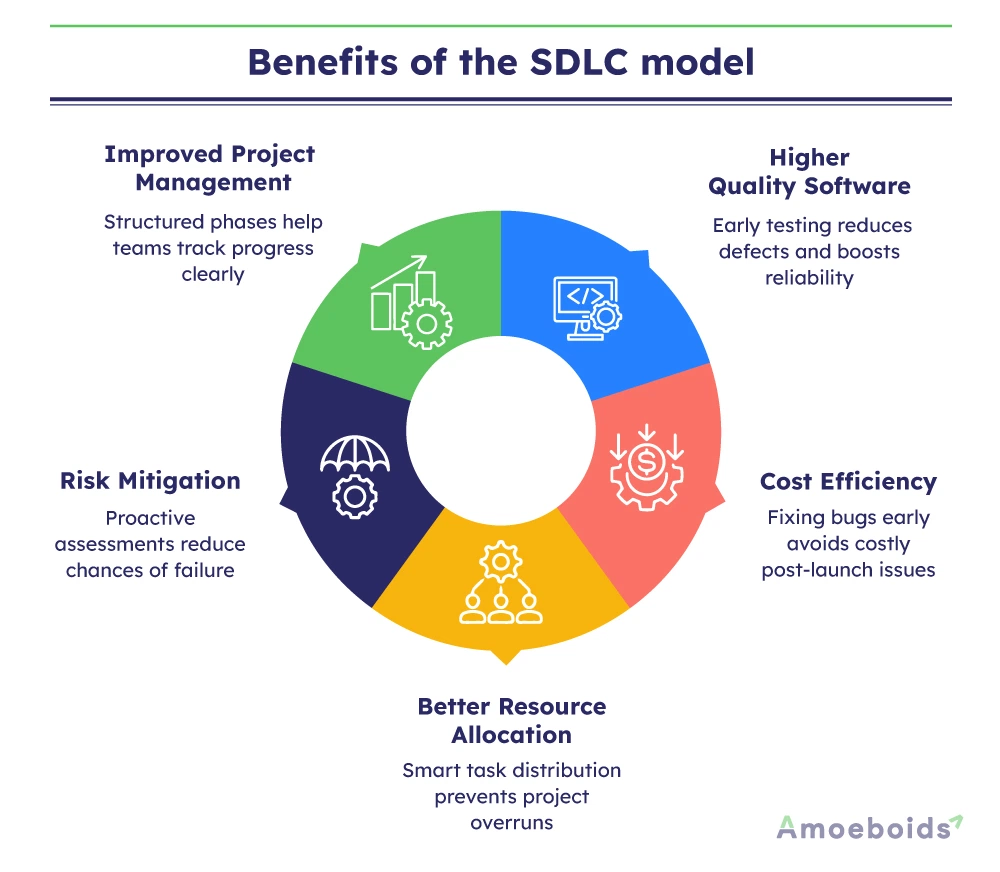
- Improved Project Management – With clearly defined phases and structured workflows, teams always know their current stage and next steps. This is particularly beneficial for startups juggling multiple priorities, as it provides a roadmap to keep projects on track.
- Higher Quality Software – Systematic testing at each stage ensures that defects are caught early, significantly improving software reliability. Research shows that rigorous testing can reduce software defects by up to 60%, enhancing overall product stability.
- Cost Efficiency – Detecting and resolving issues early in the development process prevents costly fixes later. According to IBM, fixing a bug after deployment can be 100 times more expensive than addressing it during the development phase.
- Risk Mitigation – SDLC incorporates proactive risk assessment, helping teams identify and address potential failures before they become critical. This is especially vital in high-risk industries like finance and healthcare, where software failures can have serious consequences.
- Better Resource Allocation – Properly distributing work among developers, designers, and testers ensures smoother execution. Efficient resource allocation has been shown to reduce project overruns by 40%, leading to timely project completion.
By adopting SDLC, businesses gain greater control over project timelines, improve collaboration, and ensure better alignment with business goals. A structured approach to development results in higher-quality software that meets user expectations and regulatory requirements.
Common challenges in SDLC implementation
While SDLC brings numerous advantages, it is not without challenges. Organizations often struggle with changing requirements, resource constraints, and communication gaps, which can derail development timelines. Here are some of the most common hurdles and how to address them:
- Changing Requirements – Sudden shifts in project scope or client demands can disrupt workflows. Studies indicate that 35% of project failures stem from poor requirement analysis. To mitigate this, teams should adopt Agile methodologies, which allow for flexibility and iterative improvements throughout the SDLC.
- Resource Constraints – Limited time, budget, or skilled professionals can cause delays and cost overruns. Many software projects exceed their initial budget due to inadequate resource planning. To avoid this, project managers should prioritize tasks, implement capacity planning, and leverage automation tools to maximize efficiency.
- Poor Communication – Misalignment between developers, stakeholders, and QA teams can lead to inefficiencies and project delays. Research shows that 57% of project failures result from poor communication. Using collaboration tools like Jira, Slack, or Confluence can help ensure transparency and streamline information sharing.
- Lack of Comprehensive Testing – Inadequate testing can lead to software vulnerabilities and failures, causing serious security risks. Implementing a Test-Driven Development (TDD) approach, conducting regular security audits, and leveraging automated testing tools can significantly improve software reliability.
Despite these challenges, organizations that proactively address SDLC roadblocks can enhance project success rates. Investing in better planning, communication, and testing strategies ensures a smoother development process and a higher-quality final product.
Conclusion
The Software Development Life Cycle (SDLC) is key to building high-quality software efficiently. By following its seven phases and choosing the right model, businesses can streamline development, reduce risks, and deliver successful products. For startups and enterprises alike, SDLC best practices ensure software meets industry standards and user expectations.
Amoeboids’ Automated Release Notes & Reports & Roadmap & Idea Portal apps support SDLC by automating release notes & report generation as well as improving product roadmap planning.
FAQs
What is the Agile model in the software development life cycle?
The Agile model is an iterative approach that emphasizes flexibility, collaboration, and customer feedback. It breaks development into small sprints, ensuring continuous improvement and faster delivery. Agile frameworks include Scrum, Kanban, and SAFe.
What is the V model in the software development life cycle?
The V model (Verification and Validation model) is a sequential SDLC approach where each development phase has a corresponding testing phase. It ensures early defect detection and is used in industries requiring high validation standards, like healthcare and aerospace.
Which is the best software development life cycle model?
The best SDLC model depends on the project. Agile is best for flexibility, Waterfall suits structured projects, V Model is ideal for strict validation, and DevOps is best for continuous deployment. Each model serves different business needs.
Why is testing important in the software development life cycle?
Testing ensures software reliability, security, and performance by identifying defects early. It reduces post-deployment failures, security risks, and maintenance costs, improving overall product quality.