What sets high-performing agile teams apart? They can thrive in an ever-changing landscape by continuous improvement, learning, and adapting. They’re like master chefs refining their recipes—not afraid to tweak ingredients, adjust cooking times, and try new techniques to deliver the perfect dish. Think of it as a never-ending quest for better, where every sprint, project, or reflection becomes a stepping stone to greatness.
But how do teams ensure they’re heading in the right direction? That’s where metrics come into play. Metrics act as a compass, providing teams with valuable insights into their progress, areas for growth, and opportunities to excel. According to McKinsey, performance-driven teams outperform their peers by 4.2 times and contribute 30% more revenue growth.
In this article, we’ll explore how agile and scrum methodologies harness the power of team metrics to build a culture of continuous improvement and achieve operational excellence.
What Are Agile Metrics?
Agile metrics are data points used to track team performance, progress, and delivery in Agile projects. They help teams figure out what’s working and what needs to be better. Cycle time, lead time, and agile metrics velocity, which tracks the amount of work done in a sprint, are all agile metrics examples commonly used by high-performing teams. The most effective agile metrics prioritise value over output.
These agile metrics and KPIs allow teams to make better decisions and continuously improve their performance and efficiency over time.
The importance of continuous improvement in scrum and agile
To be real, improving isn’t just a goal—it’s the essence of Scrum and agile methodologies. Continuous improvement lies at the heart of one of the 12 agile principles, which stresses the importance of regular reflection to enhance team efficiency and effectiveness. By consistently examining what works and what doesn’t, teams can unlock their full potential.
A key practice in this process is scrum retrospectives, the backbone of continuous improvement. These sessions provide structured opportunities for teams to reflect on past sprints, identify successes, and address areas needing improvement.
Here’s why embracing a growth mindset through continuous improvement is transformative:
Boosting team productivity
Agile methods like Scrum break work into short, manageable sprints. This focused approach allows teams to tackle specific tasks without distractions, streamlining workflows and delivering results much faster than traditional project management methods.
Improving product quality
With agile, continuous testing and daily stand-ups ensure that problems are spotted and resolved early. By addressing issues as they arise, teams deliver products that are smoother, more reliable, and tailored to user needs.
Keeping stakeholders happy
Agile thrives on collaboration and transparency. Frequent updates, stakeholder involvement, and iterative feedback loops allow teams to adapt quickly, meet expectations, and deliver superior outcomes.
By embracing continuous improvement, teams can enhance systems, processes, and customer satisfaction. However, to truly excel, understanding the role of metrics in driving this culture is crucial. Metrics act as the guiding light, providing actionable insights that fuel progress and ensure your team stays on track to achieve its goals.
Benefits of Tracking Agile Metrics for Continuous Improvement
Tracking Agile metrics helps teams to better understand progress, enhance performance, and deliver consistent performance. Using the right data helps with gap identification, effective planning, and continuous improvement.
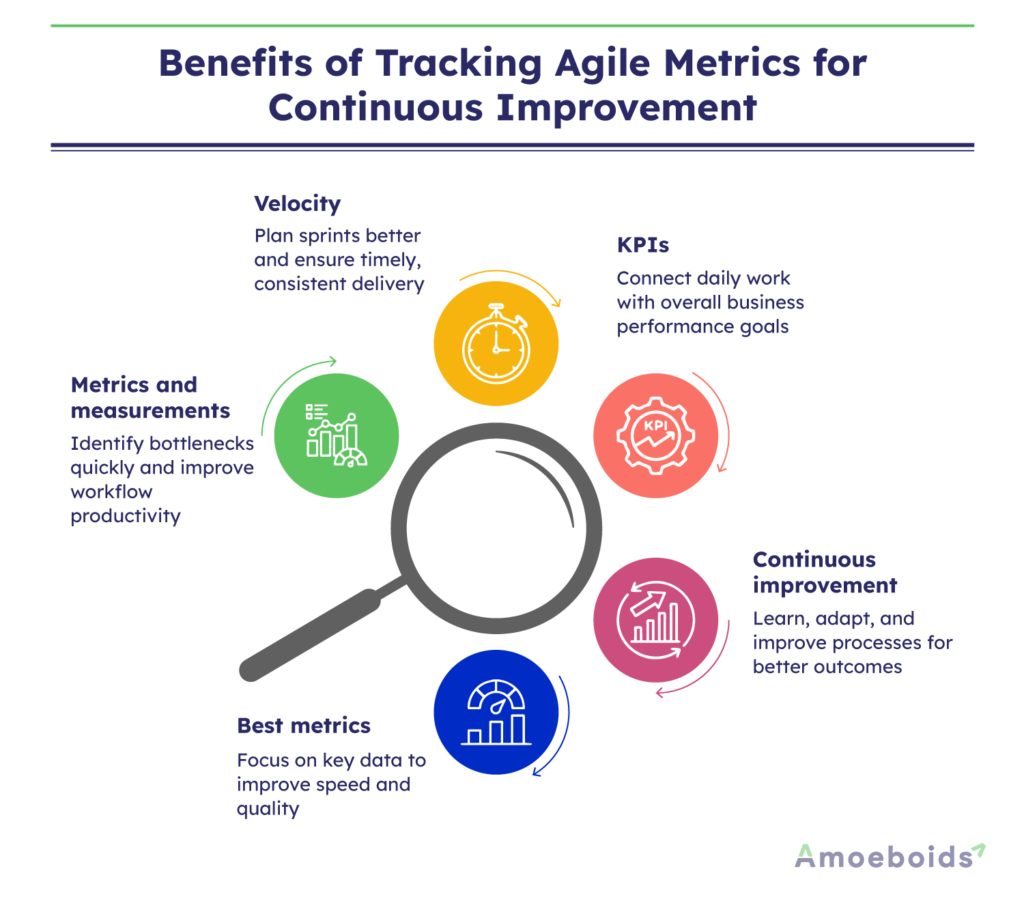
Agile Metrics and measurements:
These enable teams to quickly identify bottlenecks and delays in the workflow, making it easier to improve productivity and keep work moving forward.
Velocity:
Help teams plan better and deliver on time by giving them a clear idea of how much work they can realistically do in a sprint.
KPIs:
Making informed decisions is made easier by these metrics, which show how teamwork and daily tasks are directly linked to broader business goals.
Continuous improvement:
These help teams learn from their past work, make changes, and improve their processes over time to get better outcomes
Best metrics:
Allow teams to focus on what is truly important, improving quality, speed, and overall performance without being distracted by less important data.
Role of Agile Metrics for Continuous Improvement
Metrics are your best tool for fostering continuous improvement within your team. They provide valuable insights into how your organization is performing, enabling better decision-making and more effective processes. In agile environments, metrics help teams refine workflows, accelerate results, and continuously raise the bar on performance. Using the best agile metrics helps agile teams improve workflows, increase transparency, and make smarter business decisions.
Why metrics matter
● Provide data-driven insights: Metrics offer a clear, objective view of progress, guiding teams toward areas that need improvement. They provide a foundation for data-driven decisions, ensuring teams focus on what truly matters.
● Highlight areas of strength and weakness: By consistently tracking KPIs and other agile metrics that matter, teams can identify what’s working well and where adjustments are needed
● Facilitate informed decision-making: With reliable data, teams can adjust strategies quickly, ensuring they stay aligned with objectives and customer needs.
Avoiding vanity metrics: Focus on actionable metrics
Vanity metrics look good on paper but don’t drive meaningful change. Actionable metrics, on the other hand, provide insights that help your team make real improvements. For instance, tracking feature clicks means little on its own if it doesn’t show you whether those clicks improve user satisfaction or help users complete tasks.
Metrics act like a compass, showing how far you’ve come and where you’re headed. If progress slows, metrics reveal it early, helping teams assess tasks, adjust priorities, and stay on course. The right metrics also highlight what’s working—and what’s not. Say you’re testing a new feature, but the UX falls short. Metrics let you spot the problem quickly so you can pause, refine, and test again.
Rather than pushing forward with a flawed feature, the data tells you it’s time to pause, fix the issue, and test again, ensuring the final product is of the highest quality. Regularly checking for defects can lead to continuous refinement and a better final product.
But what are the key metrics that matter most? Let’s explore some core agile metrics fueling this continuous improvement cycle.
Key agile metrics for continuous improvement
Ensuring your teams deliver the best performance and value to your stakeholders is important. To do that effectively, you can depend on a few key agile metrics. The following are some important agile metrics to track for improving team efficiency, delivery speed, and product quality.
1. Sprint velocity
In agile metrics in scrum, sprint velocity measures how much work your team can realistically complete during a sprint. When you consistently complete 30 story points each sprint, use that data. It helps you plan better for future sprints and tasks.
2. Cycle time
It measures how quickly your team finishes work, from start to end. If tasks drag on, investigate what’s slowing you down. Fixing those delays can help everything flow more smoothly and efficiently.
3. Lead time
This tracks the time from an idea generation to completion. Improving planning can shorten that time and boost your productivity. Suppose you are working on a new feature inclusion in your existing software. So, the lead time will be the time when the first idea is generated to the release of the feature after a quality check.
4. Burndown and burnup charts
Burndown and burnup charts are essential tools project managers use to track and effectively communicate their project’s progress. A burndown chart illustrates the remaining work in a project, while a burnup chart highlights the completed work alongside the total work involved. These charts are especially popular in agile and scrum software project management.
5. Leaked defects
This highlights mistakes after the work is finished. When you find bugs in a final product, review what went wrong. Tighten your review process to avoid these issues in the future.
6. Team happiness and morale
It’s important to check in regularly with your team. Monthly check-ins let you see how everyone feels and how they work together. They can help you identify and fix issues before they become too big and motivate your team to improve. These insights are also valuable agile metrics for leadership because they help managers understand team engagement and long-term sustainability.
7. Cumulative flow diagram (CFD)
This shows where tasks sit at different workflow stages. If tasks pile up in one area, dig into what’s happening. Addressing bottlenecks keeps your team productive and projects moving smoothly.
Tracking these team metrics closely helps you identify opportunities to improve. With this focus, your team builds a culture of progress. Everyone benefits—team members, stakeholders, and even the final product.
Steps to Build a Continuous Improvement Culture Using Agile Metrics
Now that you understand how team metrics can transform your workflows, let’s dive into ways to foster a growth mindset within your team or company culture. Building a culture of continuous improvement involves embracing data-driven insights, regular reflection, and active collaboration.
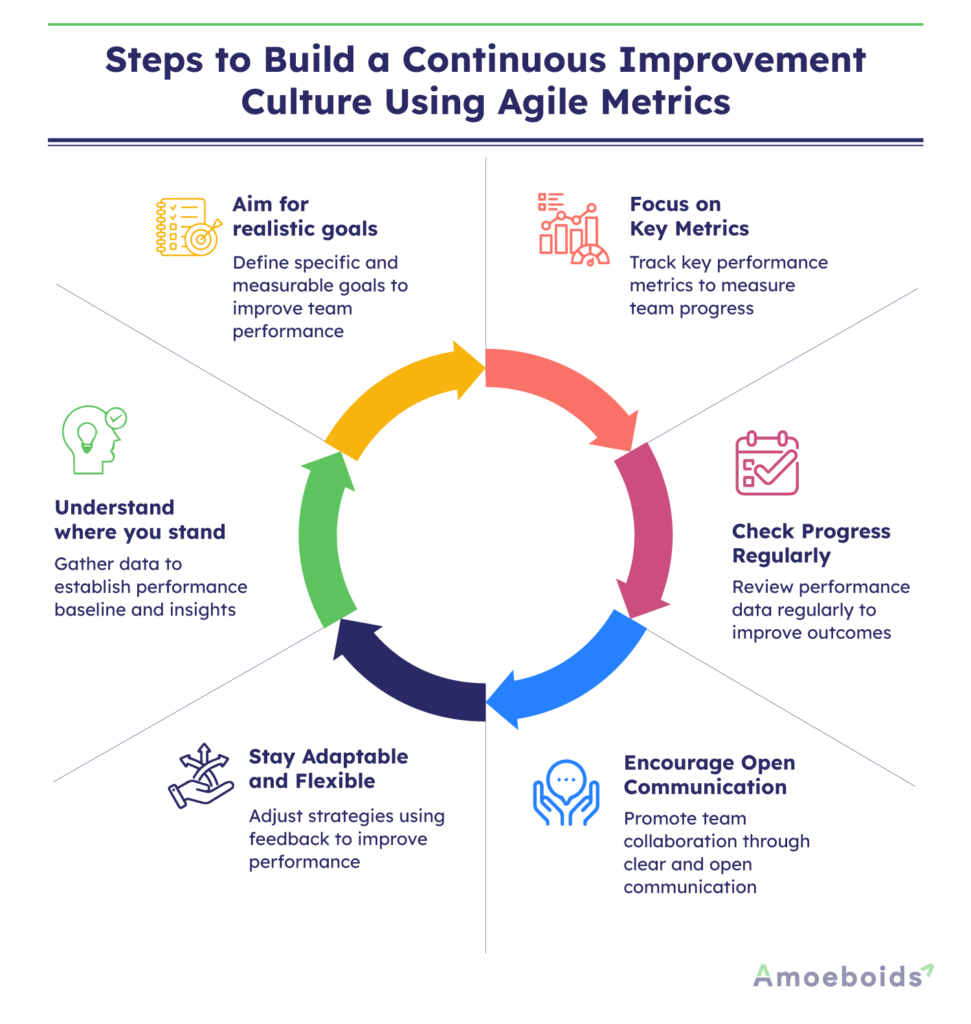
1. Understand where you stand
Start by gathering all your current data. This provides a clear baseline for improvement. Sharing the information with your team ensures everyone understands the bigger picture and sets a positive tone for improvement, keeping everyone aligned and motivated to progress.
2. Aim for realistic goals
Set SMART goals (Specific, Measurable, Achievable, Realistic, Time-bound) so everyone knows the path from your current state to the desired outcome. Clear goals provide direction and accountability, ensuring the team understands what they need to achieve and how to get there.
3. Focus on key metrics
From your SMART goals, select a few key metrics that truly matter to your team. Consider metrics like velocity, defect rates, and customer satisfaction to track progress. Keeping it simple avoids confusion and ensures everyone is focused on the most important outcomes.
4. Check progress regularly
It’s essential to monitor progress regularly. Proactive tracking is far more effective than reactive responses. Set quarterly or bi-annual check-ins to review progress, provide feedback, and support. This keeps the team on track and allows for timely adjustments when necessary.
5. Encourage open communication
Create a culture of open communication during progress reviews. Encourage honest discussions about metrics and progress. By fostering transparency, you’ll build team trust, enhancing collaboration, morale, and engagement. Positive conversations help the team feel supported, motivated, and ready to tackle challenges.
6. Stay adaptable and flexible
Experiment with new processes and strategies to find what works best for your team. Measure the results and make adjustments as needed.
For example, gather feedback after each sprint to identify barriers and bottlenecks, then refine your approach accordingly. This flexibility creates a positive, adaptive environment that encourages continuous improvement and helps the team deliver its best work.
Building a growth mindset takes time, but these steps can transform your team into a highly efficient, continuously improving unit. However, this journey comes with its own set of challenges.
Common Challenges in Tracking Agile Metrics
Building a culture of continuous improvement requires promoting growth, adaptability, and inclusivity. Along the way, there are likely to be some obstacles. Here are some common challenges and ways to overcome them:
1. Tackling resistance to change
Change can be hard, and some team members may resist adopting new practices. Address this by having honest conversations about why changes are necessary and how they will benefit the team. Clear communication can help alleviate fears and encourage openness to new ideas.
2. Understanding and interpreting metrics
Misunderstanding or misinterpreting metrics can lead to poor decision-making. Educate your team on the significance of each metric and show them how to use them to track progress effectively. This will help everyone stay aligned on the metrics and how to take action based on them.
3. Avoiding over-reliance on numbers
Metrics alone can’t tell the whole story. While quantitative metrics provide valuable data, qualitative feedback adds context and depth. Combining both perspectives gives you a more complete picture of performance, helping to identify areas for improvement accurately.
By addressing these challenges proactively, you’ll cultivate a growth mindset within your team, ensuring continuous improvement becomes a natural part of your team culture.
Best practices for using agile metrics
In agile and scrum methodologies, focusing on key metrics is essential to continuous improvement. Here are some best practices to help you maximize the impact of your metrics:
Teams following lean methodologies often rely on lean agile metrics to remove bottlenecks and continuously improve delivery processes.
1. Keep metrics visible with dashboards or reports
Use tools like dashboards or reports to make your team’s progress visible in real time. For example, a cycle time or lead time tracker can help identify bottlenecks and adjust strategies quickly, ensuring your team stays on track.
2. Focus on trends over individual data points
Trends reveal long-term patterns that help you make better decisions. Instead of focusing on isolated data points, monitor progress over time. For instance, tracking velocity across multiple sprints shows whether your team is consistently improving or facing recurring obstacles.
3. Encourage leadership to support improvement efforts
Top-down support is crucial in building a culture of continuous improvement. When leadership embraces and actively promotes improvement efforts, getting the rest of the team on board becomes easier. Leadership engagement sets the tone for the rest of the organization.
4. Revisit and refine metrics regularly
As your team evolves, so should your metrics. Periodically review and adjust your metrics to ensure they remain relevant to the team’s changing goals and priorities. For example, shifting from focusing on velocity to measuring customer satisfaction might be necessary as the team’s objectives evolve.
5. Achieve success by using metrics effectively
When you implement these best practices, metrics become a powerful tool for growth. They guide your agile team to better outcomes, smoother processes, and higher success in delivering value.
Tools to support agile metrics-driven continuous improvement
With the right tools, tracking and utilizing metrics becomes straightforward. Here are some popular tools that support continuous improvement in agile teams:
These tools simplify tracking, reporting, and visualising agile metrics to track across teams and projects.
Jira
Use Jira to track metrics like velocity and cycle time, enabling real-time adjustments to your strategies and progress.
Trello
Trello’s visual boards help you identify workflow inefficiencies, ensuring you focus on areas that need attention.
Miro
Miro makes retrospectives more interactive and focused, allowing teams to visualize challenges and solutions from previous sprints.
Power BI/Tableau
These tools turn data into actionable insights, helping you track trends like sprint completion rates and adjust strategies accordingly.
These tools enhance transparency and accountability, which in turn helps foster a culture of continuous improvement within agile teams.
Conclusion
Metrics are essential for driving continuous improvement. They provide actionable insights, helping you identify weak spots, refine workflows, and boost productivity. Regularly reviewing these metrics in agile retrospectives fosters open discussions about wins and struggles, allowing your team to adjust strategies and stay effective.
For the most impactful results, focus on clear, actionable metrics showing how your team and projects perform. When metrics are a regular part of your review process, you’ll gain deeper insights into your team’s progress, leading to smarter decisions and improved processes.