Imagine trying out a new fitness app that instantly lets you explore workouts, track your progress, and receive personalized recommendations—no lengthy descriptions or sales pitches to interrupt the experience.
This is Product-Led Growth (PLG) in action—where the product demonstrates its value, driving you to make a purchase. By building products that effectively sell themselves, Software as a Service (SaaS) businesses can minimize reliance on sales teams, foster organic growth, and accelerate scaling.
With subscription models thriving and users expecting seamless experiences, PLG provides a sustainable approach to engaging and retaining customers right from day one.
Let’s explore the key benefits, strategies, and real-world examples of how PLG is reshaping SaaS success.
What is Product-Led Growth, and how does it affect SaaS success?
Product-Led Growth (PLG) is a business strategy where the product itself serves as the primary driver of customer acquisition, retention, and expansion. Unlike traditional models that rely heavily on sales teams, PLG focuses on delivering an exceptional user experience, allowing potential customers to discover a product’s value firsthand. This often involves free trials, freemium models, or self-service onboarding, enabling users to explore and adopt the product independently.
For SaaS companies, PLG can significantly impact success by reducing customer acquisition costs, streamlining the sales funnel, and increasing scalability. By leveraging tools like personalized landing pages, in-product nudges, and robust analytics, businesses can guide users through a seamless journey—from initial engagement to becoming loyal advocates.
PLG also aligns with evolving customer expectations for simplicity and self-service, making it a powerful approach in a competitive SaaS landscape. When executed effectively, it fosters deeper user engagement, higher retention rates, and sustainable growth, positioning SaaS companies to thrive in a subscription-driven market.
To understand Product-Led Growth better, let’s look at its essential elements that can lead you to create an effective PLG strategy.
Key pillars of a successful product-led growth strategy
To succeed with a Product-Led Growth (PLG) approach, SaaS companies must focus on crafting a user-centric experience that drives acquisition, retention, and expansion. This involves minimizing friction, delivering value quickly, and ensuring the product becomes the key growth driver. Let’s explore the foundational elements of a successful PLG strategy.

Low barriers & seamless onboarding
Simplifying access to the product is essential. Remove unnecessary hurdles, such as requiring payment details upfront, and streamline the sign-up process. Once users are in, provide a seamless onboarding experience highlighting the product’s core benefits, ensuring they feel comfortable and engaged.
Example: Canva allows users to create an account or sign in using existing credentials like Google or Facebook and offers immediate access to templates without requiring payment upfront, ensuring an effortless start.
Quick value delivery
Time-to-value is critical in PLG. Guide users to experience the product’s most impactful features early on so they can immediately see its benefits. The faster users recognize the value, the more likely they will convert into paying customers and advocates.
Example: Dropbox uses an interactive tutorial to demonstrate how to upload and sync files across devices, helping users experience its core functionality immediately.
Demand-driven by product features
Understanding and responding to user needs is a cornerstone of PLG. Continuously gather feedback to refine and develop features that resonate with your audience. A product that evolves based on user expectations boosts engagement and fosters loyalty and referrals.
Example: Zoom’s ability to adapt to remote work demands by rolling out features like virtual backgrounds and meeting security options illustrates how feature-driven growth can respond to evolving user needs.
User-friendliness & organic growth
An intuitive, easy-to-use product is key to driving organic growth. Users who navigate the product effortlessly are more inclined to recommend it to others.
Example: Slack’s design encourages users to invite colleagues, naturally expanding its reach without additional effort from the company.
By focusing on these elements, SaaS businesses can create a product that attracts users, retains them, and grows organically. The next section will dive into actionable strategies for effectively implementing a PLG approach, helping your product shine in a competitive landscape.
Strategies to implement product-led growth in SaaS
Implementing Product-Led Growth (PLG) requires a clear focus on creating a seamless, value-driven user experience. By strategically designing their products and using data to inform decisions, SaaS companies can drive organic growth, enhance customer retention, and increase conversions. Below are key strategies for effectively embedding PLG into their business models.
Freemium and free trial models
Offering a freemium plan or a free trial allows users to experience the product’s value before committing. These models lower the entry barrier, encouraging users to engage with the product and discover its benefits firsthand.
To maximize effectiveness, ensure that free users experience enough value to motivate an upgrade to paid plans. For example, Spotify’s freemium model provides access to music streaming but incentivizes users to upgrade with features like ad-free listening and offline playback.
Data-driven decision-making
Analytics play a vital role in PLG. By monitoring user behavior, SaaS companies can identify patterns that inform product improvements and feature development. Data insights allow you to fine-tune the user journey, optimize engagement, and increase conversion rates.
A great example is Netflix, which uses advanced analytics to recommend personalized content, keeping users engaged and improving retention rates. Regularly leveraging data-driven insights ensures your product evolves to meet user needs.
Building virality into the product
Designing features that encourage users to share or invite others is essential for driving organic growth. Tools like referral incentives, collaborative features, or in-product experiences make it easy for users to bring others into the fold.
Dropbox is a classic example—its referral program rewarded both the inviter and invitee with additional storage, driving user acquisition and increasing its visibility. Similarly, integrating social-sharing options or collaborative tools can help amplify your product’s reach.
By adopting these strategies, SaaS companies can turn their products into powerful growth engines, reducing dependency on traditional sales and marketing efforts. In the next section, we’ll explore actionable steps to help you refine and scale your PLG strategy, ensuring long-term success in a competitive SaaS landscape.
Explore actionable strategies and real-world examples to craft a winning product strategy that drives success.
Essential metrics to evaluate the success of product-led growth
Tracking the right metrics is essential to understand how well your Product-Led Growth (PLG) strategy works. These metrics offer valuable insights into user behavior, product performance, and overall growth potential. By closely monitoring these key indicators, SaaS companies can refine their strategies, improve user experiences, and drive better business outcomes.
Product Qualified Leads (PQLs)
PQLs measure users who are engaged meaningfully with the product and demonstrate readiness for an upgrade or purchase. Unlike traditional leads, PQLs are identified based on product usage patterns, making them a critical metric for pinpointing high-intent users. For example, a free trial user who frequently utilizes premium features or exceeds usage limits is likely a strong PQL.
Activation rate
The activation rate tracks the percentage of users who reach a defined milestone that signifies they’ve experienced the product’s core value. A high activation rate indicates effective onboarding and ensures users see the product’s benefits quickly. For instance, in a project management tool like Trello, activation could mean creating a board and adding tasks—actions that reflect initial engagement with the product’s core functionality.
Retention metrics
Retention metrics measure how many users return to the product over a specific period. High retention rates strongly indicate long-term product value and customer satisfaction. Metrics like daily active users (DAU) and monthly active users (MAU) can help identify trends and potential areas for improvement. Products like Zoom, which see consistent usage due to their relevance and ease of use, exemplify the importance of strong retention metrics in driving sustainable growth.
By focusing on these metrics, businesses can gauge the effectiveness of their PLG strategy and make data-driven decisions to optimize the user experience.
Overcoming challenges and unlocking benefits of product-led growth
Adopting a Product-Led Growth (PLG) strategy requires more than simply putting the product at the center of your growth efforts. Transitioning from traditional sales-led approaches to a PLG model comes with challenges, such as aligning teams, designing seamless user experiences, and creating self-service models. However, these challenges pave the way for transformative benefits, making PLG a highly rewarding approach for SaaS businesses. Let’s explore both the hurdles and the advantages of implementing PLG effectively.
Challenges in product-led growth implementation
One of the main challenges of adopting PLG is shifting from a traditional sales-led mindset. This transition demands close collaboration between product and sales teams, aligning their goals to enhance user experience and engagement. Without this alignment, teams may struggle to deliver a cohesive journey that converts users into loyal customers.
Additionally, self-service models—a cornerstone of PLG—require significant investment in user experience (UX). Features like guided tutorials, in-product tooltips, and intuitive navigation help users explore the product independently. Failing to provide these can leave users frustrated and disengaged, reducing the likelihood of adoption and retention.
Benefits of adopting a product-led growth strategy
Despite the challenges, PLG’s benefits can be game-changing for SaaS businesses. Placing the product at the forefront, PLG ensures a scalable, user-centric approach to growth.
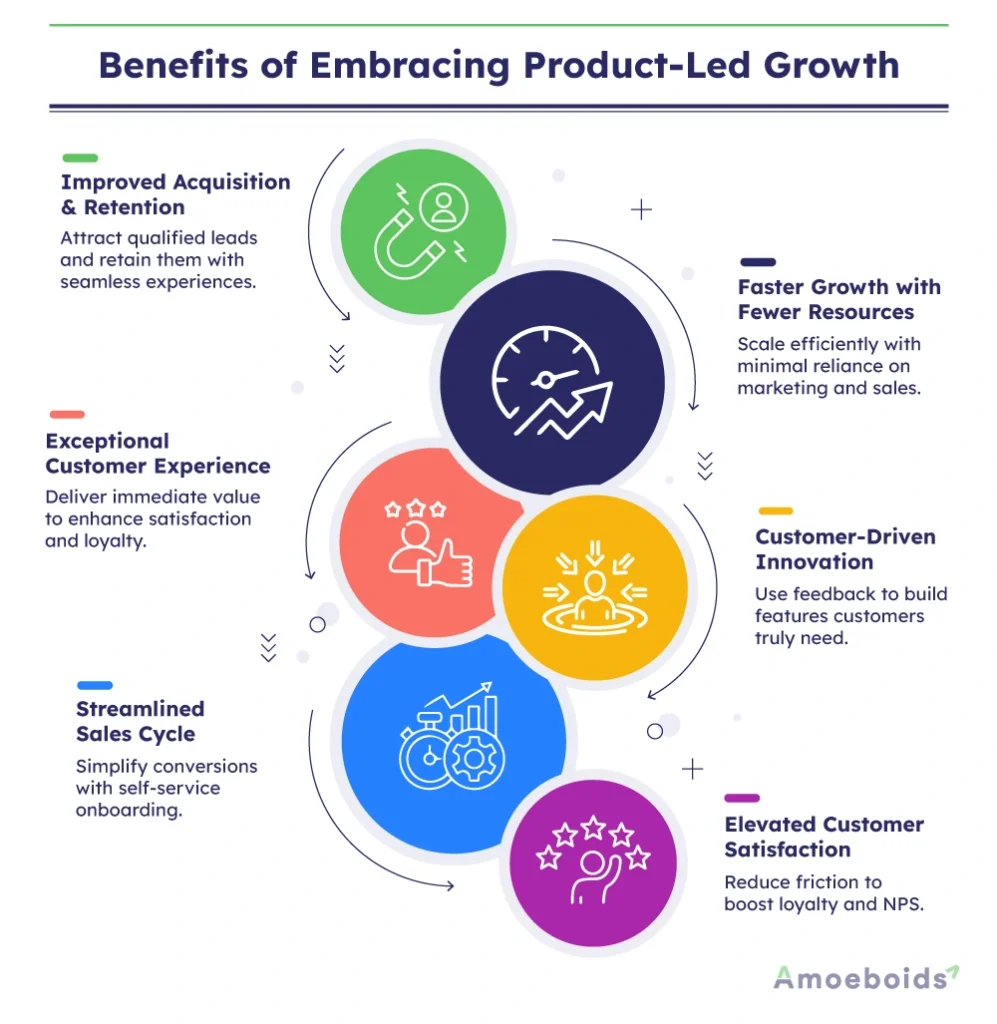
1. Boosted Customer Acquisition & Retention
PLG reduces customer acquisition costs by attracting qualified leads and enhances retention through seamless product experiences.
2. Faster, More Efficient Growth
PLG’s self-sustaining nature accelerates user acquisition and conversion without heavy reliance on marketing or sales teams.
3. Enhanced Customer Experience
Immediate value delivery improves onboarding, increasing satisfaction and loyalty.
4. Targeted Product Development
Direct user feedback guides product evolution, ensuring development aligns with customer needs and preferences. Learn how direct product insights from customer-facing teams can drive targeted product development, ensuring your efforts align with customer needs and preferences.
5. Shorter Sales Cycle
Self-service onboarding reduces dependency on sales teams, making the conversion process faster and more efficient.
6. Higher Customer Satisfaction
A frictionless experience improves Net Promoter Scores (NPS) and long-term loyalty.
By understanding and addressing these challenges, SaaS businesses can unlock the full potential of PLG, transforming obstacles into opportunities for growth.
Future trends in product-led growth for SaaS
The future of Product-Led Growth (PLG) is poised to revolutionize how SaaS companies scale and succeed. Advancements like AI-driven personalization, automated onboarding, and real-time user behavior analysis elevate PLG strategies. These innovations enable products to adapt dynamically, delivering tailored experiences that immediately resonate with individual users and highlight value.
By centering on user needs and creating frictionless experiences, PLG offers SaaS businesses a scalable and sustainable growth model. It lowers customer acquisition costs and fosters deeper engagement, transforming satisfied users into loyal brand advocates.
As these trends continue to evolve, PLG is set to become an essential strategy for SaaS companies navigating the competitive landscape. The companies that embrace these future-focused tools will be better positioned to achieve lasting success, ensuring their products drive growth and customer satisfaction simultaneously.
Additional reading: 7 Powerful Mental Models for Product Managers