
While doing business, no one wants their Plan A to fail. However, you must plan for the worst possible outcome or unexpected disruptions. Sometimes your mega supplier may suddenly go out of business or a supply chain disruption may halt your plans. Such circumstances can jeopardize your business unless you have a contingency plan ready.
What does a solid contingency plan mean? Is it about how fast you react to an unfortunate event in your business? Yes, but more than that, it’s about responding in a way that protects your people, your time, and your reputation. As you have already imagined how to deal with it before, you reduce downtime and stay focused on what matters most during bad events.
Unfortunately, there is no clear formula to create a strong backup plan. It depends on what kind of risks you’re facing. Plus, there are lots of costly mistakes to avoid down the road. Let’s discuss everything you need to know about contingency planning.
What is a contingency plan?
One in four businesses reopens after facing a disaster. A contingency plan is your backup strategy to fight back against a significant future incident. It can be against natural disasters, like floods, earthquakes, or tornadoes. It can also be for business emergencies, such as losing a big client, facing a software outage, or a sudden staffing shortage. With a solid backup plan, a business can always bounce back to resume normal operations, even under minimal favorable conditions.
However, different situations call for different types of backup plans. Let’s discuss them in the next section.
Types of contingency plans
Effective contingency plans are designed to identify potential risks and develop actionable responses. Depending on what kind of work you do and the risks you face, you might need one or more of the following types of contingency plans.
1. Business contingency plan
A business contingency plan in project management is your backup plan for situations that can have a significant impact on your business. It could be a major data breach, a head of the division quitting without notice or a sudden regulatory change. The aim is to have a backup plan ready to prevent the situation from affecting the business. For instance, if your top supplier suddenly goes out of business, a business contingency plan example would be to have a list of alternate suppliers ready and to onboard them quickly.
One of the best ways to start is with a series of “what if” questions for different types of unfortunate scenarios you need to plan for. For instance:
- What if an asset breaks down to halt production?
- What if your top three product engineers all quit at the same time?
- What if supply chain disruption suddenly curbs your raw material import from a different country?
The backup plan has clear instructions on how to resume normal business operations after an unintended interruption.
2. Environmental contingency plan
If your business operates in an area prone to earthquakes, floods or wildfires, you need to be ready with environmental contingency plans. Governments, schools and large companies often have detailed environmental plans and it’s just as important for smaller organisations to have one too.
An emergency contingency plan may include:
- List of people from different roles to handle emergency roles, like managing evacuation or contacting local authorities
- Frequency of practicing regular safety drills so everyone knows what to do when disaster strikes
- Creating a system to alert employees and share real-time updates when needed
Even if disasters are rare in your area, such backup plans come under the basic duties to keep your team safe and your business protected.
3. Technology contingency plan
It’s impossible to run a business without relying on technology these days. What if a finance company loses all its customers’ credit card information to an ugly security breach? A technology contingency plan is your safety net against all such tech disruptions that can bring your work to a halt. It helps you prepare for events like server crashes, software failures or cyberattacks.
Here’s what it might look like:
- A step-by-step action plan to restore systems and protect data
- Contact info for your IT team or cybersecurity experts
- A way to alert customers if their data is affected, along with regular updates
- A list of backup tools or systems your team can switch to temporarily
Moreover, you have to do a business impact analysis to check the potential impact of all major technological disruptions on your business.
4. Supply chain contingency plan
Your business might rely on products being delivered on time, raw materials arriving regularly or stock moving smoothly between warehouses. If any part of that chain breaks down, it can create big delays and unhappy customers.
A supply chain contingency plan prepares you for these disruptions. It helps you keep operations going even when something unexpected happens, like a transport strike, weather delay or system outage.
Your plan might include:
- A list of backup suppliers and transport partners
- A process to notify key people, like warehouse staff or major customers, right away
- A timeline to track the issue and how it’s being handled
- Clear steps to recover lost time or reroute deliveries
Planning for supply issues now saves you from scrambling later.
5. Pandemic contingency plan
The last pandemic showed us just how fast everything can change. For many organizations, work had to shift overnight. A pandemic contingency plan helps you respond to wide-scale health crises while keeping your business running and your team safe.
A good plan might cover:
- Health and safety measures like regular sanitisation, health screenings and sick leave policies
- Remote work arrangements, including tech tools and clear communication rules
- A list of who handles what if someone falls ill or can’t work
- Regular check-ins to update your plan as things evolve
Even though pandemics aren’t everyday events, having a plan gives you a head start when facing similar large-scale disruptions in the future.
Next, we will learn what things to take into analysis while working on a contingency plan.
Elements of an effective contingency plan
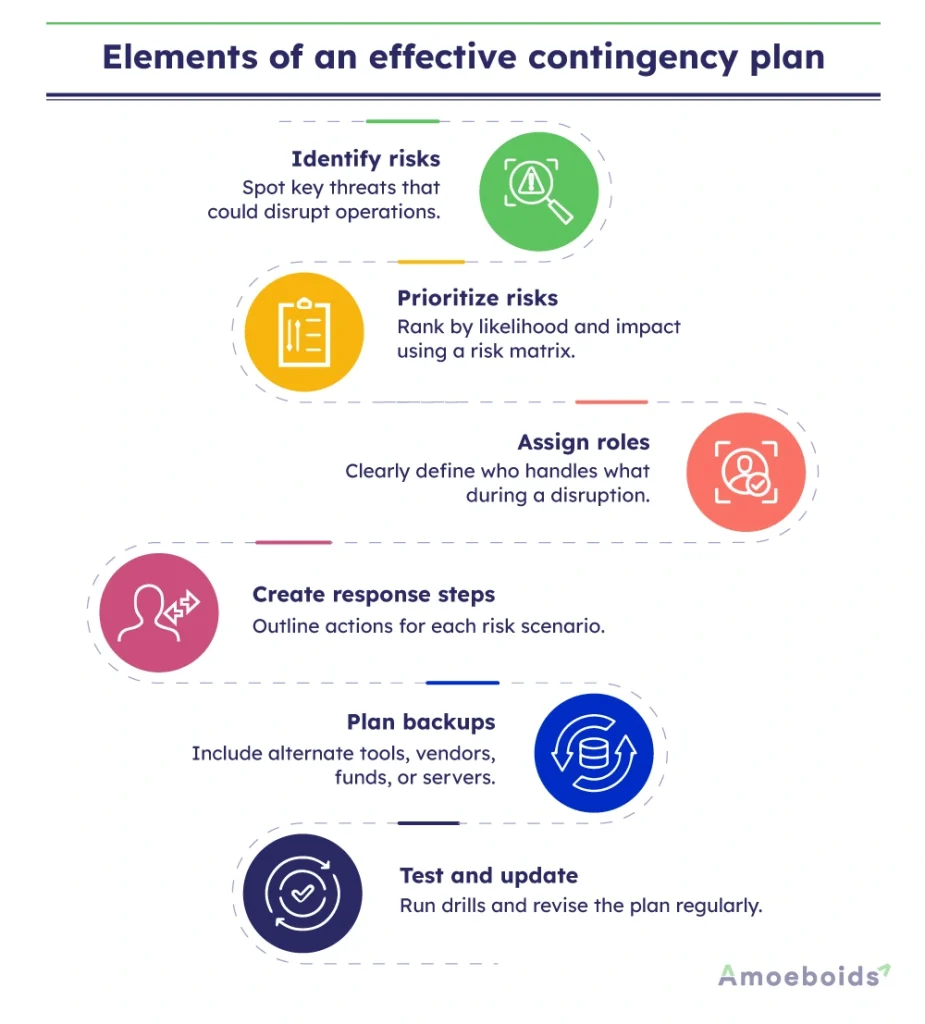
A plan on paper won’t do much if it’s not practical, easy to follow and tailored to your business. A well-thought-out contingency plan process helps protect your bottom line, reassure your stakeholders and ensure continuity of operations. Below are the key elements that every effective contingency plan should include.
1. Risk assessment
Start spotting areas of vulnerability depending on your business operations. Analyze what situations can impact your business the most. For instance, a retail brand might find its biggest risk is supplier delays during the holiday season. The more specific you are, the better prepared you’ll be.
2. Prioritised list of risks
Once you’ve listed them, rank them by their probability of occurrence and degree of damage. All you have to do is to use a simple risk matrix with two columns, likelihood and impact. This helps you focus on the most urgent ones first.
3. Clear roles and responsibilities
Everyone should know what they need to do when a disruption happens. Assign tasks to specific people or teams and write them down clearly in the plan. For instance, if your website crashes, your IT lead should know they’re in charge of restoring systems within a set time frame, no confusion, just action.
4. Step-by-step response plan
This is where you explain exactly what needs to be done when a certain risk happens. Break it down into steps so there’s no room for confusion in a high-pressure situation. Imagine a payment gateway fails during a sale. Your response plan might include switching to a backup service, notifying customers and pausing ad spend to avoid wasted clicks.
5. Backup resources
An effective plan includes alternatives, backup vendors, remote work tools, emergency funds or additional support staff. These are the resources that help you stay flexible and bounce back faster. It’s like a SaaS business keeping backup servers in a different region in case its main server faces downtime.
6. Testing and regular updates
Even the best plans need testing. Run simulations or drills to see how your team reacts. Then make updates based on what works and what doesn’t. Your plans and readiness should grow with your business.
A well-structured plan can fall apart if it’s not handled right. Let’s look at a few common mistakes that end up weakening the entire planning process for most businesses.
Contingency planning mistakes to avoid
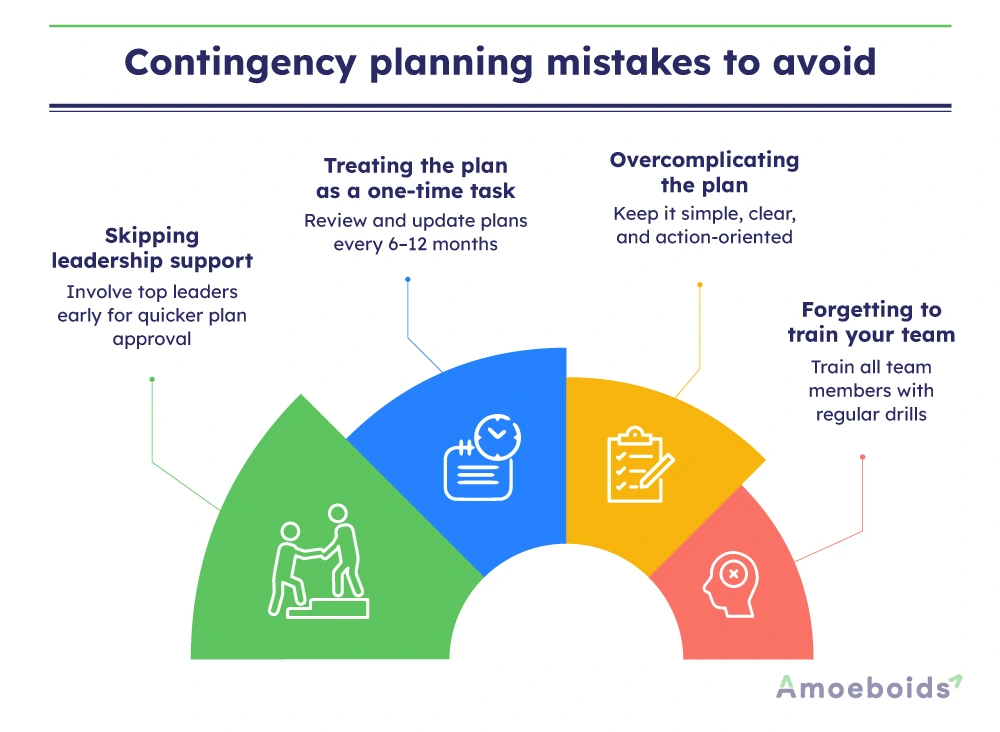
Watch out for common pitfalls that can adversely affect your contingency planning. Try to avoid the following mistakes so that your contingency plan works when needed:
1. Skipping leadership support
Imagine your project leader ignores a critical bug suggested by the development team until the product crashes on the launch day. So, it’s important to keep top leaders in the loop early. Once they understand the importance of a contingency plan in project management, it will get quick approval for development.
2. Treating the plan as a one-time task
It’s arguably true that the degree of potential risks goes up as your business evolves. Can you possibly work with an emergency contingency plan drafted a decade ago to deal with a pandemic? Your plan needs periodic review, every 6 to 12 months, as a good rule of thumb. You can leverage product roadmap tools, to crowdsource feedback from your team and key stakeholders about potential blind spots in the current plan. Update your plan with those insights, directly within Jira.
3. Overcomplicating the plan
If your plan is too long or filled with technical terms, your team won’t know what to do when time is tight. The best plans are clear, simple and easy to follow, even under pressure. Break actions into small steps and use plain language. A few clear instructions are more useful in a crisis than pages of confusing detail.
4. Forgetting to train your team
It’s not enough for the leadership team to know the plan. Everyone involved should be trained on what to do, who to contact and what’s expected of them. Skipping this step can cause panic, delays and costly mistakes. For instance, if your customer service team doesn’t know what to say during a system outage, they might give out incorrect information or miss important updates. A quick drill can make all the difference.
Conclusion
A solid contingency plan provides a structure for assessments and actions when the unexpected hits. The faster the recovery, the less chance of any damage to the company from any unfortunate event. While developing a contingency plan, do proper risk assessment, prioritize events to target, prepare plans, assign clear roles and back up resources. If you are finding it difficult to keep everyone on the same page during plan design, leverage the Amoeboids Roadmap & Idea Portal app for JSM. It can help you organize feedback in a centralized place and collect votes on plan approvals within your Jira service desk project.
FAQs
Can a contingency plan help with financial planning?
Yes, a good contingency plan can protect your business from financial risks like sudden revenue drops, rising costs or delayed payments. You have clear steps to reduce the impact, manage cash flow and protect resources to stabilize your finances.
How do you test the effectiveness of a contingency plan?
You need to run them through real-world simulations, like mockup emergencies. These dry runs help you find gaps between theory and practice, improve the plan and train your team for real events.
What is the purpose of a contingency plan?
The main purpose of a contingency plan is to help you handle unexpected events through preplanned strategies. Having a proactive approach in place gives you a clear path to follow during disruptions and helps your business bounce back with minimal impact.
What are some examples of contingency plans in business?
Here are a few business contingency plan examples:
- Including a data backup plan for IT failures
- Building a communication plan for product recalls
- Maintaining a vetted list of alternate suppliers to bypass supply chain disruption
Each one helps businesses respond quickly and avoid long-term damage during unexpected situations.