
How would you feel, if you received a product that seems tailor-built for what you need? As if the product was designed specifically for you?
You would be the happiest lot, won’t you? Such a product will be every product manager’s dream.
When a product goes global, localizing it for the target group is a key responsibility of the product manager.
Contrary to what many think, localization goes beyond translation. It aims to make each of its target groups feel as if the product was created specifically for them.
A one-size-fits-all strategy will not be effective in a global market where user needs and preferences vary.
This rationale applies as much to release notes accompanying product updates.
Changing the release notes to appeal to global audiences increases product engagement and promotes trust.
So, it’s a no-brainer to invest effort & adapt the release notes depending on the target audience. The effort will go a long way to make every user feel valued and appreciated.
But, how to write release notes that appeal to a wide range of readers?
Let’s find out.
Why is it important to create release notes for a global audience?
Creating release notes for a global audience is important for enhancing user experience and communication across borders.
By localizing your release notes, you ensure that all audiences, irrespective of language, are aware of updates, bug fixes, and new features. Localized release notes help in the development of customized training materials and user guides, allowing the global audience to better understand market-specific changes.
Furthermore, you can build trust by effectively communicating product updates to both internal and external stakeholders. Plus, localized release notes with technical data and statistics help in progress tracking and streamlining your global release management process.
Understanding the audience needs
The first step in writing best release notes for audiences worldwide is to understand the diversity of your user base. The expectations of various languages, cultures, and geographical areas vary.
- Cultural Sensitivities: Think of cultural nuances like the seasoning in a recipe. Avoid using idioms, jokes, or regional-specific terms that may be difficult to translate or may offend unintentionally.
For Example: Instead of using ‘our AI generator now creates release notes in multiple languages at the drop of a hat,’ you can now use ‘our AI generator now creates release notes in multiple languages instantly’.
Phrases like ‘drop of a hat’ may be confusing to non-native speakers or may not be understood by people worldwide. Similarly, using regional-specific humor may alienate users who are unfamiliar with the cultural context.
- Language Barriers: Avoid using complex language and jargon. Simplifying language ensures more seamless translation and enhances accessibility.
For example: To ensure cross-dialect clarity, simplify terms like “streamline” to “hacer más sencillo” in Spanish-speaking areas.
- Diverse User Expectations: Consider how users may rank specific features or fixes differently depending on where they are.
For example:
- GDPR compliance may be the most important factor to European users.
- Asian users may prefer multilingual support.
You can show that you have a better grasp of what matters to your target audience by including these regional preferences in your release notes.
Language and localization in release notes
When it comes to localizing release notes, translation is only the beginning. Here’s how you can truly connect with your global audience:
- Choosing the Right Languages for Translation: Based on the main geographic locations of your user base, select languages. Give top priority to the languages that most of your global audience speaks.
Example: A global app may start with translations in Chinese, French, and Spanish.
- Maintaining Consistency Across Channels: Make sure that your website, app, and support materials all use the same terminology, tone, and style.
Example: To prevent misunderstandings, use the same wording throughout your website, app, and support, such as “update,” instead of “new feature update.”
A centralized glossary of local terms helps to ensure consistency and a smooth user experience.
Example: “Account” and “login” are defined as “cuenta” in Spanish and “entrar” in Latin America, respectively.
Formatting for cultural relevance
Formatting release notes may emerge to be a small detail, but it is important to maintain their clarity and significance.
- Date, Time, and Number Formats: Different regions have different dates (DD/MM/YYYY vs. MM/DD/YYYY), times (12-hour vs. 24-hour), and number formats.
For example, what is the difference between 01/02/2024 and 02/01/2024? It is January 2nd in one area and February 1st in another. Confusing, right?
Adapting to local formats reduces miscommunication.
- Culturally Relevant Visuals and Icons: It is possible that images that resonate in one place will not have the same impact in another. Choose pictures with universal meanings or alter icons to suit local preferences.
Example: A thumb-up represents approval in Western cultures, but it may be offensive in some Asian regions. For greater acceptance, use icons that are neither culturally nor locally specific.
- Structuring Release Notes for Regional Expectations: Some cultures prefer brief summaries to detailed information right away. The format of the release notes should be adjusted to take these differences into consideration.
For example: Users in North America may prefer detailed release notes, whereas Japanese users may prefer more concise updates.
Tools for localization
The process of modifying release notes for global audiences can be streamlined by using localization tools. You can rely on tools like ChatGPT, Google Translator, Lokalise, and Transifex can help speed up the translation process. Think about things like your budget, potential for integration, and language support when selecting a tool.
Our free changelog software Olvy, for instance, offers AI powered instant translations and can be integrated into your current workflow easily. This guarantees enhanced quality control and quicker delivery.

If your team is already using Atlassian Jira for Project management, then try our Automated Release Notes and Reports AI Generator.
Testing and feedback
To make sure your translated release notes genuinely connect with audiences around the world, testing and feedback are necessary. Having native speakers evaluate translations can help identify problems with readability, tone, or cultural quirks.
Furthermore, listening to customer feedback from different regions allows you to adapt to their changing preferences. Your relationship with audiences around the world is strengthened by this ongoing improvement, which also improves the user experience.
Always conduct tests, take notes, and improve!
Best Practices for global release notes management
Consistency, automation, and regular updates are key to maintaining high-quality global release notes. To ensure long-term success, keep these tips in mind:
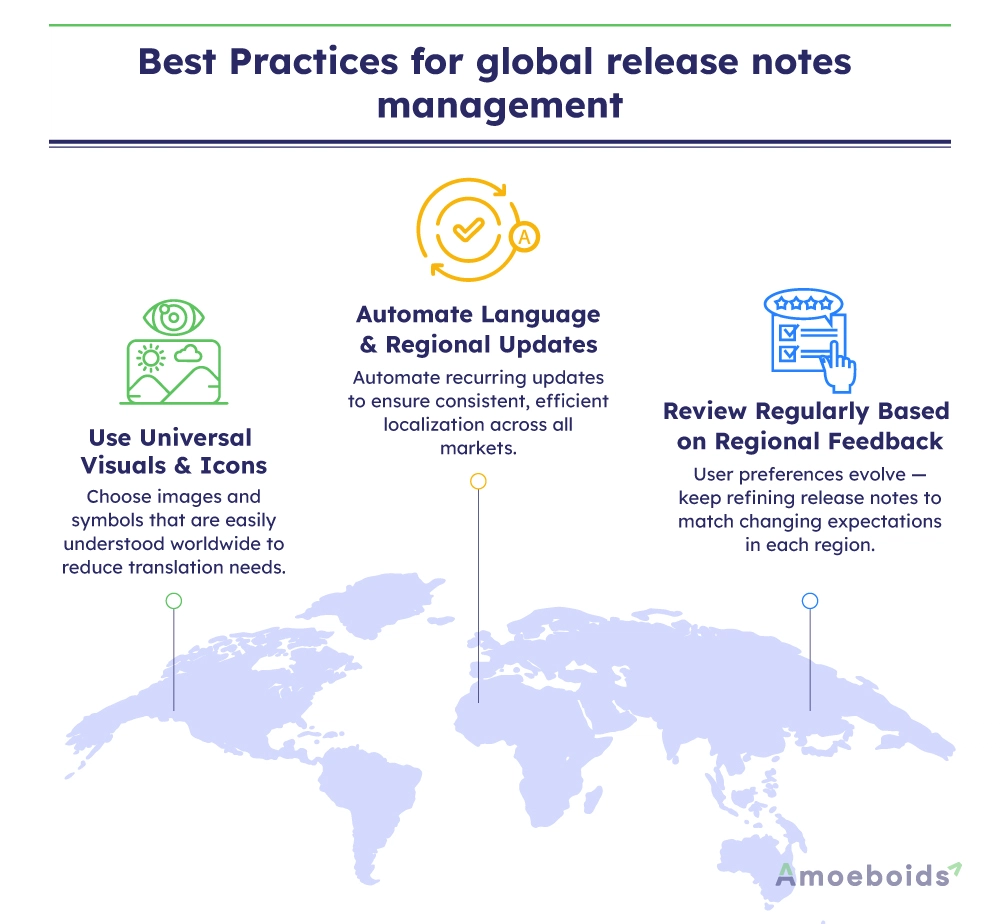
- Universal Visuals and Icons: Make use of images that are widely understood to reduce the amount of translation that is required.
- Automating language updates and regional customizations: Updates should be automated for efficiency, particularly for content that is updated often, such as release notes.
- Regular Updates for Evolving Preferences: Users’ preferences and needs might change over time. Release notes should be regularly reviewed and updated in response to regional feedback.
Conclusion
Adapting release notes for global audiences includes more than just checking off a localization box. It is about making a connection with your users and telling them, we see you, value you, and are here for you.
Your release notes can become effective engagement tools by integrating user feedback, cultural sensitivity, and careful localization.
So, the next time you sit down to write release notes, think beyond geographical boundaries.