How does an idea transform from a thought written on a napkin to a great product people can’t live without? It’s by prioritizing product lifecycle management (PLM).
PLM is a framework that connects every stage of product development, from concept to launch and beyond. Leading companies using closed-loop PLM reduce time to market by over 20% and consistently deliver on time. Without PLM, you risk missing deadlines, misaligned priorities, and wasted development cycles.
Wondering how you can implement it in your team? This article covers everything from benefits to stages and the best practices that would help you manage the product journey more effectively.
What is product lifecycle management methodology?
Product Lifecycle Management is a systematic approach to managing a product’s entire journey, from its initial concept to its service and eventual disposal.
PLM’s foundation dates back to the 1930s when Otto Kleppner described how products move through distinct phases. Back then, the systems primarily focused on design and engineering, particularly in the automotive and aerospace industries.
Over the decades, thinkers refined this into the four stages we know today: introduction, growth, maturity, and decline.
In the 1980s, it was a way for manufacturers to gain a competitive edge. Early adopters, such as American Motors, utilized technology such as computer-aided design (CAD) to expedite development and foster collaboration, setting the stage for the modern PLM systems we use today.
Understanding the concept of product lifecycle management
Let’s consider one of the product lifecycle management examples to understand the concept better.
Say you’re building a food delivery app. PLM helps you plan features like order tracking and payment integration, manage the development cycle, roll out updates, and track feedback. Over time, you redesign the interface or retire older features based on usage.
With PLM, all this happens in a connected and organized way, so your team stays aligned.
PLM matters today because product timelines are increasingly tight, customer needs are constantly changing, and teams are often dispersed. It is a straightforward way to keep everything in place from idea to launch and beyond.
PLM has become a standard practice to reduce waste, accelerate development, and build with greater clarity. What began in manufacturing is now being adopted in SaaS and other fast-moving industries. That’s because it brings focus on what works and what doesn’t, before users notice. And that’s important for every business and industry.
The importance of product lifecycle management in business
As your product grows, so do the moving parts surrounding it, such as features, bugs, and deadlines. PLM makes these complexities manageable by centralizing updates, bringing together cross-functional teams, and creating a single source of truth to manage product changes effectively. Here are the benefits of product lifecycle management:
Improves collaboration
Teams often work in silos. Marketing doesn’t know what engineering is building, and support teams are usually clueless. PLM creates one shared space for updates, plans, and decisions, making collaboration feel natural.
Accelerates time to market
When your process is straightforward, work proceeds more efficiently. PLM reduces delays caused by unclear requirements or last-minute changes. You can plan more effectively, track progress more closely, and reach the market sooner.
Improves product quality and cuts costs
PLM gives your team visibility into what’s working and what’s not. That means fewer mistakes, better testing, and more intelligent decisions. You avoid duplicate work and fix issues before they get expensive.
Encourages innovation and compliance
When the basics are under control, your team has more room to experiment and innovate. PLM provides structure and helps you maintain version control, documentation, and compliance with regulations. This helps during audits or urgent changes.
Having a PLM plan in place means your team can work with clarity and purpose. You waste less, build better, and stay aligned through every step.
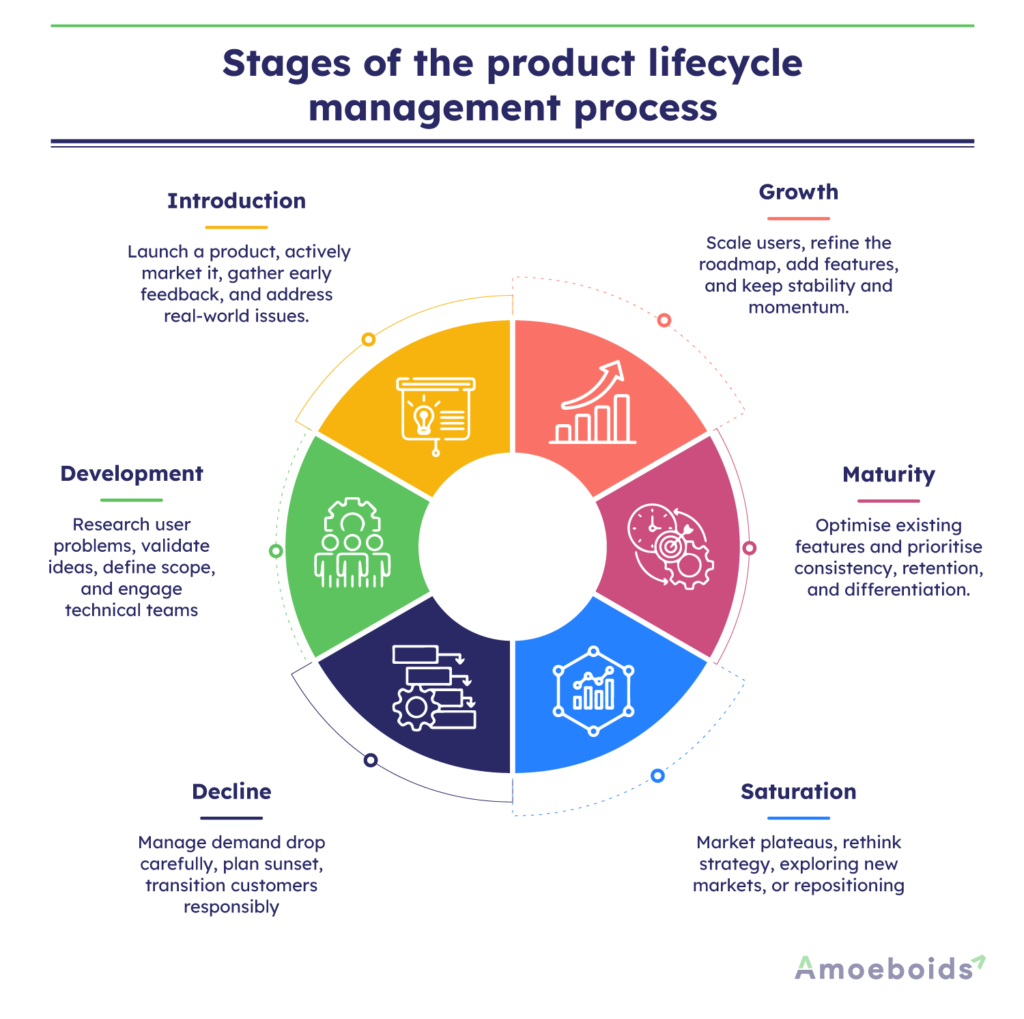
Stages of the product lifecycle management process
When we talk about a product’s lifecycle, we often think of the four market stages: Introduction, Growth, Maturity, and Decline. These describe a product’s journey in the market. However, product lifecycle management can be applied to other aspects as well. Let’s explore the key product lifecycle management phases:
Development
This is where everything begins. You research user problems, dig into market gaps, and start mapping out what the product should do. You might be sketching ideas or running early experiments. At this point, your goal shouldn’t be to build fast but to build right. You’re defining the scope, getting technical teams involved, and setting the tone for what’s to come.
Introduction
Once you’ve built something you believe in, it’s time to share it with the world. The introduction stage is all about first impressions. You launch, you start marketing, and you talk to early adopters. This is when you get real-world feedback, identify bugs you didn’t catch before, and see how people use what you have built.
Growth
Now the product is gaining momentum. Users are coming in, your roadmap is getting sharper, and you’re working to scale without losing control. More people are discovering what you’ve built, and your job is to keep that momentum going. You might add new features, improve onboarding, or expand your support. Your team needs to respond quickly while keeping the product stable.
Maturity
At some point, things settle. Growth slows, but the user base is solid. This is the maturity stage, where consistency matters more than speed. You’re not racing to build new features every week. Instead, you’re improving what already works, tightening operations, and making sure your customers stay happy. You also start seeing more competition, so your focus shifts to standing out and staying relevant.
Saturation
This often overlaps with maturity, but it also presents its challenges. The market feels full. Most people who need your product already have it. Sales start to flatten, and acquisition becomes more challenging. This is the moment to rethink your strategy. Can you enter a new market? Reposition your product? Add a compelling feature that reopens growth? If not, it may be time to plan for what’s next.
Decline
Eventually, demand drops. A better solution may enter the market. Or your product no longer aligns with consumer demands. This is the decline phase, and it’s important to manage it with care. You assess whether to sunset, sell, or support it in a limited way. You also need to notify customers, manage remaining inventory or subscriptions, and handle the wrap-up responsibly. The end of the lifecycle doesn’t mean failure. It’s a part of building with intention.
Understanding these stages helps you stay proactive in keeping your product valuable for as long as possible.
Key activities in product lifecycle management
These hands-on activities will help ensure your product delivers value and remains relevant at every stage of its journey.
- Organizing ideas and prioritization: A clear product roadmap provides clarity, enabling teams to focus on what truly matters. Listen to customers, assess value, and prioritize what drives the most impact.
- Design and engineering: Designers, engineers, and product managers should stay in sync to ensure seamless collaboration. Conduct regular check-ins, update specifications, and establish feedback loops to maintain momentum.
- Quality assurance: Testing is more effective when built into the process. Use functional, usability, and regression tests to catch issues before they ship.
- Release management: Every release should have clear timelines, comprehensive documentation, internal sign-offs, and well-defined communication plans.
- Customer experience and feedback: After release, monitor usage data, support tickets, and customer conversations. Feed that insight back into your backlog to fix what’s not working and double down on what users love.
These core activities help your product stay relevant, well-supported, and aligned with both user needs and team goals.
Product lifecycle management best practices
Sometimes essential steps get overlooked in the rush of day-to-day work. That’s why it helps to have a few non-negotiables in place. Here are some of them.
- Start with a clear product vision: Define your long-term goals early to shape your product strategy. This keeps everyone focused, even with everyday shifts in priorities.
- Encourage cross-functional teamwork: Ensure that marketing, design, engineering, and support teams work together collaboratively. Shared goals lead to faster solutions and better outcomes.
- Centralize all product information: Store designs, feedback, and decisions in a single location. This avoids miscommunication and helps teams move faster with fewer mistakes.
- Use automation and connected tools: Automate repetitive tasks and sync your tools. It frees up time and reduces manual errors across the board.
- Review and improve constantly: Don’t wait for problems to escalate. Regular check-ins, feedback loops, and quick iterations help your product stay sharp and relevant.
When you build these habits into your process, your team works efficiently even when things go south.
Benefits of following product lifecycle management best practices
Good PLM practices aren’t just for process enthusiasts. They create visible, measurable impact across your product and business. Here’s how:
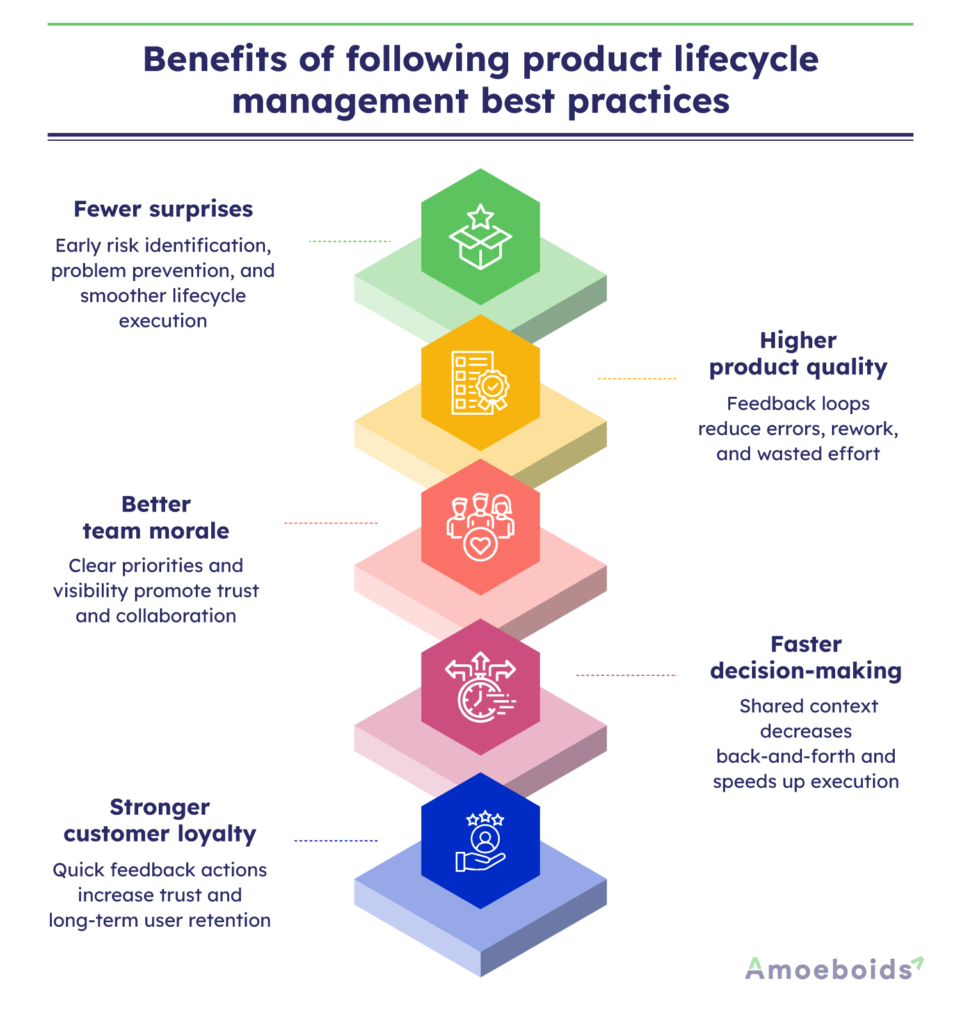
Fewer surprises:
With better systems in place for every stage, you can anticipate challenges and prevent them before they arise, making the entire product lifecycle smoother.
Higher product quality:
Built-in checks and feedback loops reduce bugs and rework, directly saving your team time and effort.
Better team morale:
Clear priorities, shared visibility, and cross-collaboration help teams feel confident and supported.
Faster decision-making:
A shared understanding of what’s next and having all the information at easy reach reduces back-and-forth and speeds up execution.
Stronger customer loyalty:
When feedback is acted on quickly, users notice and become more loyal.
Making project lifecycle management a part of your everyday rhythm saves you time fixing issues and allows you to generate more value.
Exploring the product lifecycle management process
If you are integrating the PLM process in your team, you need to know one thing. Product lifecycle management is not a one-time activity; it is an ongoing process. It’s a loop where each phase feeds into the next, and insights from later stages help define earlier decisions. That’s what makes the process so important.
However, to make it work, every team needs to be involved from the outset. Product, marketing, engineering, sales, and support all bring key insights. With the proper flow of data and communication, you can make better decisions faster.
But how do you know things are improving? Let’s find out.
Key metrics to track in product lifecycle management
After all the planning and execution, it’s time for results! Use these metrics to track progress, spot roadblocks early, and maximize the benefits of product lifecycle management.
- Time to market: Measures how long it takes to go from idea to launch. Shorter timelines give you a competitive edge and help capture early revenue.
- Development velocity: Tracks how quickly your team delivers features or updates. A substantial velocity reflects healthy team output and process efficiency.
- Customer satisfaction: Captures how well your product is meeting user expectations. Tools like surveys, NPS, or feedback forms offer reliable insight.
- Return on Investment (ROI): Measures whether the product is financially worth it by comparing revenue to development and maintenance costs.
Execution without measurement is hardly useful. These metrics keep you accountable and help you refine your product performance.
Conclusion
Understanding product lifecycle management helps you bring structure to the chaos that often surrounds product development. From development to decline, each stage helps teams act with purpose, respond to feedback, and deliver lasting value. Every activity, metric, and best practice connects to the bigger picture of building better products.
Whether you’re prioritizing ideas, planning releases, or deciding when it’s time to sunset a feature, PLM gives you the visibility to make better decisions. That’s what makes it worth the effort.
FAQs
Q1. What are some challenges in PLM?
One major challenge in PLM is getting teams to stay aligned, especially when they’re working across tools or departments. Poor data management also creates confusion, as different teams might rely on outdated or incomplete information. And without a straightforward process, decisions can get delayed or made on assumptions.
Q2. What are the four stages of the product lifecycle?
The classic product lifecycle management stages are Introduction, Growth, Maturity, and Decline. But in practice, PLM often includes two additional phases: Development at the start and Saturation between Maturity and Decline. This gives teams better control over planning and strategy.
Q3. How do you measure the success of PLM efforts?
Track metrics like time to market, development velocity, customer satisfaction, and return on investment. These depict how well your product is progressing, whether your team is delivering efficiently, and how much value you’re creating compared to your effort and cost.