Imagine this: A loyal customer stops purchasing from your business without warning. You’re left wondering what went wrong. Could it have been a product flaw? A missed opportunity to resolve a concern? Without actionable insights, the answer remains a mystery. This is where effective feedback strategies come into play.
Customer feedback isn’t just about gathering opinions; it’s a direct pathway to improving products, boosting satisfaction, and driving business growth. But relying solely on feedback collection won’t move the needle—actionable strategies that close the loop make all the difference.
In this guide, we’ll walk you through 7 tried-and-true customer feedback strategies to keep customers engaged and uncover what truly matters to them.
Why is customer feedback important?
Before we look into the strategies, let’s understand why customer feedback is vital. Among all consumers, 73% say experience is a major influence on their purchase choices, after price and product quality. When it comes to customers, it helps them voice their opinions about a service or product they have invested their time and resources in. For businesses, it’s a chance to understand their customers better and gather valuable insights about their products and services.
If done right, a good customer feedback strategy is the guiding light that steers your business toward its goals. How you gather, organize and implement customer feedback can positively impact your products and services.
Let’s look at some of the benefits:
- Customer feedback is essential to discovering customer needs and anticipating them, which is key to customer centricity.
- Collecting and consolidating feedback helps you decode customer experience, leading to better sales and improved products and brand perception.
- Customer feedback provides ideas for new products and services, which come at no extra cost, showcasing effective feedback strategy examples.
- Strengthening relationships by demonstrating that customers’ voices are valued is crucial for a robust customer relationship management strategy.
- Responding quickly to consumer needs increases client loyalty and retention, highlighting what to do with customer feedback.
The challenges of collecting customer feedback
Collecting customer feedback is crucial for improving products and services, but it comes with challenges such as:
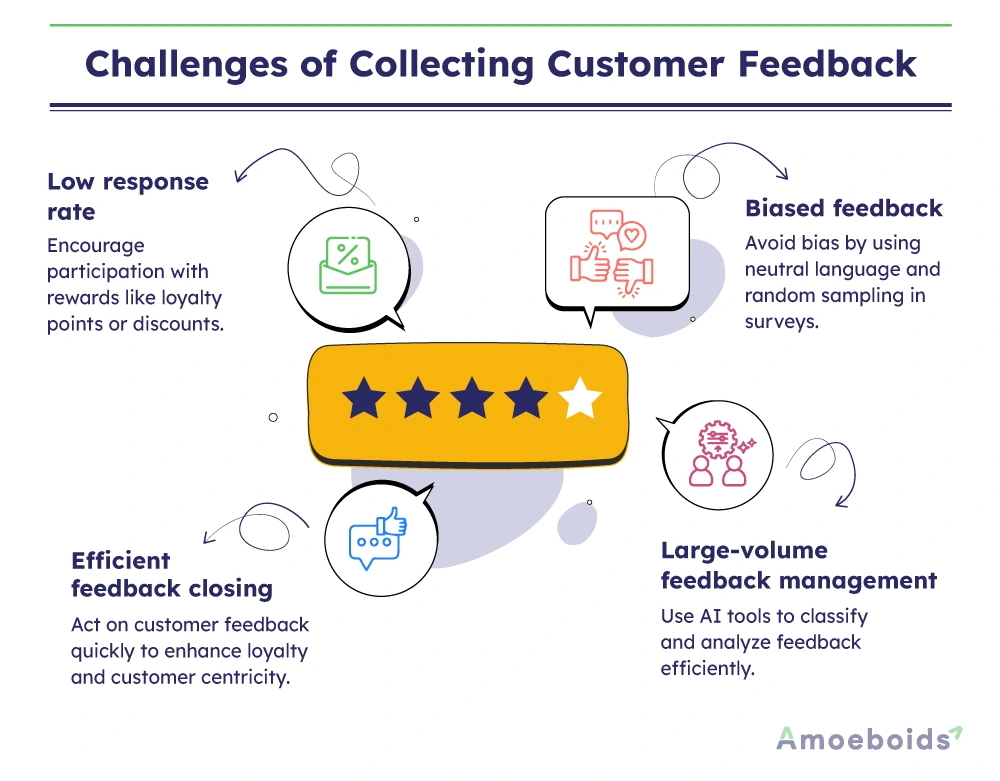
Low response rate
Low response rates can compromise the accuracy of insights. Busy consumers could, for example, overlook customer satisfaction surveys, therefore depriving companies of vital information. Giving rewards, such as loyalty points or discounts, can inspire involvement and enhance your feedback strategy.
Biased feedback
Another challenge is bias in interpretation and feedback collection. Leading questions or just interacting with vocal consumers might distort outcomes. For instance, depending only on social media complaints could lead to overlooking the opinions of the quiet majority. You can avoid this by using neutral language and randomized surveys as part of your feedback strategies.
Large-volume feedback management
Organizing and prioritizing many comments can be exhausting. Using artificial intelligence-driven tools to classify and examine comments will help to simplify this procedure. One effective approach is to focus on the most important insights to improve your customer relationship management strategy.
Efficient feedback closing
Finally, it is essential to close the feedback loop. Consumers expect you to act based on their feedback. Knowing what to do with customer feedback can significantly enhance customer centricity and loyalty. For instance, promptly replying and acknowledging a customer for their product improvement suggestion will go a long way.
Next, let’s list some strategies that can help with your customer feedback plan.
7 effective customer feedback strategies
A whopping 77% of consumers feel better about firms that actively seek out and act upon consumer input. Here are seven tried-and-tested methods for getting useful information:

1. Customer satisfaction surveys
Customer satisfaction surveys are among the most direct strategies to receive feedback. Surveys that are brief and to the point encourage more responses and provide more useful information for your brand. Customer Satisfaction (CSAT), Net Promoter Score (NPS) and post-purchase surveys are some examples of surveys that can help you gather data about customer preferences, behavioral trends, and areas needing improvement. Google Forms, Typeform, SurveyMonkey are examples of software tools used to gather organized input.
Example:
An e-commerce brand sends a post-purchase survey using SurveyMonkey to customers who recently bought a product. The survey includes questions like:
- “How satisfied are you with your purchase?” (CSAT)
- “How likely are you to recommend this product to a friend?” (NPS)
Based on the feedback, they identify that delivery speed is a recurring issue and introduce faster shipping options.
2. One-on-one interviews
In-person interviews are a great way to better understand customer requirements, emotions and motivations. They are also perfect for finding subtle feedback. To get the most out of these conversations, prepare some open-ended questions and record the sessions so you can analyze them later.
Example:
A SaaS company interviews five long-term clients to understand their workflow challenges. By asking open-ended questions like, “What additional features would make our software indispensable to you?” they uncover a demand for automation tools. The company prioritizes these features in its next update.
3. Check on social media
Look out for organic consumer feedback on social media sites like Facebook, Instagram and Twitter. Hootsuite and Brandwatch are two tools that make trend and pattern tracking easier. Find commonalities rather than responding to specific remarks.
Example:
A fashion retailer notices multiple customers on Instagram tagging them with complaints about sizing inconsistencies. Using Hootsuite, they identified this as a trend and launched a campaign promoting a new, standardized sizing chart, resolving the issue while boosting brand trust.
4. In-app feedback tools
Platforms like Zendesk, Hotjar, or Qualtrics gather feedback in real time for software as a service (SaaS) and mobile applications. Non-intrusive pop-ups can be utilized to gather user input without interrupting their experience.
Example:
A mobile banking app uses a Hotjar feedback widget to ask users, “What’s the one thing that would improve your experience?” After receiving frequent comments about complicated password recovery, the app redesigns the process to be more intuitive, reducing complaints by 25%.
5. Online reviews and ratings
Online reviews and ratings play a crucial role in shaping consumer behavior and influencing purchase decisions. A BrightLocal study found that up to 98% of consumers read reviews before making a purchase. Responding to and interacting with reviews encourages participation and studying patterns in positive and negative comments reveals where you can improve.
Example:
A hotel chain monitors Google Reviews and TripAdvisor comments, finding frequent praise for their customer service but criticism of their breakfast options. They respond to reviews, thank customers, and improve their breakfast offerings, which leads to a 15% increase in positive reviews.
6. Feedback from customer support interactions
One way to gain direct insight into the major pain area or feature is to connect with customer support via tickets, live chats, or calls. Tools like Zendesk or Intercom can help organize and evaluate this feedback for practical consequences.
Example:
A telecom company analyzes customer support tickets via Zendesk and identifies recurring complaints about billing clarity. They simplify their billing statements and include an FAQ section in their invoices, resulting in a noticeable drop in support calls.
7. Customer advisory boards
Make sure your decisions evolve around customer centricity by forming an engaged customer feedback group to offer strategic input on product vision or significant modifications. When you offer rewards or special previews, participants are driven and invested in your brand.
Example:
A tech company creates a customer advisory board with 10 key clients who regularly use its product. During quarterly meetings, they share prototypes of upcoming features and gather feedback. If a proposed feature is overly complex, they simplify it before launch, leading to better adoption rates.
A well-rounded customer relationship management strategy and utilizing customer feedback effectively can help improve your products and services. These examples of feedback strategies demonstrate how a structured approach can lead to better customer engagement and satisfaction.
How to analyze and act on customer feedback
Strategies for gathering feedback and learning how to extract the desired output from a pile of data are valuable skills for any brand. Here is a roadmap for your reference:
- Organize feedback: Analyzing client feedback effectively requires methodical structure and transparent communication. Start by compiling comments in Excel, Trello, or a specific software program. For instance, a specific software tool allows a retail brand to classify consumer service, product quality and complaints about delivery for simpler analysis.
- Identify patterns: Focus on repeating themes and data points to identify trends. If several clients report shipment delays, for instance, this points to a supply chain logistics problem requiring immediate correction.
- Prioritize insights: Align them with business goals and customer impact. If a SaaS company receives feedback about a confusing interface, resolving this can significantly improve customer retention and satisfaction.
- Close the feedback loop: Finally, close the feedback loop by addressing consumers’ remarks and informing them about the improvements. An example would be a fitness app sending emails to users, highlighting how their suggestions led to new workout features, thereby boosting customer satisfaction and engagement.
Tools for collecting and managing customer feedback
How can you collect feedback and manage it? In today’s tech-driven world, you need to know the right tools to convert your huge data set to action insights:
- Survey tools: Engaging and personalized surveys are best done using platforms like Typeform, SurveyMonkey and Google Forms. Typeform’s interactive designs, for instance, increase response rates by gathering customer feedback and conducting market research, whereas Google Forms offers a free, user-friendly interface.
- In-app feedback: Tools such as Hotjar, Qualtrics, and Usabilla capture real-time feedback directly within your app or website. To better grasp user behavior and preferences, Hotjar, for example, blends heatmaps with feedback gathering.
- Social media monitoring: When companies respond to consumer concerns on social media, 55% of those clients have a positive impression of those businesses. Solutions like Sprout Social, Brandwatch and Hootsuite track consumer reactions across several social media sites.
- Feedback management: Productboard, Intercom and Zendesk are well-known tools for organizing and responding to feedback. By centralizing comments and including them in customer support processes, Zendesk guarantees no input is missed and increases client happiness.
The bottom line
Converting customer feedback into action is about gathering ideas and implementing actual improvements that can benefit both your company and clients. Establishing a robust feedback strategy, gathering diverse comments, and evaluating them thoughtfully are crucial feedback strategies that can lead to actionable insights.
Useful tools can help you upgrade your feedback strategies by gathering, analyzing and acting on valuable customer insights. e.g. Roadmap & Idea Portal app for Jira Service Management (JSM) can help you create a compelling product roadmap by facilitating the collection of customer feedback and feature requests. This tool helps align teams to build better products.
FAQs
Q1: What is the best way to collect customer feedback?
To ensure diverse insights, you can use multiple channels, such as surveys, interviews, social media and in-app feedback tools.
Q2: How do I increase response rates for feedback surveys?
Keep them short and focused, offer incentives like discounts or loyalty points and send reminders to encourage participation.
Q3: How can I manage and prioritize large volumes of feedback?
Though managing huge feedback is daunting, use tools like Zendesk or Intercom to categorize and analyze responses, focusing on common themes and aligning insights with business goals.
Q4: What tools are best for analyzing customer feedback?
Tools like Google Analytics, Hotjar, Qualtrics and Productboard are excellent for analyzing customer feedback and offer comprehensive insights into customer behavior and preferences.
Q5: How do I ensure customers see the impact of their feedback?
The easiest way is by closing the feedback loop. Inform them of the changes implemented based on their suggestions and express appreciation for their input.