
Imagine you are about to launch a new mobile app to guide people on personal finance. The marketing team is all set. They have prepared catchy taglines, sleek ads, and a strong social media buzz for the product. However, on launch day, things didn’t go as planned. The app has a technical glitch that stops users from syncing their bank accounts with the system. Now, customer support is flooded with inquiries they weren’t prepared for. They are overwhelmed because they were never briefed on potential issues.
This situation could have been easily avoided if the marketing team had worked closely with engineering and the customer support team. The product or QA team could have identified the glitch through a final round of testing before the launch. And even if it was too late for a fix, the customer support could be ready to handle complaints with clear, realistic responses.
This is why cross-functional collaboration is very important for success on team projects.
When teams from different departments work in sync on a common project, they better tackle challenges, share expertise, and keep the progress smooth for success. Once your teams learn and can utilize cross-functional collaboration, they work smarter, innovate faster and deliver stronger results. This article will explain how cross-functional collaboration works, with easy examples. We’ll also look at common challenges teams face and share simple strategies to make collaboration more effective.
What is cross-functional collaboration?
Cross-functional collaboration is when employees from different teams of expertise come together to work toward a common goal. Instead of a one-team show, multiple teams engage and contribute to achieve better results.
Let’s look back at the earlier example of the personal finance app. In an ideal scenario, cross-functional collaboration brings together experts from different departments to work in unison. The product team defines the vision, the design team ensures a seamless user experience, the engineering team builds the app, and the marketing team plans its launch. We have already imagined what happens when they work in silos. However, when they work together, each team brings valuable insights to make the process smoother.
However, cross-functional collaboration isn’t limited to big projects. It can be as simple as a customer support team working with the product team to improve a service based on user feedback or an HR team coordinating with department heads to develop employee training programs.
Let’s understand why progressive organizations are so keen on implementing the cross-functional working method in their projects.
What are the benefits of cross-functional collaboration?
Beyond breaking down silos and harnessing the power of teamwork, let’s explore the key benefits of cross-functional teams that drive efficiency and spark innovation.
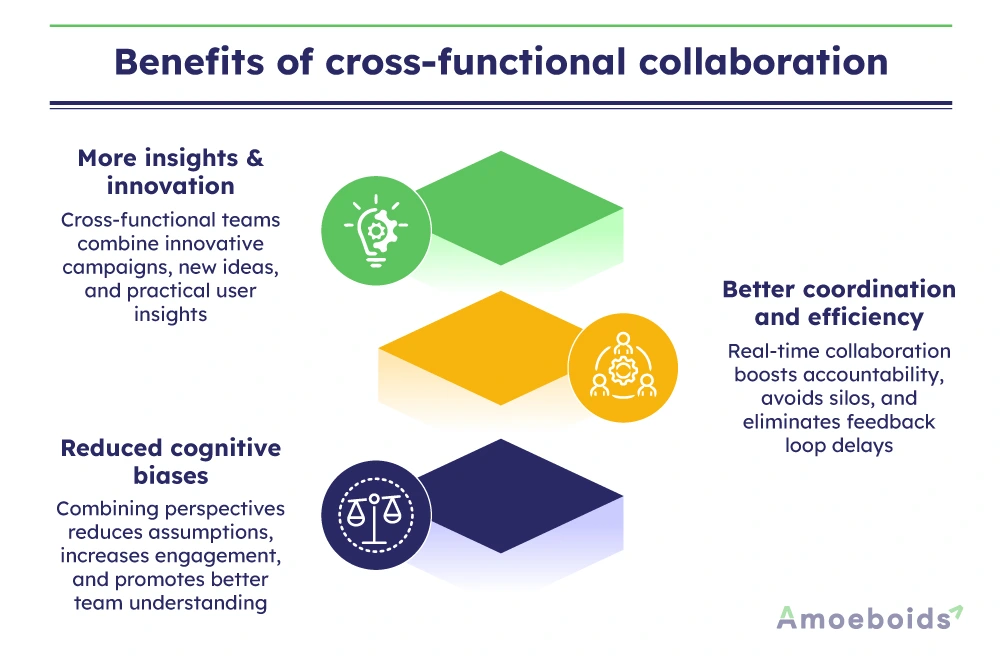
1. More insights & innovation
A cross-functional team naturally produces creative solutions and fresh perspectives. A marketing professional sees things differently from a developer. They might suggest creative campaigns or user-friendly dev notes that developers might miss. Similarly, sales executives can contribute by identifying customer pain points and real-world challenges that marketing teams might miss.
2. Better coordination and efficiency
Team collaboration is one of the biggest challenges in organizations- at least 39% of the surveyed employees opined the same. Cross-collaboration can infuse team collaboration as members see how their lack of responsibility in one area can cause a ripple effect of failure across the members. Instead of working for feedback loops between departments, cross-functional teams work together in real time.
3. Reduced cognitive biases
According to the State of the Global Workplace report, 85% of employees are not actively engaged at work. That’s because of cognitive biases, like the false-consensus effect, where individuals assume their perspective is widely understood. For example, the marketing team might assume that users want a sleek interface, while the engineering team might prioritize functionality. Cross-functional collaboration breaks such biases. By cross-functional working, each team gets to understand and value the opinions of other teams and work in unison.
By integrating technical and non-technical professionals, organizations capitalize on diverse skill sets, creating well-rounded teams that perform better and make smarter decisions.
Examples of cross-functional collaboration
Cross-functional collaboration isn’t just a concept—it’s a strategy used by some of the world’s most successful companies. Here’s how leading organizations leverage cross-functional teamwork to drive innovation, efficiency, and growth.
1. Northwestern Mutual Life: Pioneering cross-functional teams
Northwestern Mutual, a leading American financial services company, understands how valuable cross-functional collaboration can be. Initially, they built teams to meet specific project needs, but over time, they evolved how they worked together.
How cross-functional teams helped Northwestern Mutual
The company was among the first to bring together financial, investment, and actuarial experts to explore the role of technology in business. This collaboration led to the creation of one of the earliest information systems departments—giving them a competitive edge in the digital era. Today, cross-functional teams play a role in nearly every part of the organization.
Key takeaways:
- Every stakeholder, even those indirectly involved, should be represented in cross-functional teams.
- Clear communication of team goals and priorities ensures alignment and success.
2. Apple: Innovation through cross-functional collaboration
Apple thrives on collaboration. Unlike traditional corporate structures, Apple encourages open discussions where employees across departments can challenge ideas and contribute to refining solutions.
How cross-functional teams helped Apple
Apple’s cross-functional approach was key in developing the first iPhone. Experts from hardware, software, design, and marketing worked together to launch what became a technological revolution. Today, teams across the company continue to collaborate—whether it’s optimizing supply chains or enhancing customer experiences through seamless online-to-retail purchases.
Key takeaways:
- True collaboration goes beyond teamwork—it requires open, honest, and constructive discussions.
- No single team owns a product or service entirely; multiple specialized teams work together toward a shared goal.
3. Nokia: Driving growth through cross-functionality
Nokia embraces cross-functional collaboration not just in projects but also in its hiring strategy, prioritizing candidates with cross-functional working experience in multi-disciplinary teams. Agile development principles are embedded in their team operations.
How cross-functional collaboration helped Nokia
At Nokia Bell Labs, executives brought together scientists and engineers with diverse skill sets, fostering a culture that encouraged innovation, even through failure. This approach led to groundbreaking advancements, such as the vacuum tube, which transformed multiple industries. Today, Nokia continues to thrive in telecommunications, with its 5G and cloud networking solutions driving billions in revenue.
Key takeaways:
- A deeper understanding of different departments’ functions enhances collaboration and overall business efficiency.
- A risk-tolerant culture encourages innovation and technological breakthroughs.
Feeling inspired by these examples? Hold that thought. Before you enjoy the benefits of cross-functional collaboration, you’ll need to understand a few key challenges. Don’t worry; we will tell you how to avoid them like a pro.
What are common cross-functional collaboration challenges?
Let’s take a look at three most common challenges organizations face during cross functional collaboration and how to address them.
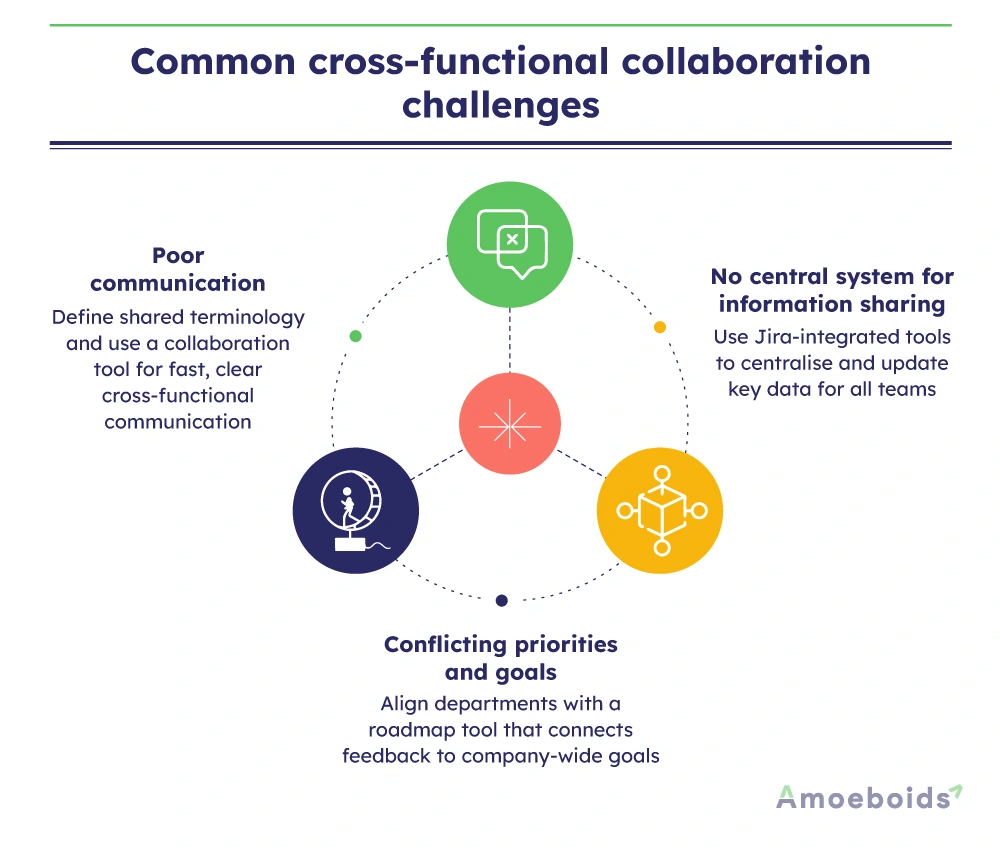
1. Poor communication
It might happen that your marketing team requests a product update from the development team, but the request lacks technical details. The developers misunderstood the requirements, and the communication was delayed. You should create a clear communication framework where the team must define common terminology using a shared collaboration tool to help other cross-functional teams establish prompt communication.
2. No central system for information sharing
What will happen if your sales team refers to an outdated pricing sheet while your finance team works with a new version? Without a central system, employees shuffle through multiple platforms to collect fragmented information, which impacts their team productivity and efficiency. By simply using dedicated apps for Project Managers, you can make all relevant information instantly accessible to employees right within Jira.
Here is a list of some useful tools from Amoeboids for project managers:
- Automated Release Notes (for Jira & JSM): automatically generate release notes and reports in different formats
- Release Planning & Reports (for Jira): effortlessly plan your release notes with Kanban and Calendar views
- Employee Success (for Jira): manage OKR goals, streamline continuous feedback and review team performance
- Employee Garrison (for Jira): manage and centralize employee records, leave management, and company info
- People (for Jira): make employees self-sufficient on decision making and retain high team morale
3. Conflicting priorities and goals
Every department has its own objectives, which don’t always align with broader company goals. When teams prioritize their own tasks over shared goals, it creates friction. For instance, your product team wants to add new features, but the customer support team prefers to focus on fixing existing issues. Without alignment, product decisions might ignore user concerns. All you need is a compelling product roadmap tool for Jira to capture customer feedback feature requests better and align your team to build better products.
Apart from these big challenges, you might also face other challenges, such as:
| Challenges | Reasons | Solutions |
|---|---|---|
| Disagreements between members from different departments | A structured way to resolve conflicts | Encourage open discussions. Set clear decision-making processes. Designate a neutral mediator if conflicts arise. |
| Some employees are resistant to team collaboration | Past negative experiences or false-consensus effect | Create cross-functional, fun team activities to build trust. |
| Different viewpoints that lead to decision-making paralysis | Lack of expert-level management | Set clear decision-making rules. Prioritize on data-driven insights to guide discussions. |
| Coordinating schedules across different teams | Departments operate on different timelines. | Use shared calendars and scheduling tools to find overlapping availability. Plan meetings in advance. |
What’s the difference between cross-functional teams vs. cross-functional work?
You might get confused if you ever hear of cross-functional teams and cross-functional work together. Aren’t they representing the same core message? Well, they are often used interchangeably, but they are not the same. Here is a quick breakdown.
| Aspect | Cross-Functional Teams | Cross-Functional Work |
|---|---|---|
| Definition | A dedicated group from different departments working on a specific project or goal. | A collaborative process where individuals or teams contribute to a shared goal without forming a separate team. |
| Structure & Commitment | Defined cross-team collaboration structure with assigned members and clear workflows. Members are committed for a specific duration. | More fluid—team members contribute as needed while focusing on their core departmental tasks. |
| Duration | One of the benefits of cross-functional teams is that they work long-term, lasting months or even years. That’s why some organizations maintain permanent cross-functional teams. | Typically short-term, occurring on an as-needed basis. |
| Goal Alignment | Fully aligned on a common goal with a clear direction. | Multiple teams collaborate while maintaining their own priorities. |
Conclusion
Cross functional collaboration is extremely important to bring innovation and efficiency to a team project. If you can leverage that to harness the benefits of cross-functional teams, that’s even more rewarding for the business. As it binds together a team of diverse expertise, the cross team collaboration fosters creativity, improves problem-solving capabilities, and aligns teams toward a common objective.
However, despite all these benefits, challenges like poor communication, lack of central information sharing, and conflicting priorities can create roadblocks. You can address these common challenges by using different tailor built tools. The key is alignment, communication, and teamwork.
FAQs
How do we measure cross-functional collaboration?
You must measure both qualitative and quantitative metrics to see if collaboration is driving the required results. Above all, gather team feedback on the collaboration and KPIs to spot areas of improvement.
Is cross-functional collaboration a skill?
Yes, every team member must be open to communicating and accepting different viewpoints for the common goal. That’s a skill which improves with practice.
How does a cross-functional team support agile collaboration?
Cross-functional teams enhance agility by enabling quick decision-making, iterative problem-solving, and seamless coordination across diverse functions.
How do we promote cross-functional collaboration?
Encourage open communication, set clear goals, use collaboration tools, align priorities, and foster a culture of teamwork.