
The ability to delegate tasks is probably the single most important skill a manager can possess. Handing off mundane assignments and allotting work equitably is critical to any scaling process. When managing multiple tasks simultaneously, it is vital to share responsibilities. Neglecting to delegate can lead to personal overload, resulting in missed deadlines and diminished productivity.
Delegation in the workplace is an essential practice for every growing business. An effective task delegation system enables employees to perform their best and allows managers to make vital decisions while sustaining project continuity. It will also improve efficiency, scaling up services and your organization’s revenue and bottom line.
In this article, we will understand the exact meaning of delegation, explore when and how to do so, discuss the benefits and challenges as well as list examples of delegation in the workplace.
What is delegation?
Delegation refers to the practice of assigning tasks to others, usually subordinates or cooperating teams while retaining accountability for the outcome. Effective delegation requires more than work distribution; rather, you need to utilize people’s talents and experience to ensure maximum effectiveness and efficiency. The practice of delegation allows project managers to spread workloads across different teams, which leads to the creation of optimized processes and frees up time for essential personnel to handle critical, high-value tasks.
The process of releasing control and trusting others to do the work can be an exceptionally challenging ordeal for some people. Micromanaging is a common malady for managers.
Here are some reasons why you might struggle with delegating work:
- You fear losing control over tasks you’re responsible for.
- It’s hard to decide which tasks need your attention and which can be handed off.
- Without proper processes in place, assigning work can feel like creating more chaos, not less.
- You’re unsure if your team members can deliver the same quality of work as you.
- You worry about overloading your team with extra responsibilities.
It is important to discover the fine line between doing the work yourself and delegating responsibilities.
When to delegate tasks?
The decision to delegate responsibilities requires objective assessment and thoughtful evaluation. One approach that has proved useful while delegating work involves asking yourself a few simple yet essential questions about your work:
- Is this task time-consuming?
- Does this task happen regularly?
- Is someone on the team better equipped to handle this?
- Could this task help a team member grow?
- Can I offer guidance and feedback?
If the answer to any of the above is ‘yes’, you should begin crafting a delegation plan and exploring the most effective methods to do so.
How to delegate tasks effectively?
Effective delegation isn’t just about offloading work – it’s about knowing what to delegate, to whom and how. Follow this 10-step process to delegate tasks effectively and set your team up for success.
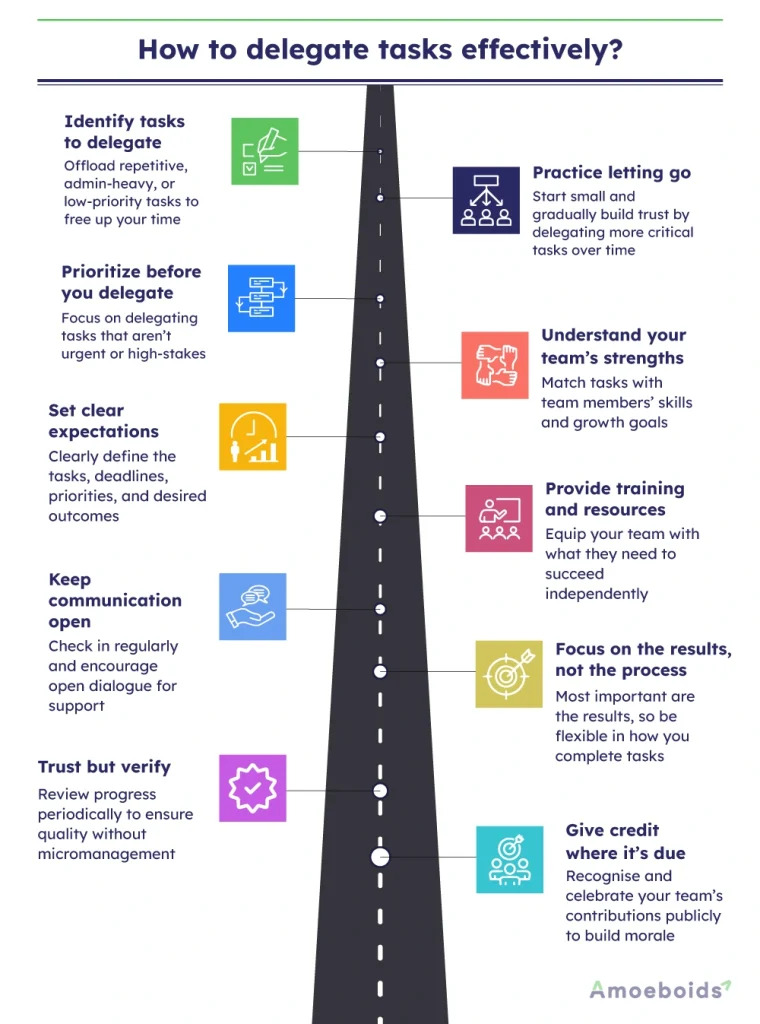
1. Identify tasks to delegate
Your first step should be to sort out which critical duties require your involvement compared to those that can be transferred to others. Strategic and high-impact projects should generally command your active participation; repetitive tasks with minimal need for decision-making should be delegated to others.
Tasks that are great for delegation include:
- Recurring administrative work – like creating reports or updating data sheets.
- Tasks aligned with team members’ interests – such as assigning social media research to someone keen on digital marketing.
- Low-priority tasks – like scheduling meetings or organizing documents.
2. Practice letting go
The most difficult aspect of delegating tasks involves trusting another person to complete the work. Overcoming this aversion takes practice. You should begin by assigning responsibility for non-vital tasks to others and gradually working up to delegating essential duties. The process of letting go offers opportunities for you to concentrate on essential matters. Sharing responsibilities with team members will allow you to focus on developing overall strategies.
3. Prioritize before you delegate
Before handing off work, assess its urgency and complexity. Time-sensitive tasks may require your direct attention, while routine or long-term tasks are better suited for delegation.
A helpful approach is to ask yourself:
- Is this task urgent or important?
- Can someone else do this without compromising quality?
- Will delegating this task allow me to focus on higher-value work?
4. Understand your team’s strengths
A valuable delegation system depends on correctly assigning work to team members. Fully understand the skills, abilities, areas of interest and working capacity of your team members.
A great rule of thumb is to delegate tasks that align with:
- Existing strengths – Give the work to someone who already excels in that area.
- Growth opportunities – Assign tasks that will help team members build new skills.
5. Set clear expectations
Handing off a task without context is like giving someone a map without directions. When delegating, always communicate:
- What needs to be done
- Why the task matters
- Deadlines and priorities
- Quality expectations
- Available resources
Clarifying the “why” behind the task helps team members stay motivated and understand how their work contributes to the bigger picture.
6. Provide training and resources
Spend your time training your staff members if you are unable to directly delegate work. Training people is a future investment which will bring substantial returns. This approach enhances your team’s confidence in taking on more work and expanding responsibilities.
7. Keep communication open
Delegation isn’t about assigning work and walking away – it’s a collaborative process. Regular check-ins allow you to offer guidance, answer questions and ensure everything stays on track.
Encourage two-way feedback by asking:
- Do you have everything you need?
- Are there any blockers?
- Is the timeline realistic?
8. Focus on the results, not the process
While delegating work tasks, you should focus on monitoring the results of your team’s work instead of insisting they mimic your process. Give your team members the freedom to determine strategies and work practices. All you need to do is see if the results match your expectations.
9. Trust but verify
Delegating doesn’t mean washing your hands off the task. While it’s important to trust your team, regular reviews help maintain quality and provide opportunities for feedback. Set up review cycles to assess the work and offer constructive feedback without hovering.
10. Give credit where it’s due
Public recognition and appreciation are essential to ensure the smooth completion of delegated work. This practice strengthens trust relationships, builds morale and incentivizes your teams to perform to the best of their ability.
Once you’ve learned to delegate tasks effectively, you’ll find that the benefits of doing so will quickly become evident.
Benefits of delegating work responsibilities
An effective delegation approach kills two birds with one stone; it reduces the managerial workload and trains your employees in new skills and to handle more responsibilities at the same time. Effective delegation empowers your team and builds a strong collaborative ecosystem, making projects advance smoothly.
Here’s how delegation can benefit both you and your team:
- Empowers your team: When you delegate work, you are providing an opportunity for others to showcase talent and competence. Delegation also shows you trust your team to get the job done. This makes them more confident and gives them a valuable experience.
For example, allowing a junior associate to make a pitch to clients reduces your workload while allowing them to demonstrate their talents and capabilities.
- Prevents burnout: The distribution of work responsibilities benefits your team members in two ways; they do not become overwhelmed and each member performs work based on their ability level. When jobs are distributed through an equitable delegation process, it creates work equilibrium which leads to better productivity.
For example, breaking down the task of designing a presentation by assigning specific responsibilities to different team members prevents them from having an uneven workload.
- Encourages professional growth and creativity: Team members who receive autonomy and greater responsibilities discover innovative ways to solve problems and get work done. Sometimes, their novel point of view or overlooked knowledge might help streamline your work process.
Continuing with the presentation example, let’s say one of the team members you’ve assigned to work on the task explains a more efficient way to design your pitch.
- Builds trust and communication: Delegating tasks demonstrates that you trust your colleagues and respect their abilities. The simple act of assigning work can improve communication channels and create a collaborative work culture. In addition, by setting teams to work, you will foster a sense of teamwork and camaraderie among them.
While preparing the presentation, for example, you and your team members will get to know each other better and learn to cooperate efficiently. This will strengthen your working relationships.
- Accelerates project timelines: Group collaboration across different sections of projects enhances both productivity and quality performance. This enables you to meet your target schedules and also prepares your organization for scaling up production and operations. For example, having different teams working on complementary tasks for a presentation will get it done faster. It will also familiarize your employees with the process, allowing you to increase your volume of production.
- Improves project management: Delegating tasks and work improves efficiency and time management. You will also be able to create more accurate predictive models and gauge the resource requirements and project expenditure amounts better. The budget process also becomes easier to monitor. For example, splitting your presentation project into daily time-stamped tasks will allow you to calculate the total time, resources and budget you’ll need.
The ability to delegate tasks effectively is very important for organizations to thrive. However, there are times when delegation does not work.
Challenges of task delegation
One important thing to remember about delegation is to always delegate tasks and never delegate authority. There are many negative examples of delegation in the workplace. Learning about them and educating yourself about standard obstacles you might face during a typical delegation process will help you develop strategies to counter them.
Here are some roadblocks you might face during the delegation process:
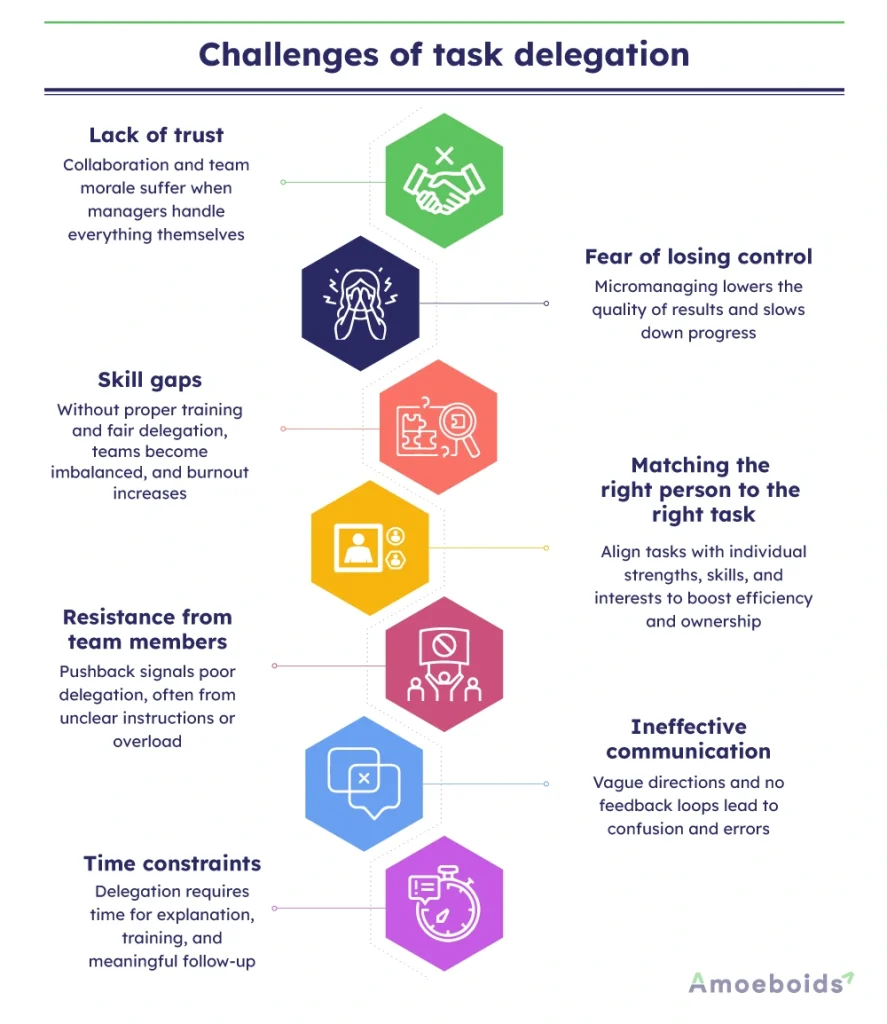
- Lack of trust: This happens when managers insist on doing most of the work themselves. They are unable to delegate responsibilities to others. This workload imbalance hampers efficiency and team-building. The perceived lack of trust can lead to a host of systemic issues such as lower morale, lack of cohesion and fragmented teams as well.
- Fear of losing control: Delegation inevitably comes with releasing control. You must let the teams you’ve assigned work complete it in their own way. Demanding constant progress reports and jogging their elbows will lead to a drop in the quality of output and increase completion times as well.
- Skill gaps: These can arise as a result of not providing adequate training. It is also a problem with organizations that do not delegate work equitably. By relying on yourself or on certain employees to do the heavy lifting, some of them will inevitably learn more than others. In contrast, the ones you’re relying on the most often burn out faster. Failure to provide appropriate training before assigning work tasks will generate frustration for yourself and your team.
- Matching the right person to the right task: People aren’t replaceable cogs. Each employee has their own set of abilities, skills and personal interests. Evaluating and matching your employees’ expertise, experience and interests with the work they must do can be a challenge. It involves dedicated observation and acquiring a lot of knowledge about your team.
- Resistance from team members: You’ll know that something has gone wrong with your delegation methods when you get pushback and complaints from the people you assigned work to. Whether it is a poorly distributed workload or unclear instructions, you must face the challenge of delegating work head-on.
- Ineffective communication: Without clear instructions, deadlines or context, tasks can easily go off track. Building multiple lines of communication with the people you’re assigning work to is crucial for many reasons. If your employees feel that they can’t bring their doubts and questions about work to you, they will substitute their own experience and go astray in their work.
- Time constraints: Managing the timeline of delegating work is a project in itself. You face the challenge of finding the right balance between ensuring that you’re available and hovering over your team. Handing over a task is just the first step. You must take the time to explain the nuances, train your workers and follow up on complications and concerns.
Recognizing these challenges is the first step toward overcoming them. With the right mindset and approach, delegation can become a powerful tool to improve both your workflow and your team’s performance.
Examples of delegation in the workplace
Effective delegation isn’t just about offloading tasks – it’s about distributing responsibilities in a way that empowers your team while helping you focus on what matters most. Here are a few everyday examples of delegation that show how managers can get more done while fostering professional growth:
Project management
A project manager assigns a team member to lead a specific project phase, like research or quality checks. This allows the team members to sharpen their coordination and planning i.e project management skills, while the manager stays focused on overall project strategy.
Why it works: It builds leadership skills without sacrificing oversight.
Client communication
Routine client follow-ups – like status updates or meeting scheduling – are delegated to a junior associate. The manager stays free to handle complex client concerns, while the associate gains confidence in relationship management.
Why it works: It balances workload and helps junior employees gain valuable client-facing experience.
Administrative support
A department head hands over data entry, calendar management, or report formatting to an assistant. The essential tasks continue to function properly while strategic leading decisions remain undisturbed.
Why it works: Time-driven execution of minor duties enables top leadership to maintain their focus on critical matters.
Training and mentorship
Senior staff members assist new team members by delivering support for processes together with institutional best practices. The program allows managers to reduce their onboarding tasks while simultaneously validating the mentor’s existing knowledge base.
Why it works: The approach improves team knowledge sharing between colleagues and enables teams to expand their expertise base.
Cross-functional collaboration
A manager distributes parts of a complex multi-sector task, like developing an e-payment gateway for a brand, to a mixed team of specialists from finance, marketing and technical operations. By teaching them to work together, the manager will increase efficiency and create a skilled team for similar work in the future.
Why it works: It creates a more collaborative environment and improves the overall quality of the work.
The common success factor rests in connecting each team member to their proper assignment while guiding them gently without supervision and giving them full trust to execute their tasks.
Conclusion
Learning to delegate effectively has many benefits for both you and your organization. It frees you up for more complex work, helps build camaraderie among your teams, improves productivity and lays a solid foundation for scaling up your organization. Learning how to delegate tasks among real-world complications and conditions is extremely useful to any business.
Delegation comes with a unique set of issues and problems, although most of them can be surmounted. Combining appropriate practices with the right tools, like Amoeboids’ Automated Release Notes & Reports for Jira, can help you enhance organizational productivity and operations through powerful automation. Its features will help you tackle most of the challenges of delegation.
FAQs
1. How to delegate tasks effectively?
A successful delegation involves identifying appropriate tasks for delegation and selecting suitable team members and providing detailed instructions together with anticipated results as well as extended assistance. Regular follow-ups, together with performance indicators help maintain task progress at suitable levels while avoiding unneeded supervisory interference.
2. How to improve delegation skills?
The ability to delegate improves through identifying team members’ strengths, followed by clear instruction delivery and by granting others full responsibility for leading initiatives. It should include smaller assignments in the beginning, while feedback should remain constructive to increase team member responsibilities as they develop confidence alongside their capabilities.