
Every project you manage requires balance — not just between people and tasks, but between expectations and realities. The project management triangle gives you a structured way to maintain that balance. Often referred to as the pm triangle, this framework helps project managers understand how scope, time, and cost influence one another and impact project outcomes.
In today’s dynamic workplaces, where priorities shift quickly and teams often juggle multiple projects, the triple constraints of project management act as your compass. They help you allocate resources efficiently, set realistic deadlines, and prevent burnout — all while safeguarding quality.
When applied effectively, this framework turns complexity into clarity. Teams gain the confidence to adapt when priorities evolve, and leaders can track progress transparently. That’s why modern organizations view the project management triangle not just as a theory, but as a practical business strategy for driving sustainable success.
What is the project management triangle?
The project management triangle, also called the iron triangle, represents three constraints that shape every project:
- Scope – What you’re building or delivering
- Time – How long will it take
- Cost – The resources and budget you have
This model is also known as the golden triangle in project management because it highlights the core factors that determine project success.
At the center of the triangle sits quality, which depends on how well you balance these three forces.
According to the Project Management Institute’s 2024 Pulse of the Profession Report, only 63% of projects meet their original goals due to imbalances among scope, schedule, or cost. You can’t optimize one side of the triangle without affecting the others — success lies in finding equilibrium.
Why balance matters
When one element of the triangle is stretched, the others must give way. If you expand the scope without increasing time or budget, you risk compromising quality. Similarly, cutting costs can delay delivery or reduce features. This relationship is often described as the time cost and quality triangle, where improving one area usually requires adjustments in the other two. Balancing expectations and resources early prevents downstream chaos.
If you use software such as Jira to track deliverables, this relationship becomes clear. Each sprint connects effort, time, and output, which ultimately depends on how accurately you measure and manage sprint velocity. Understanding this metric helps you align capacity with timelines and keep the project triangle in balance.
This balance is what gives the project management triangle its value — it helps you visualize how scope, time, and cost interact so that you can make intentional decisions rather than reactive compromises. When you understand these trade-offs early, you can set realistic expectations, avoid unnecessary pressure, and maintain consistent quality.
What is the triple constraint of project management?
The triple constraints of project management — time, cost, and scope — form the foundation for planning, executing, and measuring projects. These three constraints in project management are deeply interconnected, meaning any change in one will inevitably affect the others. Understanding this relationship allows you to plan proactively, make strategic trade-offs, and maintain control over project quality.
In essence, the triple constraint acts as your decision-making compass. It helps you identify which factors can flex without affecting overall quality, so you can keep projects realistic, balanced, and aligned with business goals — even as priorities evolve.
In modern project management, the triple constraint isn’t just a theoretical model — it’s a decision-making framework. Many organisations use the triple constraint model to guide project planning and execution. When used effectively, it helps you forecast risks, prioritize resources, and balance competing expectations without sacrificing results. For instance, expanding the project’s scope might delight stakeholders in the short term, but if not balanced by additional time or budget, it can lead to missed deadlines or reduced quality.
To better understand how each constraint interacts with the others, here’s a breakdown of what each element represents and the typical impact of changing it:
| Constraint | What it means | Typical impact when it changes |
| Scope | Defines project deliverables | Expanding scope increases time/cost |
| Time | Defines the delivery schedule | Tightening timelines raises cost or reduces scope |
| Cost | Defines available resources | Cutting costs risks quality or speed |
Understanding these trade-offs lets you make deliberate adjustments instead of reactive compromises. For example, if your team uses Jira to manage projects and new features are added midway through development, the impact becomes immediately visible. Your sprint board may show additional issues, dependencies may shift, and workloads may increase.
Without proper adjustment, deadlines could slip or quality could drop. However, using modern tools and techniques, you can proactively visualize how these additions affect the schedule. As a result, you may consider extending the delivery timeline, reallocating resources, or deprioritizing lower-value tasks. This helps you maintain equilibrium within the triple constraint — keeping your project on track while preserving quality and stakeholder trust.
Components of the Project Management Triangle
The project management triangle is more than just a concept, it’s a tool for balancing project managers around key priorities. Many professionals refer to this framework as the project triple constraint.
It keeps projects running smoothly with no confusion or major issues.
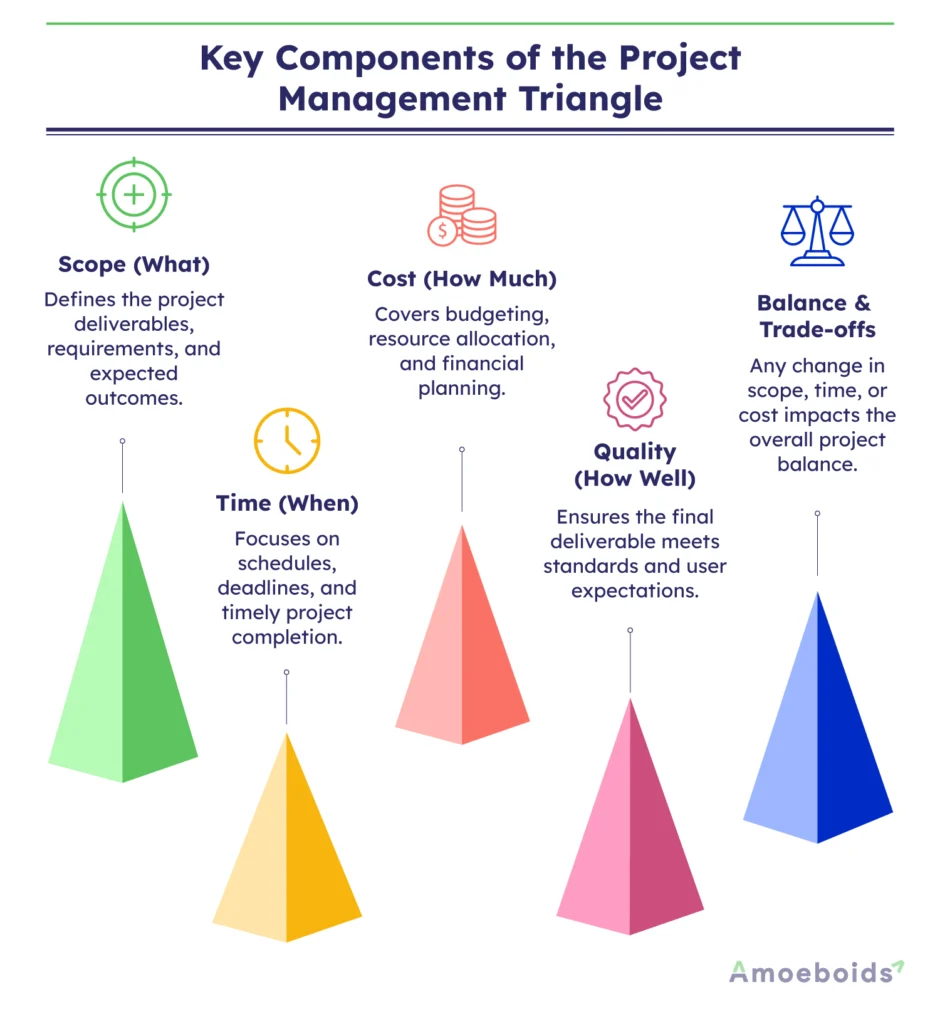
Scope (What)
Specifies what the project will deliver, such as features, requirements, and outcomes. Within the project management scope triangle, scope defines the boundaries of project delivery. Clear scope management helps to prevent scope creep and ensures that stakeholders’ expectations are met.
Time (When)
The project schedule, deadlines, and milestones are included. Effective time management ensures timely delivery and sustains workflow efficiency and team productivity.
Cost (How Much)
Budget, resources, and overall financial planning are all covered. Cost control helps to maintain profitability and improves resource allocation throughout the project’s lifecycle.
Quality (How Well)
Ensures that the final deliverable meets the specified standards and user expectations. Balancing quality, time, and cost is critical for successful project delivery.
Balance & Trade-offs
The central concept of the project management triangle is trade-off management. Changing one constraint affects the others, requiring continuous prioritisation and strategic decision-making.
Why Should You Use the Project Management Triangle?
The project management triangle gives you a clear lens to navigate competing priorities without losing direction. It helps you understand the interplay between scope, time, and cost, so every decision is more intentional and considered. You can do it without speculation, you can evaluate choices, manage constraints, and establish realistic stakeholder expectations.
The triple constraint triangle in project management helps teams understand how changes affect project outcomes.
It also strengthens project planning, improves resource management, and reduces delivery risks. In dynamic environments, this framework acts like a guide, helping you stay flexible while still delivering consistent, high-quality outcomes.
Strategies for managing the project management triangle
You can’t remove constraints, but you can manage them intelligently. The key lies in understanding how scope, time, and cost interact — and applying structured approaches to keep them balanced. Successful project managers use a combination of clear communication, proactive planning, and continuous refinement to stay in control. These strategies don’t just help you deliver on time and within budget; they foster accountability, reduce rework, and build stakeholder trust.
The pm triangle provides a practical framework for making these decisions.
1. Define the scope clearly and revisit it often
A clearly defined scope is the foundation of every successful project. When everyone knows exactly what’s being delivered and what isn’t, you reduce confusion, prevent scope creep, and set achievable expectations from the start. Defining scope early ensures your team stays aligned with business goals, while revisiting it periodically allows you to adapt to new insights or shifting priorities without derailing progress.
A clear project management scope triangle reduces the risk of scope creep. A well-documented scope also promotes transparency. It helps stakeholders understand trade-offs and keeps your team focused on high-impact tasks rather than ad-hoc requests. As projects evolve, refining your scope ensures that time and budget remain proportional to the work being done — a key aspect of maintaining balance within the project management triangle.
Hint: Use Confluence pages to define the “what” and “why” of your project. Then connect those documents to Jira issues for visibility. This keeps customer feedback visible while protecting timelines and budgets.
2. Use data-driven scheduling
Overly optimistic timelines cause burnout and missed deadlines. Base your timelines on data, not assumptions. Use Jira’s velocity charts to estimate delivery times from past performance. These insights help you adjust priorities before issues snowball.
3. Build a flexible budget
Budgets shouldn’t be fixed numbers — they should reflect changing realities. Maintaining the project triple constraint requires balancing budget, timelines, and deliverables.
According to Boston Consulting Group’s 2024 survey on software project performance, more than 30% of development projects exceed their planned budgets and timelines due to shifting requirements and resource constraints. Add contingency reserves (10–15%) to your project plan for unexpected changes. And track financials alongside task progress in Jira or Confluence dashboards.
4. Communicate trade-offs early
Transparency prevents tension. Understanding the triple constraint triangle in project management improves stakeholder alignment during change. When project conditions shift, communicate early and clearly. Strengthening team communication across tools such as Jira and Confluence ensures that every stakeholder remains aligned as priorities evolve. Instead of manually drafting updates, automate them. You can then send tailored updates to teams or clients, saving hours each sprint.
5. Keep quality at the center
Quality is the glue that holds the triangle together. The time cost and quality triangle reminds teams that quality should remain a priority.
For achieving the right quality, build checkpoints into your workflow:
- Add QA steps to Jira workflows.
- Run retrospectives after each sprint.
- Use automation to flag blocked or delayed issues.
When you consistently monitor quality, you maintain stability even under tight timelines.
How to apply the triple constraint in project management?
The triple constraint of scope, time and cost helps project managers make informed trade-offs to keep projects aligned and achievable. Here’s how to apply it effectively:
Managing the three constraints in project management requires continuous monitoring and adjustment.
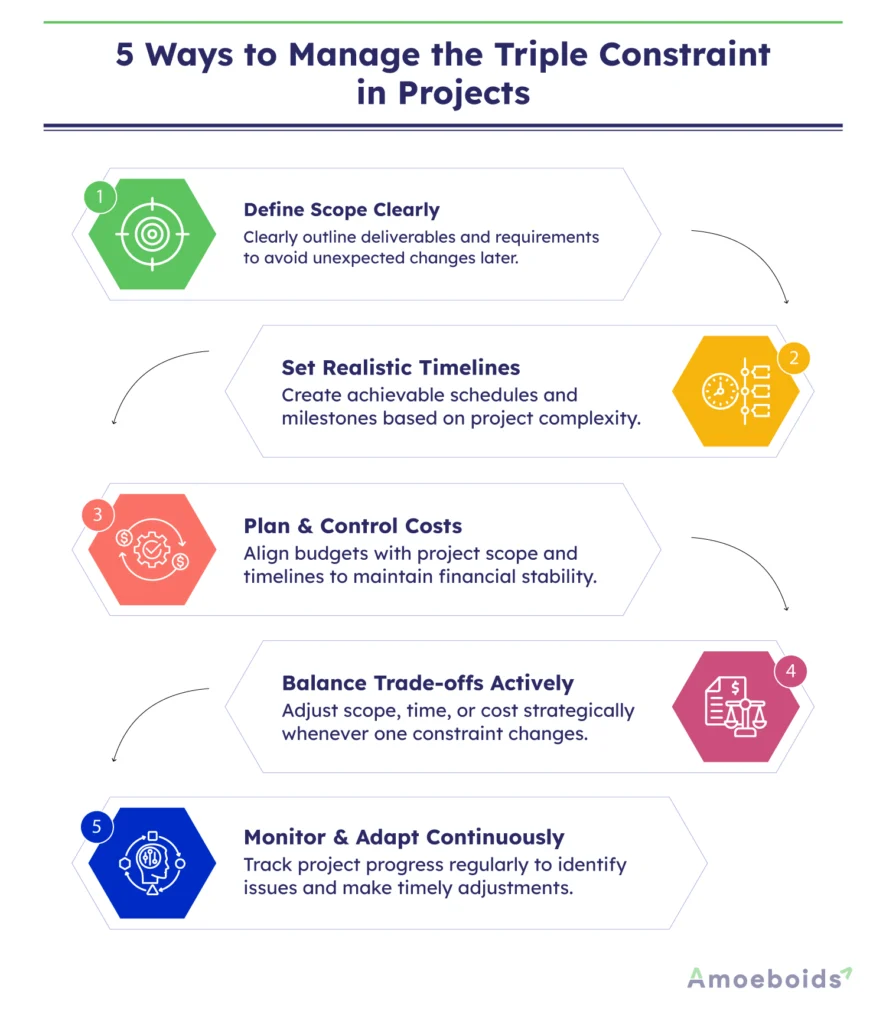
Define scope clearly
Start by defining the deliverables, requirements, and success criteria. A clear scope avoids unforeseen changes that can affect time and cost.
Set realistic timelines
Divide work into milestones and develop realistic schedules. If timelines are shortened, be ready to change scope or add resources.
Plan and control costs
Estimate budgets based on scope and timeline. Any increase in scope or reduction in time is likely to affect overall costs.
Balance trade-offs actively
When one constraint changes, adjust the others accordingly. For example, expanding scope may require more time or a higher budget.
Monitor and adapt continuously
Track progress and performance metrics regularly. This helps you identify imbalances early and make informed adjustments across scope, time, and cost.
The triple constraint model helps teams evaluate trade-offs before making changes.
Real-world example: Managing a release cycle
Imagine your product team is preparing a significant release. Two weeks before launch, leadership requests an additional feature. Let’s break this development down using the project management triangle:
- Scope expands: You assess the potential impact of the latest update as you plan adjustments. It helps to explore different release management tools that simplify tracking, coordination, and approvals.
- Adjust the time: You spot dependencies and adjust sprints.
- Analyze the cost: Incorporate the new workflow’s cost into the budget.
The result? Stakeholders are informed, the team stays organized, and the release maintains quality despite change. That’s how balance looks in action — managing the triple constraint without losing control.
Alternatives to the project management triangle
The project management triangle is a helpful model, but projects today can be more complex. They require adaptable, value-driven frameworks to effectively manage changing priorities. Even though the golden triangle in project management remains relevant, many organizations complement it with Agile and Lean approaches.
- Agile Framework: The priority is on flexibility, iterative delivery, and continuous feedback. It responds quickly to changing requirements, increasing stakeholder satisfaction.
- Critical Chain Method: Resource optimisation and task dependencies are highlighted. It reduces delays by managing buffers and increasing workflow productivity.
- Value-Based Models: Put customer value and outcomes ahead of fixed constraints. They carefully align projects with business objectives.
- Risk-Focused Approaches: Make risk management a key component of your strategy. They allow teams to anticipate uncertainties and make proactive decisions.
- Lean Methodology: Focuses on eliminating waste and improving efficiency. It streamlines processes and enhances delivery speed.
- Hybrid Models: Use a combination of traditional and agile approaches. They provide flexibility while maintaining structure for improved project management.
Conclusion: Turning balance into predictable success
Understanding what a project management triangle is empowers you to maintain balance between scope, time, and cost. When you manage these triple constraints of project management effectively, you create a foundation of predictability and trust. Teams operate more confidently, stakeholders gain clarity, and projects progress without unnecessary friction.
In today’s fast-paced, collaborative environments, visibility and communication are the true enablers of success. When every stakeholder has access to accurate, timely information, decision-making becomes faster and more transparent.
FAQs
1. Why is the project management triangle important?
It helps you understand the relationships among scope, time, and cost — the three forces that shape project success. Recognizing this balance enables you to make more informed trade-offs, maintain quality, and achieve greater alignment with stakeholders.
2. What is the purpose of the project triangle?
It serves as a simple, practical guide for decision-making when projects change. By seeing how one factor affects the others, you can adapt quickly while keeping projects balanced and achievable.
3. What are the factors of the project management triangle?
The three factors — scope, time, and cost — all influence overall quality. Successful managers continuously monitor and adjust these elements to stay balanced and deliver predictable, high-quality results.