
Understanding and optimizing sprint velocity is the key to building a sustainable and high-performing Agile team. If you’re using tools like Jira for product development, you’re probably already running sprints, holding planning meetings, and conducting retrospectives. But if you often find your team over-committing or struggling to meet sprint goals, the problem may lie not in your team’s capability but in how you’re measuring and interpreting performance.
Sprint velocity gives you a practical way to track output, spot inefficiencies, and make data-informed decisions about what your team can achieve realistically. It helps you bring consistency to sprint planning, identify blockers faster, and set the right expectations with stakeholders. Learning how to calculate and improve sprint velocity can help you bring clarity and give the right direction to your Agile workflow.
What is sprint velocity?
Sprint velocity, sometimes also known as scrum velocity, refers to the amount of work your Agile team can complete during a sprint. It’s most commonly measured in story points — an estimation unit used to evaluate the relative effort required for tasks.
For example, if your team completes 30 story points in a two-week sprint, your team’s velocity in Scrum for that sprint is 30. This number becomes a benchmark to forecast how much work your team can take on in future sprints. While some teams measure effort in hours or number of completed tasks, story points are more effective at capturing complexity, effort and uncertainty, especially when using Agile frameworks like Scrum.
It’s important to note that Scrum velocity is unique to each team. It should never be compared across teams or treated as a competition. Instead, think of it as your internal compass. It tells you how much you can realistically deliver based on your team’s own historical performance.
Why is sprint velocity important in Agile?
If you’re aiming for predictability, better planning and efficient delivery, you can’t afford to ignore sprint velocity. It’s also important when it comes to planning your workflow and turnaround time. Here’s why:

- Reliable sprint planning: Knowing your average Agile team velocity helps you commit to a realistic amount of work for the upcoming sprint. No more guesswork — just data-backed decisions.
- Improved forecasting: With a stable team velocity in Scrum, you can project how many sprints it will take to complete your product backlog. This helps in setting the right expectations with stakeholders and leadership. It also improves accuracy in release management. For example, if your team consistently completes around 25 story points per sprint and your product backlog for the upcoming release totals 100 story points, you can estimate that it will take four sprints to complete the work.
- Identifying patterns: A sudden dip or spike in velocity is often a sign of underlying issues. Perhaps a team member was on leave, or a technical dependency caused delays, or unforeseen issues cropped up, throwing your entire team off-schedule. Tracking velocity helps you spot these patterns and course-correct.
- Team alignment: Sprint velocity can also serve as a shared metric for team discussions. It encourages transparency within the team and helps you facilitate retrospectives where you can discuss what’s helping or hindering your team’s progress.
In short, your team’s velocity in Scrum acts as a health indicator for your Agile practice. And when used responsibly, it helps you deliver faster without burning your team out.
How to calculate sprint velocity
The process of calculating sprint velocity is straightforward, but getting accurate data depends on consistent practices. Breaking it down into steps helps ensure your approach stays consistent across teams and timeframes. Here’s a step-by-step process:
Step 1: Add up completed story points
At the end of the sprint, total the story points for all user stories that are 100% done. Anything partially complete should be excluded, even if it’s close to the finish line. This ensures your sprint velocity only reflects fully delivered work.
Step 2: Repeat over multiple sprints
To build a reliable average, calculate sprint velocity across 3–5 previous sprints. For example:
- Sprint 1: 25 story points
- Sprint 2: 28 story points
- Sprint 3: 30 story points
Looking at multiple sprints helps smooth out anomalies and gives you a clearer view of your team’s actual delivery pace.
Step 3: Calculate the average
Add up the total completed story points and divide by the number of sprints. In the example above: (25 + 28 + 30) / 3 = 27.6
So your average velocity in Agile would be approximately 28 story points per sprint. This number becomes your planning baseline. If your backlog contains 140 story points and your average velocity is 28, you can project that you’ll need about five more sprints to finish the work.
If you’re using Jira, the sprint velocity chart in the reports section provides a visual representation of your team’s historical performance. This built-in feature can save time and eliminate the need for manual tracking.
Best practices for improving sprint velocity
Improving team velocity in Scrum is about working smarter rather than faster or harder. Focus on building habits and systems that allow your team to deliver consistent, high-quality work without burnout. Here are some practical strategies you can apply:
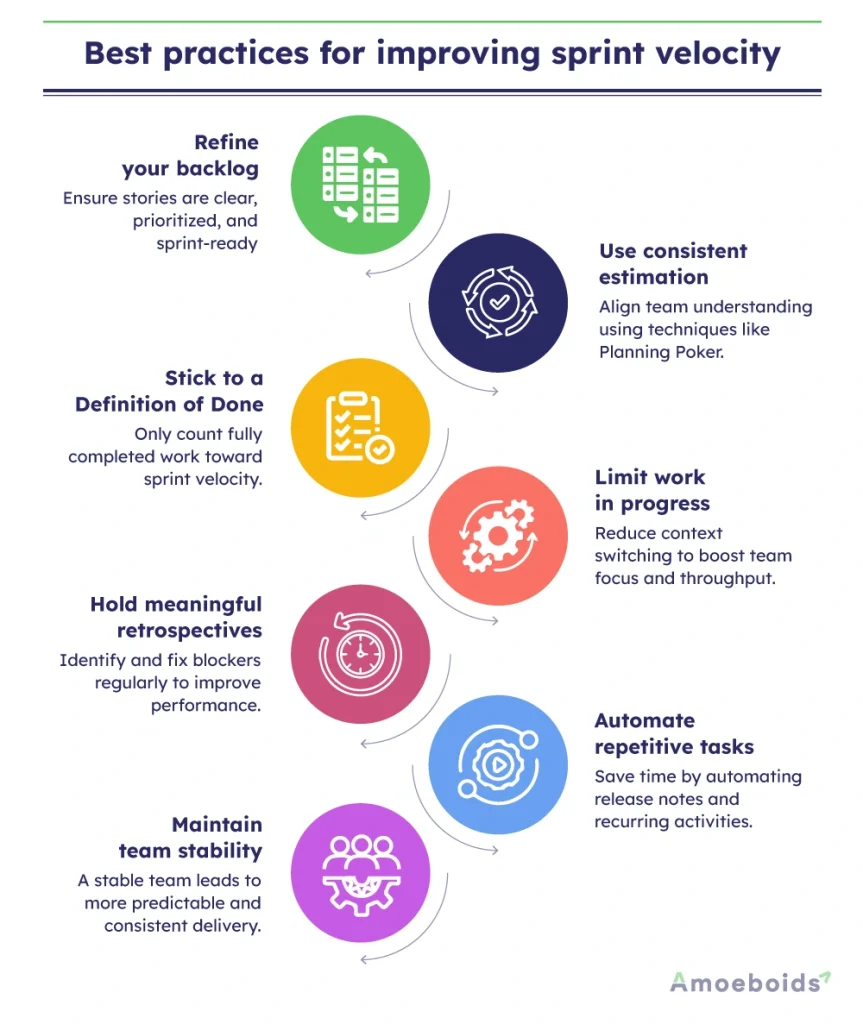
- Refine your backlog: This ensures that stories are clear, prioritized, and broken down into manageable tasks before sprint planning.
- Use consistent estimation methods: For example, you can use Planning Poker to calibrate the team’s understanding of effort and complexity.
- Stick to a shared Definition of Done: When everyone knows exactly what ‘done’ means, only fully completed stories will be counted toward your sprint velocity.
- Limit work in progress: This will reduce context switching and increase throughput for the entire team.
- Hold meaningful retrospectives: That way, you can identify and resolve blockers affecting your team’s performance.
- Automate repetitive tasks like writing release notes: If your team is consistently delivering work every sprint, manually compiling release notes can become a recurring time sink. Using a solution like Automated Release Notes & Reports App for Jira can help you automate this process. The app pulls in completed issues from your Jira sprint and formats them into structured, branded release notes or reports.
- Maintain team stability: While this is not always possible in an Agile environment, if you can maintain stability where possible, the resulting consistent team collaboration will drive predictable delivery.
Each of these best practices contributes to a healthier Agile process and a more accurate, actionable sprint velocity.
Common challenges and how to overcome them
While measuring your Agile team’s velocity is a valuable tool, nothing is without challenges. From complex user stories to inconsistent estimates, here are some common pitfalls you might face while measuring your team’s velocity in Agile:
- Dealing with complex user stories: If your sprint is overloaded with high-effort, high-uncertainty stories, your sprint velocity might appear lower than it actually is. This isn’t a reflection of your team underperforming – it’s just that the complexity wasn’t balanced across the sprint. To maintain a steadier velocity, try mixing in a few low-effort or “quick win” tasks alongside the more challenging ones. This helps smooth out delivery while still making space for deep work.
- Managing external factors and weak links: Even with impeccable planning, there will be things beyond your control – team members calling in sick, unexpected feedback from stakeholders, technical outages, or mid-sprint scope changes. These can all impact how much work your team can deliver and cause velocity to fluctuate. To keep your forecasts grounded in reality, make allowances for these factors when they arise and look at your average over the last few sprints instead of relying on a single number. That broader view can help you plan more reliably without being thrown off by one unpredictable week.
- Frequent changes within the team: Onboarding new members or temporarily losing a few will naturally affect your output. Acknowledge these changes during sprint planning and consider them when evaluating your Agile team’s velocity trends.
- Inconsistent use of estimation or unclear definitions of “done”: Misalignment in estimation techniques or the criteria for what counts as completed work can severely skew your sprint velocity data. Ensuring that your team is aligned on these definitions ensures you’re tracking the right work in the right way.
When you recognize and address these challenges proactively, you can ensure that sprint velocity remains a useful and accurate tool for your team’s Agile practices.
Ready to bring more predictability to your sprints?
Sprint velocity gives you the visibility you need to plan better, deliver more consistently, and respond faster to change. When used alongside tools like Jira and Confluence — and supported by strong Agile practices — it becomes more than a metric. It becomes a conversation starter, a decision-making tool, and a signal for when things are working (or not).
FAQs
How does sprint velocity impact sprint planning?
Sprint velocity gives you a concrete baseline for deciding how much work to take on in your next sprint. Instead of guessing, you use past performance to forecast how many story points your team can reasonably complete. This helps reduce overcommitment and creates a more predictable delivery rhythm.
What factors can affect sprint velocity in Agile teams?
Team composition, estimation accuracy, backlog clarity, external dependencies and unplanned work are just a few examples. Even changes like holidays or onboarding a new developer can shift the team’s capacity and affect how much gets done in a sprint.
Can sprint velocity be used to predict project completion dates?
Yes, but only when used responsibly. By dividing the total number of remaining story points by your average sprint velocity, you can estimate how many sprints are needed to complete a project. Just remember that team velocity in Scrum is not static, so this estimate should be updated regularly.
How can teams improve their sprint velocity over time?
Improvement comes from consistency and reflection. Hold regular retrospectives, refine your backlog, and make sure your team is estimating and working from a clear Definition of Done (DoD). Over time, these small adjustments compound into better flow and faster delivery.