What’s harder than building a great feature? Launching it. You’ve tested it. Your team’s burned through sprints and closed bugs. But the moment the release date inches closer, the anxiety creeps in — Did we cover every touchpoint? Is marketing ready? Will users know how to use it? A recent study by Productboard found that 80% of product teams admit to missing critical steps in their feature launch process. It demonstrates how easily things can slip through the cracks when there’s no solid release plan in place.
This blog highlights the ultimate feature launch checklist, a practical, Agile-informed guide to help product managers navigate every stage of a release. You’ll learn how to plan, communicate, and execute a feature release checklist that keeps your team in sync and your users engaged.
What is a feature launch checklist?
A feature launch checklist is a clear list of actions that teams need to complete to successfully release a new product feature. It makes sure product managers miss nothing during a rollout. From internal coordination to customer communication, it covers everything that needs to happen before, during, and after a feature goes live.
Having a checklist brings order and clarity. It improves cross-functional handoffs and reduces last-minute surprises. It turns the stress of a launch into a repeatable process you can rely on.
Essential steps in a feature launch checklist for product managers
A clean launch needs more than just a code push. Here are the key steps your feature launch checklist should include to keep things smooth and predictable:
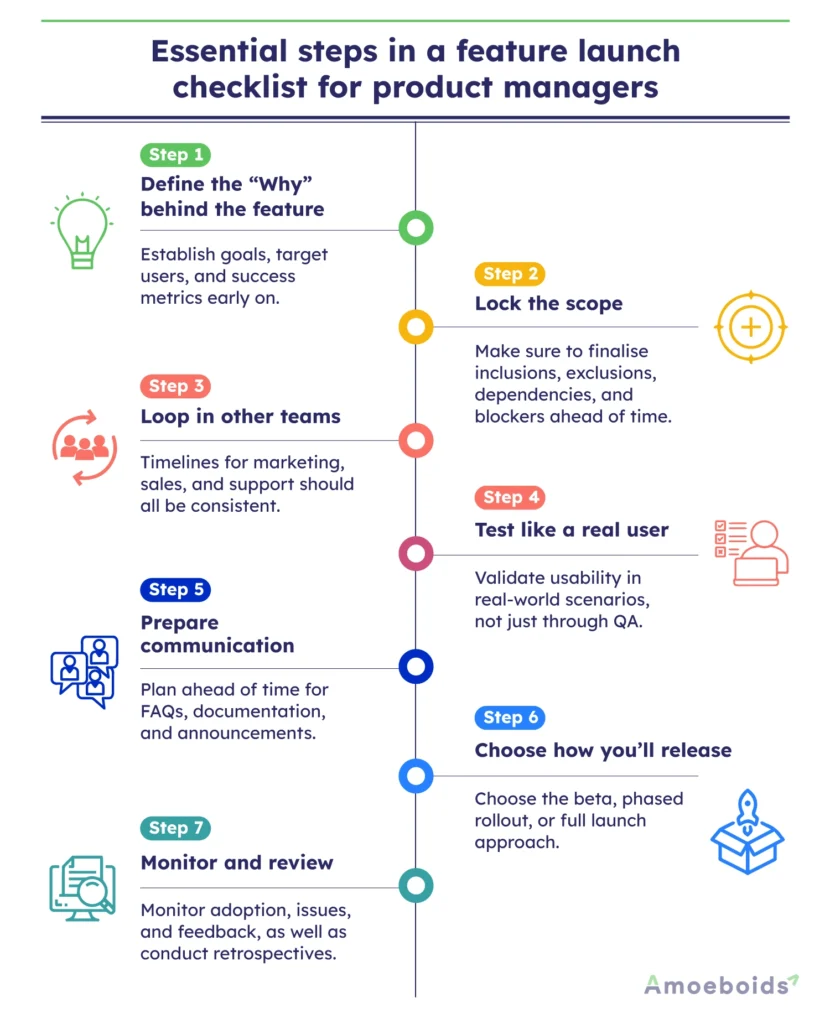
Step 1 – Define the “Why” behind the feature: Define the goal of the feature, who it’s for, and how success will be measured. It keeps everyone focused.
Step 2 – Lock the scope: Avoid last-minute changes. Finalize what’s in and out, and identify any blockers or dependencies early.
Step 3 – Loop in other teams: Share timelines and expectations with marketing, sales, and support. A simple kickoff doc or call works well.
Step 4 – Test like a real user: Go beyond QA. Use the feature in real-world scenarios to catch UX issues before users do.
Step 5 – Prepare communication: Draft internal FAQs, help docs, and customer announcements ahead of time to avoid scrambling later.
Step 6 – Choose how you’ll release: Decide if it’s a slow rollout, beta, or full launch.
Step 7 – Monitor and review: Track adoption, bugs, and user feedback after launch. Run a quick retro to learn and improve.
Let’s look at what a typical feature release checklist might look like next.
The ultimate feature release checklist for a successful launch
The real work is getting the feature out into the world without unexpected issues. This feature release checklist serves as a final layer of checks before you hit that launch button. Here’s what to review before you go live:
- Feature flag in place (if needed): Helps control the rollout and reduce risk if something goes wrong.
- Final round of QA completed: Make sure the latest build was tested under real conditions.
- All key assets are approved: Release notes, help articles, internal guides, and customer-facing messages.
- Marketing and support are prepped: Everyone knows what’s launching, when, and how to talk about it.
- Metrics and alerts are set up: Track feature usage, load times, and any possible errors.
- The rollback plan is ready: Just in case something breaks, make sure your team knows how to revert quickly.
- Post-launch check-in is scheduled: A quick sync to review feedback, monitor adoption, and handle any follow-ups.
Treat this feature launch checklist like your final run-through before showtime. It’s a small step that prevents big problems.
How to plan a feature launch using a release checklist
Your feature release checklist should guide the entire launch, not just the final week. Here’s how to use it from the start:
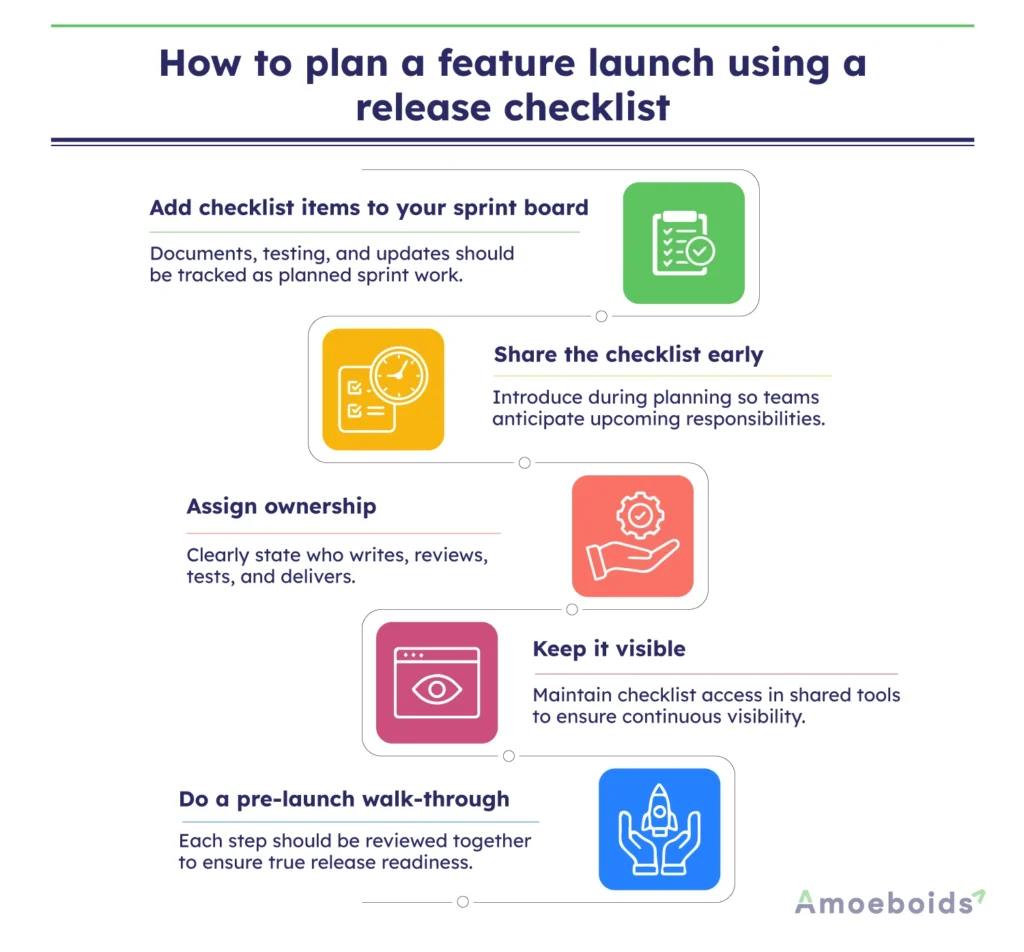
- Add checklist items to your sprint board: Treat docs, testing, and internal updates as real tasks and not as extras.
- Share the checklist early: Bring it into sprint planning or backlog grooming so teams know what’s coming.
- Assign ownership: Don’t leave things hanging. Decide who’s writing, reviewing, or testing what, and by when.
- Keep it visible: Use shared tools like Jira, Confluence, or even a pinned doc to keep the checklist front and center. With Amoeboids’ Automated Release Notes and reports app, you can link checklist items directly to Jira issues. This makes it easier to track progress, reduce miscommunication, and ensure nothing slips through the cracks during the release.
- Do a pre-launch walk-through: Before going live, review the complete list with your team. Discuss each step thoroughly instead of simply ticking boxes.
This way, your feature launch checklist becomes an integral part of your workflow, not just something you skim through the night before launch.
Common mistakes to avoid in a feature launch checklist
Here are the most common slip-ups that can derail a launch and how to avoid them:
- Rushing through the checklist just to “get it done.” When you treat it like a box-ticking exercise, you miss the chance to fix gaps before they become problems.
- Building the checklist without input from other teams. If you don’t involve marketing, support, or engineering early on, you’ll end up redoing work or dealing with misaligned expectations later.
- Assuming internal communication will sort itself out. Your users may be informed, but if your team doesn’t know what’s live or how it works, that disconnect will surely cost you.
- Only testing the ideal use case. Features often break not on the happy path, but in unusual workflows, old browsers, or under slow internet connections. If you don’t test those edge cases, your users will.
- Not assigning checklist tasks. If ownership isn’t defined, small steps slip through the cracks. And during a launch, even a missed “small step” can lead to significant consequences.
- Skipping follow-up after release. Many teams launch and move on, but you need to track how your feature is performing and review what went well and what didn’t.
Best practices for a seamless feature launch
Here are some measures to keep in mind to optimize your feature release checklist and make it as comprehensive and valuable as possible:
- Treat the feature launch checklist as a living document. Keep it updated based on what you learn from each release. What worked once might not work every time.
- Start planning for launch during development, not after. As soon as the feature is scoped, begin filling out your feature release checklist so other teams can plan alongside you.
- Communicate early, even if the date might change. A quick heads-up to marketing or support gives them breathing room, even if the details shift later.
- Document every version of your release notes. Whether you’re shipping to internal teams, beta users, or all customers, each group needs a different context and clarity.
- Build in time for unexpected delays. Buffers aren’t wasted time — they give your team space to breathe and reduce last-minute fire drills.
By following these best practices, you turn your feature launch checklist into more than a task list; it becomes a shared framework for cross-functional success. Keep refining it, stay aligned with your teams, and you’ll set the stage for smoother launches and better outcomes, every time.
Conclusion: Mastering the feature launch checklist for success
A successful feature launch comes down to preparation, not luck. You saw how assigning clear ownership, prepping internal and external communication, and testing like a real user can prevent last-minute stress. We also covered how to use the checklist during planning, not just at the end of the process. And how a quick post-launch check-in can give your team a clear path to improve. Pick one of the strategies we’ve discussed and try it in your next release. Small changes in how you plan can lead to much smoother launches.
If you’re using Jira, Amoeboids can help with its Automated Release Notes & Reports app and Roadmap & Idea Portal, so your launch tasks stay connected to your sprint work.
FAQs
Q. What should be included in a feature launch checklist for product managers?
A feature launch checklist should cover various aspects of the release plan. Key items include defining the feature’s goal, finalizing scope, preparing internal and external communication, testing, rollout planning, and post-launch monitoring.
Q. How does a feature release checklist ensure a successful product launch?
It keeps teams aligned, reduces last-minute surprises, and ensures nothing critical is missed before, during, or after the release. It also provides a record of the release timeline and helps track the process.
Q. What are the key steps in a feature launch checklist?
Steps include clarifying the “why,” assigning ownership, cross-team coordination, real-world testing, setting up metrics, and planning a follow-up. These can be used to optimize your feature release.
Q. How can a feature launch checklist help avoid common product launch mistakes?
It highlights areas often overlooked, like internal handoffs, unclear messaging, or skipped testing, so you can address them early. A checklist also ensures you don’t skip critical steps by mistake.
Q. Why is a feature release checklist important for a seamless product launch?
It gives structure to the launch process, helping product managers stay organized and confident across every phase of the rollout. It also helps teams coordinate and stay on schedule for the release.