
Imagine you’ve just launched a new feature in your app after weeks of brainstorming and development. You’re excited, but weeks later, adoption is low and user reviews are lukewarm. You’re left wondering whether it is the wrong feature or if you missed what users actually needed.
Smart businesses use data instead of guesswork to make smart decisions. Due to this, product analytics has become the foundation of strategic product building. Using data analytics, companies can learn about the behavior and expectations of their customers, which helps in achieving sustainable growth.
With this detailed resource, you will completely change your attitude toward product analytics and will get some practical ideas that will help you enhance business success in the shortest time.
What Is Product Analytics?
Product analytics refers to the process of analyzing user interaction with any product or service. The aim is to understand user engagement and behavior patterns to further improve their products or features.
The process involves:
- Tracking user interaction at every touchpoint
- Defining metrics as per business objectives
- Analysing user behaviour and engagement
- Identifying trends and areas of friction
- Building strategic plans for product/service optimization
The data you glean from a product analytics platform tells you on which features users spend most of their time, which actions they take the most, and which features get used least. However, before you use analytics, it’s important to understand its different stages of operation and the key metrics to track progress.
Understanding Product Analytics: Four Key Parts of Product Analytics
Any product analytics works in four unique steps. First, you decide the type of data that needs to be recorded. Then you set benchmarks for their evaluation. It helps you constantly track user behavior and opens the door for necessary modifications to your product or service. Let’s understand how each phase works with some product analytics examples.
To make this easier to follow, consider a scenario where you want to know how users interact with a newly introduced “AI Task Suggestion” feature in your project management application.
Now, the four steps go as follows:
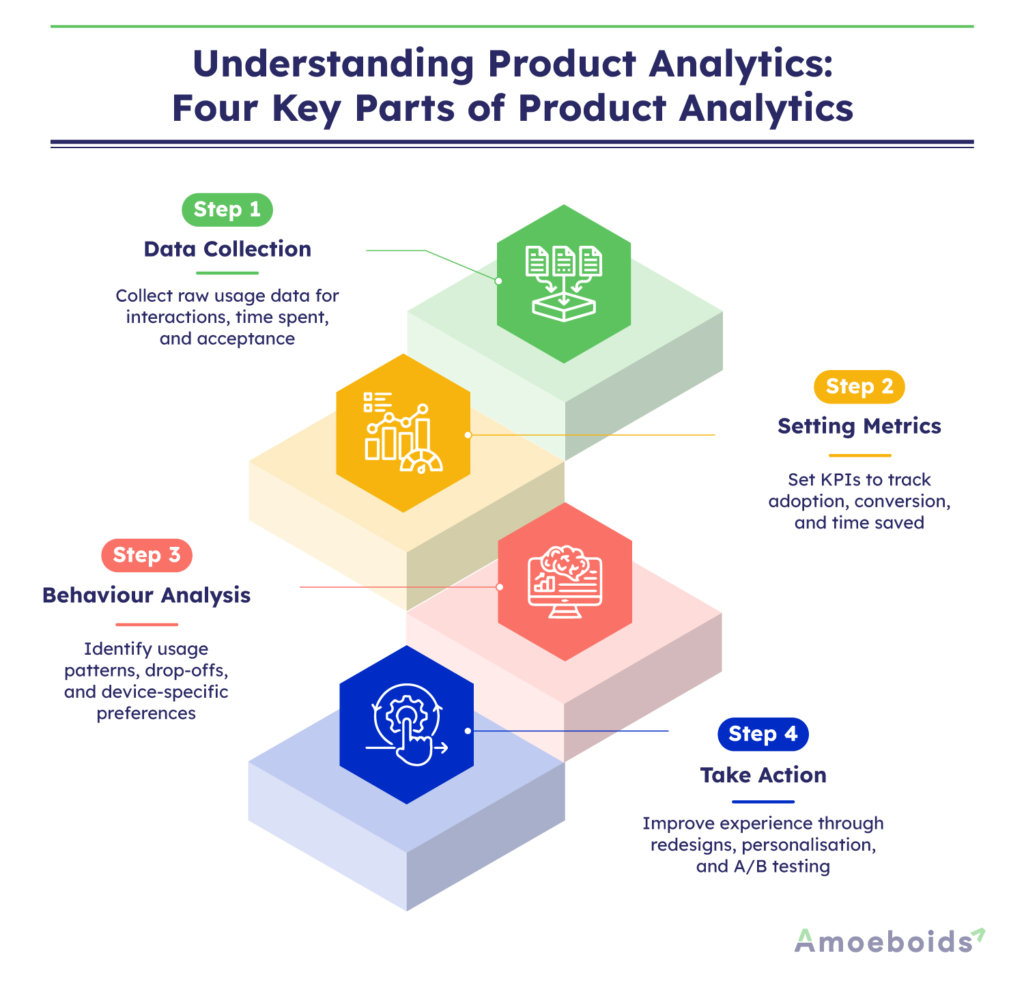
Step 1: Data Collection
In this stage, you decide what kind of data you need for analysis. For example, it could be:
- Number of users interacting with the new feature
- The amount of time they spend on it
- The type of AI suggestions is accepted most frequently
Note: This is the raw data, which will be processed for further analysis.
Step 2. Setting Metrics
Once data starts coming in, you need to decide what success looks like by defining your KPIs. For the new feature of your project management app, you might
- Monitor daily active users
- Measure the conversion rate
- Track the average time users saved by the feature
Step 3. Behaviour Analysis
Here, you look for patterns and insights hidden in numbers. For example, you might find:
- Many users abandon the new feature within a few seconds of interaction
- Acceptance rates are higher on mobile devices compared to desktops
Gradually, you start to understand what your users actually want and why.
Step 4. Take Action
Now it’s time to apply what you’ve learned to improve the feature and overall user experience. Based on the analysis, you might:
- Redesign the suggestions panel to make it more intuitive
- Personalize AI suggestions based on user history
- Run an A/B test comparing the current interface with a new one to see which drives more engagement
One of the major challenges with using product analytics is selecting the right metrics to gauge the real impact.
As we’ve explored the four core parts of product analytics, let’s look at why these elements matter and how they directly impact your business success.
The Importance of Product Analytics: Track Success through Key Metrics
Key metrics give you a real-time performance report of your product or newly added features. Here are some useful metrics to track the real impact in product analytics.
User Engagement
This measures how actively users are using your product and its features. For the ‘AI Task Suggestions’ feature, the ideal user engagement metrics can be:
- Daily Active Users (DAU): shows how many people use your product daily (e.g., only 200 out of 2000 active app users try it).
- Session Time: reveals how long they stay. A higher session time indicates a good value offering for users.
- Feature Adoption: compares the adoption rate of the AI feature with other recent updates to see which innovations are resonating.
- Retention Rate: shows returning users for the new feature week after week. A drop here could signal that the novelty wears off quickly.
Conversions
Metrics, as listed below, show how effectively you move users from interest to action.
- Funnel Rates: maps the user journey to show you where users drop off.
- Trial-to-Paid: measures how many users upgrade to the paid version after the trial period ends.
- Onboarding Completion: see if the new users finish the onboarding flow to learn how to use the new feature. Low completion means they might not even know the feature exists.
Business Impact
These metrics help you see how your features affect revenue and long-term value. Some popular metrics are:
- Customer Lifetime Value (CLV): find the long-term worth of users who actively use the feature vs. those who don’t. Higher CLV could justify further investment.
- Monthly Recurring Revenue (MRR): tracks whether revenue grows after launching the product or its features
- Churn Rate: see how many users leave after launching new features. A lower churn rate means the feature is helping with retention.
Overcoming Common Implementation Challenges
It’s often a challenge to keep the analytics pipeline accurate, actionable, and collaborative for teams and stakeholders alike. All it takes is using the best practices and the right tools that fit seamlessly into your existing workflow.
1. Data Quality Issues
Poor tracking becomes a significant impediment to successful analytics. Incomplete or inaccurate data can lead to flawed decisions.
What to do?
- Follow a strong data validation process to capture data correctly.
- Use a uniform naming convention to avoid confusion during analysis.
- Continuously audit data to maintain accuracy over time.
Consider leveraging advanced AI-powered apps to streamline the process. Such automated reporting solutions ensure that every update, sprint milestone, or release event is tracked and documented in consistent formats.
2. Analysis Paralysis
Information overload can affect teams negatively. This is called analysis paralysis. The solution lies in:
- Focusing on 5-7 actionable metrics instead of vanity ones
- Designing dashboards that help you make quick decisions
- Linking insights directly to next-step actions
3. Cross-Team Alignment
Analytics efforts lose impact when teams work in silos. To foster alignment:
- Use shared dashboards and centralize core metrics
- Conduct regular cross-team meetings to ensure uniform data interpretation
- Maintain visibility into what’s in progress and what’s coming next
It’s often a challenge to create a centralized, transparent roadmap for everyone to see priorities, contribute feedback, and track progress. A tool can help you overcome these challenges by helping you create a compelling shared product roadmap.
The Future of Product Analytics
Real-Time Analytics provides the opportunity to monitor user behaviour in real time and allows teams to jump on it, personalising at the point of interaction.
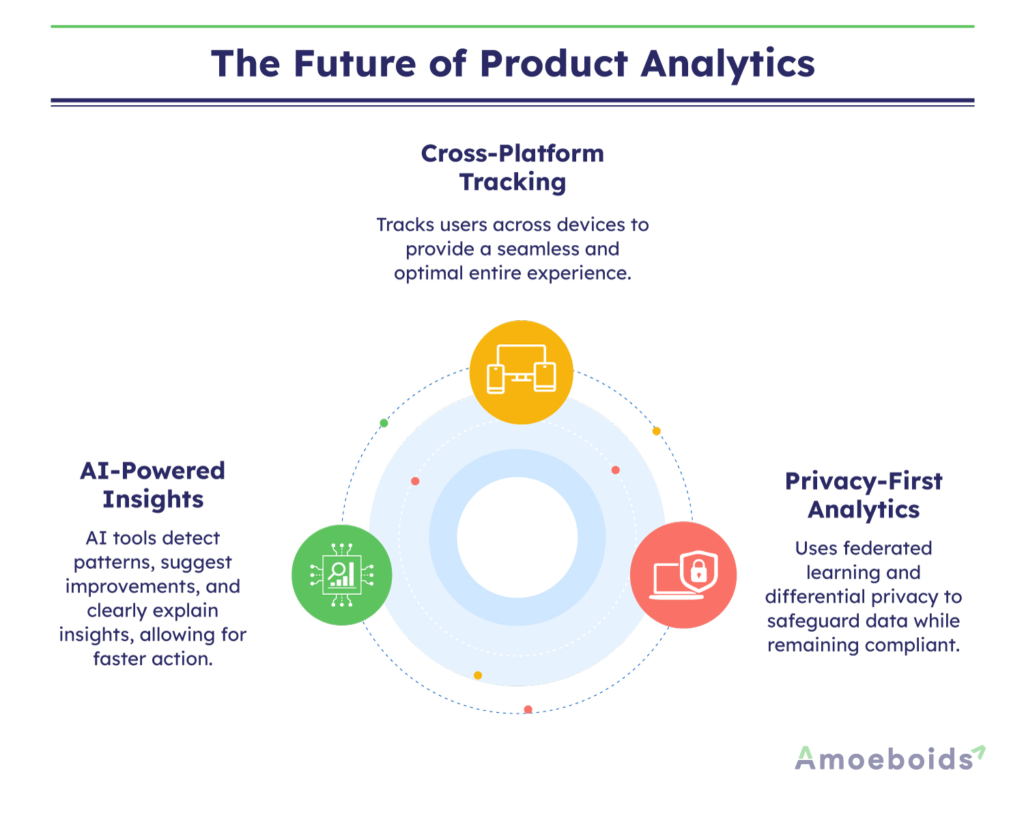
AI-Powered Insights
Besides collecting data, AI tools also help you make sense of it. They spot patterns, suggest improvements, and even explain results in plain language so teams can act quickly.
Cross-Platform Tracking
As users access devices, cross-platform tracking is used to guarantee a smooth user journey overview, and therefore easy and practical optimisation.
Privacy-First Analytics
Modern analytics protects user data while staying compliant with privacy laws. Federated learning trains models without moving raw data, while differential privacy adds statistical noise to mask individual identities. Together, they let businesses gain insights without exposing sensitive information.
Conclusion
Besides tracking numbers, product analytics acts as a bridge between what your customers want and what your business delivers. Once you learn how to set the right metrics, identify patterns, and overcome implementation challenges, you gain the clarity to improve user experiences, strengthen retention, and unlock new revenue opportunities. Combining product analytics with collaborative tools makes your team faster, sharper, and more confident.
Don’t let valuable data go unused. Start putting product analytics at the heart of your strategy today and see the difference it makes in building products that customers truly value.
FAQs
How can I begin using product analytics?
The first step is to locate your key metrics. Then select one of the best product analytics tools, implement tracking, and gradually improve your analytical abilities.
What distinguishes web analytics from product analytics?
A product analytics platform is a form of analytics distinguished by attention to consumer interaction with the features and operation of your product. On the other hand, web analytics is focused on the traffic of a website and other marketing statistics.
How frequently should I examine data from product analytics?
Regular monitoring is important daily on key indicators, weekly to trend, and monthly on strategic appraisals.
Can product analytics help small businesses?
Of course. Using the best product analytics tools may provide important data that will assist the small-sized business to make the right decisions using the limited resources available, as well as improve product decisions.