
Analysis paralysis refers to a state characterized by an inability to make a decision. It often arises from having too many choices or overthinking potential outcomes. Psychologist Barry Schwartz coined the term “Paradox of Choice” to describe how an abundance of options can cause anxiety and dissatisfaction.
Choice paralysis often strikes consumers during their day-to-day lives. It could hit them at the supermarket, where they find themselves dazzled by the wide selection of milk products available and can’t choose one for themselves.
Analysis paralysis can strike in the workplace as well. Think of a time when your team was asked to work on an important project with huge expectations placed on your shoulders. Did you find yourself agonizing over every choice and decision you had to make? And sometimes get stuck in place, unable to choose what to do. If the answer to either question was yes, then you’ve already experienced analysis paralysis.
In this article, we will look into what analysis paralysis is, why it occurs and the many different ways it can be overcome.
What is analysis paralysis?
Analysis paralysis refers to a state in which an individual gets stuck due to overthinking and is unable to make a decision. This usually happens when the person is faced with too many choices or the pressure to make a decision overwhelms them. Instead of taking action, they end up wasting endless hours over-analyzing the problem.
Let’s consider the following scenario. A sales director needs to finalize a pricing strategy for a new product. He spends weeks analyzing competitor pricing, resource allocation, running projections and testing different models.
Afraid of making the wrong choice, he keeps requesting more data and delaying the launch. Meanwhile, competitors introduce similar products, capturing market share while his team awaits his decision.
Let’s dive into figuring out analysis paralysis in greater detail next.
Analysis paralysis in action
Analysis paralysis doesn’t just affect big business decisions – it can also impact customer behavior and revenue. A fascinating client case study from Email Opshop highlights how too many choices can lead to decision fatigue, ultimately hurting conversions!
The study focused on an email marketing campaign from a previous holiday season. The original email (control) featured nine product blocks from two different categories – six from one category and three from another. The test version simplified the layout, reducing the number of product blocks to just six. The goal was to decrease analysis paralysis and improve conversions.
The results were eye-opening. The test version, with fewer choices, generated 21% more revenue per email (RPE) than the original. While the test email resulted in 20% fewer orders, the average order value (AOV) was 49% higher. This suggests that reducing choices helped customers make faster, more confident purchasing decisions, leading to higher-value transactions.
This demonstrates that too many choices can overwhelm people, leading to hesitation or inaction. By simplifying options, businesses can boost conversions and improve customer experience. They can also mitigate most of the adverse effects of choice paralysis.
The effects of analysis paralysis
While analysis paralysis might seem like simply overthinking and over analyzing at first, its impact goes far beyond mental exhaustion. It impacts businesses and even individual performance in many ways, including:
- Missed opportunities: Overthinking a particular decision can sometimes lead to missed opportunities due to delayed decision-making. For instance, they may lose out on top talent while recruiting or lose market share to another competitor.
- Decreased productivity: When stuck in decision-making, you waste resources and time. The projects are halted and the employees keep waiting for the decision which ultimately reduces productivity.
- Increased stress: With so much overthinking and overanalyzing comes stress. The fear of making the wrong decision causes anxiety and might lead to burnout. This increases overall work stress.
- Decreased confidence: When every decision becomes difficult, it impacts the individual’s confidence level. This lost confidence impacts everyday operations and might even lead to decision fatigue.
It is crucial to understand that striving for perfection in decision-making often leads to a bigger negative impact. It prevents individuals from utilizing their resources optimally and causes stress and burnout.
Let’s look at some methods to overcome paralysis by analysis next.
How to overcome analysis paralysis
Despite the seemingly insurmountable hurdles, there are many ways to overcome analysis paralysis. Two straightforward methods involve boosting decision-makers’ confidence and simplifying their choices. Let’s look at practical steps that can help you overcome analysis paralysis:
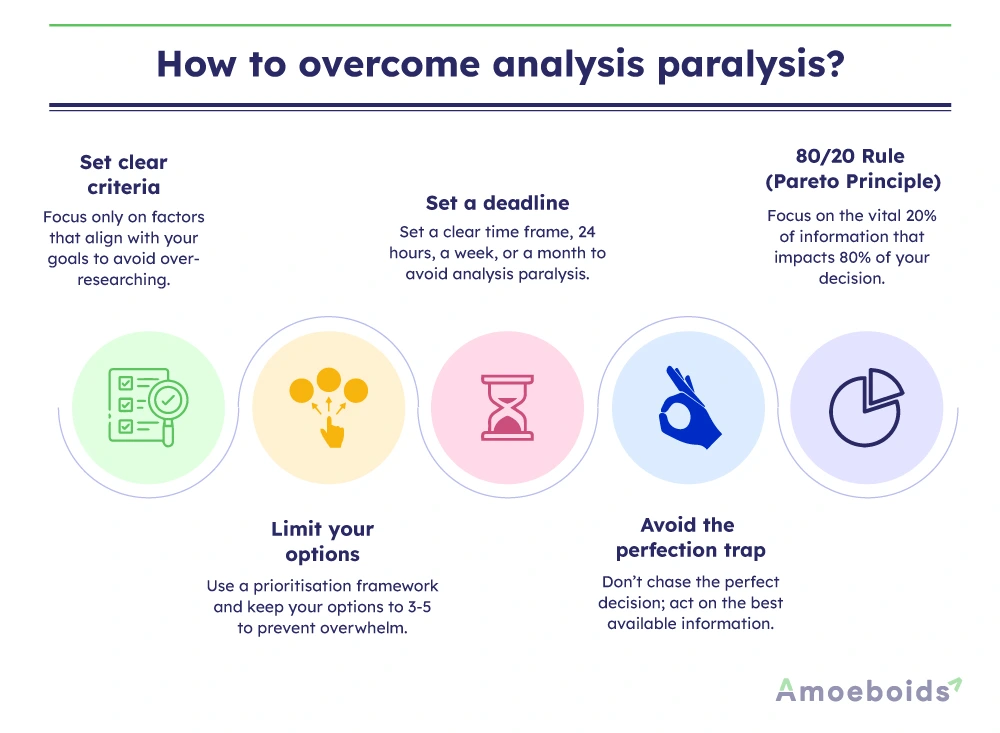
- Set clear criteria: Establish clear criteria for decision-making, utilizing only the truly important factors. This will help you focus on the most prominent factors instead of endless research.
Actionable step: Create a list of must-have vs. additional factors for your decision. Focus only on what aligns with your goals.
- Limit your options: Too many choices can be overwhelming. Narrow down the number of choices by eliminating some of them for faster and easier decision-making.
Actionable step: Narrow your choices to 3-5 options (use prioritization frameworks, if necessary) instead of considering every possible alternative.
- Set a deadline: An open-ended decision-making process leaves space for endless analysis. On the contrary, a clear deadline forces action upon the individual.
Actionable step: Assign a specific time frame – whether it’s 24 hours, a week, or a month – based on the complexity of the decision.
- Avoid the perfection trap: Many people get stuck in analysis paralysis because they fear making the wrong decision. Always remember that in most cases, progress is better than perfection.
Actionable Step: Shift your mindset from making the perfect decision to making the best decision with the information available.
- 80/20 Rule (Pareto Principle): In many cases, 80% of results come from 20% of inputs. Instead of getting lost in every detail, focus on the factors that have the biggest impact.
Actionable step: Identify the top 20% of information that drives 80% of your decision and ignore the rest.
- Accept external feedback: Sometimes, a fresh perspective helps break the cycle of overthinking. However, only take advice when it does not add to the confusion.
Actionable step: Consult 1-2 trusted colleagues, mentors, or friends. However, avoid seeking opinions from too many people.
Following these guidelines can help you overcome analysis paralysis in a systematic and step-by-step manner.
Conclusion
Analysis paralysis happens when critical decisions or too many choices create uncertainty, causing missed opportunities and leaving employees without clear direction. The pursuit of a perfect decision-making process can slow progress, lower productivity, and add stress. Setting clear criteria, establishing deadlines, and limiting options can help ensure timely, confident decisions without unnecessary pressure.
FAQs
How to know if you have analysis vs. decision paralysis?
Analysis paralysis happens when you overthink a decision to the point that you feel stuck and unable to act. Decision paralysis, on the other hand, refers to general difficulty in making decisions, even simple ones, often due to a lack of clarity or confidence.
How to avoid analysis paralysis?
To avoid analysis paralysis, set clear decision-making criteria, limit your options and impose time constraints on making choices. If a decision feels overwhelming, break it into smaller steps and take action gradually.
Does analysis paralysis come from stress?
Yes, stress can be a major trigger for analysis paralysis. When under pressure, your brain may overanalyze situations to reduce risk and avoid mistakes.