Imagine pouring months of effort into building a product, only to find that no one wants to buy it. The idea seemed great, and the features looked promising, but customers just weren’t engaging. This is a common pain point for startups—launching a product without ensuring there’s a real demand for it. This is where product-market fit (PMF) comes in.
Achieving PMF means your product effectively solves a pressing problem for a clearly defined audience, creating natural demand and sustainable growth. Without it, even the best marketing strategies and funding won’t save a startup from failure.
In this beginner’s guide, we’ll break down what product-market fit is, why it’s crucial for startup success, and the key steps to achieving it. Plus, we’ll highlight the clear signs that indicate whether your product has truly reached PMF.
What is Product Market Fit (PMF)?
In simple words, Product Market Fit means that your product meets the needs of your market. That is, people want what you’re selling. Marc Andreessen, a Silicon Valley investor and former founder, coined this term.
In his own words, “Product market fit means being in a good market with a product that can satisfy that market.” If you closely read Marc’s Product Market Fit definition, you will realize the emphasis on ‘good market.’
Marc argues that among the three variables – team, product, and market- the last one is probably the most found underlying reason for the success or failure of startups. You start with a ‘Bad market,’ and no matter how good your team and product are, you are already on the path of failure.
Also, note the phrase “a product that can satisfy that market”—it doesn’t say an extraordinary or groundbreaking product. The key is simple: if your product meets the needs of the right market, you have Product-Market Fit.
Why is product market fit important?
Product market fit is important because it is the foundation of a successful business. This means your product effectively solves a real problem for a specific market, leading to happier customers, better retention, and sustainable growth.
Product–market fit is crucial for the following reasons:
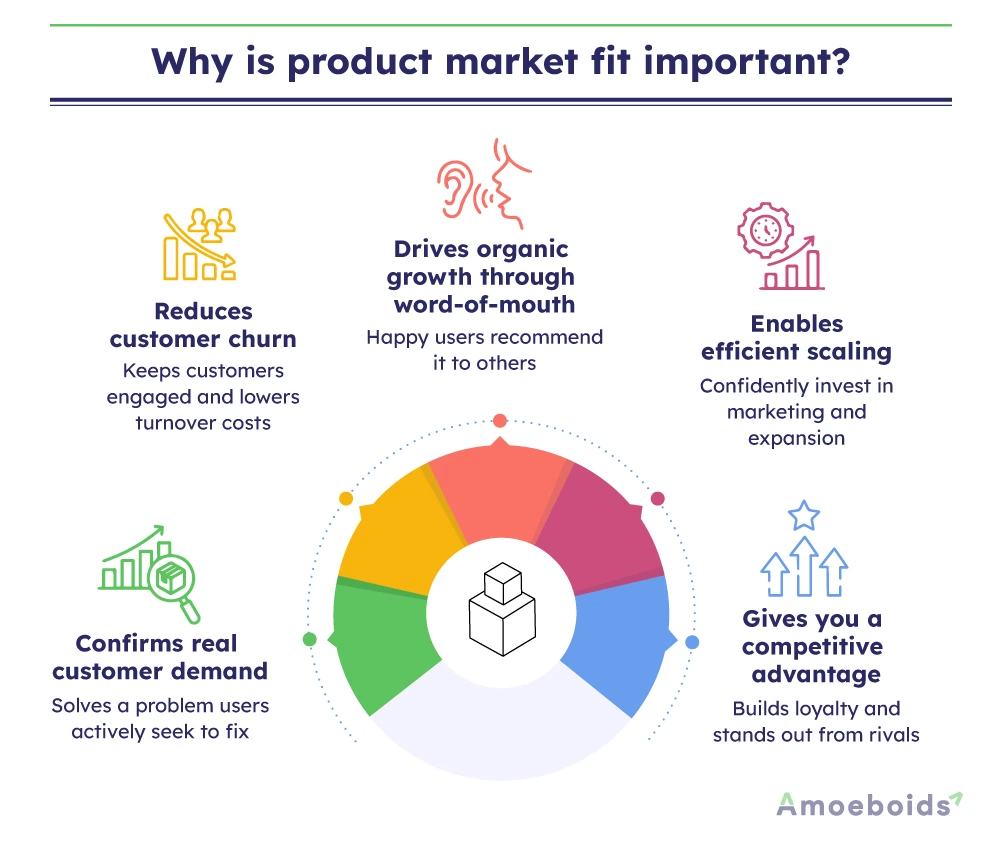
Confirms real customer demand
PMF proves that your product isn’t just a nice-to-have—it addresses a pressing issue your target audience is actively seeking to solve.
Example: Airbnb
Airbnb found PMF by offering affordable, local stays when hotels were fully booked during major events. This solved a real pain point for travelers, leading to widespread adoption.
Reduces customer churn
When people genuinely benefit from your product, they stick around. A strong PMF ensures lower customer turnover, meaning you spend less on reacquiring users.
Drives organic growth through word-of-mouth
A great product naturally gets people talking. When users find value in it, they share it with their networks, fueling organic growth.
Example: Notion
Notion, the all-in-one workspace tool, became a sensation because users loved its flexibility for note-taking, project management, and collaboration. Early adopters shared templates, tutorials, and workflows across social media and YouTube, leading to massive adoption without paid ads.
Enables efficient scaling
Once you’ve achieved PMF, you can confidently invest in marketing and expansion without wasting resources on a product people don’t truly need.
Gives you a competitive advantage
A product that meets real market demand is harder to replace. It builds customer loyalty and sets your brand apart.
Example: Slack
Slack revolutionized workplace communication by replacing fragmented tools with a simple, centralized messaging platform. Its seamless experience made it indispensable for teams, securing its dominance in the market.
Achieving product market fit isn’t just a milestone—it’s the key to long-term success. It validates demand, fuels growth, and ensures your business can scale with confidence.
How is product market fit measured?
The product market fit framework isn’t an exact science, but there are clear indicators that show whether your product is truly resonating with your market. Here are some ways to measure it:

- Customer retention rate: A strong sign of PMF is when customers keep coming back. If your retention rate is high, your product is valuable enough for users to continue using it over time. If retention drops, it may indicate a lack of long-term appeal.
Formula:
| CRR = (Customers at start of period − New customers acquired ) / Customers at end of period X 100 |
High retention = strong product–market fit.
- Net Promoter Score: NPS measures customer satisfaction by asking, “How likely are you to recommend this product to others?” You’re on the right track if most responses fall in the 9-10 range. A low NPS means your product might not solve a real problem effectively.
Responses grouped as: - Promoters (9–10)
- Passives (7–8)
- Detractors (0–6)
Formula:
| NPS = % of Promoters − % of Detractors |
A score above 50 is considered excellent.
- Churn rate: A high churn rate (customers leaving after a short time) signals poor PMF. If users drop off quickly, the product fails to meet their expectations or needs. Reducing churn should be a priority if PMF is weak.
Formula:
| Churn Rate = (Customers lost during period / Total customers at start of period) X 100 |
A low churn rate signals PMF.
- Market demand: A long waitlist or a surge in demand before launch indicates strong PMF. If customers are willing to sign up before the product is fully available, they truly want what you’re offering.
Measuring PMF is an ongoing process. Combining quantitative data and qualitative insights will give you a clear idea.
- Sean Ellis Test (The 40% Rule): Survey your users: “How would you feel if you could no longer use this product?”
If ≥ 40% respond “Very disappointed”, you likely have PMF.
If PMF Score ≥ 40%, it’s a green flag.
- User Engagement Metrics (DAU/MAU Ratio):
Formula:
| DAU / MAU Ratio = (Daily Active Users / Monthly Active Users) X 100 |
20–30% is typical.
50%+ indicates strong engagement → PMF likely.
- Revenue and conversion metrics: Look for consistent growth in monthly recurring revenue (MRR) and free-to-paid conversion rates.
| MRR Formula: MRR = Number of customers X Average monthly revenue per customer |
Benefits of Achieving Product Market Fit
Startups can grow, launch smarter, and make something people really want once they find the right product-market fit.
- Builds confidence: When your startup has product-market fit, it means that it is solving a real problem. This gives teams faith that they are making something that people really need.
- Reduces guesswork: It allows teams to make more informed product and business decisions based on current customer demand. Instead of making assumptions or forming personal opinions.
- Improves market alignment: When your product meets the needs of your target market, it becomes easier to attract customers and retain them over time.
- Supports launch success: PMF builds momentum before a successful product launch, allowing your product to enter the market with more relevance and demand.
- Drives long-term growth: Startups with product-market fit often see organic adoption, stronger engagement, and a clearer go-to-market strategy.
- Enables efficient scaling: Once demand is confirmed, teams can improve the user experience, boost conversions, and set the stage for growth in the future.
Examples of Product Market Fit
Understanding real-world product market fit examples is made easier when you see how companies identify and solve user problems effectively. These examples show how strong market demand, user adoption, and retention indicate the optimal product market fit stage.
Spotify
Spotify is a digital music platform that allows users to listen to songs at any time. It transformed music listening habits by making it quick and easy to access.
Challenge: Spotify identified a gap in how users wanted to access music: quickly and without restrictions, owing to rising piracy and declining sales.
Solution: It introduced on-demand streaming with a freemium model, personalised playlists, and a simple user interface. This improved the user experience, increased engagement, and drove repeat usage, which are all clear indicators of product-market fit.
Netflix
Netflix is a service that lets people watch movies and TV shows whenever they want. It changed the way people watch movies and TV shows.
Challenge: Netflix recognised that users wanted more control and convenience as their viewing habits changed and their interest in rentals decreased.
Solution: It added on-demand streaming with personalised suggestions, which helped people find content. This resulted in increased customer satisfaction, binge-watching behavior, and strong retention, making it an effective product market fit example.
Zoom
Zoom is a video chat service that is easy to use and dependable. It grew in popularity as remote communication became more common.
Challenge: After looking at feedback and problems with usability, Zoom found that the tools they already had did not meet users’ needs for ease of use and performance.
Solution: It focused on making it easy to get to and keeping connections stable, which made communication easier. This strong value proposition led to quick user adoption and regular use, proving that its product market fit strategy worked in the real world.
Canva
Canva is an online design tool that makes it easy for anyone to make graphics. It gave people who weren’t designers access to design.
Challenge: Canva found that people who didn’t know how to design had trouble with complicated tools and high prices.
Solution: It made the design process easier by adding drag-and-drop features and ready-made templates. It made usage simple, increased adoption, and improved retention, showing how companies run a product-market fit test using real user behavior.
How to achieve product market fit for your product?
Finding product market fit can seem tricky, but it’s all about listening to your customers and adjusting the product to meet their needs. Here are the steps in brief:
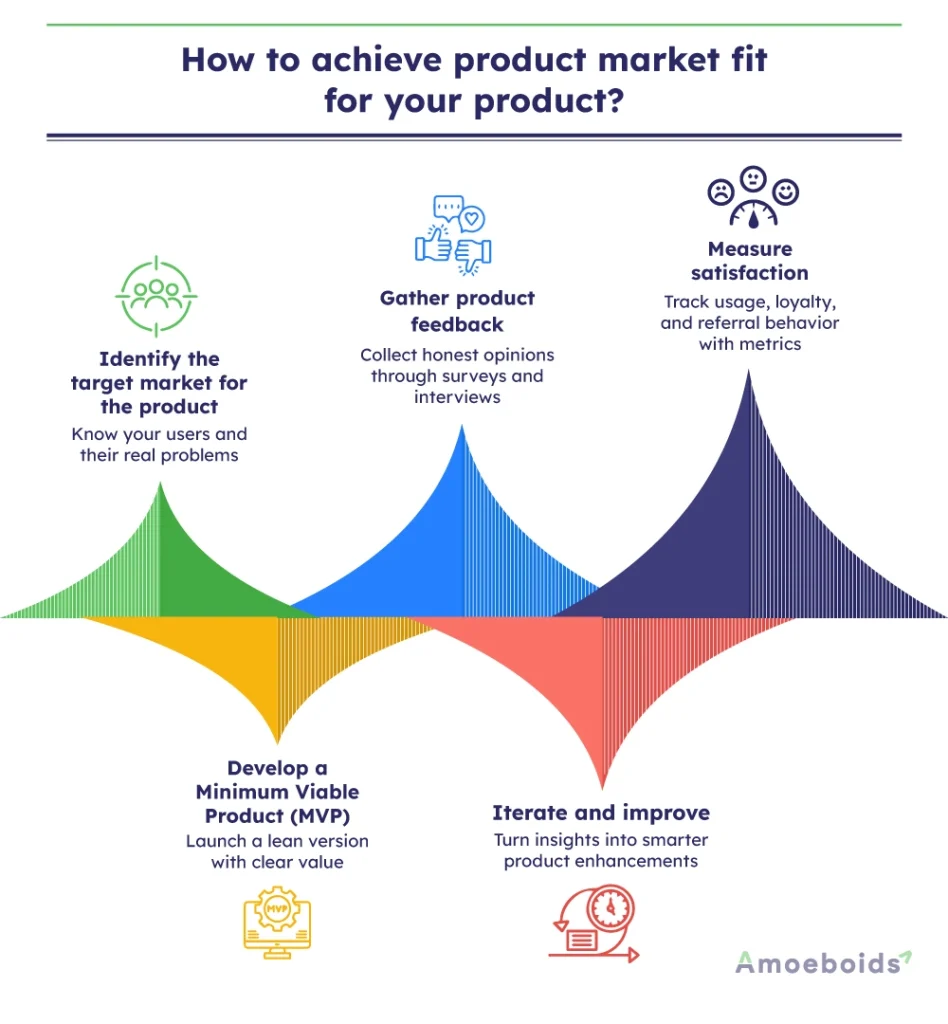
Identify the target market for the product
Know who your customers are. What are their problems? What do they need? Survey your audience and analyze market trends to get a clear picture.
Develop a Minimum Viable Product (MVP)
Start with a basic version of your product that solves a key problem. Think of it as the first draft of your big idea. This way, you can test your concept without investing too many resources. Craft a compelling value proposition to go along with the MVP.
Gather product feedback
Listen to your customers. Are they happy with your MVP? What features do they want? Use surveys, interviews, and user testing to get honest opinions.
Iterate and improve
The key to unlocking Product-Market Fit lies in truly understanding your users. Turn their feedback into actionable insights that drive meaningful product improvements. This might mean adding new features, changing existing ones, or rethinking your whole approach.
Measure satisfaction
Check if your customers are satisfied. Are they using your product regularly? Are they recommending it to others? Tools like Net Promoter Score (NPS) & CSAT can help.
Finding Product-Market Fit isn’t a one-time event—it’s an ongoing process of refining your product to meet customer needs. The key is to stay adaptable and listen to feedback.
Signs of a good product market fit
There’s no exact formula for Product-Market Fit, but you’ll know you’ve got it when your product starts selling faster than you can keep up.?
Here are some other tell-tale signs:
- High demand – Your target market has a high appetite for your product & you are struggling to douse that appetite with your current capacity.
Example: Tesla faced massive pre-order demand for its Model 3, far exceeding production capacity. This overwhelming interest confirmed that Tesla had built a product the market truly wanted.
- Positive feedback – Customers are giving you great feedback about your product on their own. The customers are not just delighted, they have become evangelists.
Example: Apple’s early iPhone users became brand evangelists, passionately praising the product and driving demand through organic enthusiasm.
- Strong word-of-mouth – Customers are talking about your product and recommending it to others without much marketing effort from you.
Example: Dropbox relied on referrals for growth, offering extra storage space for each new user invited. This strategy helped it achieve rapid adoption.
Product-market fit isn’t just about having customers—it’s about having passionate users who demand your product. If you notice these signs, you’re on the right track!
How to navigate a lack of product market fit?
Not every product finds its perfect market immediately. Here’s how to course-correct when you haven’t yet achieved PMF:
- Reevaluate your target audience: If your product isn’t resonating, you may be targeting the wrong audience. Conduct surveys, analyze customer feedback, and study market trends to ensure you’re addressing a real problem for the right people.
- Improve your product based on feedback: Listen to your early users. What do they like? What’s missing? Use this feedback to refine features, fix pain points, and enhance the user experience.
- Pivot if necessary: A strategic pivot might be the best option if your current product-market fit seems unattainable. Look at your core strengths and explore adjacent opportunities where your product can thrive.
By listening to your audience and being open to change, you can find the right market and set your business up for success.
What to Do After You Achieve Product Market Fit
Achieving product-market fit is a significant success, but it is just the beginning. Once your product has created demand, concentrate on improving customer retention, onboarding, and user experience. Protect your PMF from growing too quickly.
Next, make sure your go-to-market strategy aligns with the messaging, channels, and features that are driving adoption. This is an ideal time to invest in customer acquisition and expansion. Continue to monitor the product-market fit analysis, as continuous feedback and iteration are important for sustainable startup growth.
Conclusion
Finding the right product-market fit is like hitting the jackpot. It’s that crucial moment when your product truly resonates with your target audience, solving the right problem in the right way. Getting there requires time, iteration, and a deep commitment to listening to your market. But once you find that fit, everything else—growth, retention, advocacy—starts to fall into place.
Whether you’re launching a new product or expanding into a new market, embedding a product-market fit framework into your Go-To-Market (GTM) strategy isn’t just a best practice—it’s a strategic necessity. This framework helps you continuously validate assumptions, stay close to evolving customer needs, and build something people genuinely want.
As you move forward, remember: great products don’t just get built—they get shaped by the markets they serve. And finding product-market fit is what turns potential into lasting impact.
FAQs
Can a product lose product-market fit over time?
Yes, a product’s product-market fit can decline over time as customer expectations, competition, and market needs shift. That’s why conducting regular product-market fit analysis is critical for remaining relevant and delivering value.
What industries require faster product-market fit validation?
SaaS, eCommerce, fintech, healthtech, and consumer apps are some of the industries that need faster product-market fit validation because customer behavior and market conditions change quickly. In these areas, early feedback and market validation are critical.
How long does it typically take to achieve product-market fit?
Product-market fit can take several months or longer, depending on your product, target audience, and how quickly you respond to customer feedback. For most startups, it is a continuous process instead of a single milestone.
Can you scale a business without product-market fit?
You can scale without product-market fit, but it usually results in low customer retention, wasted budget, and unsustainable growth. PMF provides your company with the necessary foundation for a successful product launch and long-term traction.
How often should you reassess product-market fit?
You should review the product-market fit on a regular basis, particularly after major product updates, market changes, or shifts in customer behavior. Continuous review ensures that your product meets customer needs and market demand.