
The Atlassian Marketplace is no longer simply a directory of Jira apps.
It has grown into an ecosystem of more than 6,000 apps and integrations created by over 2,000 Marketplace Partners. These apps extend Jira, Confluence, Jira Service Management, Bitbucket, and other Atlassian products with specialised capabilities that Atlassian does not provide natively.
That scale exists because no two organisations use Atlassian products in exactly the same way. One team may need advanced reporting, another may require test management, while others need better automation, time tracking, roadmapping, documentation, or employee performance management.
Building each missing capability internally would be expensive and difficult to maintain. The Atlassian Marketplace gives teams another option: install a ready-to-use app that works with their existing Atlassian environment.
But the Marketplace is now entering a new phase.
Forge is changing how Cloud apps are built. AI is changing what those apps can do. Atlassian Rovo and Rovo Studio may also change how users discover and interact with specialised capabilities.
This guide explains what the Atlassian Marketplace is, how it works, why it matters, how to choose the right apps, and where the ecosystem may be headed in the age of AI.
What is the Atlassian Marketplace?
The Atlassian Marketplace is an online platform where organisations can discover apps that extend Atlassian products.
It includes free and paid apps for Atlassian products, with many paid apps offering free trials. Marketplace apps add functionality in many areas such as reporting and analytics, workflow automation, test management, time tracking, release management and so much more.
Marketplace Partners build everything from small utilities that solve one specific problem to enterprise applications supporting complex workflows across multiple departments.
How Does the Atlassian Marketplace Work?
Teams can search for apps on the Marketplace by Atlassian product, category, hosting environment, pricing model, and use case.
Each app listing generally includes its features, screenshots, pricing, compatibility information, documentation, support details, customer ratings, and recent reviews.
Once a potentially suitable app has been identified, teams can usually start a free trial and test it inside their own Jira, Confluence, or Jira Service Management environment.
The process itself is simple. The harder part is identifying which app genuinely fits the team’s workflow.
A search for “Jira reporting,” for example, may return apps designed for Jira dashboards, advanced analytics, financial reporting, sprint summaries, executive reports, or automated stakeholder communication. Although these products belong to the same broad category, they may solve very different problems.
Teams should therefore begin with a clearly defined outcome rather than a generic feature request.
Instead of saying: we need a Jira reporting app.
A more useful requirement would be: we need to automatically send leadership a standard project progress report every Friday without requiring them to log in to Jira.
That distinction makes it easier to compare relevant apps and avoid purchasing functionality the team does not need.
Why Does the Atlassian Marketplace Matter?
Atlassian products provide broad and flexible foundations, but they cannot support every organisation’s processes, industry requirements, or preferred way of working.
The Marketplace fills that gap in several ways.
It adds specialised capabilities
Different teams often need different functionality from the same Atlassian platform.
Product teams may need roadmapping or customer communication tools. QA teams may require test management. PMOs may need portfolio-level reporting. HR teams may want to manage OKRs and performance reviews alongside work already tracked in Jira.
Marketplace apps allow these teams to add specialised capabilities without replacing their existing Atlassian systems.
It reduces the need for custom development
A custom solution may offer an exact fit, but it also creates long-term responsibilities.
Someone must design, build, test, secure, document, and maintain it. The solution may need further development whenever Atlassian changes its APIs, architecture, or platform requirements.
For common business problems, purchasing a mature Atlassian Marketplace app can be faster and less risky than building an internal solution from scratch.
It connects Atlassian with other tools
Most organisations use Jira and Confluence alongside tools such as Slack, Microsoft Teams, GitHub, GitLab, CRM platforms, business intelligence systems, and customer-support software.
Marketplace apps help information move between these systems without requiring users to repeatedly copy, export, or re-enter data.
It helps processes scale
A workflow that works for one Jira project may become difficult to control when it is used across hundreds of projects and several business units.
Marketplace apps can introduce reusable templates, standardised reports, central administration, permissions, governance controls, and automated workflows as an organisation grows.
Popular Atlassian Marketplace App Categories
The Atlassian Marketplace covers thousands of use cases, but several categories are particularly common.
Reporting and analytics
Reporting apps turn Jira data into dashboards, charts, scheduled reports, management summaries, and stakeholder updates.
For example, Automated Release Notes and Reports for Jira creates release notes, sprint reports, project updates, and other recurring reports using Jira issue data. These reports can then be distributed through email, Confluence, Slack, Microsoft Teams, PDFs, webpages, and other channels.
Test management
Apps such as Xray and Zephyr add test cases, test plans, execution cycles, traceability, and quality reporting to Jira. They allow QA teams to manage testing without moving the entire process into a separate system.
Workflow automation
Apps such as ScriptRunner extend Jira with advanced scripting, workflow conditions, validations, integrations, and automation. These tools are useful when standard Jira automation cannot support the complexity of an organisation’s processes.
Time and resource management
Apps such as Tempo help organisations track time, allocate resources, manage project costs, and understand how effort is distributed across teams or initiatives.
People management and OKRs
UpRaise adds OKRs, continuous feedback, forms, employee engagement, and performance reviews to Jira. This enables organisations to connect employee goals and performance conversations with the work already being managed through Atlassian products.
These examples demonstrate why the Atlassian Marketplace matters: it allows organisations to adapt a shared Atlassian foundation to the specialised needs of different teams.
How Atlassian Marketplace Apps Improve Everyday Work
Most Marketplace apps create value in four broad ways:
- Automating recurring work: Generating reports, release notes, notifications, issue updates, or documentation without repeating the same manual process.
- Improving visibility: Turning raw Jira data into information that managers, customers, executives, and other stakeholders can understand.
- Connecting systems: Keeping information synchronised across Atlassian products and external business tools.
- Standardising processes: Providing reusable templates, centrally managed workflows, and consistent outputs across projects and teams.
The value of an app should therefore be judged through the workflow it improves, not the number of features displayed on its Marketplace listing.
How to Choose an Atlassian Marketplace App
With thousands of apps available, teams should evaluate a product through five practical questions.
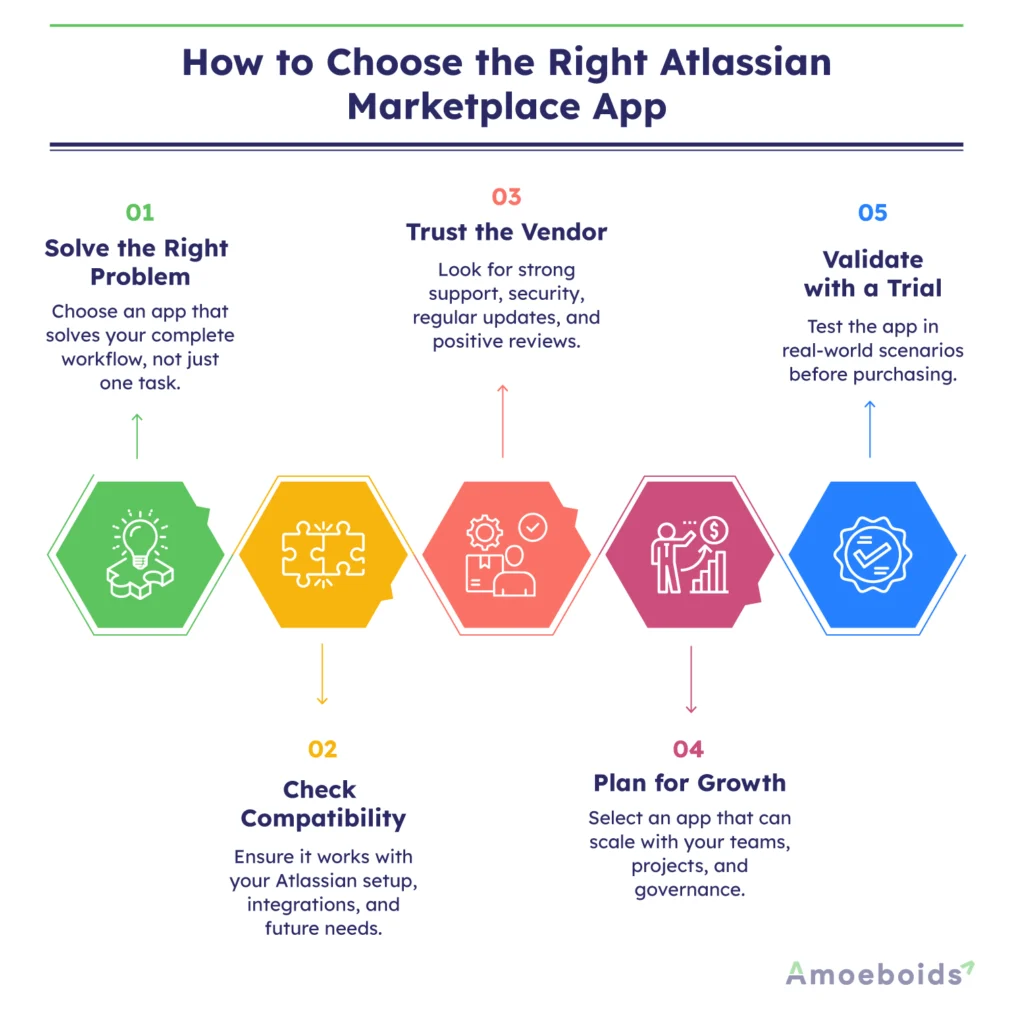
1. Does it solve the right problem?
Begin with the business outcome you need.
An app may have an impressive feature list but still fail to solve your actual workflow. Test whether it handles the complete process, including configuration, day-to-day use, output, distribution, and administration.
2. Is it compatible with your environment?
Confirm that the app supports your Atlassian product, Cloud or Data Center environment, user tier, existing configuration, and required integrations.
Cloud and Data Center versions of the same app may not provide identical functionality.
For existing Connect apps, customers should also understand whether the vendor has a credible Forge migration plan, since Atlassian has announced that Connect support will end after December 2026.
3. Is the Marketplace Partner trustworthy?
App selection is also vendor selection.
Consider the vendor’s history, update frequency, documentation, support quality, security practices, customer reviews, and product roadmap.
For an app supporting a business-critical process, responsive support and dependable maintenance may matter more than a long list of secondary features.
4. Will the app scale?
A utility that works for one project may become difficult to manage when adopted across several departments.
Consider whether the app supports larger data volumes, central administration, permissions, reusable templates, governance, and future requirements. Also review how its pricing changes as the number of Atlassian users increases.
5. Can you validate it during the trial?
Test the app using realistic projects, permissions, configurations, data volumes, and integrations.
Involve the people who will actually use or administer it. A trial conducted only by the buyer may overlook usability or workflow problems that become obvious to end users.
Common Atlassian Marketplace App Mistakes
A few avoidable mistakes account for many unsuccessful app purchases:
- Installing several apps with overlapping functionality
- Choosing solely by ratings or installation numbers
- Skipping the trial
- Ignoring Cloud and Data Center feature differences
- Failing to involve end users
- Evaluating only the immediate requirement
- Treating security and data handling as afterthoughts
- Underestimating the importance of vendor support
Organisations should also periodically audit installed apps. Products that are unused, redundant, or no longer supported can increase cost, complexity, and security risk.
How Are AI and Rovo Changing the Atlassian Marketplace?
AI is not merely becoming another feature inside Marketplace apps. It is beginning to change what apps do and how users interact with them.
Marketplace apps are becoming more intelligent
AI-powered apps can now help teams generate release notes, summarise Jira issues, categorise feedback, search knowledge, draft reports, and identify patterns across large amounts of project data.
The strongest implementations do more than add a generic chatbot. They apply AI to a specific workflow while using relevant Jira, Confluence, or Jira Service Management context.
For example, generating a project update is more useful when the app also knows which issues to include, how the report should be structured, who should receive it, and when it should be delivered.
Rovo may change how users interact with apps
Atlassian Rovo provides AI-powered search, chat, and specialised agents. Forge developers can also create Rovo agents and actions that invoke custom application logic.
Traditionally, users identify a problem, search the Marketplace, install an app, learn its interface, and perform the task inside that application.
In an agent-driven model, a user may instead describe the required outcome: Prepare a summary of the completed sprint and send it to the leadership team.
A Rovo agent could interpret the request, while a specialised Marketplace app retrieves the right Jira data, applies an approved template, generates the report, and distributes it.
The app does not disappear. Its capability is invoked through a different interface.
Rovo Studio may blur the line between building and buying
Rovo Studio allows users to create agents, no-code apps, and automation flows using an AI-powered builder workspace. This may enable organisations to create simple internal solutions that would previously have required a small Marketplace utility. Apps that perform one easily replicated task may therefore face greater competition from native automation and AI-assisted app building.
However, mature products that provide complex configuration, workflow depth, integrations, security, governance, support, and continued development will remain much harder to reproduce internally.
Why specialised Marketplace apps will still matter
Native AI will likely absorb more general-purpose activities such as search, summarisation, content generation, and simple automation.
But a general AI assistant and a specialised application do not provide the same thing. An AI assistant may summarise Jira issues. A specialised reporting app can additionally determine:
- Which issues are included
- How the information is formatted
- Which approved template is used
- When the report is created
- Who receives it
- Where it is published
- Which governance controls apply
AI provides intelligence and a more natural interface. Marketplace apps provide the structured processes required to perform specialised work consistently and reliably.
Where Is the Atlassian Marketplace Headed?
The Atlassian Marketplace is unlikely to disappear in the age of AI. It is more likely to evolve.
Forge is changing how Cloud apps are developed. Rovo is introducing new ways to search, automate work, and invoke specialised actions. Rovo Studio is making it easier for organisations to create some solutions themselves.
As these changes continue, the Marketplace may gradually become more than a catalogue of traditional app interfaces. It could become an ecosystem of apps, agents, actions, automations, and specialised capabilities operating across Atlassian’s platform.
Some simple app functions will become native features or internally generated automations.
But organisations will continue to need dependable solutions for reporting, testing, service management, governance, collaboration, and other complex workflows.
The interface may change. The need for specialised solutions will not.