Did you know that conversion rates can be increased by up to 200% with focused marketing initiatives?
Focused is the keyword here.
Days of mass marketing to thousands of people with the same message are long gone.
You cannot have a marketing team trying to reach each & everyone on earth. It just isn’t humanely possible to position your product/services to sundry.
And to help you focus, identifying & segmenting the target audience is the first step. In fact, all types of strategies – GTM strategy, Product strategy etc begin with target group segmentation.
Group customers according to their personality, behavior patterns etc & then focus only on the relevant cohorts. That’s the group that matches your ICP or Ideal Customer Persona.
This article is your reference guide to identify & segment the relevant audience.
What is customer segmentation?
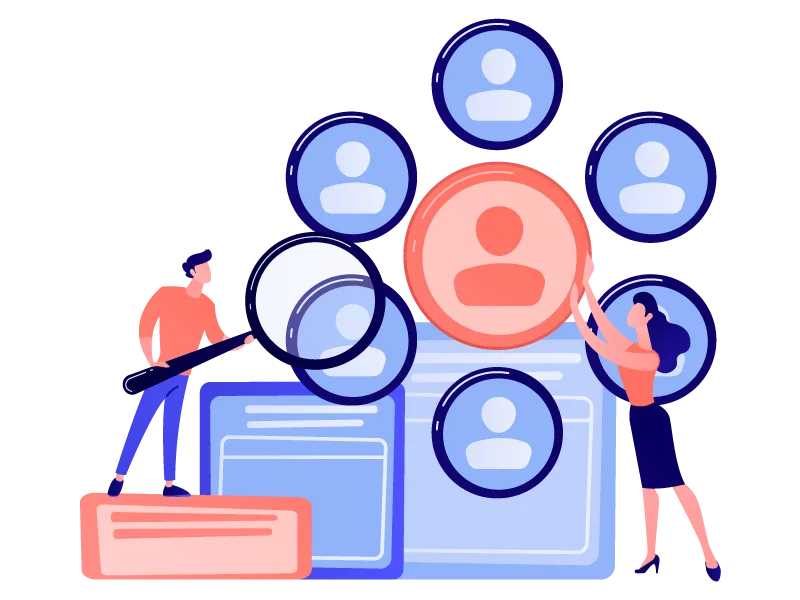
Customer segmentation is the activity to classify customers in clusters based on their traits that are relevant to your use case.
Relevant to your use case – that is, one business can segment customers based on their marital status while another can rely on its customers’ age or geography.
But why should you even consider segmenting your customers? That’s what we try to answer in the next section.
Why is it crucial to segment your target audience?
The process of audience segmentation is necessary because it allows you to target specific groups of users with specific messages that improve relevance and engagement.
Imagine trying to market a team collaboration software. Unless you zoom upon the audience by focusing on – either startups with less than 10 users, or SMBs or enterprise companies – it will be too difficult to position your product.
Each segment will need different messaging for you to convince them of your software’s utility. So according to the availability of resources, you can prioritize the marketing campaigns.
Resource allocation then becomes an informed exercise rather than guesswork. For example, you can invest more to target startups & SMBs in the initial stages. And then move upmarket at a later stage. Or the other way round.
But how do I identify & segment my target audience? Well, read on.
Steps to identify & segment your target audience
Take below steps & you are on your way to right customer segmentation:

- Create personas for your customers: First step is to create detailed customer personas (based on your own intuition & acquired knowledge) for your product/service. Mind you, these ‘detailed’ personas need not be perfect. In fact, we use them as our base & refine them in the following steps.
- Competitor analysis – Study the competitors, their messaging & thereby their customer segmentation logic. Look at their website/s, social handles, YouTube videos etc. Do this for at least 2 closest competitors. Use the analysis to refine the persona from first step.
- Conduct market research: Look at whitepapers & market surveys in your industry. In this step, you are looking for any clues around how your target customer group is adapting to technological advances & competitor failures. This will help you position yourself in a forward looking way.
- Evaluate sales data: If your product/services are already live, analyse your sales data with a keen eye. See if you can spot any patterns that reveal characteristics of your target group. If possible, do customer surveys to find more about your audience.
Customer segmentation methods & examples
With the primary data at your fingertips, now is the time to use various segmentation methods. Following methods will help you in dividing your target market:
- Demographic segmentation: This method of segmenting audiences is the most popular and usually the simplest. It depends on classifying your audience based on factors that include their age, income level, and job.
- Geographic segmentation: This technique uses data such as where people work, live. These data points can be further split into country, state etc
- Psychographic segmentation: This method divides the target users based on their ways of life, behavioral characteristics, beliefs, hobbies etc
Key is to utilize a method that is pertinent to what your product/service is. For example, a skin care product may be supported by demographic segmentation rather than geographic.
To refine your understanding of this topic further, here are few more customer segmentation examples.
Benefits of effective segmentation
A thought through customer segmentation will go a long way in generating the returns on your investments. Especially, it will help you in product development & marketing efforts.
Early-stage startups, especially the ones pursuing Product market fit (PMF) can derive outsized benefits by nailing their customer segmentation.
Here are some key benefits of effective target audience segmentation:

- Clear product/service messaging: Having in-depth knowledge about the target group improves your messaging.
- Better customer insights: You might have a better grasp of your users’ habits and preferences if you divide them up into smaller segments.
- More sales opportunities: Targeted marketing techniques can help identify unexplored markets and market niches, which could attract customers and boost revenue.
Avoid these mistakes while segmenting your target audience
Dividing your target audience into distinct smaller groups does offer a bunch of benefits. But, there are some common mistakes that marketers get trapped into while segmenting their customers.
Here are a few of the most common ones.
- Finding the correct balance is necessary. As the phrase states, “It’s a case of not seeing the forest for the trees,” which means that having too many different groups may make your marketing efforts tough.
- However, if there are too few groups, the messaging may be overly broad and fail to connect with any specific group.
- Customer segments are never static. They change as your product/service & its market evolves. Failing to update and review these segments can harm your business in the long term.
Last word
Customer segmentation is a powerful tool, but it’s not just the responsibility of the marketing team.
To truly harness its potential, collaboration across all customer-facing teams—sales, support, and product development—is essential. Each team brings unique insights that can refine and enrich your segmentation strategy, ensuring it aligns perfectly with real-world customer interactions.