
Struggling to make your business stand out in today’s crowded market? You’re not alone. A recent report by Forbes revealed that 73% of small business owners lack confidence in their current marketing strategies, feeling overwhelmed and uncertain about their effectiveness.
This uncertainty can lead to missed opportunities and stalled growth. Without well-defined business marketing strategies, even exceptional products or services may remain unnoticed, leaving potential customers unaware of the value you offer.
In this article, we’ll delve into practical and effective business marketing strategies designed to enhance your brand’s visibility. You’ll gain actionable insights and step-by-step guidance to develop a robust marketing business plan. It also covers how to conduct a thorough marketing analysis in your business plan and implement a successful digital marketing strategy.
By the end, you’ll be equipped with the tools to elevate your business’s presence and drive meaningful engagement.
What is a business marketing strategy?
In textbook terms, a business marketing strategy is “the basic approach a business unit uses to achieve its goals, encompassing decisions on target markets, market positioning, the marketing mix, and marketing expenditure allocation.” This definition comes from Philip Kotler, often referred to as the father of modern marketing. In his book Marketing Management (published in 1967), Kotler explains that a marketing strategy is rooted in understanding customer needs, crafting a compelling value proposition, and positioning the brand accordingly.
So, in layman’s terms, a business marketing strategy is a company’s overall game plan for reaching prospective consumers and turning them into customers of their products or services.
A comprehensive business marketing plan outlines the strategic framework of a company. Whether part of a broader marketing business plan or created independently, it serves as a roadmap for executing effective business marketing strategies.
Below are the essential components typically found in a well-crafted business marketing plan:
1. Executive summary
A concise overview of the company’s strategic marketing objectives and the key initiatives planned to achieve them.
2. Market and audience analysis
A data-backed evaluation of the target market, including customer segmentation, buyer personas, and behavioral insights. This section often includes detailed market research to support positioning and messaging decisions.
3. Competitive landscape
An analysis of competitors’ strengths, weaknesses, and market positions to identify gaps and opportunities for differentiation.
4. Unique Value Proposition (UVP)
A clear statement that articulates what makes the brand, product, or service distinctly valuable to its target audience. This forms the foundation of all messaging and branding efforts.
5. Marketing objectives and key metrics
Defined goals aligned with business outcomes—such as increasing customer acquisition, improving retention, or expanding into new markets—supported by key performance indicators (KPIs).
6. Digital marketing strategy
A structured plan for online engagement through SEO, content marketing, email campaigns, paid advertising, and social media. An effective digital marketing strategy ensures that every channel contributes toward overarching objectives.
7. Content and campaign planning
A tactical breakdown of the content types and marketing campaigns to be deployed, including timelines, audience segments, and performance benchmarks.
8. Budget planning
A financial plan outlining how resources will be allocated across channels and campaigns to maximize return on investment (ROI).
9. Team roles and responsibilities
A detailed outline of personnel involved in executing the marketing plan, including cross-functional coordination where Agile or Scrum methodologies are used.
10. Timeline and milestones
A structured calendar that outlines campaign launch dates, project checkpoints, and review cycles—functioning much like a sprint schedule in Agile product development.
11. Monitoring and optimization:
An ongoing strategy for tracking campaign performance, gathering feedback, and iterating based on real-time results and customer data.
Together, these elements create a cohesive structure that ensures all business marketing strategies are data-driven, goal-oriented, and aligned with the broader marketing business plan.
Why is a Marketing Strategy Essential?
A marketing strategy is important because it keeps your business on track and gets the right people to see it. It clarifies your goals, messaging, and channels, making it easier to follow structured marketing strategy steps and avoid chaotic efforts.
Understanding the importance of marketing strategy also allows teams to align their actions with business goals and track what works.
Learning how to develop a marketing strategy allows you to make better decisions and adapt to market changes. Using real-world marketing strategy examples and a simple marketing strategy template boosts reliability and overall performance.
Types of Marketing Strategy
Marketing strategies help companies reach the right people and grow steadily. The correct way to do things depends on your goals, your audience, and the channels you choose.
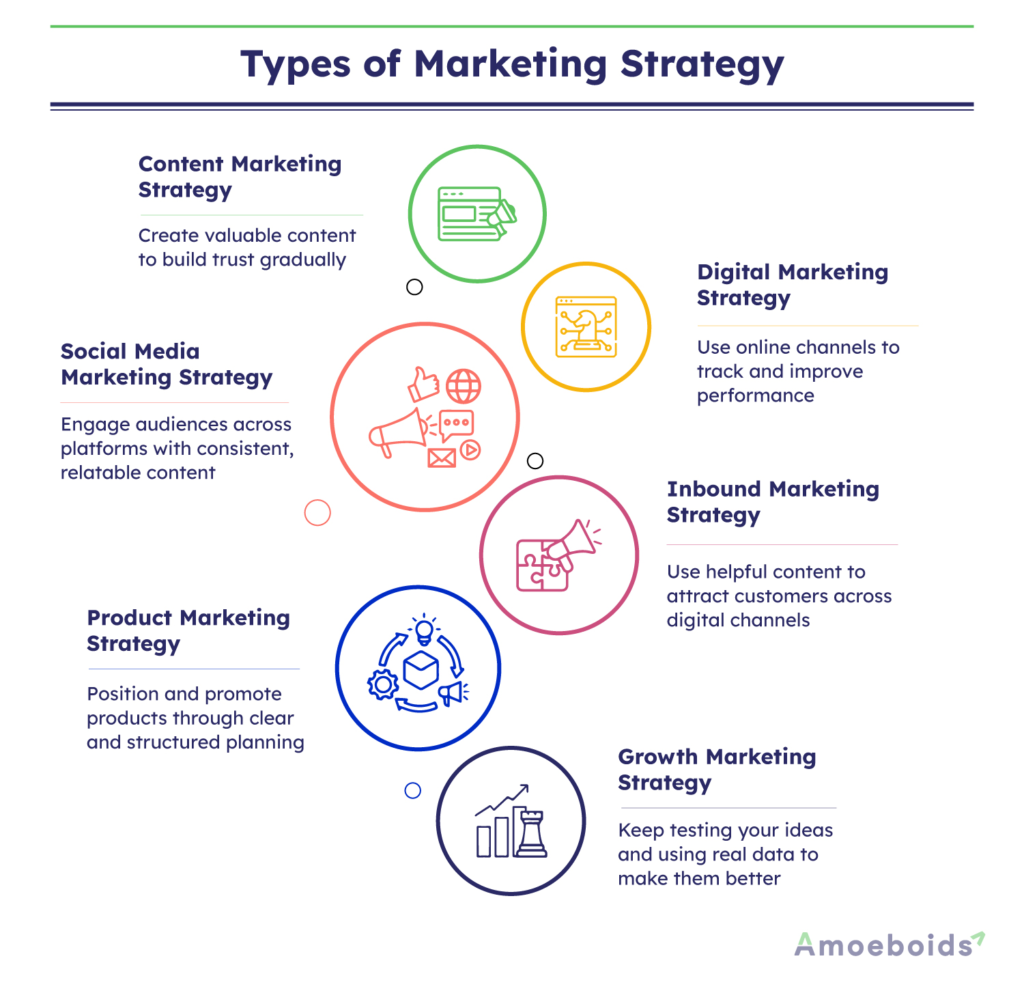
Content Marketing Strategy:
Making useful and captivating content, like blogs, videos, and guides, to engage your target audience and earn their trust over time.
Digital Marketing Strategy:
Using online tools like SEO, ads, and email, and following a clear plan to keep track of and improve your marketing performance.
Social Media Marketing Strategy:
Connecting with your target audience through platforms such as LinkedIn or Instagram, which are frequently inspired by real-world marketing strategies.
Inbound Marketing Strategy:
Bringing in customers through channels such as search engines, social media, and websites by sharing useful content and experiences is an important component of developing a marketing strategy.
Product Marketing Strategy:
Planning how to present and promote a product, typically using a simple marketing strategy template.
Growth Marketing Strategy:
Testing different ideas and improving based on data is useful in determining how to improve your marketing strategy.
Marketing strategies vs. Marketing Plans
Although the terms are often used interchangeably, marketing strategies and marketing plans serve distinct purposes within a company’s broader marketing framework.
Here’s a comparison to clarify:
| Aspect | Marketing Strategy | Marketing Plan |
|---|---|---|
| Definition | A high-level approach outlining long-term goals and brand positioning. | A tactical document detailing how to implement the strategy through campaigns and channels. |
| Focus | Vision, objectives, value proposition, audience segmentation. | Execution, scheduling, resource allocation, and performance tracking. |
| Time horizon | Long-term (typically 1–5 years). | Short- to mid-term (quarterly or annually). |
| Questions answered | Why are we marketing? Who are we targeting? What value are we offering? | How will we reach the audience? When and where will campaigns happen? |
| Key components | Brand positioning, buyer personas, UVP, marketing goals. | Campaign calendar, content types, budget, tools, KPIs, timeline. |
| Role in business planning | Forms a core part of the business marketing strategy and guides overall vision. | Forms the tactical layer within the broader business planning framework. |
| Example | “Position our SaaS platform as the go-to Agile tool for distributed teams.” | “Launch a 3-month LinkedIn ad campaign targeting Scrum Masters with a $10K budget.” |
The business marketing strategy lays the blueprint, while the marketing plan acts as the construction schedule that turns it into reality.
How to Develop a Marketing Strategy?
Understanding the importance of marketing strategy is essential because a strong business marketing strategy drives long-term business growth. Without it, your campaigns risk becoming reactive and disconnected from real business goals.
Follow these key steps to lay a strong foundation and drive results with purpose:
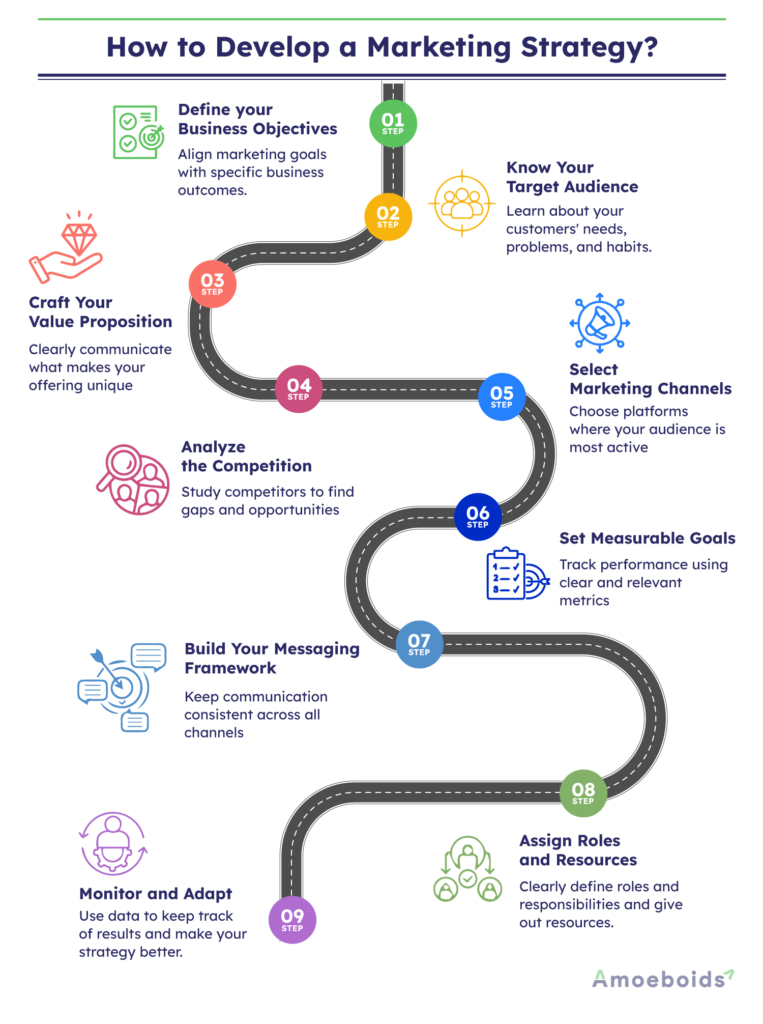
Step 1: Define your business objectives
Start by aligning your marketing goals with business outcomes—whether it’s brand awareness, lead generation, or product adoption.
Step 2: Know your target audience
Conduct a detailed marketing analysis as part of your business plan to identify ideal customer segments, pain points, and buying behaviors.
Step 3: Craft your value proposition
Clearly articulate what sets your offering apart. This becomes the core message across all campaigns.
Step 4: Analyze the competition
Study your competitors’ positioning, messaging, and tactics to identify opportunities for differentiation.
Step 5: Select marketing channels
Choose platforms based on where your audience is most active—email, paid ads, SEO, social media, or influencer marketing.
Step 6: Set measurable goals
Establish KPIs (e.g., lead volume, conversion rate, website traffic) to track performance and improve continuously.
Step 7: Build your messaging framework
Ensure consistent communication across channels. Tailor messaging for each customer segment and touchpoint.
Step 8: Assign roles and resources
Define who owns what—whether you’re managing sprints internally or working with external marketers.
Step 9: Monitor and adapt
Track progress, gather feedback, and refine your digital marketing strategy based on data, not assumptions.
Business marketing strategy becomes the anchor of your entire marketing business plan, ensuring every campaign drives measurable value.
Marketing strategy tools
Using the right tools can help you execute structured marketing strategy steps more effectively. These tools help with planning, tracking, and optimisation, making it easier to understand how to create a marketing strategy and improve results over time.
- Google Analytics:Tracks website traffic, displays user behavior, and counts actions such as sign-ups and purchases.
- SEMrush: Finds relevant keywords, analyses competitors, and boosts your online presence.
- HubSpot: One platform handles leads, runs email campaigns, and automates marketing tasks.
- Hootsuite: Plans social media posts and keeps track of how people interact with them on different platforms.
- Mailchimp: Makes email campaigns, divides audiences into groups, and keeps track of how well the campaigns are doing.
Implementing the Marketing Strategy for Sustainable Growth
Putting your plan into action is key to long-term success. A successful marketing strategy ensures consistency, better results, and continuous improvement across all of your marketing initiatives.
- Follow clear steps to make sure that campaigns go well and stay on track with business goals.
- Use a structured template to make sure that all teams send the same message and do the same things.
- Choose the right method based on who you want to reach, what you want to accomplish, and where your business is right now.
- Find out how to make a marketing strategy by trying out different ideas and using real data to make them better.
- Study real-world examples to better understand what works and how to apply what you’ve learned.
- Keep an eye on performance metrics and customer behavior to keep getting better results.
Conclusion
The importance of marketing strategy lies in its ability to support sustained business growth through clear direction and measurable goals. It helps you focus on the right target audience, choose effective channels, and deliver clear messaging.
Companies that follow structured marketing strategy steps and learn how to develop a marketing strategy can avoid uncertainty and make more informed decisions.
Using the appropriate tools and researching real-world marketing strategy examples improves your approach.
Remember that success requires consistent testing, learning, and improvement over time.
Stop speculation, start growing, and create a marketing strategy that produces measurable outcomes today.
FAQs
What are the types of business marketing strategies?
Some common types include content marketing, social media marketing, email marketing, influencer marketing, SEO, and product-led marketing.
What is an example of a business marketing strategy?
Nike has an impressive marketing strategy. They focus on emotional storytelling, brand positioning around innovation and athleticism, and partnerships with high-profile athletes. Their consistent messaging across campaigns reinforces their identity and deepens customer loyalty.
What do the four P’s mean in a marketing strategy?
The four P’s—Product, Price, Place, and Promotion—represent the core components of a marketing mix. Together, they guide decisions around what you’re offering, how much it costs, where it’s sold, and how it’s promoted to customers.
What does a marketing strategy look like?
It typically includes your target audience, goals, value proposition, competitive analysis, and the channels and messaging you’ll use to reach and convert customers.
Is a marketing strategy the same as a marketing plan?
No. Strategy defines the direction and goals, while a marketing plan outlines how you’ll execute that strategy through specific tactics, timelines, and resources.