
Imagine a growing company where product managers are buried in spreadsheets, engineers wait for missing details, and customer feedback is scattered everywhere. Progress slows down, and teams start pointing fingers. Such a scenario is common in many product-led organizations because there’s no clear system in place. That’s where Product Ops (Product Operations) comes in. It serves as a crucial catalyst to accelerate production by keeping teams aligned with a unified vision.
In this article, you’ll learn why Product Ops is so important, the challenges it solves, and how it can make product development faster, clearer, and more customer-focused.
If you’re wondering what is product ops, it is the operational backbone that helps product teams work effectively, make better decisions, and expand successfully.
What is Product Ops?
Product Ops is an operational framework that every product-led organization needs to handle the day-to-day tasks involved with development. The meaning of Product Operations can be perceived as a role or as a skill that every PMO can develop. At a core level, Product Ops involves assisting the R&D team with product planning and guiding their go-to-market counterparts to enhance processes related to the product. It also involves establishing standard operating procedures and governance to manage a unified product lifecycle.
For instance, Product Operations might introduce a new framework to help product managers manage multiple user feedback sessions at once, instead of analyzing them differently. The consistent prioritization of customer input in every session will reduce confusion and accelerate decision-making across teams.
The priorities of a Product Ops team can change depending on company maturity, industry type, and the nature of the product itself. Successful companies align product strategy and operations to ensure customer needs, business goals, and execution efforts remain connected. If it’s a fast-growing SaaS startup, the Product Ops team may feel responsible for setting up scalable feedback loops and customer data dashboards. However, while working for a mature enterprise in healthcare technology, the same team may prioritize compliance and governance to ensure products meet strict regulatory requirements.
Why is Product Ops important?
Product Operations caters to four main pillars of a product-led organization. The product ops role becomes increasingly important as companies grow and require greater alignment across teams, data, and workflows. These are:
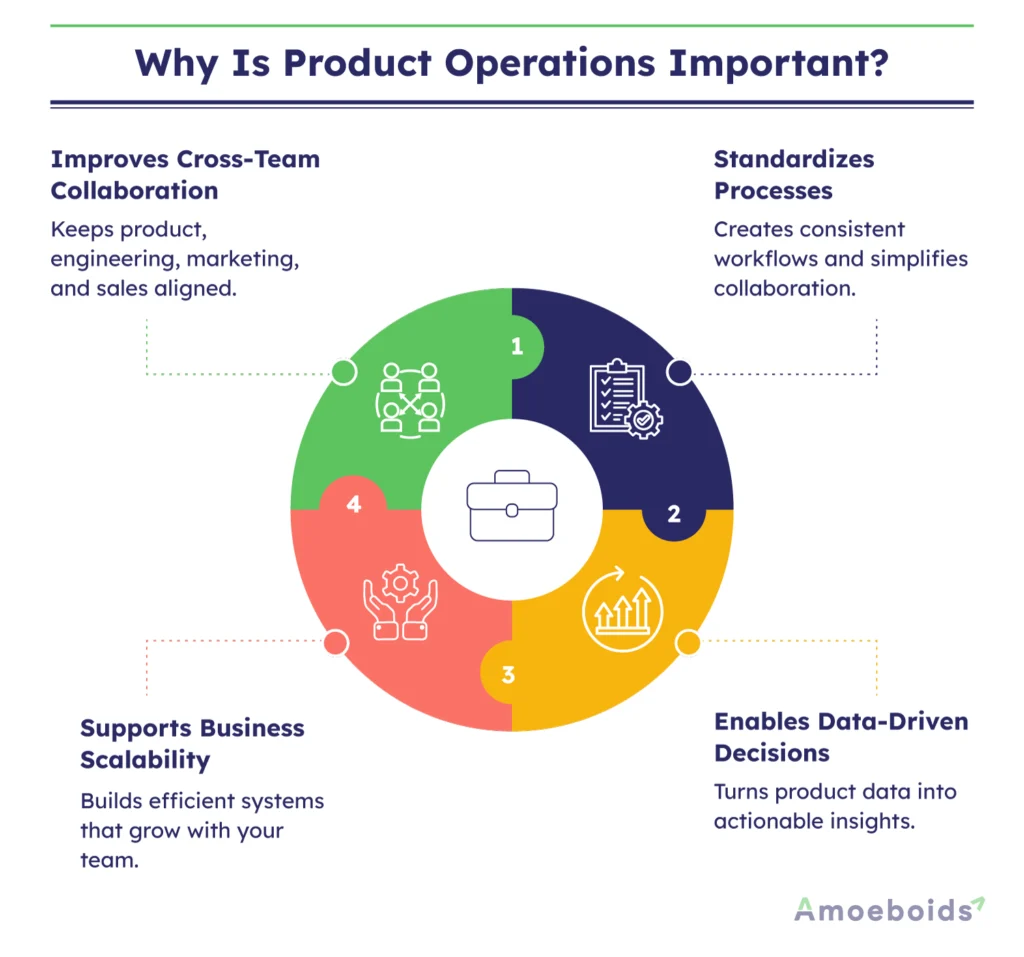
Cross-team collaboration
How far can you imagine the successful run of a product in the market if its engineering, marketing, and sales teams are not aligned? The R&D might deliver the feature on time, but marketing may lack substantial research to attract the right audience. With Product Ops, every team works in sync.
Process standardization
Senior product managers like to work in their signature process to collect feedback or track KPIs. This is absolutely fine until they have to collaborate and centralize the insights for future reference. The Product Ops team may roll out a unified system, allowing PMs to work within a consistent framework and eliminating any scope for confusion.
Data-driven decision-making
A product with multiple features may generate numerous insights on product analytics. Product Operations guides teams on how to separate the wheat from the chaff. Product leaders decide which features to double down on.
Scalability
A fast-growing organization may no longer benefit from ad hoc processes. If a startup moves up from 10 to 50 product managers, they can’t rely on informal Slack updates any longer. This is where the company can benefit through Product Ops by ensuring clear workflows for everyone.
Product Ops vs. Product Management
As product teams grow, responsibilities are frequently divided between strategic product leadership and operational support. Product Management is about defining what to build and why. Product Operations ensures people, methods, and tools allow for effective product execution.
| Aspects | Product Operations | Product Management |
| Primary Focus | Optimises product methods, workflows, and operational productivity | Defines product vision, strategy, and roadmap |
| Key Responsibility | Manages tools, systems, reporting, and team enablement | Identifies customer needs and prioritizes product initiatives |
| Success Metrics | Process performance, team productivity, and operational consistency. | Product adoption, customer satisfaction, and revenue growth |
| Stakeholder Collaboration | Works with product, engineering, analytics, and operations teams | Collaborates with customers, executives, sales, marketing, and engineering teams |
| Decision-Making Role | Offers data, insights, and frameworks to help with decision-making | Makes decisions on product direction, priorities, and investment |
| Business Outcome | Creates scalable systems to help product teams perform more effectively | Delivers products that solve customer problems and help companies grow |
What does Product Ops do?
The purpose of Product Ops falls into five core areas:
Tools
In a product development environment, teams may waste hours switching between multiple tools, only to end up with duplicate work or lost information. Product Ops guides teams on how to effectively use those tools to speed up the process.
Data
The Product Ops team can conduct both qualitative (such as customer feedback) and quantitative (such as usage data) analyses of your product performance. They turn this information into insights to help PMs make better decisions.
Experimentation
Let’s say the prototype of your new product requires testing a new pricing page for a smooth user experience. Product Ops saves you hours by organizing the A/B test and tracking results to share valuable insights with everyone.
Strategy
If analytics indicate that the new feature is not achieving success, Product Ops may bring together marketing and product managers to decide whether to improve it or retire it.
Developing a strategy with regular cross-functional syncs ensures alignment across teams. Strong coordination between product strategy and operations helps teams prioritise the right initiatives and achieve better business outcomes. The engineering team knows what features to build, the marketing team knows how to promote, and the sales team avoids pushing features that don’t exist yet.
A product ops manager plays a critical role in improving workflows, managing tools, and helping product teams operate more smoothly. A typical product operations job description includes process improvement, reporting, tool administration, stakeholder alignment, and operational support for product teams.
Key Responsibilities of a Product Ops Manager
A Product Operations Manager simplifies processes, manages tools, and supports data-driven decisions. They allow Product Managers to focus on strategy and customers.
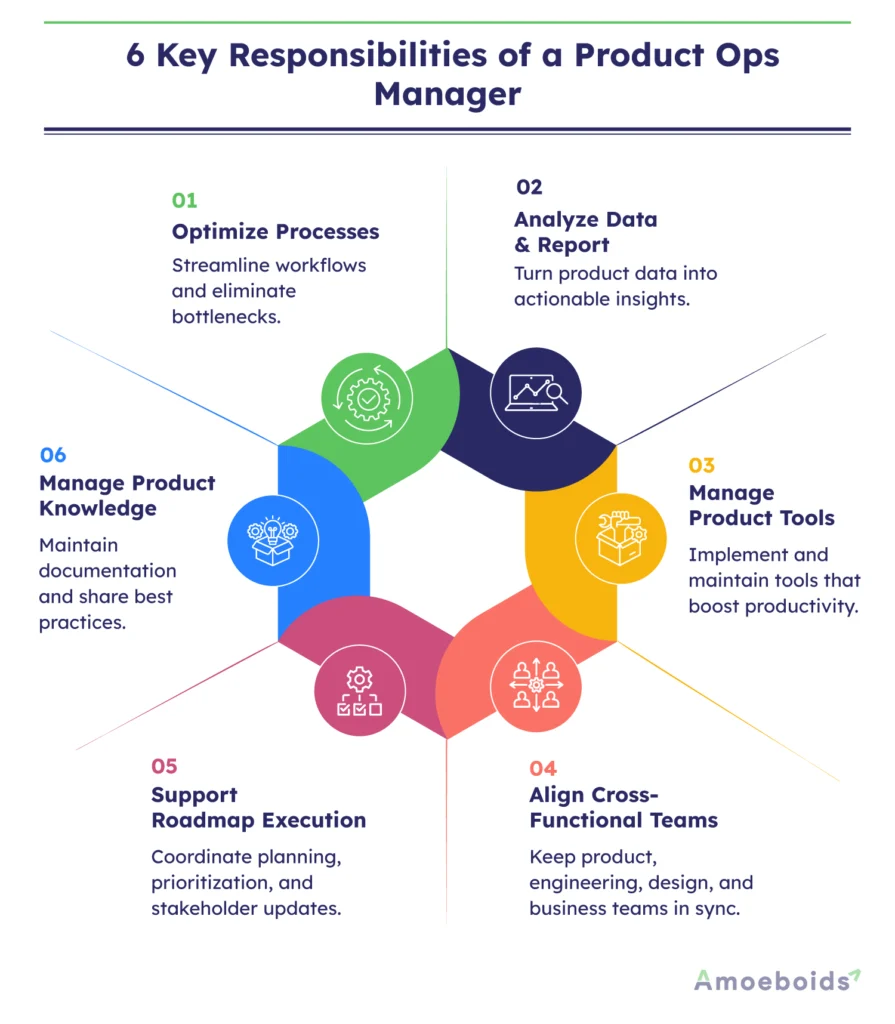
Process Optimisation:
Creates and refines structured workflows to help product teams operate more smoothly. This reduces bottlenecks and ensures consistent project execution.
Data & Reporting:
Turn product data into insights that guide your strategic decisions. Regular reporting allows teams to track their performance and identify areas for improvement.
Tool Management:
Tools used to support product operations are evaluated, implemented, and managed. This ensures that teams have the necessary tools to collaborate and work effectively.
Cross-Functional Alignment:
Fills communication gaps among product, engineering, design, sales, and customer success teams. This leads to greater cooperation between priorities and business goals.
Roadmap Operations:
Coordinates roadmap workflows for better planning, prioritisation, and stakeholder visibility. This helps teams focus on the most important initiatives.
Knowledge Management:
Provides key product information, documentation, and operational resources. This allows teams to quickly access knowledge and maintain consistency in best practices.
Why does a company need Product Ops?
As companies grow, product teams have to brace themselves for new layers of complexity. Below are some reasons why companies adopt Product Ops and the unique benefits it brings.
1. Reducing decision-making bottlenecks
A McKinsey study found that managers spend nearly 40% of their time making decisions, often due to a lack of reliable data. Product Ops creates a single source of truth by consolidating customer insights and product usage data for the same feature in the competitor products onto a dashboard. This reduces guesswork, and teams feel more confident about their direction.
For instance, there may likely be a difference in opinion between your marketing team and engineering team regarding adding a new feature. Without a product ops plan in place, the decision-making process might drag on for weeks.
2. Enhancing customer feedback loops
When teams work in silos, support tickets stay with the service team, and user reviews with product managers. As a result, companies miss valuable insights. For example, if customers complain about a slow checkout, the support team may log it, but product managers might never see the pattern. This can lead to frustrated customers and higher churn.
The Product Ops team knows how to categorize tickets, surveys, and reviews through a unified system. They may introduce prioritization frameworks (like RICE or MoSCoW) to separate “must-haves” from “nice-to-haves.” Repeated complaints get prioritized and proactively addressed to boost customer satisfaction and loyalty.
3. Improving product experimentation success
Many organizations struggle to test new features effectively. Imagine a mobile app team wants to test a new onboarding flow. Marketing runs one A/B test, while product managers try another, and engineering doesn’t fully capture the right metrics.
Product Ops standardizes the experimentation process. It sets clear hypotheses and coordinates across teams to capture the right metrics. Insights from successful tests help the team to focus on work that gives a more competitive edge to the product.
What Types of Businesses Need Product Ops
Product Operations develops adaptable workflows, enhances collaboration, and ensures effective execution as product teams expand and difficulty rises.
- SaaS Companies: SaaS companies manage frequent product updates, customer feedback, and changing roadmaps. Product operations helps to streamline releases, increase visibility, and ensure team alignment.
- Enterprise Organisations: Product Operations defines guidelines and governance to enhance consistency, collaboration, and execution across multiple product teams and regions.
- High-Growth Startups: Product Ops develops scalable workflows, reporting, and collaboration processes that support growth and prevent operational bottlenecks.
- Marketplace Businesses: Marketplace companies must simultaneously meet the needs of buyers, sellers, and partners. Product operations improves cross-functional coordination and contributes to the overall customer experience.
- Technology Companies: Product Operations enhances collaboration, operational productivity, choices, and delivery across large product portfolios and distributed teams.
Product Operations Tools
Product Operations teams use specialised tools to enhance clarity, automate workflows, and help with data-driven decisions. The right combination of tools allows product teams to collaborate effectively and scale their operations.
| Category | Purpose | Popular tools |
| Project & Work Management | These tools allow teams to manage tasks, prioritise initiatives, track progress, and maintain visibility across product roadmaps and ongoing development activities. | Jira, Asana, http://Monday.com |
| Documentation & Knowledge Management | Product requirements, meeting notes, guidelines, and best practices are all stored in centralised documentation tools, ensuring that information is easily accessible across teams. | Confluence, Notion, Slab |
| Analytics & Reporting | Analytics platforms provide insights into user behavior, product adoption, and performance metrics, helping teams make informed product decisions. | Amplitude, Mixpanel, Google Analytics |
| Customer Feedback Management | Feedback tools collect, arrange, and analyse customer suggestions, feature requests, and pain points to support product enhancement efforts. | Productboard, UserVoice, Canny, Roadmap & Idea Portal for JSM |
| Collaboration & Communication | Communication platforms allow for real-time discussions, project updates, and cross-functional collaboration among product, engineering, and business teams. | Slack, Microsoft Teams |
| Automation & Workflow Management | Automation tools reduce manual activities by connecting systems, streamlining repetitive tasks, and improving overall operational efficiency across workflows. | Zapier, Make, Airtable |
How is AI Changing Product Operations?
AI is changing Product Operations by automating routine tasks, boosting decision-making, and unlocking valuable insights from large data sets. This allows Product Operations teams to focus more on strategy and continuous enhancement.
- Automated Reporting: AI can automatically create reports, dashboards, and performance summaries, reducing manual effort while providing timely and actionable insights to stakeholders.
- Customer Feedback Analysis: Machine learning algorithms handle a large volume of customer feedback, helping teams in identifying recurring themes, feature requests, and emerging customer needs.
- Predictive Analytics: AI-powered predictive models help teams forecast user behavior, product performance, and potential risks, allowing for more proactive decision-making.
- Workflow Automation: Many common tasks like ticket category, documentation update, and status notification can all be automated. Simplifies tasks and reduces administrative workload.
- Decision Support: AI-powered recommendations help product teams prioritise initiatives, allocate resources properly, and make faster decisions based on data and trends.
Product Operations Trends
Product operations are evolving as organizations strive for greater performance, scale, and team alignment. Several emerging trends are influencing how Product Operations functions support modern product companies.
- AI-Driven Product Operations: Companies are increasingly using AI-powered tools to automate workflows, boost reporting accuracy, and ease operational decision-making across product teams.
- Unified Product Data Platforms: Companies are consolidating multiple data sources into centralised platforms, creating a single source of truth for product insights and reporting.
- Greater Focus on Product-Led Growth: Product operations teams are increasingly supporting product-led growth strategies with data analysis, experimentation, and customer insights.
- Increased Process Standardisation: Companies are investing in common frameworks, governance models, and operational practices to enhance consistency across product teams and initiatives.
- Enhanced Cross-Functional Collaboration: Product Operations is becoming a critical connector between product, engineering, customer success, marketing, and executive leadership teams.
- Outcome-Based Measurement: Organisations are moving away from activity-based metrics and toward customer outcomes, business impact, and long-term value creation.
Where can I learn more about Product Ops?
To harness Product Ops as a skill, you can take the help of plenty of resources available online, such as:
- Product-led communities: Join product-led communities or independent learning platforms offering free resources such as articles, podcasts, reports, and case studies
- Medium and Substack newsletters: Subscribe to newsletters of product professionals, like Melissa Perri or Marty Cagan, who publish free content on Product Ops best practices.
- YouTube talks and webinars: Follow channels like Product School and Product Coalition, which regularly host free sessions on Product Ops processes, tooling, and scaling
- Certification programs: Take a certification course in product operations from any reputable institution to gain proficiency in best practices
Note: Many teams get confused about product operations vs product management. It will help you to start right from there.
Conclusion
Product Operations is the framework that streamlines processes, aligns teams, and supports data-driven decision-making in product-led organizations. By managing tools, collecting feedback, and sharing precise data, Product Ops removes confusion and helps teams make better decisions. It also saves time by creating simple, repeatable processes that everyone can follow. As companies continue to scale, the product ops role will remain key for improving collaboration, consistency, and product execution.
In this regard, using the right tools makes all the difference. Tools can help you collect and centralize all customer feedback, ideas, and requests in one place, ensuring transparency and facilitating quick action. Collaborate with customers, come up with a compelling idea, and build what matters the most.
FAQs
What is the purpose of product operations?
The meaning of Product Operations is to ensure the product lifecycle runs smoothly. For that, it acts as a bridge between different teams to reduce friction. Product Ops also aids in standardizing test processes, managing software, organizing qualitative analysis, and centralizing insights that guide decision-making.
What is a key advantage of a product-focused operation?
A product-led operation always focuses on making better products that solve burning challenges of a consumer market. That effort, by default, prompts the team to use unique tools, track every single feedback, and respond to customer needs quickly.
What does a product operations lead do?
A product ops manager is responsible for improving workflows, reducing operational friction, and enabling product teams to perform at their best. The lead of Product Ops is responsible for reducing friction from the processes to keep product teams efficient. Sometimes, it requires customizing dashboards to convert customer feedback into a single source of truth. The other times, you will find the lead facilitating cross-team communication to ensure data, compliance, and go-to-market plans are in sync. The goal is to enable teams to focus more on strategies to deliver customer value rather than on understanding the processes involved. These responsibilities are commonly included in a product operations job description, especially in growing product-led organisations.
What are the key focus areas of product operations?
Product Ops typically focuses on five key areas: tools, data, experimentation, strategy, and leadership support. Together, these areas ensure the product lifecycle is smooth, customer feedback is prioritized, and growth is sustainable. Each area reduces inefficiencies and ensures teams work in sync, rather than in silos.
How does product operations differ from product management?
Understanding the distinction between product operations and product management is crucial for identifying roles and responsibilities. Product management is all about identifying what your product is going to be and why the customers are going to love it. Product operations, on the other hand, is about figuring out how you are going to bring your vision to life.
Which tools does product operations rely on?
The core operations of Product Ops revolve around team collaboration, data analysis, and process management. Therefore, tools that aid such functions, such as the Roadmap & Idea Portal for JSM from Amoeboids, are integrated and used consistently.