Imagine you have launched a new productivity app for busy entrepreneurs, but no one seems interested. The sales are low, the ads are not converting, and you start wondering what went wrong.
This is where a go-to-market strategy framework comes in. A go-to-market (GTM) strategy gives you a well-organized marketing plan to bring your product in front of the right people, at the right time, through the right medium.
However, many companies rush into applying the GTM framework to their marketing strategy without proper research and end up with more failures. They don’t invest time to fully understand their customers, the competition, or even how to present their product.
We will walk you through a simple, step-by-step guide to design your own GTM framework so you can launch with confidence and avoid common mistakes.
What is a GTM framework?
A go-to-market strategy or framework is a comprehensive plan to launch a new product or expand your business successfully into new markets. The framework serves as a guide to target the right potential customer with the right message through the appropriate marketing channels at the optimal time.
A structured gtm strategy framework helps companies align product, marketing, and sales efforts to achieve successful launches and sustainable growth.
A go-to-market strategy is useful when:
- An existing brand introduces a new product line in its current market (Example: A popular men’s clothing brand is introducing baby garments)
- An existing brand pushing its existing product to new markets (Example: A local beverage brand entering a new state)
- A company testing a novel item for a new customer segment (Example: Peloton launching in the US)
GTM Framework vs. Marketing Plan
A Go-To-Market (GTM) Framework and a Marketing Plan are frequently used together, but they have different purposes. A Go-To-Market (GTM) framework describes a comprehensive approach to launching, positioning, and delivering a product to the right customers. A marketing plan outlines the campaigns, channels, and promotional activities that will be used to execute and support the strategy.
The table below highlights the key differences.
| Aspect | GTM Framework | Marketing Plan |
| Purpose | Defines how a product will enter the market and meet business goals. | Determines how the product will be promoted to increase awareness and demand. |
| Focus | Market entry strategies include positioning, pricing, sales, and customer acquisition. | Campaigns, content, channels, and promotional initiatives. |
| Scope | Cross-functional teams work on product development, sales, customer success, and marketing. | Primary focus on marketing initiatives and execution. |
| Key Components | The target audience, value proposition, pricing, distribution, and sales strategy. | Campaign objectives, content strategy, budget, channels, and KPIs. |
| Success Metrics | Product usage, customer acquisition, revenue, and market share. | Leads, conversions, engagement, traffic, and campaign ROI. |
| Outcome | Develops a strategy for successful market entry and growth. | Drives awareness, demand generation, and engagement with customers. |
When Do You Need a GTM Framework?
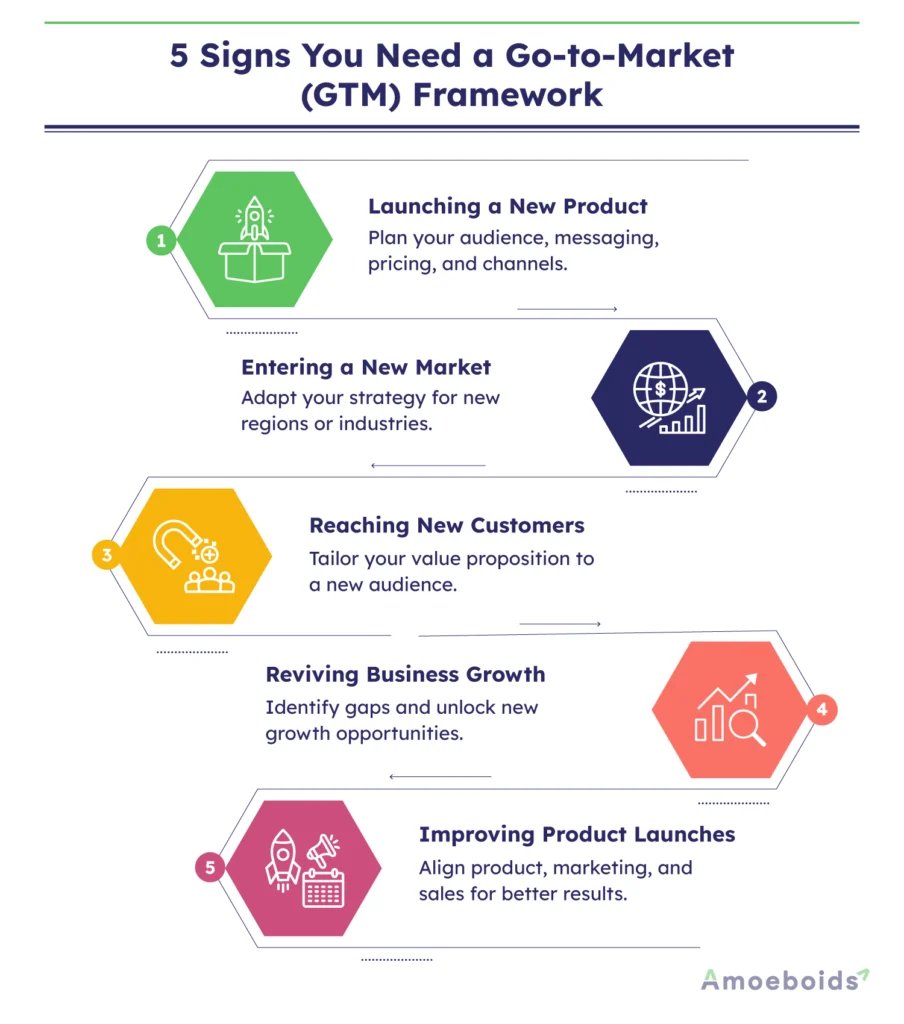
A Go-To-Market (GTM) framework helps you successfully launch a new product, enter a new market, or reach a new audience. It also helps to align teams, reduce confusion, and ensure that every launch is supported by a clear strategy.
Launching New Products:
Bringing a new product to market? A GTM framework can help you define your target audience, messaging, pricing, and distribution strategy before launch day.
Entering New Markets:
Expanding into a new region, industry, or customer segment requires more than optimism. You can better position your offering and understand market dynamics with the help of a GTM framework.
Targeting New Customers:
When you change your focus to a new customer segment, a GTM framework assures that your value proposition, messaging, and sales approach are appropriate for their needs.
Reviving Growth:
When customer acquisition slows or revenue growth plateaus, a GTM framework can help identify gaps in strategy, positioning, and execution. It allows teams to realign efforts, allocate resources, and identify new growth opportunities.
Improving Launch Success:
Great products do not always equal great results. A GTM framework helps align product and sales and marketing efforts to maximize adoption and impact on the market.
Why do you need a GTM framework?
McKinsey’s research shows that one out of four marketing attempts to penetrate a new market fails. The probability holds both for inexperienced and sophisticated startups. It could be due to various reasons, such as targeting the wrong customer segments or selecting a market that is already saturated. A comprehensive GTM strategy helps businesses avoid such costly missteps.
A well-planned go-to-market strategy can significantly benefit your project by:
- Creating alignment: With well-thought-out Standard Operating Procedures (SOPs), you can keep your entire team on the same page to prevent disorganization.
- Saving money on unnecessary processes: You will be more strategic and focused with your budget allocation for underlying processes to meet your goals.
- Establishing product-market fit: A GTM strategy enables you to tailor your messaging and pricing to align with your target audience segments.
Take Apple, for example. Long before launching the iPhone, Steve Jobs experienced the biggest flop with the Apple Lisa computer. Despite having the best graphic technology of its time, the product failed to resonate with its target audience. Critics attributed the failure to its misleading ads and high price.
Go-to-Market Strategy Benefits
GTM strategy is not just a support system for a product launch, it is a clear roadmap to the right customers, creating demand and profitable growth. It allows teams to work toward common goals while avoiding costly mistakes and missed opportunities.
- Faster Market Entry: A GTM strategy provides a clear path from planning to execution, allowing teams to move more quickly and confidently.
- Better Customer Alignment: A GTM strategy makes sure that your messaging connects and provides real value by targeting the right audience and understanding their needs.
- Stronger Team Collaboration: Sales, marketing, product, and customer success teams follow a common strategy, reducing silos and improving execution.
- Higher Revenue Potential: Clear positioning, targeted outreach, and effective sales efforts improve the chances of attracting, converting, and keeping customers.
- Reduced Business Risk: GTM strategy helps validate norms, identify potential challenges early on, and make data-driven decisions before significant resources are spent.
Key components of a GTM framework
Most organizations combine marketing and sales strategies to customize their GTM strategy. However, in general, an ideal go-to-market framework has the following key components.
- Target market definition: Identify your ideal customers and their needs
- Customer segmentation and personas: Group customers into segments and build clear personas
- Value proposition and messaging: Define what makes your product unique and valuable
- Pricing and packaging strategy: Set competitive pricing and promote bundle offers
- Sales and distribution channels: Decide how and where your product will reach customers
- Marketing strategy and demand generation: Plan campaigns to build awareness and attract leads.
- Sales enablement and alignment: align sales and marketing teams for clarity on product USPs
- Customer journey and onboarding: Design smooth experiences from awareness to adoption
- Metrics and KPIs: Track campaign performance with various GTM metrics to measure success
- Feedback and iteration loop: Collect insights and refine your strategy continuously
Popular GTM framework models
Most organizations combine marketing and sales strategies to customize their GTM strategy. However, in general, there are four popular gtm frameworks, as follows.
- Self-service model
This model works best for low-priced B2C products that customers can buy directly from a website or app, such as Amazon. There is no need for a sales team, as marketing alone can bring traffic and drive conversions. It’s ideal for simple, easy-to-understand products.
- Inside sales business model
This model is common in B2B companies where prospects need some guidance before buying. Sales reps connect with leads through calls, emails, or demos to explain the product’s value. It suits products of medium complexity and usually has a sales cycle that lasts a few weeks or months. Profitability increases when the company handles a high volume of sales.
- Field sales business model
This approach is used for large enterprise deals where products are complex and costly. Sales representatives meet clients in person, build relationships, and tailor solutions to their needs. Although the sales cycle is long and the number of deals is low, each sale brings in high revenue. A skilled and experienced sales team is essential here.
- Channel model
In this model, companies work with partners, distributors, or affiliates who sell their product for them. It reduces the cost of maintaining a large sales team and helps expand reach faster. This model works best when your product matches the partner’s existing customer base or business interest
Understanding different gtm frameworks allows businesses to select the approach that best matches their product, audience, and growth goals.
How to Choose the Best GTM Strategy for Your Business
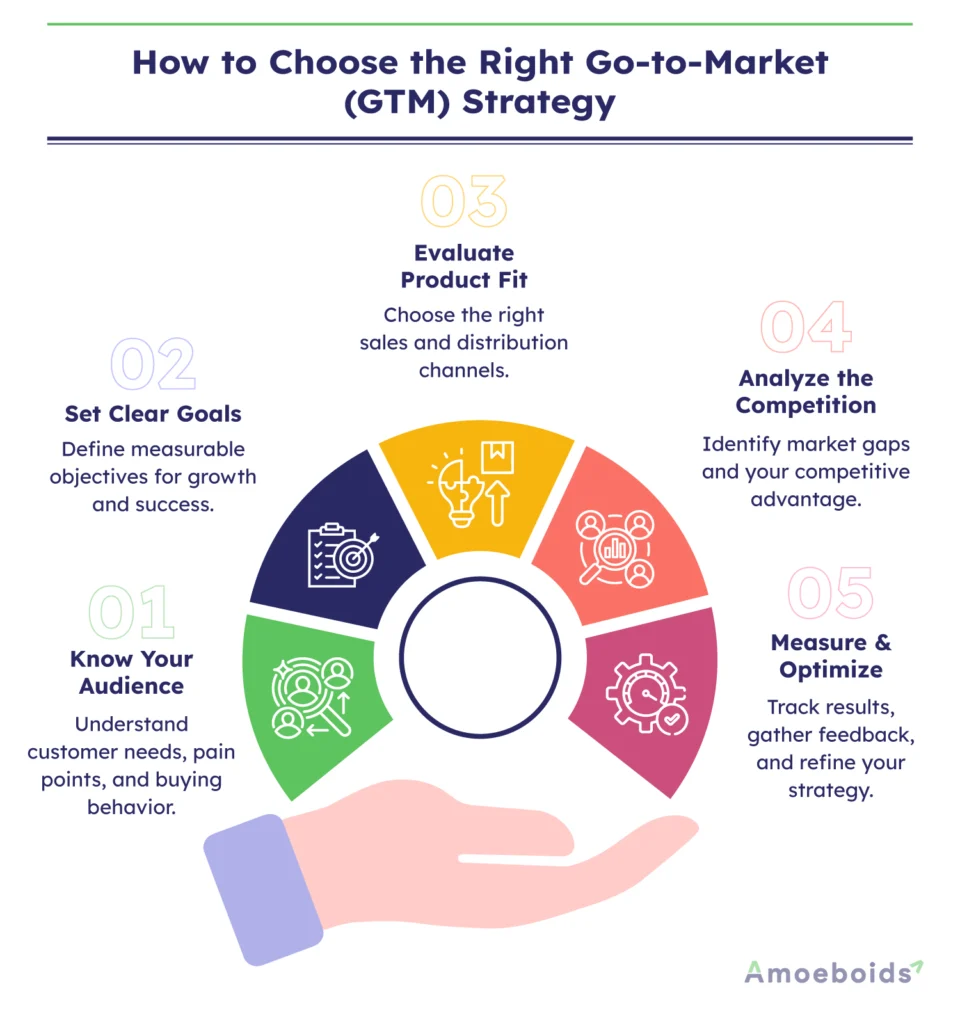
The most effective Go-to-Market (GTM) strategy is defined by your customers, product, and business objectives. You can choose an approach that has the greatest impact and drives long-term growth by considering a few key variables.
Know Your Audience:
Understand your ideal customers, the challenges they face, and what drives their purchasing decisions. This allows you to create messages and offers that truly resonate.
Set Clear Goals:
Define success as acquiring new customers, increasing revenue, or expanding into new markets. Your GTM strategy should directly support these goals.
Evaluate Product Fit:
Look at the value, complexity and price of your product to identify the best sales and distribution channels. The right fit will make the transition easier and faster.
Study the Competition:
Analyse competitors to better understand their strengths, weaknesses, and market positioning. This allows you to identify opportunities to stand out and capture customer attention.
Measure and Adapt:
Track performance metrics and collect customer feedback on a regular basis. Use these insights to improve your strategy and results over time.
Whether you’re launching a startup or entering a new market, a clear framework for go to market strategy helps turn ideas into measurable business outcomes.
Step-by-step guide to creating a GTM framework
Follow this exact blueprint to build your GTM framework from scratch.
Step 1: Find a go-to-market framework template
Find a free go-to-market strategy template to keep your teams aligned while launching a new product or service. They contain formats for email, product roadmap, lifecycle mapping, SWOT analysis, and sales plan. Using a structured go to market strategy template can help teams stay organized and avoid missing critical launch activities.
Step 2: Identify ideal customers
According to Gartner, a typical customer segment can have between six and ten decision-makers. For instance, a customer segment may have influencers as well as gatekeepers, who may act as blockers in getting your product approved in the market. Be sure to understand the pain points of your target audience to tailor your product features and marketing lines accordingly.
Step 3: Create a value matrix
A value matrix compares each customer segment identified in the previous step with your product’s key benefits. It shows how your product solves specific problems for different buyers.
Your value matrix can include four main columns:
| Persona name | Pain points | Product value | Message |
| Customer segment 1 | Using costly competitor products | Your product costs less yet provides the same service | Target this potential customer segment |
Step 4: Test your message
Once your value matrix is ready, it’s time to start advertising on marketing platforms. The success will depend on three variables:
- Choice of medium
- Choice of target audience
- The message you share
Note: Go for channels where your target audience spends most of their time. After a test run for a couple of days or weeks, continue advertising on channels that bring you maximum conversions.
Step 5: Optimize ads
Choose ad platforms by looking at their options to select the target audience. For example, you can advertise on LinkedIn for potential customers from any particular job title or industry. It is better to use dedicated marketing analytics tools that can test and show which value propositions and pain points work best.
Step 6: Understand a buyer’s journey
There are two ways to analyze a buyer’s journey in sales.
- From a buyer’s perspective, the process goes something like this:
- Buyers have a problem, and they start looking for solutions.
- They see many options and shortlist a few.
- The list is further narrowed down by further product research.
- Ultimately, the buyer chooses the product that addresses the major pain points.
- From a business’s perspective, the buyer goes through a sales funnel:
- Top funnel: represents the stage at which the product receives an initial impression from the potential buyers. It can be in the form of a white paper, checklist, blog, or short video.
- Middle funnel: at this stage, potential customers are more interested to learn how your product can solve their problems. They like downloading an ebook or joining a webinar to learn more about the product.
- Bottom funnel: Once a prospect reaches this stage, the sales team takes over and closes the sale.
Step 7: Select GTM sales strategies
Now, it’s time to pick any one of the GTM models we discussed before to push your product into the market.
- Self-service model: Customers buy and use the product on their own through your website or app.
- Inside sales model: Sales happen remotely through calls, emails, or video meetings.
- Field sales model: Sales reps meet clients face-to-face to close deals
- Channel model: Partners, distributors, or resellers sell your product for you
You can mix and match these strategies based on industry or customer size.
Step 8: Work on demand generation
Once your product starts selling, it’s time to bring more and more potential customers to fill your pipeline. That’s called demand generation. There are two ways to increase demand for your product.
- Inbound method: prospects discover your product through social media, blogs, or paid ads, and reach out to you organically
- Outbound method: your sales team contacts potential leads through cold outreach methods and leads them into the sales funnel.
Note: Focus more on inbound lead generation as it is cheaper and attracts organic leads.
Following a proven framework for go-to-market strategy ensures that every customer touchpoint is aligned with your business goals.
GTM Metrics & Measuring Success
A GTM strategy is only effective if its impact can be measured. Tracking the right metrics allows you to understand what works, identify areas for progress, and make more informed growth decisions.
- Customer Acquisition Cost (CAC): Measure the cost of acquiring a new customer through your sales and marketing efforts. The lower the CAC, the more efficient the GTM strategy.
- Lead-to-Customer Conversion Rate: Monitor the percentage of leads who become paying customers. Strong conversion rates imply that your messaging, targeting, and sales process are in sync.
- Revenue Growth: Keep track of how revenue changes after you launch your GTM strategy. Consistent growth is a strong indicator that your marketing strategy is working.
- Customer Retention Rate: Getting new customers is important, but keeping them is even more valuable. High retention rates are often indicative of a strong product-market fit and customer satisfaction.
- Time to Market: Track the time it takes your team to go from product development to launch. Faster execution can help you grab the opportunity before the competitors do.
Common GTM mistakes to avoid
When applying a go-to-market strategy, avoid the following mistakes at all costs.
Insufficient market research
Products launched in the market without validating customer pain points may end up as failures. Instead, it may attract an entirely unsuitable audience. That’s why market research is essential. Also, check if the pricing is competitive enough to fetch you profits without costing too much to customers and vice versa.
For example, what if your newly launched project management tool is not meeting the expectations of targeted small business customers?
Misaligned sales and marketing
When there is no sync between your sales and marketing teams, your ads give mixed messages and confuse customers. To avoid such issues, create shared KPIs for both teams to follow. Hold regular team meetings and review sessions.
Imagine your marketing campaign says, “affordable plans for everyone,” but your sales team pitched it as a “premium lifestyle product.”
Unclear value proposition
If customers don’t find your offerings valuable, they will not engage with your product/service. One of the best ways to avoid this is to interview current customers about why they chose you. Based on those insights, work on your value proposition.
Take this marketing message, for example: “We make drinking water better.”
The message couldn’t tell whether it is about taste, design, or sustainability.
Overlooking customer journey mapping
Do you know that a go-to-market strategy should actually be applied across the customer’s experience rather than around internal processes? You should create a comprehensive customer journey mapping to identify:
- Customer touchpoints with your product/service
- Their queries across each stage of consideration
- Ideal value proposition for each of those stages
Research shows that such a customer journey mapping can fetch you 54% greater ROI on your marketing investments.
GTM framework examples
Looking at a real-world go to market strategy example can help companies understand how successful brands position products and attract customers. Let’s take a look at some case studies of companies that have successfully implemented GTM strategies into their business.
Metaverse
Nowadays, people are doing most of their important activities online, including online shopping. Metaverse understands that very well. It creates a hyper-real alternative world where digital avatars of people can shop, trade, travel, and socialize with one another. Just in time when people are losing the fun of in-store shopping, the Metaverse comes up with a parallel real-life marketing in the virtual environment.
Baggu
Baggu is a reusable bag brand. How is it applying the go-to-market strategies to the business? The brand utilizes deadstock products and fabrics to manufacture its bags. That way, it is directly appealing to environmentally conscious customers looking to minimize their use of plastic bags.
Upscope
This interactive screen-sharing platform addressed one of the critical issues that people face during video calls. Most newbies find themselves fumbling through the screen share process during crucial moments. Upscope features an instant, interactive screen-sharing platform. It has also maintained a solid content marketing strategy to resonate with its core audience, demonstrating a successful alignment with its GTM strategies.
Each go to market strategy example highlights the importance of aligning customer needs, messaging, and distribution channels.
Conclusion
A strong GTM framework is not only about launching a product; it is about making sure it reaches the right people in the right way. Many good products fail because the planning behind them is weak. You need clear steps, such as knowing your audience, crafting the right message, selecting the appropriate channels, and tracking results to avoid costly mistakes. A GTM strategy is not fixed and should grow as you learn from your customers and the market. This guide gives you a starting point to design your own GTM plan and launch with confidence.
FAQs
How is a GTM framework different from a marketing strategy?
A go to market strategy framework focuses on launching a product successfully and achieving revenue growth. The go-to-market strategy consulting framework focuses on launching a product successfully and achieving revenue growth. However, a marketing strategy is all about creating demand and brand awareness to generate consistent leads.
Can AI tools improve a GTM framework?
Yes, AI tools have great data processing capabilities. You can engage AI agents to process customer data and offer personalized recommendations. They can also handle your daily repetitive tasks. From automatic data entry to programmed email marketing, you can save a lot of time by training your AI models to improve your GTM framework.
What is the best GTM framework for startups?
For startups, the best GTM plan focuses on two things: customers and data. A model like ARISE (Assess, Research, Ideate, Strategize, Execute) gives a clear step-by-step path. Other methods, such as Product-Led Growth or Account-Based Marketing, can also guide startups to reach the right audience.
How do you measure the success of a GTM framework?
The success of a go to market strategy framework can be measured through revenue growth, customer acquisition, and retention metrics. Look at revenue, cost to get customers, lifetime value, and conversion rates. Additionally, review marketing results, including lead quality, return on investment, and brand awareness. These show if your GTM plan is working.