Product management never sits still. What worked a year ago might not cut it today. Teams are working differently, technology is evolving fast, and users expect more. Airtable recently reported that 92% of product leaders own revenue outcomes in 2026, more than double from just a few years ago. That says a lot about how the role is changing.
And it can all be exciting if you know how to keep up with the product management trends and grow with them. So what’s shifting in 2026, and how can you use it to grow your team?
Let’s find out!
Top product management trends to watch in 2026
Some trends don’t disappear with time. They stay relevant because they continue to deliver results when applied with intent and consistency. Here are some of the product management trends that have evolved:
Customer centricity and feedback loops
Customer focus has always been essential. What’s changed is how you gather and apply customer feedback. Instead of relying on surveys alone, you now have smarter tools that pull insights from multiple sources. This helps you spot real patterns, cut through noise, and build what people need.
Agile as a core mindset
Agile started as a framework for faster development. Now, it’s the way teams think and adapt. The only difference now is that the focus is on maintaining flexibility while ensuring consistent delivery. Remote and hybrid teams especially benefit from these refined approaches to project management.
Data-driven decision-making
Good decisions need good data, and teams are getting smarter about this. You can now track user behavior, market shifts, and competitor moves in real-time. AI-based software helps pick up patterns you might miss. When you can see the bigger picture clearly, you make faster decisions and feel more confident about direction. It’s no longer about reacting. You’re anticipating what’s next and building with genuine purpose.
These are the principles that still hold up no matter how fast everything else changes. They’re the habits you need to carry into every new trend you adopt.
Latest trends in product management for 2026
Now, let’s get into the latest trends in product management and see how they are pushing the boundaries of what’s possible with innovative approaches:
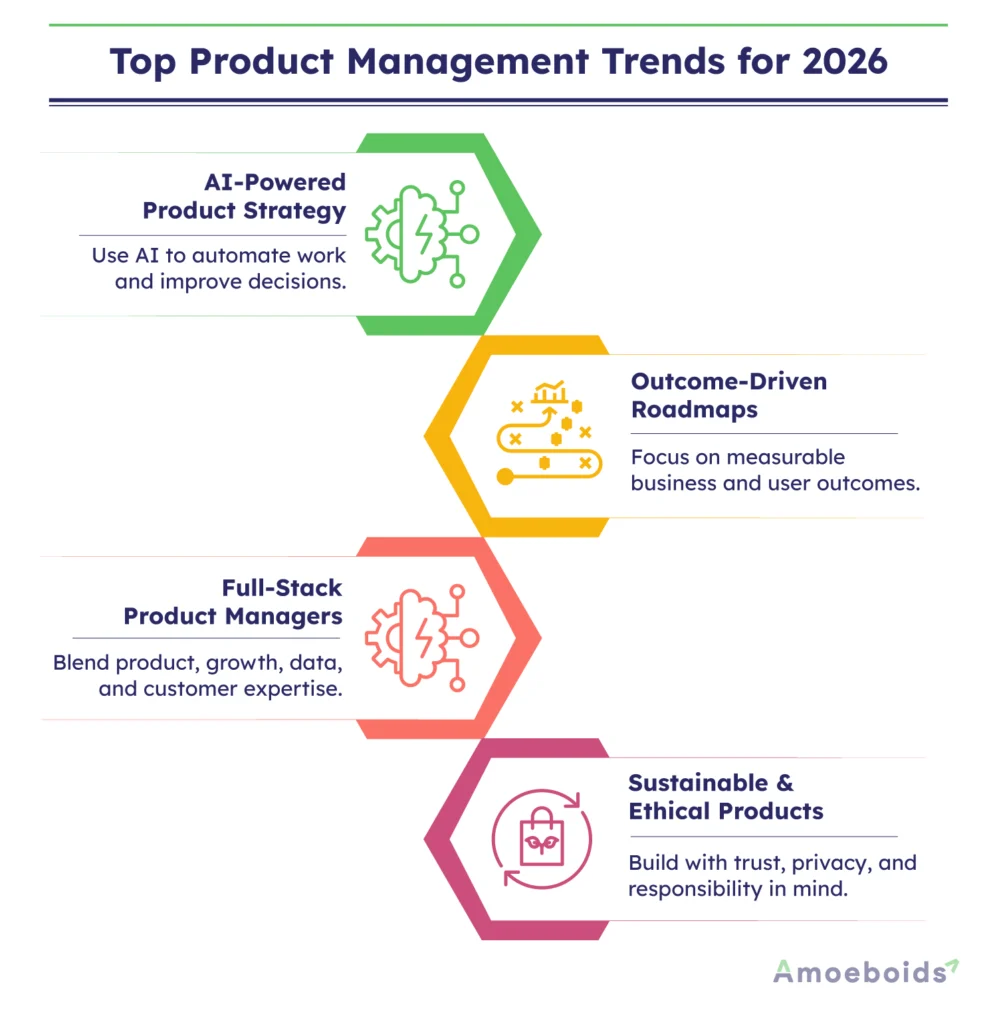
AI-powered product strategy
Unsurprisingly, product management with AI is becoming easier. It’s helping teams automate routine tasks like drafting user stories, tracking dependencies, and generating release notes. It is also offering predictive insights that align product decisions with long-term goals. As this adoption grows, digital product development is projected to increase efficiency by 19% and cut production costs by 13% over the next five years.
Outcome-driven product roadmaps
In 2026, product roadmaps will become increasingly outcome-focused. Every initiative will now connect to a specific, measurable outcome, such as boosting retention rates or driving revenue growth. This shift is prompting product teams to collaborate more closely with marketing, sales, and finance. Users want products that solve real problems, and businesses need measurable impact. The sweet spot is building something that genuinely delights users while contributing to the company’s success.
Demand for full-stack product managers
The product manager career is also going through a change. Along with product development, there’s a growing need to understand customer experience, growth strategy, and even monetization. At the same time, automation is making it easier to go deep into areas like data, AI, or onboarding without losing sight of the bigger picture. So, if you can see the big picture while having enough expertise to make smart decisions, you are a valuable asset.
Sustainable and ethical product development
More teams are now leading with values, and it’s making a difference. Sustainability and ethics have become key parts of product conversations, from discovery to launch. Data privacy, environmental impact, and algorithmic fairness are being considered early, not as afterthoughts. Products built with these principles are earning user trust and creating stronger, longer-lasting relationships in the market.
These trends indicate a future where product management is more strategic, cross-functional, and impact-driven. Staying up-to-date helps you build with greater focus, improved speed, and long-term relevance.
AI Agent Orchestration & AI Workflows as the New Operating Model
In 2026, AI will allow multiple agents to orchestrate connected workflows, changing product management from assistance to autonomous execution.
- Multiple agents, one workflow: Instead of having a single chatbot answer questions, teams now use a chain of specialised agents. One user is doing research, another document drafting, and another flagging risks, they automatically pass work to each other.
- Less babysitting, more building: PMs spend less time prompting and re-prompting tools and more time creating the rules and safeguards that allow agents to work independently. This saves hours spent on repetitive coordination.
- Faster discovery-to-delivery cycles: Agent orchestration shortens the time between problem identification and solution delivery by automating key workflow tasks. It collects data, drafts documentation, and proactively flags blockers, reducing delays and requiring less human intervention.
- New skills to manage, not just tools: Leading an AI-driven workflow requires product managers to think like systems designers, defining how agents collaborate and hand off tasks. They must also identify areas where human intervention is required to review decisions and make the final call.
- Risk of over-automation: Teams are learning the hard way that not all decisions should be made by agents. The smartest product leaders are creating clear checkpoints where human judgment still has the final say, particularly on anything customer-facing.
AI-Powered Market Intelligence & Competitive Research
Competitive research used to mean going through reports and hoping they weren’t already out of date by the time you read them. In 2026 AI is turning that slow research process into more of a live feed.
- Real-time competitor tracking: AI tools can scan competitor pricing, feature releases, and customer reviews all the time. It gives PMs a constantly updated picture, instead of a quarterly snapshot.
- Faster, sharper market sizing: AI models now pull market data, trends, and customer sentiment into a clear, digestible summary, where analysts once spent weeks.
- Spotting gaps before they’re obvious: AI-powered research allows teams to identify underserved customer segments and emerging needs more quickly, often before they appear in traditional surveys or sales conversations.
- Smarter positioning decisions: Product teams refine messaging and differentiation in near real-time using faster intelligence, adapting instead of relying on insights.
- A word of caution on accuracy: Not all AI-generated insights are equally reliable, so the best teams combine automated research with a quick human sanity check before making a major decision.
Design as the New Competitive Moat
Everyone now has access to similar AI tools and data sets. Design is moving from being a finishing touch to a real strategic advantage in 2026.
- Design as a retention lever: A confusing or clunky experience will drive churn just as fast as a missing feature. Design decisions are now directly tied to retention metrics.
- Tighter design-PM collaboration: Product managers are engaging designers earlier, often at the discovery phase. They’re not just giving a finished spec for design to skin over now.
- AI-assisted design, human-led judgment: AI tools streamline prototyping and variations in all areas. The final say on what feels right stays with human designers and PMs.
- Consistency across touchpoints: Products now include both web and mobile versions, as well as AI assistants. Teams are investing in design systems that ensure the experience remains consistent no matter where a user visits.
- Design debt is being tracked like tech debt: Forward-thinking teams track design inconsistencies with real discipline. They no longer let friction points quietly pile up unaddressed.
Trust-First & Responsible AI as the New Baseline
AI is now embedded in almost every product. Trust is no longer an optional feature in 2026. It’s the standard expectation.
- Transparency by default: Teams build in clear explanations of how AI features make decisions. They no longer treat the AI as a black box and hope users won’t ask questions.
- Bias testing as a standard step: Now it is standard practice to check AI outputs for bias and fairness. It’s part of the normal product development cycle, not a one-time audit when something goes wrong.
- Privacy-first data practices: AI requires more user data than ever before. Product teams are tightening up how data is collected, stored, and used, often within the product experience itself.
- Regulatory readiness: Rules for AI are getting stricter in more places every year. PMs are now collaborating more closely with legal and compliance teams early in the roadmap to avoid costly rework later.
- Trust as a growth driver: Products that are upfront about AI’s limitations see stronger user loyalty. This proves responsible AI is good business, not just good ethics.
Speed of Learning as the Real Product Moat
Features can be duplicated in a matter of weeks. The ability of a team to learn quickly and act on that knowledge is more difficult to replicate.
- Shorter experimentation cycles: Teams are running smaller, faster experiments instead of waiting months to prove out a big idea. This means they learn what works much faster.
- Feedback loops measured in days, not quarters: Customer feedback is now processed in days using AI-assisted analysis. Teams correct their course before a small problem becomes a big one.
- A culture that rewards being wrong fast: The best teams view failed experiments as valuable data points, not setbacks. This keeps people willing to try out new ideas.
- Learning velocity over output volume: Success is no longer defined by the number of features delivered. Teams are now measuring how quickly they can turn an idea into a validated insight.
- Compounding advantage: Teams that learn faster don’t just move quicker once. They enhance the advantage because each quick learning cycle feeds into a better decision the next time around.
Every PM Is a Growth PM—Distribution Is Everything
Making a great product is no longer sufficient on its own. PMs in 2026 should be thinking as hard about reach as they do about the product.
- Growth thinking baked into the roadmap: Acquisition, activation, and retention metrics are now included directly in product roadmaps. They are no longer limited to a separate growth team dashboard.
- PMs partnering closely with marketing: The line between product and marketing is blurring quickly. PMs are becoming more involved in messaging, onboarding flows, and even pricing experiments.
- Built-in virality and referral loops: More products are built to have sharing, invites, or network effects from day one. These loops are now not bolted on after launch.
- Data-informed channel decisions: PMs use performance data to determine which distribution channels are actually changing. This allows teams to stop wasting effort on unused channels.
- Product-led growth as the default mindset: The accepted way now is to let the product lead the adoption. Free trials, in-app prompts, and self-service upgrades are leading the way.
The Rise of New Pricing Models (As-a-Service / Usage-Based)
The way a product is priced is becoming as important as what it does. Pricing now flexes according to how much value a customer actually receives.
- Usage-based pricing gaining ground: More companies are charging based on actual usage, like API calls or active users. This is more fair to the customers and grows naturally with their growth.
- As-a-service models expanding beyond software: The subscription mindset has spread to hardware, AI tools, and even physical products. Companies want more stable and predictable recurring revenue.
- Pricing as a product decision, not just a finance one: PMs are being drawn into pricing discussions earlier than before. The pricing structure directly influences how a feature is built and positioned.
- Transparent pricing builds trust: Customers prefer clear and predictable pricing tiers over confusing add-ons. This is pushing teams toward simpler, more honest structures.
- Experimentation with hybrid models: Many teams combine subscription and usage-based pricing. They blend predictable revenue with flexibility, testing combinations to discover what customers actually want.
How product management trends are evolving in 2026
The way you manage products today looks very different from how it did a few years ago. Here’s a quick look at how trends have changed in 2026:
| Feature | Then | Now |
| What success means | Shipping features, finishing on time, and within budget | Delivering real value, achieving business outcomes |
| Feedback collection | Done in batches or surveys | Collected continuously through integrated channels |
| Reporting | Manual updates and status meetings | Automated with real-time dashboards |
| Team collaboration | Siloed roles and handoffs | Cross-functional and flexible |
| Success metrics | Measured by on-time delivery | Measured by retention, revenue, and user value |
| Decision-making | Based on past data | Guided by real-time insights and predictive tools |
The latest trends in product management aren’t about discarding everything we know. Instead, you should take note of traditional practices that worked and upgrade them. Doing so will help product teams stay sharp and truly make an impact, no matter how quickly things shift.
Key insights on product management trends 2026
Staying ahead in 2026 means focusing on how teams work, learn, and grow. Here’s how you can turn these trends into real opportunities for growth:
Embrace AI and smart technologies
AI is already part of product workflows, from automating documentation to analyzing feedback at scale. Start by actively exploring how it fits into your product workflow. Instead of just adding tools randomly, integrate them into your workflow so they work together. Automate repetitive tasks to free up time for strategy, innovation, and customer focus. Treat efficiency as more than a time-saver. Make it your competitive advantage.
Build adaptive teams
Restructure your team to respond faster to change. Invest in training for emerging tools, but don’t ignore soft skills. Push your team to think critically, communicate clearly, and influence decisions across the organization. Give product managers ownership and space to lead initiatives from start to finish.
Measuring success through outcomes
Define clear outcomes for every initiative, like retention, engagement, and revenue, to track real impact. Use those results to refine your roadmap and strategize future decisions. Make outcome-based thinking a core part of how your team operates.
Roadmap & Idea Portal App for JSM directly helps you with this. It centralizes feedback, removes duplicates, and turns insights into clear, outcome-driven roadmaps.
This makes it easier to prioritise what matters most and align your team’s work with real customer value and measurable business impact.
Most of keeping up with growing trends is just about how ready you are for change. So, stay adaptive and flexible to thrive through these changes.
The Future of Product Management (What’s Next Beyond 2026)
The pace of change is not slowing. The trends that will define 2026 are likely just the first signs of a larger shift coming.
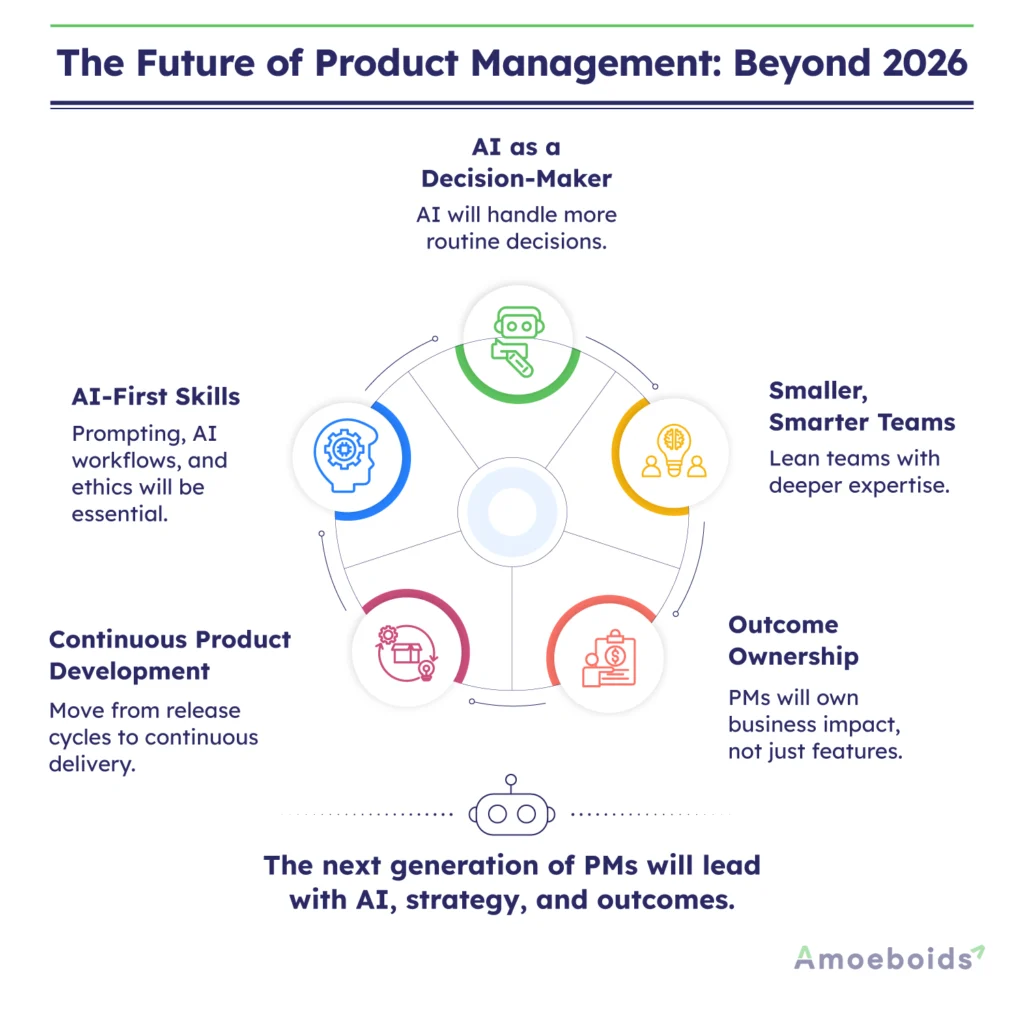
AI moving from assistant to decision-maker:
Expect AI to take more autonomous decisions in lower-stakes domains. Humans will make the high-stakes, judgment-intensive calls.
Smaller, more specialised product teams:
As automation takes over more of the routine work, teams may get smaller and more specialised. Each PM is probably going to have a narrower but deeper slice of the product.
Outcome ownership becoming universal:
PMs owning revenue and business outcomes will likely be the norm everywhere. It won’t remain exclusive to fast-moving tech companies.
Continuous, always-on product development:
The gap between planning, building, and learning will continue to close. Teams will progress toward continuous shipping rather than specific release cycles.
New skills becoming essential:
PMs are increasingly expected to have skills such as prompt design and AI workflow management. Ethical oversight is likely to become as standard as roadmapping itself.
Conclusion: Preparing for product management trends 2026
These 2026 product management trends aren’t just predictions. They’re your opportunity to stay relevant. Pick one area where AI can immediately help your workflow. Build stronger feedback loops with your users. Focus your next roadmap on outcomes that move the needle.
Your competition is already adapting. The question isn’t whether these changes will happen, but whether you’ll lead them or follow. Take the first step today. Your future product success depends on the moves you make right now.
FAQs
Q1. What are the top product management trends to watch in 2026?
AI is playing a big role in shaping product strategy, making it easier to automate work and plan with better insights. Outcome-driven roadmaps and the demand for full-stack project managers are shifting how teams work together. At the same time, staying close to your customers, working with agility, and making data-driven decisions are still relevant.
Q2. How do the latest trends in product management impact businesses in 2026?
Businesses are adopting more automation, deeper integration across tools, and focusing more on sustainability and ethics. These trends are changing how teams plan, execute, and connect with users.
Q3. What are the key emerging product management trends for 2026?
Key emerging trends include the integration of AI into product workflows, a strong shift towards outcome-focused roadmaps, and the growing importance of sustainable and ethical product development practices. These emerging trends are leading to a rapid evolution in business operations.
Q4. How are product management trends evolving in 2026?
Trends are evolving by transforming traditional practices with new technology. For instance, feedback is now continuously collected and AI-analyzed, and decision-making uses real-time, predictive insights instead of just past data.
Q5. Why is it important for product managers to stay updated on product management trends in 2026?
The role of a product manager is expanding beyond traditional job descriptions. Staying updated helps you lead more confidently, adapt faster, and keep your team focused on what matters.