Imagine you’re a product manager at a growing tech startup overseeing a new app launch. You’ve gathered tons of customer feedback, competitive insights, and historical data. However, analyzing everything manually feels like finding a needle in a haystack—time-consuming, overwhelming, and inefficient.
Enter AI. In minutes, AI sifts through that data, highlighting emerging trends, predicting customer preferences, and providing actionable insights. Now, your product roadmap is crystal clear, and you’re ready to roll out features that align perfectly with user needs from day one.
Welcome to the future of product management!
AI is no longer just a buzzword—it’s a game-changer for product managers.
In this article, we’ll explore how AI reshapes product management, key AI tools every PM should know, and best practices for integrating AI into your workflow.
What is AI in product management?
At its core, AI in product management is like having an ultra-efficient assistant that crunches data and delivers insights. This enables product managers to make smarter, faster decisions.
Using machine learning, predictive analytics, and natural language processing, AI tools help sift through massive datasets. These datasets include user feedback, competitor movements, and market trends.
By leveraging these technologies, product managers can ensure that their products align with customer needs and market demands. This streamlines development and improves time to market.
How AI is transforming product management
AI reshapes product management by improving workflows, decision-making, and customer alignment. Here’s how:
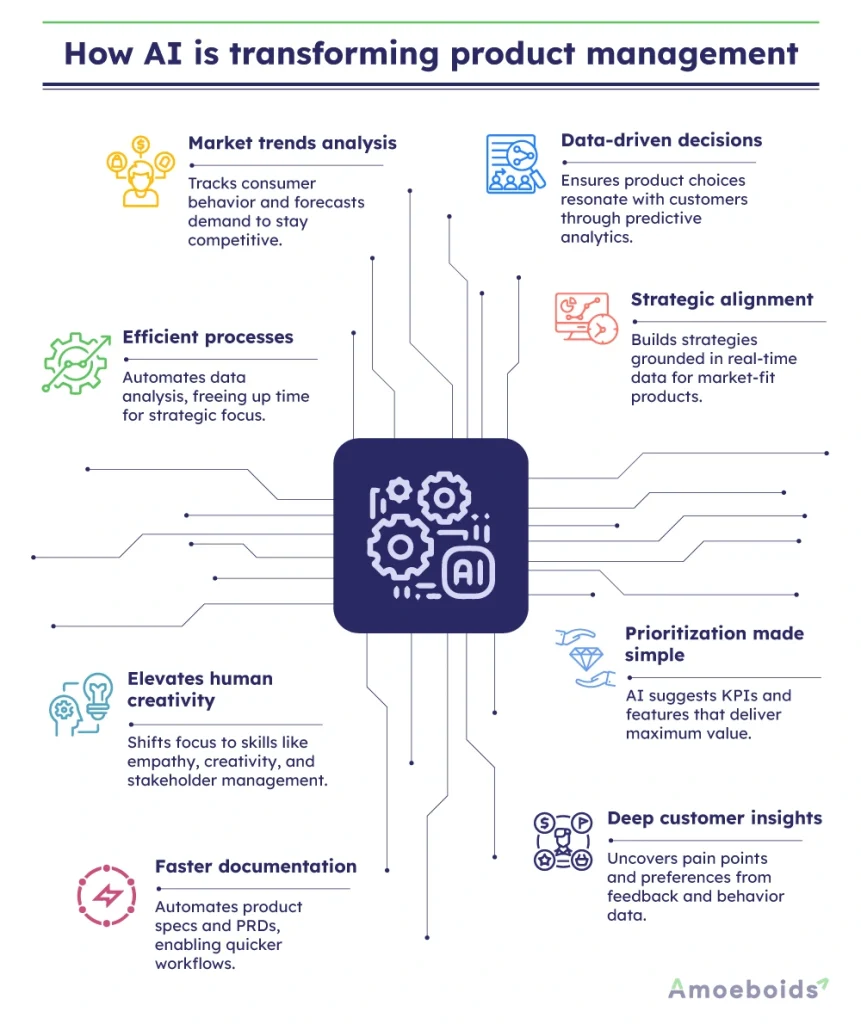
- Efficient processes: AI automates data analysis, turning raw feedback and performance metrics into actionable insights, freeing product managers to focus on product strategy.
- Market trends analysis: AI analyzes vast datasets to uncover market trends, track shifting consumer behavior, and forecast demand, keeping product managers ahead of the competition.
- Data-driven decisions: Predictive analytics allows product managers to prioritize tasks based on data rather than intuition, ensuring feature choices resonate with customers.
- Data-driven strategy: AI helps product managers develop strategies grounded in real-time data, ensuring products are aligned with market needs.
- Efficient goal setting & prioritization: AI tools suggest KPIs and objectives, helping product managers define goals and prioritize features that deliver maximum value.
- Customer insights: AI speeds up customer insights by analyzing feedback, behavior, and purchase data to uncover key pain points and preferences.
- Faster documentation: AI-powered tools automate documentation tasks like product specs, PRDs, and prototypes, allowing more time for high-level planning.
- Human skills matter more: With AI handling technical tasks, human skills like creativity, empathy, and stakeholder management become even more essential for success.
AI fundamentally changes how product managers approach their roles, driving smarter, faster, and more customer-aligned decisions.
Now, let’s dive into the key AI tools empowering product managers to enhance their workflows.
Key AI tools for product managers
AI tools can empower product managers to do more with less, optimizing efficiency and boosting productivity. Here are some top platforms to consider:
- Predictive analytics platforms: These tools use historical data and algorithms to forecast market trends, customer preferences, and potential product success. They enable proactive decision-making and highlight opportunities and risks before they emerge.
Examples: Forecast by Productive, Alteryx, DataRobot
- Machine learning software: Machine learning tools analyze vast datasets and improve user experience by continuously refining product features based on predictive modeling.
Examples: Google Cloud AI, Azure Machine Learning, H2O.ai
- AI-driven customer insights tools: These tools aggregate feedback, social media mentions, and purchase patterns, giving product managers a deeper understanding of customer behavior and pain points.
Examples: Qualtrics, Medallia, Crimson Hexagon
- Automation tools: From project management to quality assurance, automation tools reduce manual workloads, allowing product managers to focus on more strategic tasks.
Examples: make.com, Zapier
- Data visualization solutions: These tools transform complex data into easy-to-understand visuals, making it simpler for product managers to communicate insights to stakeholders.
Examples: Tableau, Power BI, Looker
Product managers can streamline their workflows and make data-driven decisions by leveraging these AI tools.
Let’s also explore the best practices for integrating AI effectively into your product management strategy.
Best practices for using AI in product management
Product managers must blend technology with human expertise to fully unlock AI’s potential. Here are some best practices:
- Blend AI with human intuition: While AI offers powerful insights, human judgment remains key. Use AI to inform decisions, but trust your experience and instincts to guide strategic choices.
- Maintain a user-centric approach: AI should enhance—not replace—the user experience. Keeping the user at the heart of your decisions ensures that AI helps create products customers want.
- Foster cross-functional collaboration: AI’s potential is realized when it’s partnered with data scientists, engineers, and other cross-functional teams. This collaboration ensures that AI tools align with business goals and provide maximum value.
While these best practices lay the foundation for successfully integrating AI into product management, teams may face challenges along the way. Addressing these obstacles is crucial to fully unlock AI’s potential to drive product success.
Challenges in adopting AI for product management
Integrating AI into product management has its challenges. Here are some common obstacles and ways to overcome them:
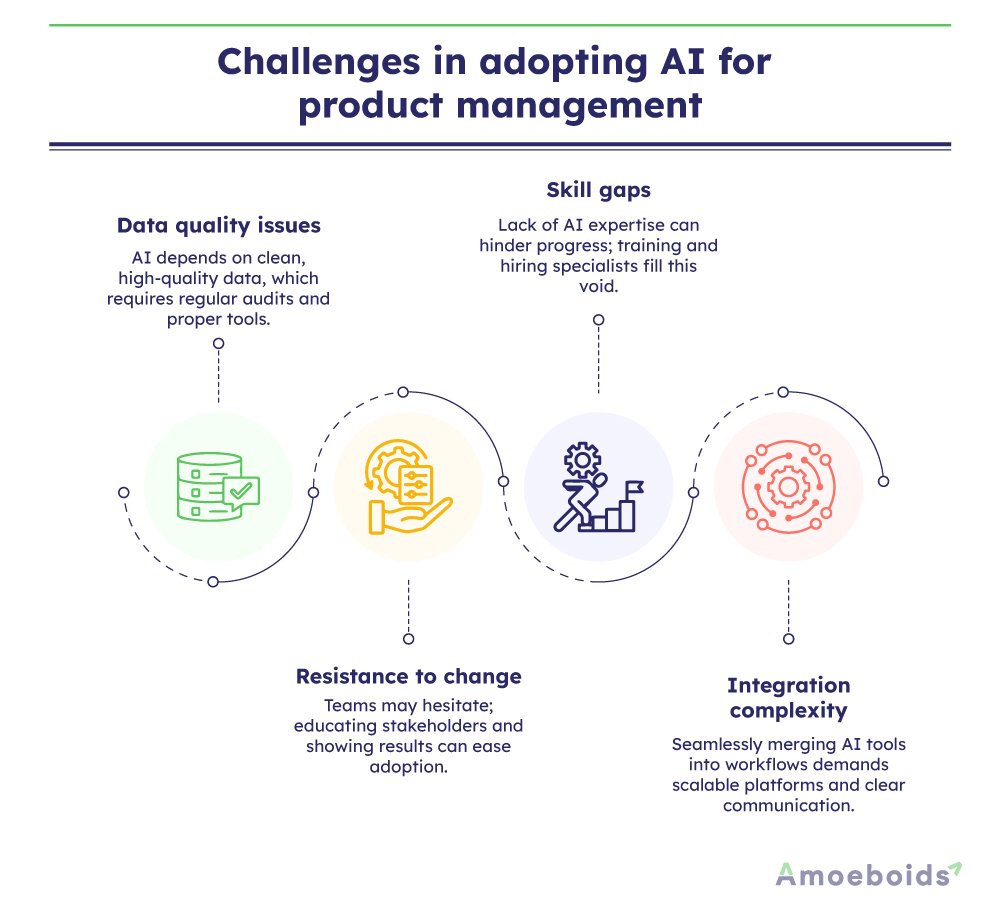
- Data quality issues: AI relies on large volumes of high-quality data, which can be difficult to gather and maintain.
Solution: Invest in data collection and cleaning tools and audit data regularly for accuracy.
- Resistance to change: Teams or stakeholders may hesitate to adopt AI without fully understanding its benefits.
Solution: Educate stakeholders through case studies and incremental changes demonstrating AI’s value.
- Skill gaps: Product managers may need more AI expertise to manage AI-driven tools.
Solution: Upskill through training programs or hire AI specialists to bridge the knowledge gap.
- Integration complexity: Integrating AI tools into existing workflows can be complex.
Solution: Opt for scalable platforms and ensure strong communication between technical and non-technical teams to smooth integration.
What’s ahead: Emerging trends for AI in product management
As AI evolves, product managers must stay ahead of emerging trends to harness its potential fully.
In 2025, key advancements such as AI-driven product development, hyper-personalization, will reshape how products are designed, developed, and optimized. These innovations will enable more precise decision-making, offer tailored user experiences, and enhance product monitoring throughout its lifecycle.
AI is not just a tool for automation; it is a transformative force that enables product managers to innovate faster and deliver better outcomes.
Product managers can confidently navigate this evolving landscape by leveraging the tools and techniques discussed. Embracing AI thoughtfully will empower them to create products that exceed customer expectations, driving business success and staying ahead of the competition.