
In the data-driven world, your enterprise is no longer limited to trying to guess or arbitrarily anticipate features and updates for products and services. Instead, utilizing a customer feedback platform will help you align your strategies and operations to meet needs and desires in the market.
It also means that you don’t have to take a risk that adoption will be low and avoid churn creeping up. A customer feedback management system will help your organization learn what features customers found confusing, the problems they cared about during beta testing as well as actionable insights about the popularity of your products and services.
Becoming customer-centric today means listening to customers closely and acting fast enough to take advantage of the data gathered. An ideal customer feedback platform can bridge this gap for you. Let’s understand how it gives you a clearer view of your customers and allows you to fix issues early to build better products.
Imagine you’re creating a product that speaks your customer’s language so well that they feel heard, valued, and eager to come back to purchase your product again.
What makes that possible?
Not just guessing what users want, but actually you need to know it through meaningful conversations and customer feedback, all powered by a useful customer feedback platform.
Customer feedback platforms are helping today’s brands move from assumptions to insights. These tools do more than just collect feedback, they change it into real and practical information. Top customer feedback management platforms can help your product teams make better decisions. It helps by organising the chaos of feature requests, bug reports, and user feedback.
The top user feedback platforms are helping companies in making connections and creating better experiences. It is useful for collecting in-app feedback, identifying trends, and promoting updates. Even minor changes triggered by thoughtful feedback management software can result in significant increases in customer satisfaction and retention.
In this blog, explore the 15 best tools for 2025 that will help you move beyond surveys and begin building with your customers, rather than vice versa.
What is a customer feedback platform?
A customer feedback platform can centralize, organize, and understand feedback from your customers. It can collect information and relevant data from multiple channels, such as surveys, product reviews, support tickets, emails, social media comments, or even live chats. Through a single dashboard, you can track how people feel about your product or service, what issues they’re facing, and what they love the most about it.
Some advanced customer feedback management platforms also offer sentiment analysis, trend tracking, or even automation to respond to customers faster. They also provide valuable actionable insights that can help you with your customer-facing policies and operations.
Importance of a customer feedback platform
One of the toughest challenges organizations face today is keeping abreast of trends and areas for improvement in the marketplace. They also often don’t know how to analyze and utilize the customer feedback input they receive effectively. A customer feedback platform is a structured system for your brand to organize feedback and refine it into critical insights that can help improve customer satisfaction.
Let’s say you run a mid-sized SaaS company. You’ve been constantly receiving customer complaints about a recent dashboard update. For some customers, it’s confusing, while others are not comfortable with using it. Without using a feedback platform, you might assume it’s a minor issue and even make changes that prove to be even more unpopular. However, a user feedback platform helps you cut through the guesswork by organizing complaints and highlighting exactly what customers dislike about the update. You can also fix the issue according to your customers’ preferences by analyzing their suggestions and pain points.
By listening to customer voices, you get a clearer picture of which features your users love, where they’re struggling and what they expect next. Now, each of your decisions can be backed by real data, not guesswork. Organizations focusing on improving user experience are projected to outperform competitors by 25% in satisfaction metrics for both customer and employee experience.
You can use a customer feedback platform as your map for growth to improve your offerings, align with customer needs and stay a step ahead of the competition. Let’s consider the benefits these platforms have to offer.
Selecting the appropriate customer feedback platform is important if you’re focusing on product features, collecting feedback, or using surveys to gauge user sentiment. Here is a categorised list of the best customer feedback platforms for 2025, each of which excels in a specific area and provides examples to help you decide what to do next in your game plan.
Survey & NPS Champions
1. Typeform: This app generates visually appealing and conversational surveys that feel like real interactions. Its simple interface leads to higher response rates.
Example: A fintech app leverages this platform to gather customer experience feedback following the signup process.
2. Qualtrics: A strong, enterprise-level feedback system with advanced analytics and multichannel surveys. It is great for companies that require complex data processing.
Example: Qualtrics is used by universities and healthcare providers to assess employee experience across departments.
3. SurveyMonkey: This app offers templates, logic branching, and simple data visualisation and is widely recognized for its simplicity and adaptability.
Example: HR departments can easily conduct annual employee engagement surveys.
4. SurveySparrow: Delivers chat-style surveys via email and web platforms, boosting response rates with a personal touch.
Example: Remote teams conduct regular pulse checks using automated survey workflows.
5. AskNicely: NPS tracking and customer loyalty are the main focus, with built-in automation for reminders and follow-ups.
Example: A service provider sends out automatic NPS emails after delivery to verify customer satisfaction.
In-App & Visual Feedback Masters
6. Userback: Collects direct feedback from websites or apps via screen captures, annotations, and video recordings.
Example: It is used by product designers to gather contextual bug reports during beta testing.
7. Hotjar: This tool provides heatmaps, session replays, and on-page surveys to illustrate user behavior and motivations.
Example: Marketing teams measure CTAs based on scroll depth and click patterns.
8. Userpilot: This app provides in-app micro-surveys triggered by user behavior, resulting in targeted and timely feedback.
Example: Product managers validate feature success by sending out post-interaction surveys.
9. Intercom: This app seamlessly blends live chat and feedback capabilities, enabling rapid user responses during interactions.
Example: Support teams collect immediate post-chat feedback to improve the agent experience.
10. Mopinion: Web and app widgets are fully customisable and provide both structured and unstructured feedback. These are supported by strong analytics.
Example: During the troubleshooting process, telecom companies keep track of customer frustration.
Feedback Management & Roadmap Portals
11. Canny: Customers can vote on feature requests through Canny, which increases transparency in product development.
Example: Users can see which features are planned, under development, or already available at a SaaS startup.
12. UserVoice: To establish data-driven product priorities, UserVoice combines product ideas, support tickets, and votes.
Example: Product releases are coordinated by an enterprise software company with user-submitted demand.
13. Roadmap & Idea Portal App for JSM: This app enables customers and internal teams to submit, upvote, and track ideas directly in JSM. It integrates seamlessly with Jira, streamlines decision-making, connects ideas to delivery timelines, and builds trust through clear communication.
Example: A B2B technology company uses it to crowdsource new features and share roadmap updates with enterprise clients.
14. Olvy: This app brings together AI-powered insights, changelogs, and a comprehensive feedback inbox from sources such as Slack, Intercom, and Twitter. It helps to close the feedback loop by connecting it to product releases.
Example: A SaaS team collects feedback from various channels and uses Olvy to auto-categorise and publish feature updates in one place.
Analytics & Insight Engines
15. Medallia: Through the use of AI, Medallia gathers feedback from various channels and instantly identifies trends, urgency, and emotion.
Example: A retail chain adjusts staff training and product placements by comparing online reviews and feedback from in-store kiosks.
Benefits of using a customer feedback management tool
Every bit of feedback can provide insights and has the potential to help your business grow and expand. Let’s check out some exciting benefits that show how valuable a customer feedback tool can be for your business:
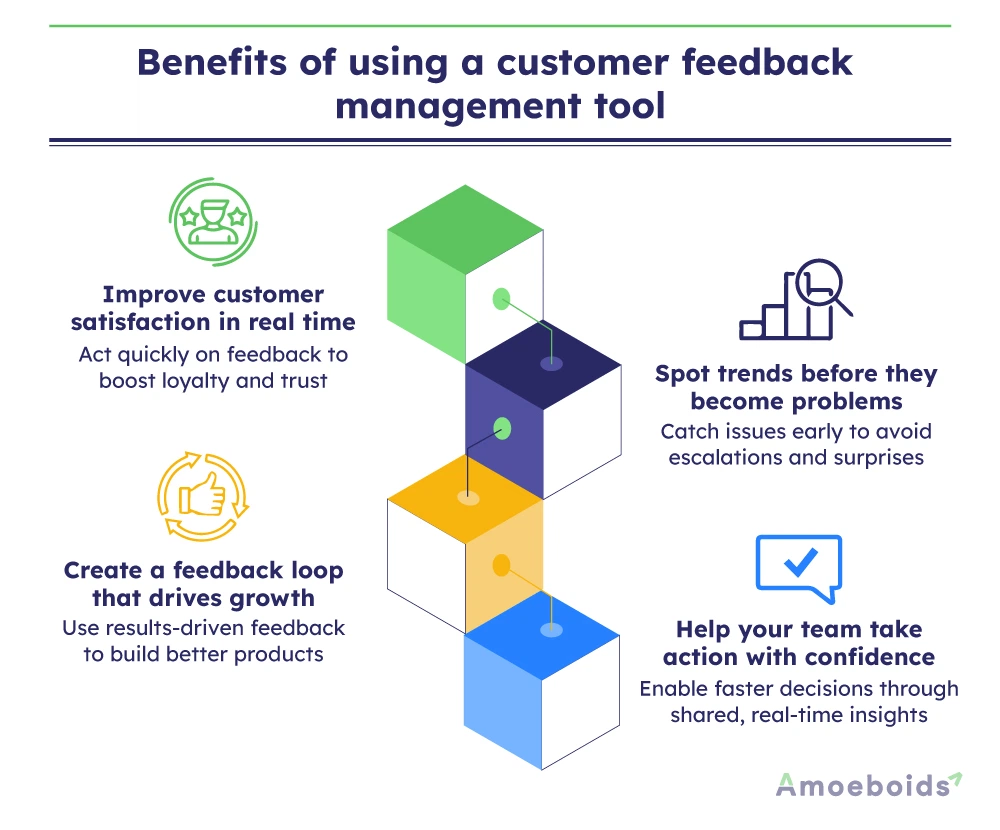
Improve customer satisfaction in real time
Nearly 77% of customers feel valued when you seek out and apply their feedback. Acting on their feedback in real time builds trust and leads to happier, more loyal customers who are less likely to leave. Even a small bug fix on a critical feature based on real-time insights on your customer feedback platform can go a long way to show that you are listening to your customers’ suggestions.
Spot trends before they become problems
One major benefit of real-time feedback tracking is that you might see a rising complaint early before it escalates, or spot a feature request that keeps showing up. As a result, you turn proactive instead of reactive to solve customer problems. That means fewer surprises, better planning and more control over your customer experience.
Create a feedback loop that drives growth
Customers who see you act on their feedback to produce results will interact more and create a feedback loop. Over time, this loop helps you build a stronger product, a more loyal user base and a business that improves continuously based on real input.
Help your team take action with confidence
The feedback loop helps all departments of your company work in sync toward creating a more positive customer experience. Moreover, with data-driven feedback on a central dashboard, they can act faster and make better choices without waiting for approvals. For instance, your product team can see feature requests, your support team can spot common issues and your marketing team can pick up on what customers are excited about. This kind of visibility reduces delays and inculcates more ownership between teams.
However, your brand needs to consider different factors while choosing a customer feedback management system. You should take the time to explore, compare and test different available platforms, because the right one can make all the difference.
Choosing the best customer feedback platform includes more than just gathering feedback; it’s about gaining insights that drive growth, retention, and innovation. To help you shape your CX strategy, among the many tools available, concentrate on customer feedback platforms that provide real-time, actionable feedback and go beyond simple surveys. Here’s what to look for:
- Multi-Channel Feedback Collection: You should collect data from in-app, email, mobile, and web touchpoints because your customers are everywhere.
- Real-Time Analytics & Reporting: Make choices supported by sentiment analysis, visual data breakdowns, and dynamic dashboards.
- Customisable Surveys & Forms: Create custom surveys that are in line with each step of the customer journey, represent your brand voice, and lead users through logical flows.
- Feedback Management & Ticketing Integration: Connect tools such as Jira, Zendesk, or Slack for issue tracking and collaboration to put feedback into action.
- AI-Powered Insights: Teams can act more quickly and make better decisions by using AI. It allows them to analyse feedback on a large scale and identify emotions, recurring themes, and urgency.
- Customer Segmentation & Targeting: Personalise feedback requests based on user demographics, behavior, or lifecycle stage to increase relevance and response quality across all segments.
- Roadmap & Feature Request Voting: To promote a sense of ownership, boost engagement, and direct product strategy based on real user needs, let customers vote on features and share ideas.
- Gamification & Incentives: Increase response rates by offering rewards, badges, or personalised appreciations for survey completion.
How to choose the right customer feedback platform
The market is filled with so many customer feedback management platforms that anyone can get overwhelmed. But if you know what features to look for and more about the different platforms available, you can find the one that’s most suitable for your needs. Here are a few clear steps to follow to make an informed choice:
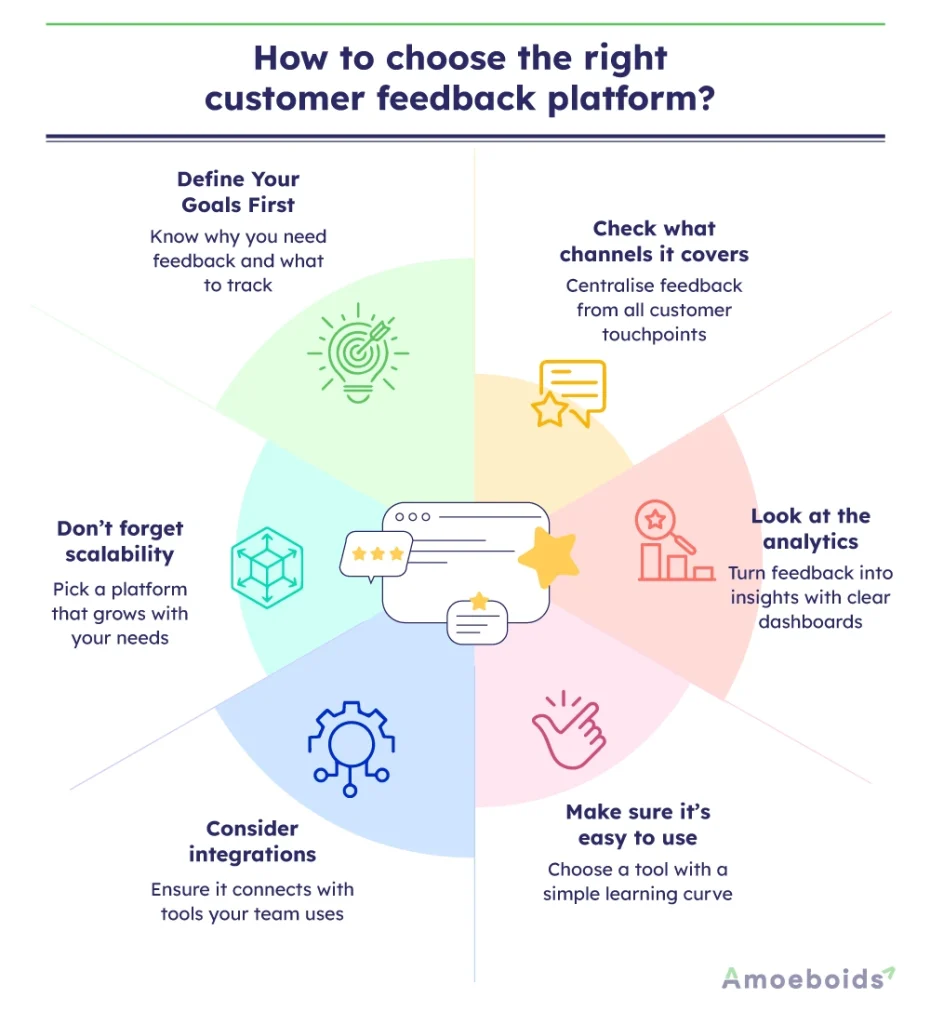
Define your goals first
First, ask yourself why you need a customer feedback management tool. For instance, if you’re expanding your product to new markets, you would like to use the platform to understand how users in different regions feel about your features. So, you will look for a customer feedback platform that supports multilingual feedback and can sort insights by region.
Check what channels it covers
Nowadays, customers can talk about your product in multiple channels, such as social media, website reviews and even review sites. That said, ideally, your user feedback platform should be able to collect and centralize feedback from all such channels without any capacity cap. Identify customer feedback management platforms that cover a broad spectrum of input channels and leverage AI-based solutions to collate data and provide actionable recommendations.
Look at the analytics
Like we already discussed before, gathering customer feedback is just the first step. You need to make sense of it in just a matter of time after looking at the dashboard. Focus on user feedback platforms that offer a clear dashboard, sentiment analysis, trend tracking and the ability to provide group insights. These features are crucial in today’s fast-paced and competitive market environment.
Make sure it’s easy to use
Your team should be able to leverage the customer feedback management tool without a steep learning curve. If it’s too complicated, it’ll just sit there. Choose something that your team can start using quickly without frequent technical help.
Consider integrations
The best customer feedback platform is one that fits the tools you already use, like your CRM, helpdesk or project management software. This ensures that feedback flows easily into your existing systems so your team can act on it faster.
Don’t forget scalability
You need to think ahead. Will the platform still work for you when your customer base grows or your team expands? Look for something that can grow with you so you don’t have to start over in a year.
Now that you understand what to look for in an ideal customer feedback platform, you should compare different systems to see which one suits your needs best.
Comparison of top customer feedback management systems
Choosing the right customer feedback management system can feel overwhelming. With so many options available, it’s important to find one that fits your business’s unique needs. Let’s explore some of the top platforms, highlighting their key features to help you make an informed decision.
| Platform | Best for | Key features | Integration / Ease of use |
|---|---|---|---|
| Roadmap & Idea Portal App for JSM | Getting feature requests and feedback from customers | Vote on requests and feedback, remove duplicate feedback, easy configuration, JQL integration, 24/7 customer support | Easy configuration, add unlimited tabs and columns |
| Qualtrics | Advanced survey design & analytics | Custom surveys, predictive analytics, flexible reporting | User-friendly, widely adopted |
| Medallia | Multi-channel feedback | Real-time insights, AI analytics, experience management | Scalable, great for enterprise use |
| Zonka Feedback | Closing the feedback loop fast | Real-time alerts, automation, NPS/CSAT/feedback widgets | Simple UI, AI-powered suggestions |
| Userback | Visual product feedback | Annotated screenshots, video feedback and real-time updates | Ideal for design/dev teams |
| AskNicely | Integrating feedback into CRM workflows | CRM integration (like HubSpot), customer satisfaction automation | Easy setup, great for support teams |
| SurveyMonkey | Simple survey creation | Templates, branching logic, analytics | Beginner-friendly, flexible |
| Hotjar | Understanding user behavior | Heatmaps, session recordings, user journeys | Web-focused, visual data |
| Chattermill | Sentiment analysis | AI-powered insights, emotion tracking across channels | Best for large-scale data analysis |
| Anecdote | Actionable insight generation | Unified feedback view, smart dashboards | Built for real-time decision-making |
Conclusion
A customer feedback management system helps your enterprise organize, analyze and identify patterns in customer data. It enables two-way interactions to improve customer satisfaction and drive business decisions. With the right customer feedback platform, you can truly listen to your customers to improve what you offer, build stronger relationships and grow your business with confidence.
The right tool can help you make smarter decisions and gain a competitive edge in the market as well. However, with so many tools out there, the key is to find one that fits your goals and makes acting on feedback easy. If you want a smart, scalable and customer-centered customer feedback management system, Roadmap & Idea Portal App for JSM is a great choice.
FAQs
How does a customer feedback platform work?
A customer feedback platform collects feedback from different places like emails, surveys, websites and social media. It then helps you organise this feedback, find patterns and take action based on what your customers are saying all in one simple and easy-to-use space.
What types of customer feedback can be collected through a platform?
You can collect many types of feedback, like product reviews, survey responses, ratings, suggestions, complaints and even comments from social media. This helps you understand what’s working well and where your customers feel improvements are needed.
Can a customer feedback platform improve customer retention?
Yes, it can. When you listen to your customers and act on their feedback, they feel valued. This builds trust, improves satisfaction and encourages them to stay with your brand for longer, helping you reduce churn and grow stronger customer relationships.
What’s the best customer feedback platform for SaaS?
The best customer feedback platforms for SaaS companies are Userpilot, Canny, Roadmap & Idea Portal App for JSM, and UserVoice. It will offer in-app surveys, collecting feedback, idea voting, and product roadmap integration to encourage continuous improvement and user-driven development.
Are there free customer feedback tools?
Yes, several customer feedback tools provide free plans that include basic features. Typeform, Google Forms, and Userback are a few examples that are ideal for startups or small teams just starting out with feedback collection.
What is the difference between NPS and CSAT tools?
NPS (Net Promoter Score) tools measure long-term customer loyalty by asking users how likely they are to recommend your product. Customer satisfaction (CSAT) tools measure how satisfied customers are right away with particular experiences. NPS provides strategic insights, whereas CSAT is ideal for estimating short-term service or product performance.