
Consider the following scenario: Your team has been working on a project for five months when someone else develops a more effective solution to complete the project faster. However, your team ignores the new development, believing you have invested too much time and energy. This is a classic example of a sunk-cost fallacy.
This mental trap stems from the mistaken belief that quitting a project means throwing away the time and effort you’ve already invested. Sunk cost fallacies occur when you convince yourself to continue with an unproductive course of action in the belief that you will somehow be able to recoup your losses in the future.
As a result, you never move on to better, more effective solutions that can do your business good. Read on to learn more about the sunk cost fallacy, the logic behind why it occurs and how to overcome it.
What is the sunk cost fallacy?
The sunk cost fallacy is a thinking trap where you continue to carry out a failing process simply because you feel that you will waste the time, money or effort you’ve put into the project if you quit. In short, it refers to a refusal to cut your losses and abandon an unproductive strategy.
Like a gambler throwing away good money after bad, this fallacy can lead to an incalculable wastage of resources and losses. This sunk cost fallacy definition highlights why people often struggle to walk away from unsuccessful projects.
History of the sunk cost fallacy
The concept of sunk costs originated in economics, where it is defined as a cost that has already been incurred but cannot be recovered. The sunk cost theory suggests that these unrecoverable costs should not influence future decisions. Economists argue that sunk costs should not influence decisions because they have no bearing on future outcomes. This principle forms the foundation of sunk cost theory in economics.
The term “sunk cost fallacy” became widely recognised in behavioral economics and psychology when researchers observed that people often let past investments influence their decisions. Instead of focusing on the future, they persist in their current course of action due to the time, money, or effort they have already invested.
This tendency, known as the sunk cost effect, explains why individuals and companies may continue to invest in failed projects even when better alternatives exist.
How does the sunk cost fallacy work?
The sunk cost fallacy, often referred to as sunk cost bias, occurs when previous investments influence current decisions. Instead of asking, “Is this the best decision for the future?” people focus on the time, money, or effort they have already invested.
Here’s how it typically works:
- An initial investment is made: Time, money, effort, or resources are committed to a project or decision.
- Problems begin to appear: The project underperforms, or a better alternative emerges.
- Past investments take over the decision: People don’t view the situation objectively they view what they already have spent.
- More resources are invested: More time, money, or effort is spent in the hope of recovering earlier losses.
- Losses continue to grow: The project becomes more and more expensive, and the chances of success are still low.
In other words, the sunk cost fallacy focuses people on what they’ve invested in, rather than what will add the greatest value.
The psychology behind the sunk cost fallacy
The sunk cost fallacy can be summed up by the phrase “throwing good money after bad.” People fail to consider a situation objectively or register that a better solution is available.
There is also the concept of loss aversion. A key aspect of sunk cost fallacy psychology is understanding why emotions often outweigh logic during decision-making. This is when you refuse to accept the fact that you’ve lost. Rather, you continue to put in more time, effort and resources in the vain hope that things might turn around.
Why does the sunk cost fallacy happen?
Several reasons contribute to the sunk cost fallacy relationships. It’s often a mix of internal psychological factors and external pressure that worsens it:
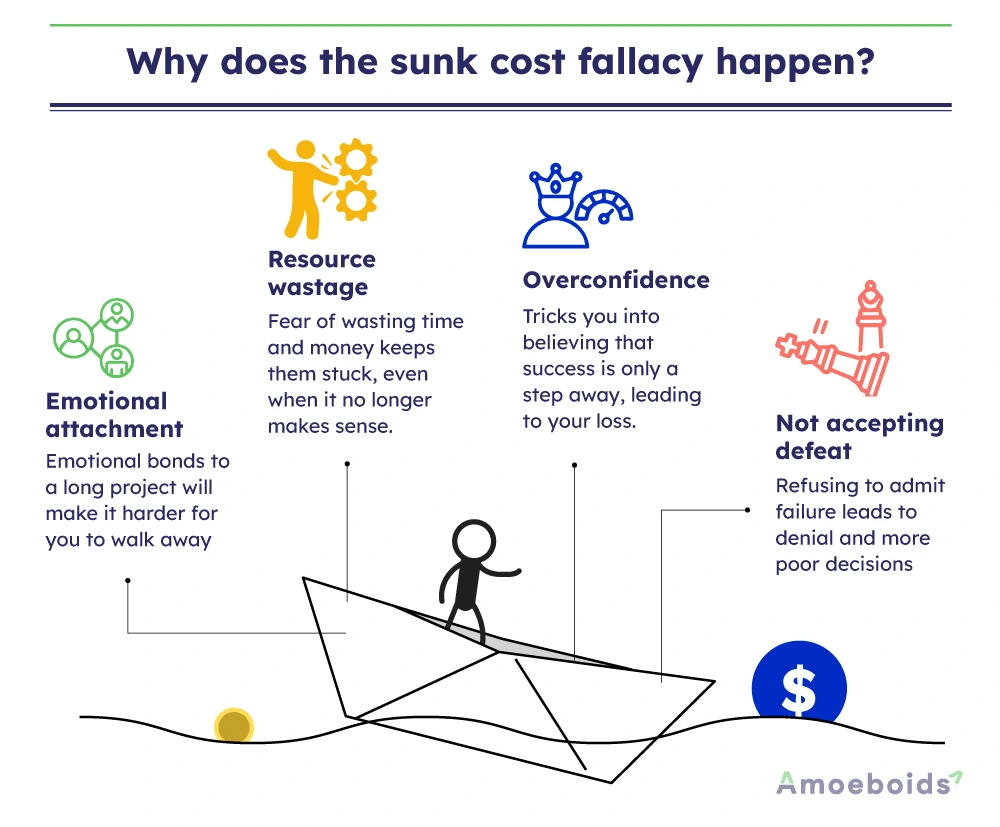
- Emotional attachment: It is natural to get emotionally attached to a long-running project. However, this attachment can negatively impact future decision-making.
- Resource wastage: If you stop a project, this would mean that the time and money spent on it is wasted. This fear keeps people from realizing the sunk cost and continuing to invest.
- Not accepting defeat: No one likes to admit they have made a mistake. Instead, they try to convince themselves and others that they will be able to ultimately succeed.
- Overconfidence: Sometimes, you might feel that a little effort or investment is all that is needed to turn things around. This overconfidence in recovery leads to a greater loss.
Recognizing when you’re caught in a sunk cost bias is the first step to overcoming it.
Examples of sunk cost fallacy
Let us look at some real-world examples of sunk cost fallacy to see how it affects sunk cost decision-making:
Example 1: Resistance to change
Let us consider the example of Research In Motion (RIM) and the BlackBerry. At it’s peak, the BlackBerry accounted for nearly 45% of the cellphone market. However, they did not recognize the potential of App-based infrastructure and touchscreen technology in the telecommunications sector and persisted with their text-and-call model, citing the amount of effort they had already put into it. This was one of the reasons the company went under a few years later.
Example 2: Continuing a failing product
Another well-known example of the sunk cost fallacy is Ford’s Edsel, a car launched in the late 1950s. Ford invested years of research and millions of dollars into developing what they believed would be a revolutionary vehicle. However, when the Edsel hit the market, it failed to attract consumers.
Despite clear signs that the Edsel was not resonating with buyers, Ford continued to pump money into production and marketing, convinced they could salvage their investment. This refusal to pivot ultimately led to even greater financial losses.
Example 3: Everyday life
Sunk cost fallacies can be found in our daily lives. For instance, continuing to read a book or watch a movie that you got tired of in the first few minutes. You rationalize wasting time by only considering what you’ve already spent, not how much more you will lose.
Both these decisions are driven by teams making decisions based on past investments rather than evaluating the situation in the present.
How does the sunk cost fallacy affect your work?
Have you ever continued working on a project after investing months of effort, even when it was clear that the results weren’t worth the investment? This behavior is often driven by the sunk cost effect, a cognitive bias that leads people to keep investing in decisions that no longer provide value.
We tend to focus on what we have already invested, rather than judging what will deliver the best results going forward. This can lead to poor choices, wasted resources, and lost opportunities.
- Holding on to failing projects because “we’ve already spent too much time and effort on them.”
- Choosing the lesser option when there are newer, more efficient options available.
- Throwing good money and time and energy after bad at an unproductive endeavor.
- Delaying difficult decisions because admitting a mistake or changing direction feels uncomfortable.
- Reducing productivity and innovation by focusing on past investments instead of future opportunities and outcomes.
The key takeaway: Successful professionals and companies base their decisions on future value, not on time, money, or effort spent. Avoiding sunk cost decision-making helps teams stay focused on future opportunities rather than past investments.
Is the sunk cost fallacy really so bad?
The sunk cost fallacy can have a big impact on both people and companies. Often, decisions made based on past investments rather than future outcomes result in wasted resources and missed opportunities.
Leads to poor decision-making: People keep going on with a project, not because it makes the most sense today, but because they’ve already invested time or money or effort in it.
Wastes valuable resources: Continuing to support a failing initiative consumes resources that could be better spent elsewhere.
Prevents innovation and adaptability: Teams may ignore new ideas, technologies, or opportunities because they are overly committed to their current approach.
Creates missed opportunities: By focusing on recovering past investments, companies often miss more promising projects and growth opportunities.
Increases losses over time: The longer you devote to a failing strategy, the more resources you waste, and the bigger your losses will be at the end.
How to overcome sunk cost fallacy?
Let us now look at practical ways to overcome the sunk cost fallacy:
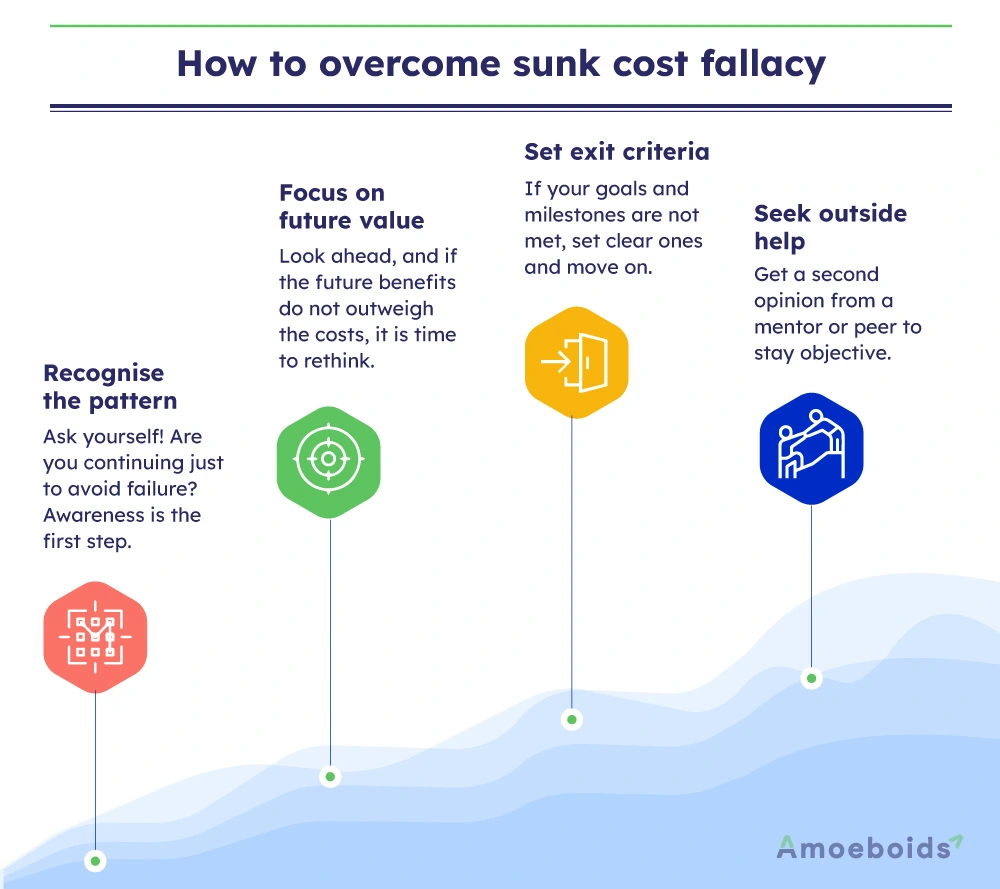
- Recognize the pattern: The first step to breaking free is recognizing it. Ask yourself if you only invest in the project because you fear admitting failure.
- Focus on future value: Instead of looking at your past journey, evaluate the project’s future potential. Conducting a sunk cost analysis can help separate past investments from future opportunities. Evaluate questions such as whether future benefits are more than the cost spent or not. Also, reevaluate your future goals and see if the project aligns with them.
- Seek outside help: When you fear being objective about important decisions, it is best to seek an outside perspective before deciding on something. Choose a mentor, colleague, or supervisor to assess the situation and make a rational decision.
- Set exit criteria: When you want to invest a little more resources in the hope of reaping profits, set clear exit criteria. Set up clear milestones and targets. It is time to stop investing if the project does not meet them.
These measures can help you evaluate if you have fallen prey to the sunk cost fallacy and how to go about overcoming it.
Conclusion
The sunk cost fallacy is a trap that leads to individuals and businesses making decisions with the wrong motivation. Instead of looking at a situation objectively, they make emotional choices. This happens because they fail to accept past losses and fear failure.
Breaking free from this pattern may seem challenging, but it starts with awareness. Recognizing that you’ve fallen into this fallacy is the first and most crucial step. From there, shift your focus to the future – analyze the potential value of continuing versus cutting losses.
Setting clear exit points and seeking an outsider’s perspective can also provide the clarity needed to make smarter, more rational decisions. A regular sunk cost analysis can help organizations allocate resources more effectively and avoid costly mistakes. By overcoming the sunk cost fallacy, you open the door to better opportunities, greater efficiency, and long-term success.
FAQs
How to avoid the sunk cost fallacy?
To avoid the sunk cost fallacy, focus on a project’s future value rather than past investments. Set clear exit criteria in advance and make decisions based on potential outcomes rather than emotional attachment to previous efforts.
Is the sunk cost fallacy bad?
Yes, the sunk cost fallacy can be harmful as it leads to wasting more time, money, and resources on projects that no longer provide value. It can prevent individuals and businesses from making rational, forward-thinking decisions.
Are the fixed cost fallacy and sunk cost fallacy the same?
No, they are different concepts. The fixed cost fallacy misinterprets unavoidable costs as avoidable, while the sunk cost fallacy occurs when people continue a decision based on past investments rather than future benefits.
How does identity impact the sunk cost fallacy?
Identity can strongly influence the sunk cost fallacy, as people may persist in decisions that align with their self-image or reputation. The fear of appearing like a failure can make it difficult to abandon a project, even when it’s no longer beneficial.
Is the sunk cost fallacy related to motivation?
Yes, the sunk cost fallacy can create false motivation by making individuals feel compelled to continue efforts in failing endeavors. This happens because they want to justify past investments, even when cutting losses would be the wiser choice.