
More than 20% of a company’s budget allotted for new products goes into repaying technical debt. This highlights the importance of proactively managing technical debt, as reducing it early can free up significant resources for innovation and growth.
Technical debt occurs when developers need to manage both speed and quality simultaneously. When developers trade speed for quality, inefficiencies and extra work result in technical debt. This debt not only takes up extra effort to fix but also slows down technical development.
Struggling with slow technical developments? This article delves into the concept of technical debt, compares tech currency vs tech debt, explores the various technical debt categories, and offers strategies for managing it effectively.
What is technical debt?
Software developers often build features or write code under time pressure to meet tight deadlines. While this might solve the company’s purpose in the short term, the long-term consequences are not favorable. These consequences are what we refer to as technical debt.
What does technical debt look like?
- Increased maintenance costs
- Slower development life cycle (SDLC)
- Potential system failures
Rushed development is a key reason for technical debt; however, poor coding practices and lack of expertise can also contribute to it. This ultimately leads to developers taking more time to fix past technical debt than creating fresh developments.
Tech currency vs. tech debt
While technical debt can slow down progress, there’s a related concept called technical currency. It is the ability to leverage a well-structured codebase for faster delivery. Here’s a brief comparison between tech currency vs. tech debt to understand how the two differ:
| Tech currency | Tech debt |
| Speeds up new feature delivery | Slows down future delivery |
| Built with best practices | Built under pressure or shortcuts |
| Flexible and adaptable | Rigid and prone to breakage |
| Helps reduce maintenance costs | Increases maintenance costs |
Managing technical debt while strengthening technical currency is key to keeping your codebase healthy, adaptable, and ready for whatever comes next.
Different types of technical debt
Your business will be impacted based on the types of technical debt you accumulate. Let’s look at the different technical debt categories, examples, and their repercussions:
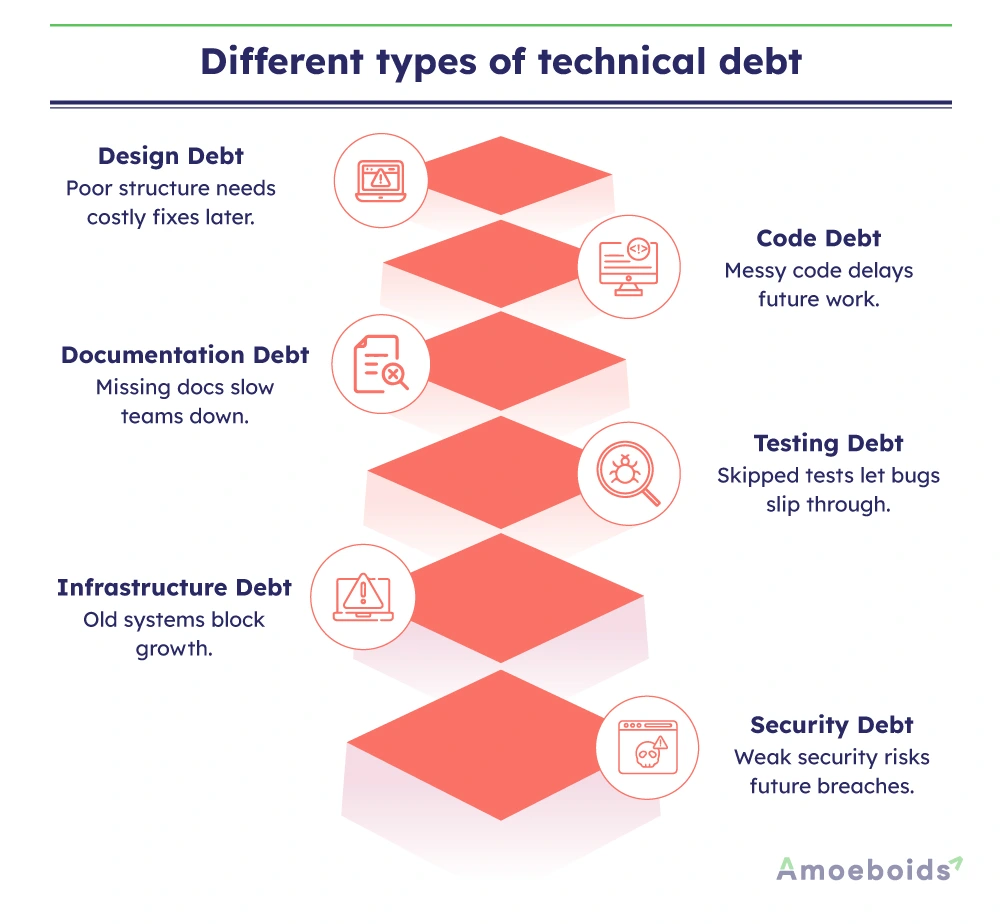
- Design debt: Software is sometimes built too quickly to meet business needs. Often, the design isn’t flexible and scalable enough for the future. Such designs require expensive rework.
- Code debt: Code is one of the key components of software. Hastily or imperfectly written code leads to various challenges. Working on future updates or debugging with hard-to-read code results in a waste of time.
- Documentation debt: Clear documentation is essential for helping new employees onboard smoothly and making troubleshooting easier. However, developers often see it as unnecessary in the rush to meet deadlines. While skipping documentation might speed things up in the short term, it creates major challenges later, making updates, debugging, and collaboration much harder.
- Testing debt: Any new software must go through extensive testing to ensure it’s foolproof. This process is sometimes skipped while chasing deadlines. Bugs can then slip through, and fixing them can consume countless hours.
- Infrastructure debt: Are you running on outdated systems or patching things together instead of upgrading? That’s infrastructure debt. It slows everything down and makes scaling a hassle.
- Security debt: Skipping security updates or taking shortcuts can lead to security debt. It might not seem important at first, but it may turn into a severe issue if a breach happens.
Monitoring technical debt is crucial to ensuring efficiency and maintaining stability throughout the software development lifecycle.
What causes technical debt?
The reasons behind technical debt are myriad, including rushed practices and negligence.
Here are the key reasons for technical debt:
- Rushed deadlines: When facing tight deadlines, teams often choose quick fixes to keep the project moving. The assumption is that things will be refined later, but in reality, that “later” often never comes. This leads to long-term inefficiencies, accumulation of technical debt, and challenges in software maintenance.
- Poor planning: Technical debt is a byproduct of teams beginning with software development without a clear product roadmap. Uncertainty regarding upfront designs and unclear requirements can create challenges.
- Communication gap: Misunderstanding within teams due to lack of clear communication is another reason for technical debt. Costly rewrites become unavoidable if software development is not aligned with business goals.
- Negligence in refactoring: Codebases need regular cleanup. Sometimes refactoring is often overlooked in favor of new features. Thus, the system becomes harder to work with, adding to debt.
Technical debt cannot always be avoided; however, understanding its causes is essential to minimizing its accumulation.
How to reduce technical debt
Technical debt can sometimes be inevitable. However, there are ways to manage and reduce it, including:
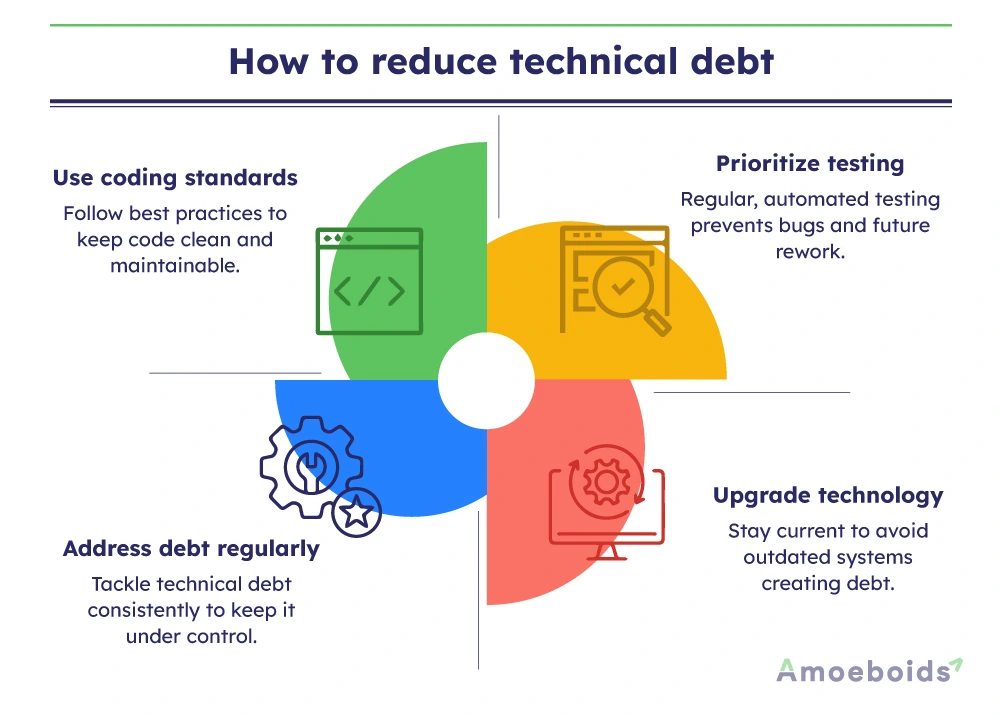
- Usage of coding standards: Set up coding best practices. Apply these standards to every new software development to keep the code maintainable and easy to understand.
- Prioritization of testing: Invest in automated testing tools and ensure that codes are tested regularly. This will help you identify errors beforehand and ensure minimal technical debt.
- Upgrading technology: Businesses must adapt to new technology. Timely technical shifts ensure you stay on top and do not risk gathering technical debt over time.
- Prioritization of technical debt: Finally, the most important way to reduce technical debt is to pay continuous attention to it. You must dedicate enough time to technical debt on an ongoing basis to avoid its accumulation.
Technical debt must be treated like real debt. If not managed actively, it negatively impacts software development and becomes an obstacle to new development.
Conclusion
Technical debt is often a byproduct of software development. The first step in managing it is understanding how it occurs and the consequences it brings. Focus on regularly updating your technology and prioritizing testing.
Ensure that your team is clear on the expectations of software development, and there is no communication gap. Technical debt can be a hindrance; however, when managed properly, it helps teams meet current demands and ensures smooth software development in the future.
FAQs
1. What is technical debt in Agile?
Technical debt in Agile refers to compromises in software quality made to meet deadlines or deliver features quickly. These shortcuts can lead to future maintenance challenges, requiring additional time and effort to resolve.
2. What is technical debt in scrum?
In Scrum, technical debt accumulates when development teams prioritize speed over code quality, leading to unresolved design flaws, poor documentation, or incomplete testing. If not managed properly, it can slow down future development and increase rework.
3. How to measure technical debt?
Technical debt can be measured using code quality metrics, maintainability indexes, and static code analysis tools. Tracking factors like code complexity, duplication, and test coverage can help quantify the impact of technical debt on a project.
4. What is technical debt in software development?
Technical debt in software development arises when shortcuts are taken in coding, testing, or design to meet immediate goals. While it may speed up delivery, it often results in long-term inefficiencies that require extra work to fix later.
5. How to prevent technical debt?
Preventing technical debt requires proactive strategies such as regular refactoring, maintaining code quality standards, thorough testing, and keeping software dependencies updated. Encouraging collaboration and documentation also helps mitigate debt accumulation.
6. Are bugs technical debt?
No, bugs and technical debt are not the same. Bugs are defects or errors in software functionality, whereas technical debt refers to design or structural compromises that may not cause immediate failures but can hinder future development.
7. How much technical debt is acceptable?
Some level of technical debt is inevitable, but it should be managed carefully. It becomes a problem when it significantly impacts software performance, maintainability, or the ability to implement new features efficiently.
8. Is technical debt bad?
Technical debt isn’t inherently bad, but if left unmanaged, it can slow development, increase costs, and create long-term maintenance challenges. Addressing it early through regular code reviews and refactoring can prevent major setbacks.