Using AI is proving to be a game-changer for product managers. You show up at work, check your dashboard, and instead of manually analysing spreadsheets of user behaviour, you fire up a tool that uses generative AI to highlight key segments where churn risk is rising, suggests a feature experiment to address it, and estimates the expected impact in real time. You then collaborate with your engineering and data science leads in a meeting where the AI-enabled platform has already pre-defined the candidate feature set, surfaced regulatory/ethical risks, and simulated three alternate go-to-market scenarios. AI for product managers is no longer a fantasy; it’s a reality shift already in motion.
For you as a product manager (PM), embracing AI means shifting from a reactive stance (responding to analytics after the fact) to a proactive one (anticipating trends, enabling faster decision-making, and focusing on strategic value). You’ll spend less time wrestling spreadsheets and more time driving vision, aligning teams, and ensuring your product roadmap stays relevant in a constantly evolving market. Teams increasingly focus on using ai in product management to improve efficiency, collaboration, and product outcomes.
In this article, you’ll learn why AI is changing the role of product managers, the core skills you need (from data literacy to ethical awareness), practical upskilling strategies, and how to select and use the best AI tools for product managers.
AI adoption: Must-have AI skills for product managers
As companies ramp up AI adoption, the role of a PM is evolving. You’re now the linchpin between business objectives, user needs, and the AI-enabled systems that deliver value. The phrase “AI tools for product managers” has become a common reference.
According to a recent McKinsey survey, 65% of organisations report regularly using generative AI across at least one business function, up markedly from earlier years. That means your peers, competitors, and stakeholders are already using AI.
So what does that mean for you, practically? Here are the skill areas that matter:
- Understanding what AI can and cannot do – so you can spot real use cases vs. hype.
- Translating data and insights into decisions that drive products forward.
- Collaborating seamlessly with engineers, data scientists and business stakeholders.
- Ensuring AI applications align with ethical, regulatory and user-trust standards.
The next sections break down each of these in more detail so you can map your own learning path.
Learning machine learning for product managers is becoming increasingly important for PMs leading AI-driven products.
How AI is Changing the Role of Product Managers?
Historically, the PM role has emphasized market insight, customer empathy, roadmap prioritization, and feature delivery. All of those remain important – but the overlay of AI adds four significant changes:
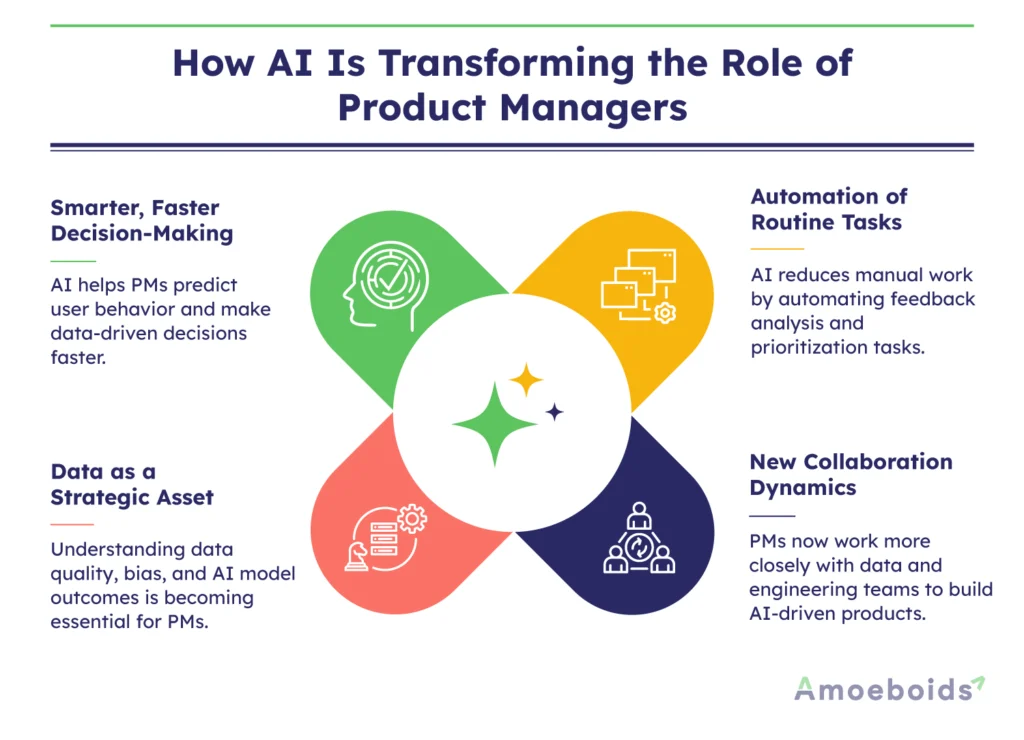
Smarter, faster decision-making:
With AI-driven predictive models, you can anticipate user behavior, forecast churn, identify upsell potential, and simulate outcomes before launching. This improves the value of your time rather than simply needing to work more hours for the same quality of output.
Automation of routine tasks:
Tasks such as gathering feedback, sentiment analysis of user comments, and feature-prioritization based on historical data are increasingly handled or augmented by AI. This gives you more bandwidth to focus on strategy.
New interfaces and collaboration dynamics:
As PMs engage with data scientists and engineers, you’ll need to translate business goals into AI-friendly requirements, monitor model performance, and integrate AI outputs into the roadmap. The boundaries between PMs, designers, and engineers are shifting.
Data as a strategic asset:
You’ll increasingly rely on data not just for insights but as a core input to AI models. That means understanding data quality, biases, and the implications of model decisions becomes part of your remit.
In short, your job is becoming less about deciding what to build and more about orchestrating how intelligence and automation support product strategy. Ensure you remain the driver of outcomes, not just a passenger. Understanding ai product manager job description expectations can help PMs prepare for evolving responsibilities.
Core AI product manager skills
AI is transforming product management from instinct-driven decision-making to intelligence-driven strategy. To thrive in this shift, you need to master a blend of technical understanding, analytical depth, ethical awareness, and cross-functional collaboration.
Today’s AI-ready product manager must be able to translate complex data into strategy, align technical and business teams, and ensure AI applications remain transparent and ethical. The following skill areas define this new generation of product managers.
AI and data literacy
You don’t need to become a machine-learning engineer, but you do need to speak the language of AI. That means:
- Understanding key concepts like supervised vs unsupervised learning, reinforcement learning, model drift and bias.
- Knowing what data inputs drive models and how data strategy ties into product strategy.
- Being able to challenge model assumptions, ask the right questions of your data science team, and make sense of AI outputs.
- Appreciating data privacy, security, model interpretability and transparency issues.
For example, when you receive a feature recommendation from an AI system, you should be able to ask: “What, exactly, is the data input? What bias might exist? Is the model trained on the right segment? What happens if usage shifts?” These questions ensure you remain accountable for outcomes.
Additionally, here are the steps you can take to build this skill:
- Undertake short courses, e.g., “AI for Non-Engineers” or “Data Science for PMs”.
- Engage with data dashboards and logs early – don’t wait for “final” outputs.
- Partner with data teams to learn the pipelines, error rates, and validation processes.
Many aspiring PMs study ml for product managers courses to better understand AI-driven workflows and data models.
Analytical thinking and data-driven decision-making
Your analytical skills are what transform AI-generated insights into decisive action. But having more data doesn’t always lead to better decisions. Too much information can easily lead to analysis paralysis. The key is learning to interpret, prioritize, and communicate insights effectively.
Here are some practical ways to strengthen your analytical mindset:
- Translate AI-generated results into roadmap items. Say the AI tool flags a 22% churn risk for a user segment, you decide a feature update, targeted outreach or UX improvement is required.
- Use visualization and storytelling. Present complex analytics so stakeholders understand them.
- Run experiments:.Use AI to propose hypotheses, then validate with A/B testing, and feed results back into your model loop.
- Set metrics and define what success looks like in AI-augmented workflows – feature adoption, reduced time-to-market, increased retention, etc.
A strong analytical mindset allows you to turn raw AI output into a human-centric strategy – and ensures you remain the driver, not the passive recipient of analytics.
Technical collaboration
As AI becomes embedded in product processes, your ability to collaborate with engineers, data scientists, UX designers, and QA teams becomes ever more critical.
Here’s what effective collaboration means:
- Translating business goals into data requirements: Example: “We need to reduce refund rate by 15 % – what features and data inputs can we collect to feed an AI model that predicts refund risk?”
- Understanding feasibility and trade-offs: How much data preparation is needed? What are the model limitations? What is the infrastructure cost?
- Communicating constraints and implications: If the model uses sensitive user data, what are the privacy or compliance issues? If the model makes decisions, what human-in-the-loop workflows remain?
- Governance and monitoring: You don’t just launch the AI feature and walk away. You monitor performance drift, user backlash, explainability, and ensure the AI continues to deliver value.
By strengthening your technical collaboration skills and leveraging the right team collaboration tools, you position yourself as a conduit for innovation – ensuring PM, engineering and data teams are aligned, efficient, and strategic. Strong knowledge of machine learning for product managers helps bridge the communication gap between technical and business teams.
Ethical and responsible AI awareness
The AI tools you use and the features you build can impact user trust, fairness, privacy and compliance. Key areas of focus include:
- Bias and fairness: AI models may inadvertently discriminate or produce biased outcomes. As PM, you should be aware of which segments are underrepresented in training data and how to explain your team’s decisions.
- Transparency and interpretability: Users may reject or mistrust an automated decision if they don’t know how it was reached. Provide transparency.
- Privacy and consent: Are you collecting or using sensitive data? Do users know and consent? Are you compliant with regulations (GDPR, CCPA, etc.)?
- Governance and safety: Who is accountable if the model fails? What is your process for monitoring unintended outcomes?
A recent academic study on product management and generative AI found that PMs often struggle with “uncertainty regarding what ‘responsibility’ means” and highlighted the importance of leadership, clear principles and proactive micro-actions to embed responsibility.
By embedding ethical awareness into your AI-enabled product strategy, you not only protect your brand and user trust but also create better outcomes and differentiate your offerings through integrity.
How to build essential AI skills as a product manager?
Developing AI skills as a product manager doesn’t mean a total career pivot, it’s about adding practical knowledge on top of your existing workflow. If you want to understand how to become an AI product manager, choose consistent, hands-on learning over theory-heavy deep dives.
Here’s how you can start building real-world AI skills:
- Start Small: Experiment with simple use cases such as churn prediction and feedback analysis.
- Learn by Doing: Build intuition with no-code tools, dashboards, and real product data.
- Take Courses: Discover beginner-friendly AI, data, and product analytics programs.
- Collaborate Closely: Work with data scientists and engineers to gain an understanding of real-world workflows
- Build Systems: Develop repeatable processes for using AI in decision-making and prioritisation.
- Track Impact: Measure outcomes such as adoption, retention, and efficiency to help you fine-tune your approach.
Practical experience, cross-functional collaboration, and iteration enable you to make confident AI product decisions.
Upskilling strategies for product managers using AI
Knowing the skills is one thing; upskilling is another. Here are practical strategies you can use to build and sustain your AI-enabled PM skillset:
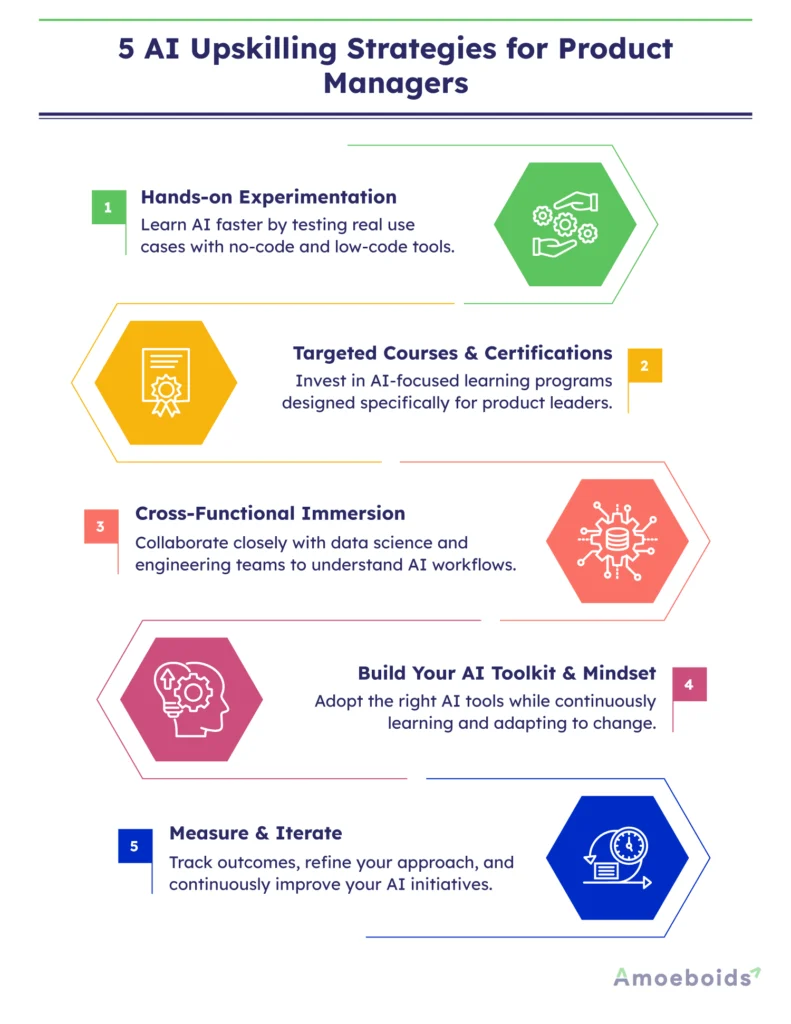
1. Hands-on experimentation
Use no-code/low-code AI platforms (for example, autoML tools or embedded AI in analytics dashboards) to experiment with real data from your product. Start small: for instance, build a prototype that predicts user churn or categorizes customer feedback using NLP. Use feedback loops: capture outcomes, learn what works, iterate.
2. Targeted courses and certifications
Look for AI courses designed for PMs, such as “AI for Product Leaders”, “Machine Learning for Non-Engineers”. Attend webinars, workshops, and bootcamps focused on the “best AI tools for product managers”. Consider internal certification and promote in-house AI literacy programs for your product team.
3. Cross-functional immersion
Shadow your data science and engineering teams to understand data pipelines, model training, and deployment challenges. Facilitate “AI playbooks” or “feature design labs” within your product org where PMs, data scientists and engineers co-create. Participate in internal AI governance, ethics and tooling committees – this gives you context beyond feature delivery.
4. Build your AI toolkit (and mindset)
Curate a set of AI tools that integrate with your product workflow: analytics platforms, customer-feedback tools with NLP, and feature-prioritization tools that use predictive models. Stay updated on emerging tools. In 2025, many tools now labeled “AI” are actually sophisticated automation or augmentation. Your job is to distinguish truly strategic tools. Cultivate a mindset of continuous learning. The AI landscape shifts rapidly – prompts, model capabilities, governance norms, and toolsets evolve quickly.
5. Measure and iterate
Define metrics for your AI-enabled product initiatives, such as reduced time-to-market, increased feature adoption, and improved retention. Regularly review and refine your approach. As a PM, you know that iteration isn’t optional – it’s central. The same applies to your AI learning path.
By layering experimentation, learning, collaboration and measurement, you position yourself not as a follower of AI trends, but as a leader using AI strategically to drive product success. Professionals exploring how to become an ai product manager should focus on practical implementation and continuous experimentation.
Key takeaways: Essential AI skills for product managers
Let’s bring together the key insights for you:
- Build AI and data literacy so you understand both the capabilities and the limitations of AI tools.
- Cultivate strong analytical thinking to translate AI-driven insights into strategic product decisions.
- Strengthen your technical collaboration to work effectively with engineering and data teams, turning ideas into deliverable features.
- Embrace ethical and responsible AI awareness to protect user trust, comply with governance and differentiate through integrity.
- Commit to continuous upskilling – your skill set evolves alongside the AI tools and practices you adopt.
When you adopt this mindset, you’ll move beyond being a PM who simply reacts to data towards being a PM who shapes product strategy using intelligence, automation, and trust. The role of product manager is evolving – and you’re in a position to lead that evolution. Companies increasingly value PMs experienced in using ai in product management to accelerate innovation and customer-centric decision-making.
Conclusion: Lead your AI-enabled product journey
As AI continues to reshape product management, the focus is shifting from manual execution to intelligent decision-making. To stay ahead, teams must embrace automation, data-driven insights, and cross-functional collaboration. By integrating AI thoughtfully into your product workflows, you can move faster, reduce friction, and make every release more impactful. The future of product management isn’t just about keeping up with technology—it’s about using it to build products that deliver real value and lasting impact.
Modern organisations are also changing the ai product manager job description to include strategic AI adoption, ethical oversight, and cross-functional collaboration skills.
FAQs
What are the top AI skills for product managers today?
Key skills include understanding AI and data (analytics, modeling, data quality), strong collaboration with engineering/data teams, the ability to translate AI outputs into strategy, and a deep awareness of ethical and governance issues. Your role shifts from feature logistics to intelligence orchestration.
How can a PM start learning about AI and machine learning?
Begin with accessible courses designed for non-engineers, pick a small, low-risk project in your product context (e.g., automating feedback categorisation), and partner with your data science team. The hands-on experience plus collaboration solidifies learning faster than passive study alone. Many beginners start with ml for product managers’ learning paths to gain foundational AI knowledge.
What tools or platforms help product managers work with AI?
Look for AI-enabled analytics platforms that provide predictive insights, NLP tools for user feedback, and automation tools for workflow integration. Many PM platforms now include AI-powered recommendation engines, sentiment analysis, and prioritisation aids – together these become part of your product-management toolkit.
Is AI going to replace product managers?
No, AI is designed to augment, not replace, product managers. Machines can crunch data, surface insights, suggest experiments, and even prototype features. But they don’t replace human judgment, creativity, user empathy, stakeholder management or ethical oversight. Your role evolves, but remains central.