
Imagine you’re busy working on a big project. You see that everyone is on their toes, but no one has an eye on how close you are to the finish line. This happens because, in reality, tasks and updates often don’t show real progress. Projects go off course when there are no distinct checkpoints.
There are studies that have shown that one of the main reasons for project delays is the lack of clarity about objectives and milestones. In these situations, project milestones can make a substantial difference. They give every phase of the project focus and direction. Teams can spot delays before they become problems.
This guide will describe how project management milestones work, why they are more significant than most people realize, and how to report them correctly. You will see real-world examples, typical errors to avoid, and the reporting tools that can help you maintain the progress of every project.
You can equate project milestones to stopovers on a long journey. They are a narrative instrument for your journey from Point A to Point B. They also signal if you’re on the right track. A milestone is an important event, deliverable, or turning point in your project timeline. It is a sign that your project has completed a significant stage. It doesn’t focus on the completion of the entire work.
As a navigation map for your projects, milestones can help track time as well as manage obstacles. They also help in assessing how well you have advanced and ensure that your project doesn’t start looking like a mere endless list of tasks.
Typical examples of milestones include:
- The official project kickoff
- Approval of the project scope or budget
- Completion of a major deliverable, such as a prototype or test phase
- Client sign-off or final handover
Each milestone serves a purpose. It’s proof that the project is moving forward. They separate major achievements from routine work. Further, they help stakeholders see progress at a glance without digging through daily updates.
| Milestone Type | Example | Why It Matters |
| Initiation | Team assembled, project charter approved | Confirms that work can officially begin |
| Planning | Scope finalized, budget and schedule approved | Ensures alignment on resources and timelines |
| Execution | First deliverable completed | Marks tangible progress and builds momentum |
| Closure | Stakeholder sign-off | Confirms final delivery and completion |
Milestones help you track your progress and stay organized. This is made possible by their function of giving everyone involved a clear picture of how far you’ve come and how far you still have to go.
Milestone vs. Tasks, Goals & Deliverables
Understanding milestones, tasks, goals, and deliverables leads to better project planning, execution, coordination, and overall management productivity. Here are the main differences between them:
| Aspects | Milestones | Tasks, Goals & Deliverables |
| Meaning | Project milestones represent important checkpoints or achievements during the project lifecycle. | Tasks, goals, and deliverables focus on activities, outcomes, and final project results. |
| Purpose | Ensures that teams effectively track progress, deadlines, and major project phases. | Supports execution, defines objectives, and ensures successful project completion. |
| Focus Area | Focuses on approvals, launches, testing phases, or project completion events. | Concentrates on daily tasks, project goals, and final results or services. |
| Impact | Enhances project visibility, scheduling clarity, and team alignment throughout projects. | Improves productivity, workflow structure, customer satisfaction, and project performance. |
Knowing the importance of milestones in project management
Project milestones ensure that your team moves beyond simply ticking items off their to-do list. As indicators for project progress, they present opportunities for your team to regroup, halt, reflect, and restructure. Here is why project milestones are highly efficient in project management:
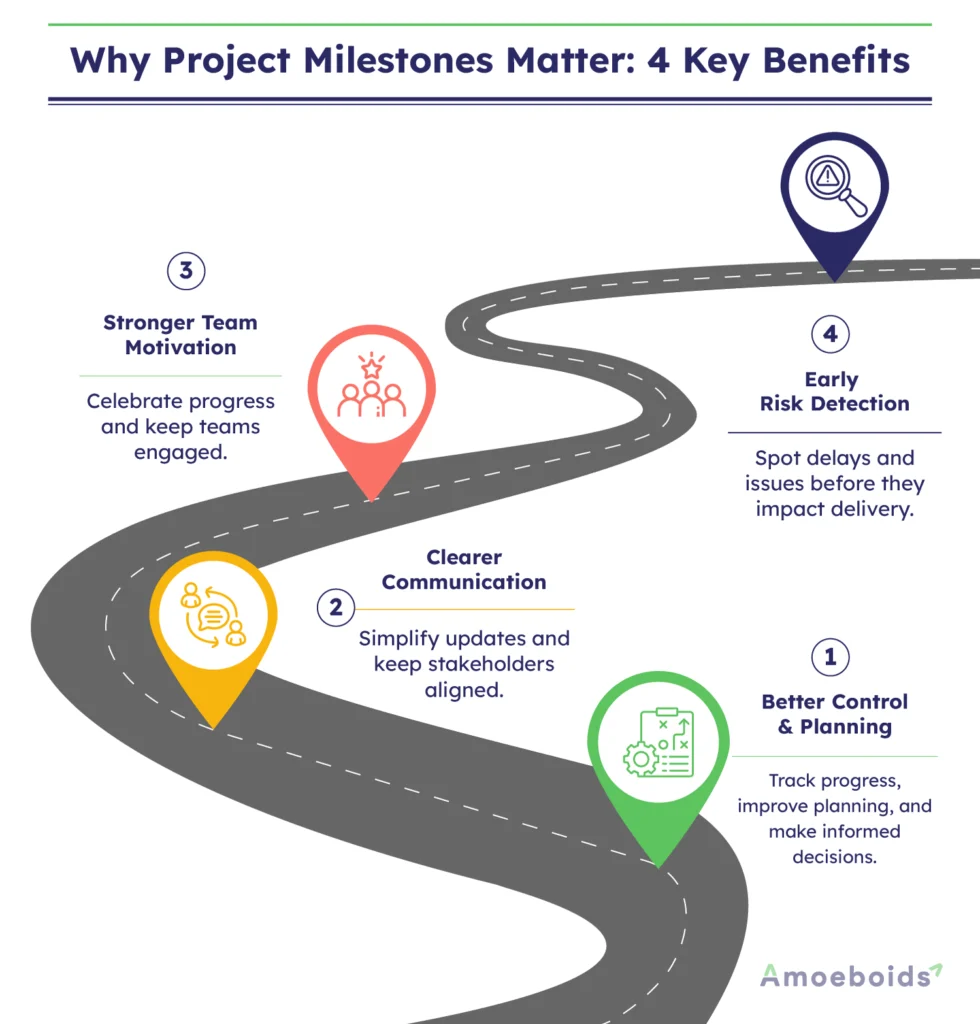
1. Control and predictability
Project managers can organically assess progress and make necessary plan adjustments thanks to milestones. They serve as boundaries that help identify problems early and maintain reasonable schedules.
2. Improved communication
Using milestone charts, you get the chance to streamline project reporting. This is a giant improvement over simply bombarding sponsors with incessant updates. It makes it easier to quickly grasp the big picture.
3. Team motivation
Each accomplished milestone signifies a small win. Honoring these occasions raises spirits and keeps teams motivated. Recognizing progress has even been shown to enhance long-term retention.
4. Proactive risk management
Each milestone acts as a built-in review point for performance data and KPIs. It’s a chance to identify risks or delays before they grow into bigger problems.
Milestones have use cases that go beyond planning. For stakeholders, they make it easy to get a sense of how things are progressing. Project managers are able to better monitor results. For the team, every milestone gives them a sense of accomplishment.
What is a Milestone Chart?
A milestone chart is a simple visual tool for highlighting key project milestones along a project timeline. It helps teams to monitor major achievements, deadlines, approvals, and key milestones in a project without burdening them with every small task.
A milestone on gantt chart does not have detailed schedules, it only contains the important points of progress. This makes project tracking simpler and clearer.
Companies use milestone charts frequently to communicate, track deliverables, and ensure stakeholder alignment. Reviewing various project milestone examples or a project milestone sample can also assist teams in better project planning.
What is Milestone Planning?
Milestone planning is the process of identifying and scheduling key checkpoints in a project. It allows teams to define project milestones, organise deliverables, and create a realistic project milestone schedule for more efficient execution.
Understanding the meaning of milestone in project management helps companies track progress, manage deadlines, and enhance project transparency. Teams frequently create a project timeline with milestones to help them clearly see their goals and maintain departmental alignment.
Many software teams use jira milestones to track sprint progress, manage releases, and improve teamwork during project execution.
How to decide what’s a project milestone
Every task or deliverable cannot be designated as a milestone. If you end up treating every small update like a major checkpoint, your project timeline becomes cluttered. When this happens, real progress is likely to get buried under noise.
So how do you decide what truly counts as a milestone? Start by looking for moments that define progress. Instead of emphasizing each task you complete along the way, focus on your successes that demonstrate that you are headed in the right direction.
Next, think about the S-M-A-R-T requirements. A milestone should be Specific, Measurable, Achievable, Time-bound, and Relevant. In other words, it should be clear enough that anyone looking at the project plan can understand its goal and when it is expected to be finished.
Common examples include:
- Reaching a major funding or budget approval
- Completing regulatory reviews or quality checks
- Delivering a key release or client-facing version
- Securing stakeholder sign-off before the next phase
The goal isn’t to have more milestones but to choose the right ones. When chosen wisely, each one provides a moment of clarity.
Example of project milestones in use
Consider a case where you are responsible for a SaaS rollout project. Different stages and teams are involved. Check how milestones are established to give a clearer picture of the project status and progress:
| Phase | Milestone | Description |
| Initiation | Team kick-off | All key roles are introduced, goals are discussed, and expectations are aligned |
| Planning | Feature set finalized | The core product scope and deliverables are locked in |
| Execution | Beta release | The working version is launched internally for feedback and quality checks |
| Closure | Final stakeholder approval | The client or leadership team gives the official green light for launch |
Each milestone serves as an important checkpoint. As and when the team crosses a milestone, it shows that the project is in rhythm with its original intent. This is of higher significance than just keeping track of completed tasks.
Tools like Gantt charts elevate project visibility. Further, it has been seen that milestone charts help teams focus on achievements rather than individual tasks.
When milestones are visible and widespread, conversations become easier. Instead of debating who finished what, teams can discuss what’s coming next. That shared clarity keeps everyone aligned and confident that the project is on track.
How to Create & Integrate a Project Milestone Schedule
Creating and integrating milestones allows teams to clearly manage deadlines, improve collaboration, and keep projects on track from start to finish.
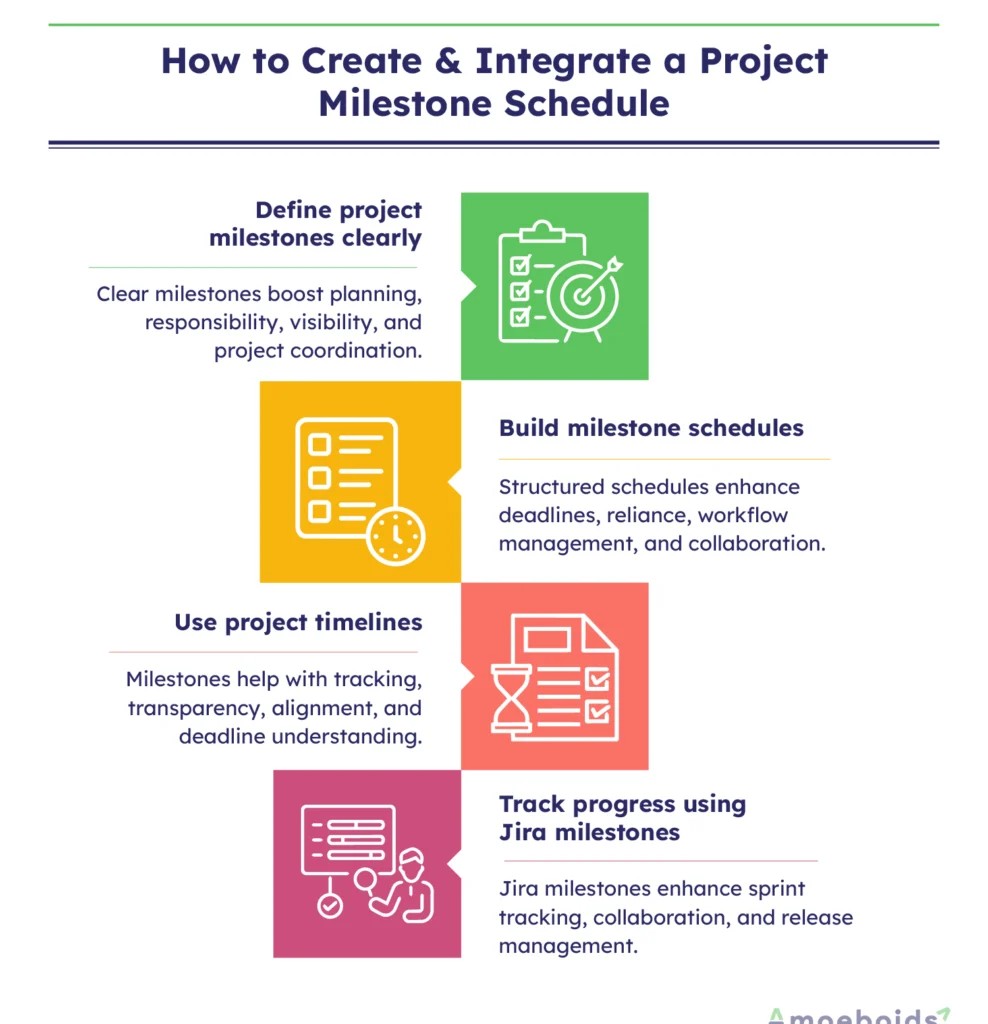
Define project milestones clearly
The first step involves identifying key project milestones, such as approvals, testing phases, or product releases. It leads to better planning accuracy, responsibility, and overall visibility of the project.
Build a project milestone schedule
Develop a structured project milestone plan for visibility of due dates, outputs, and dependencies. It enhances workflow management, scheduling clarity, and team collaboration.
Use project timeline with milestones
Make a project timeline with milestones to help you better visualise deadlines and key tasks. This helps with tracking, increases openness, and keeps teams aligned.
Track progress using jira milestones
Use jira milestones to effectively track sprint progress, releases, and project updates. It enhances collaboration, clarity, and project execution consistency.
How to Visualise Project Milestones?
Visualising milestones allows teams to better grasp progress, stay focused on priorities, and make project tracking easier for all involved.
- Identify key milestones in a project: Start by figuring out the key milestones in a project like approvals, launches, or testing phases. This enhances workflow visibility, strengthens planning, and maintains team focus.
- Create project timeline with milestones: Develop a simple project timeline with milestones to give a visual of key deadlines. It improves team collaboration, clearly tracks progress, and quickly highlights upcoming deliverables.
- Use milestones on gantt chart: Connect goals with project activities and dependencies by using a milestone on a gantt chart. This increases visibility, improves scheduling, and streamlines project tracking.
- Review project milestones examples: Check out various examples to learn how successful teams manage checkpoints. It improves project planning and communication and enables easier collaboration.
Project milestones reporting
When milestones aren’t reported clearly and frequently, stakeholders lose visibility and teams lose direction. Milestone reporting turns scattered data into meaningful insight and keeps everyone accountable.
A good milestone report should:
- Declare if each milestone is finished, postponed, or in danger.
- Describe the reasons behind the modifications and how they affect the timeline.
- Clearly outline what will happen next to ensure that everyone, from team members to executives, is aware of the plan.
Regular milestone reviews ensure consistent progress, foster accountability, and permit early course corrections. Using visual tools that highlight dependencies and provide a quick overview of progress is advised.
For example, A fintech company automated release notes and milestone updates. The result was reduced manual effort, faster review cycles, and smoother communication between developers and leadership. You can read their story here.
Best practices when preparing milestone reports
Keep the following points in mind while reporting milestones:
- Assign one person to oversee each milestone for consistent accountability.
- Include target and actual dates, key dependencies, and short notes on next steps or outcomes.
- Use templates or automation to keep milestone data accurate and easy to access.
- Keep updates concise but meaningful. Note that stakeholders value clarity over excessive detail.
- Pair milestone charts with short status summaries to keep executives and teams aligned.
When updates are timely and visual, decisions come faster and confidence grows across the organization.
Common project milestone pitfalls
Undefined milestones can cause even the most well-planned project to veer off course. To stay on course, keep an eye out for these typical errors and make adjustments early.
- Avoid setting too many milestones. Only highlight significant accomplishments that demonstrate genuine progress and cause the group to stop and think.
- Clearly define each milestone to prevent confusion and rework. Specify what completion means—it could be approved, reviewed, or delivered.
- Identify all dependencies. Note which milestones rely on others to avoid bottlenecks and maintain a balanced schedule.
- Celebrate achievements. Acknowledge milestone completions in meetings or updates to keep morale and motivation high.
- Keep milestone reports current. Use automated tools to maintain visibility and accuracy across the team.
Clear, up-to-date, and celebrated milestones serve as a roadmap for advancement rather than a to-do list.
Winning with project milestones
Here’s the thing. Effective milestone reporting builds trust in addition to tracking progress. Teams feel appreciated for their hard work, and stakeholders see results rather than promises. This pattern of success gradually generates momentum that advances the project.
Consider using Amoeboids’ suite of apps to improve the efficiency of milestone tracking.
With the help of these time-saving and communication-enhancing tools, milestone management can become a natural part of your team’s operations, allowing you to concentrate on results rather than tedious administrative duties. Start organizing your next project now.
FAQs
Q: How can project milestones be tracked?
The best method for monitoring milestones is to use visual aids. You can use Gantt charts, milestone charts, or automated reporting apps to stay current without using countless spreadsheets. Maintaining consistency is essential; give each milestone a designated owner, note due dates, and regularly evaluate your progress. You can identify risks early and modify timelines before problems arise with the aid of visual milestone tracking.
Q: Why should project milestones be used?
Milestones give projects a rhythm, clear up confusion, and keep teams focused. Every milestone marks progress, making it easier to celebrate wins and see what’s next. Milestones foster accountability as well. Teams remain motivated and stakeholders remain informed when progress is evident.
Q: What is the purpose of project milestones?
Milestones are there to help make complicated projects more understandable. They divide a lengthy timeline into more manageable, significant phases that indicate the accomplishment of major goals. Each one provides managers and clients with a common understanding of the project’s status, demonstrates progress, and aids in identifying possible delays.