
Can you recall that one project concept that initially excited everyone? You could see the timeline, the results, and the potential. However, it lost steam in the interim. There is a good chance that the concept was not expressed in clear terms.
It is not uncommon for great ideas to fall flat. This often happens not because they aren’t sound, but often due to poor presentation of the thought. This brings us to talk about the need for a strong project proposal.
If you are looking to learn about how to write a project proposal that grabs attention, read this quick guide. Get acquainted with simple project proposal tips and techniques that can make your next pitch clearer and more convincing.
What is a project proposal?
Don’t think of a project proposal outline as a simple list of tasks and deadlines. Rather, it is a document that presents you with an opportunity to showcase the ‘why’ behind your project. It’s akin to a written version of your project’s pitch deck. You also get to link the outcome (the ‘what’) and the implementation process (the ‘how’) of your project in this document.
In other words, this road map of your proposal details what issue you’re trying to solve, your objectives, and the strategies you’ll employ. It also entails the team and resources you’ll need.
When Should You Write a Project Proposal?
A project proposal is typically written when an idea requires approval, funding, client support, or team alignment before it can be implemented. Learning how to write a project proposal allows you to present goals, timelines, budgets, and expected outcomes in an understandable and professional manner.
Using the right project proposal format and referring to a project proposal template also makes your document easier to understand and more convincing for stakeholders. A competent proposal builds trust, reduces confusion, and increases the chances of project approval and successful implementation.
Types of project proposal
Not all proposals have the same objective. Some are created to inform, while others are intended to convince or solicit funds. We’ve listed the most typical kinds you may encounter.
Understanding the different type of project proposal helps teams choose the right structure, audience, and communication approach for every project.
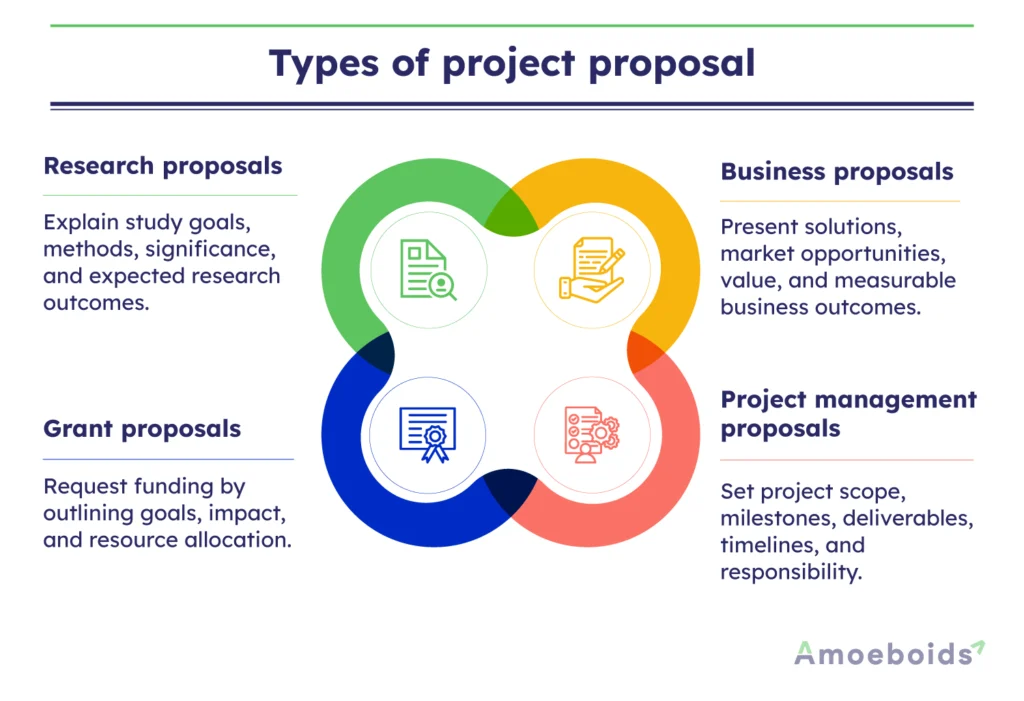
1. Research proposals are common in scholarly or scientific contexts. It describes the topic of your study, its significance, and the methods you’ll use for data collection and analysis. Before their work starts, researchers use it to obtain funding or approvals.
2. Business proposals are frequently written to present concepts to partners, investors, or clients. Persuasion is the aim here. You’re demonstrating how your project can address an issue, close a market gap, or produce quantifiable outcomes.
3. Project management proposals are utilized within organizations to organize and oversee projects. They help teams remain accountable and in sync by outlining deliverables, milestones, and scope as work progresses.
4. A grant proposal is created to obtain outside funding. It describes the project’s goals, potential outcomes, and the prudent use of funding to achieve them.
Even though their target audiences are different, all the above types of proposals are focused on bringing clarity.
Project Proposal vs. Project Plan
Understanding how to write a project proposal, project proposal format, project proposal template, and related documents helps with planning, approvals, communication, and project success. The table is provided below:
| Aspect | Project Proposal | Project Plan |
|---|---|---|
| Purpose | Written to obtain approval, funding, or stakeholder support for a project idea. | Created to organise and manage project execution following approval. |
| Focus | Explains why the project should start. | Describes how the project will be completed successfully. |
| Timing | Prepared before the project starts | Prepared after the proposal gets approved |
| Main Content | Goals, budget estimates, projected outcomes, and business value | Tasks, deadlines, milestones, risks, and resources |
| Structure | Often follows a clear project proposal format for better presentation | Follows a detailed planning and scheduling structure. |
| Supporting Resources | May include a project proposal sample or project proposal template for reference | Contains workflows, schedules, and execution strategies. |
| Audience | Clients, sponsors, investors, or decision-makers | Project managers and internal teams |
| Style | Persuasive, concise, and idea-focused | Detailed, technical, and execution-focused |
Project Proposal vs. Business Case
Understanding these differences helps professionals learn how to prepare a proposal for a project while improving strategic business decision-making. The table highlights documents that support planning and investment decisions.
| Aspects | Project Proposal | Business Case |
|---|---|---|
| Purpose | Presents a project idea and requests approval | Explains why investing in the project makes business sense |
| Main Goal | Gain stakeholder approval and project support | Justify costs, benefits, and return on investment |
| Focus | Project objectives, solutions, and expected outcomes | Financial assessment, risks, and long-term business value |
| Detail Level | Moderate overview with essential project details | Detailed evaluation with cost-benefit analysis |
| Includes | May include the content of a project proposal such as goals, budget, and timeline | This includes ROI analysis, financial forecasts, and business impact. |
| Audience | Clients, sponsors, or management teams | Executives, investors, and senior leadership |
| Usage | Helpful when learning how to make a proposal for a project | Helpful for evaluating whether the project should move forward |
| Style | Persuasive and solution-oriented | Analytical and financially focused |
Project Proposal Outline – Key Components
Having a powerful project proposal outline allows teams to express ideas, communicate more effectively with stakeholders, and improve approval ratios.
- Start with a concise project summary that outlines objectives, challenges, and expected outcomes in the correct project proposal format.
- Define the problem and explain why the project is important to stakeholders while learning how to write a project proposal professionally.
- A project proposal template should be structured and easy to follow. It should include project goals, deliverables, timelines, and milestones.
- Add estimated budgets, required resources, and responsibilities of teams to make planning stronger and project execution clearer.
- Explain the implementation strategy in detail, including practical steps, workflows, and risk management to help with project teamwork and decisions.
- End with expected results, approval requests, and supporting details, as in a professional project proposal sample or example of project proposal.
How to write a project proposal?
It’s not just about filling up the sections of a proposal. Together, all sections must tell a story. Here are some practical project proposal steps to help you understand how to write a project proposal clearly and professionally.
1. Know your target audience
One of the basic project proposal tips you’ll hear from a project management expert is to consider who will read your proposal before you begin typing. Are you speaking to technical teams that want specific specifications or executives who want a clear return on investment? You may need to deploy a slightly different tone and degree of detail for each group.
Consider this example: A CEO of an organization would like to focus on why the project is a priority. On the other hand, an engineering lead will care more about how it can be delivered.
2. Follow a clear structure
A solid structure makes sure that your proposal is well-organized and easy to follow. The framework shared by PeerRecognized includes nine essential sections:
- Title
- Problem statement
- Objectives
- Methodology
- Resources
- Participants
- Results and impact
- Dissemination plan
- Timeline and budget
This structure can work well for you, as it will give your readers everything they need to make an informed decision. You can also arrange these sections using a simple project proposal form to maintain consistency and simplicity across teams. By answering all the right questions in the right order, you get to show that you’ve thought through the details.
3. Craft a compelling introduction
Make your opening count. A short, engaging summary of the problem you’re solving is a great way to open. Then talk about why it is a priority right now. Next, you introduce your proposed solution and its expected impact.
Here’s the thing. Stories stay longer with people than numbers. Before jumping into technical details in your project proposal outline, paint a picture of the pressing problem and help them imagine how your idea can solve it.
4. Define clear and measurable objectives
Be specific when it comes to defining what success means in this project. A good practice is to use the formula of SMART goals (specific, measurable, achievable, relevant, and time-bound). Take this example. Don’t just say “make support faster”. Instead, set a goal like this: “Improve customer response time by 40 percent within six months.”
Clear objectives work in favor of building trust. They help your team keep an eye on the big outcome rather than just being busy with activities.
5. Describe your approach
In this stage, talk about how you plan to make the project a reality. Walk the reader through your methodology. This will include aspects like phased deliveries, agile sprints, or research. Being transparent is important as it shows you are thorough.
Mention if there are risks or limitations, and share your plan to manage them. Showcase your confidence and foresight, which usually goes well with the decision-makers.
6. Detail resources and participants
You need to talk about your project requirements here. Clearly mention the team members, their responsibilities, and the resources needed. This section could include resources like money, tools, or equipment.
7. Outline the anticipated outcomes and effects
Here’s where you demonstrate what kind of impact your project will create. Make sure you discuss success in tangible terms. Use metrics like time saved, money made, or increased user satisfaction in the project proposal outline.
8. Include a dissemination plan
Now, our idea just doesn’t stop at execution. You need to talk about it at different stages to keep everyone in the loop. In your proposal, detail the mechanism of reporting progress or communicating updates. You could be publishing internal reports, sharing dashboards, or holding stakeholder demos to disseminate the progress report.
9. Provide a realistic timeline and budget
Time and money are two things reviewers always look at closely. Be realistic here. Present a timeline that aligns with your project scope and include a budget that justifies the costs. Avoid vague estimates. Decision-makers appreciate numbers backed by reasoning.
10. Review and revise
Before you hit send, take a step back. Read your proposal from your reader’s perspective. Does it flow logically? Is it free of jargon or long-winded sentences? Check for consistency in tone and facts. A clean, error-free proposal gives a lasting impression of professionalism and care.
Project proposal example
Let’s look at how a project proposal might work in tactical terms. A small software development team is looking to create a new tool for collecting customer feedback on their product. They are clear about what they want to create. But to get started, they must persuade the leadership that it is worth the investment of time, money, and energy.
Here’s how their proposal might unfold:
- Give it a straightforward title, such as “The Customer Feedback Tool Implementation Project.” The team presents a clear issue: they currently collect feedback in an unorganized and slow manner, relying on manual reports that delay insights.
- They then accurately outline their goals to inform stakeholders in a timely manner. Next, they explain their strategy for using an Agile approach in the methodology section. Testing and enhancements are made early rather than late thanks to this rhythm.
- Then comes the resources section. Every requirement is laid out clearly. This is done to ensure that there’s no confusion about what’s needed once the proposal is approved.
- Now move to the participants’ component. Detail how the project manager oversees the schedule, developers build features, and the UX designer focuses on user flows. Everyone’s role is visible and defined.
- The results and impact section connects effort to outcomes. Faster feedback means the company can spot product issues early, release improvements quickly, and boost user satisfaction.
- The team also includes a dissemination plan. This talks about how they’ll share progress reports and updates. With this, every stakeholder can view live updates and track milestones without chasing down reports.
- Finally, they close with a timeline and budget. The plan is broken into phases so that spending aligns with progress.
Now, step back and look at what makes this proposal effective. It’s specific, transparent, and easy to follow. Every section leads naturally into the next. Anyone reading it can visualize how the project will unfold and why it’s worth supporting.
That’s exactly what a strong proposal does. It turns a good idea into a clear, actionable plan that others can believe in.
Tips for Writing an Effective Project Proposal
A concise project proposal improves communication, builds stakeholders’ confidence, and increases the chances of successful project approval.
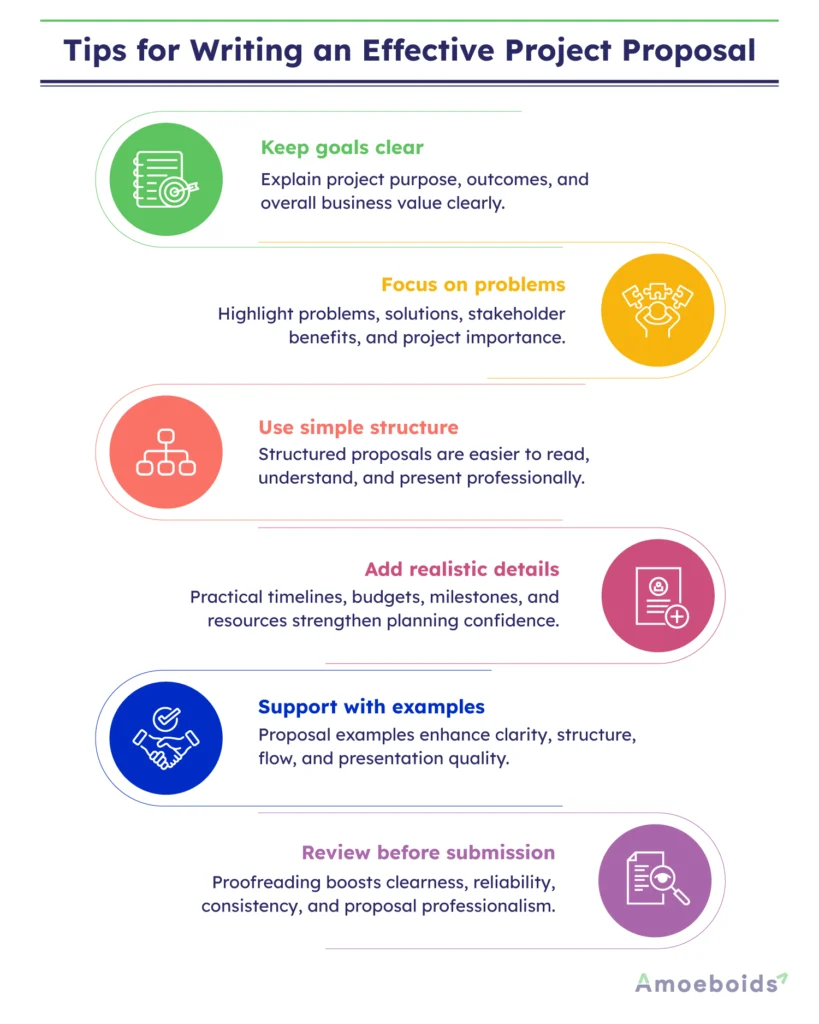
Keep Goals Clear:
Simply explain the project purpose, expected outcomes, and business value while learning how to write a project proposal effectively.
Focus on Problems:
Show the problem that your project solves and explain why stakeholders should support your idea and proposed solution.
Use Simple Structure:
A standard project proposal format makes your document easier to read, comprehend, and review professionally.
Add Realistic Details:
Naturally integrate practical timelines, budgets, milestones, and resources to streamline planning and enhance stakeholder confidence.
Support with Examples:
Looking over a project proposal sample can help improve clarity, flow, and presentation quality.
Review Before Submission:
Check the content of a project proposal for clarity, grammar, precision, and consistency with project goals and expectations.
Getting your project proposal right
After reading your proposal, readers should have confidence in the viability of your plan. Keep an eye on the fundamentals as you polish your proposal. Be clear about your goals, be truthful about your approach, and emphasize the benefits your project will provide. Approvals usually follow when your proposal presents a coherent narrative supported by facts and reasoning.
And remember, utilizing the right tools can make this process easier. The Roadmap & Idea Portal App For JSM helps you turn scattered ideas into organized plans that stakeholders can track in real time. The Automated Release Notes & Reports App for Jira saves hours of manual reporting and keeps communication transparent across teams. When combined, they give each step of the creation and implementation of proposals structure and visibility.
So go ahead and start your next proposal with clarity and confidence. You’ll find that once people understand your vision, getting a “yes” becomes much easier.
FAQs
Q: How do I start a project proposal example?
You could start by explaining the issue your project addresses. Stress on why it is important. A pro-tip is to keep the introduction brief and straightforward. With this you set the scene before you get into technical details. When you help your readers understand the context and problem at hand at the outset, they will be naturally more attuned to know about the solution.
Q: Why is a project proposal important?
A project proposal acts as a connector between an idea and its implementation. Clear communication of your plan ensures everyone who reads it is clear on priorities and the overall thought. When you do it right, the decision-makers get the confidence they need to give the green light to your project. There are other benefits too. It keeps everyone aligned on the scope, objectives, and execution plan, reducing the chances of misunderstandings later on.
Q: What are the key elements of a project proposal?
Some core components are generally found in all strong proposals. The list includes elements like a precise problem statement, quantifiable goals, and a clear title. You must make sure that the resources or people you’ll need for the project are clearly mentioned. Also, explain your methodology and approach. Other sections that will make your proposal more comprehensive include projections and a plan for disseminating updates or reports. You cannot miss mentioning your budget and schedule, which are in line with the size of your project. Each of these components works together to give a complete picture of your project.