
Every team wants to move faster, do more with less, and deliver real value. Businesses are constantly looking to reduce hidden inefficiencies like wasted steps and outdated processes.
Lean process improvement helps you identify friction and remove it step-by-step. It sharpens your focus on what truly matters and cuts out everything that doesn’t. The approach first began at Toyota and then sparked a global shift in how businesses approach process improvement.
In this guide, we’ll explore how lean process improvement works, why it matters, and how you can use it to reduce waste and stay focused on meaningful outcomes.
What is lean process improvement?
Lean process improvement means removing anything that doesn’t directly contribute to customer value. It helps you identify and eliminate wasteful actions, ensuring your efforts are effective, not just busy. In practical terms, this could mean eliminating unnecessary approval steps in product development or streamlining clunky handoffs in a support process. The goal is to simplify the everyday workflow.
Lean process improvement is a crucial component of lean process management. Management sets the goals, provides the necessary tools, and fosters a culture that encourages continuous improvement over time.
What is lean operations management?
You might confuse lean process management with lean operations management. They are interconnected but not the same. Lean process management guides continuous improvement efforts across an organization’s workflows. Lean operations management, on the other hand, applies these principles to the entire business system. This includes culture, leadership, strategy, and even supply chains.
Both matter, but one focuses on the engine parts while the other ensures the whole car runs smoothly. Together, they help you create long-term efficiency.
Role of lean operations management in business success
Lean operations management turns strategy into action, driving daily efficiency, accountability, and results. Here’s how it helps teams:
- Reducing workflow waste: Eliminates non-value-adding steps by intentionally mapping how work is done. This optimizes team efforts, cuts delays, and saves resources right from the start.
- Standardizing best practices: Creates consistent workflows across teams, reducing miscommunication, speeds up onboarding, and keeps everyone informed.
- Structuring daily problem-solving routines: Establishes routines, like daily huddles, that surface minor issues early. This encourages quick action and continuous team improvement.
- Aligning operations with feedback: Uses customer insights to guide operational choices, ensuring products keep up with realistic expectations rather than assumptions.
- Managing resources efficiently: Uses clear systems to manage resources, like materials, equipment, and staff. This helps cut waste, lower costs, and keep operations running smoothly.
- Using real-time data to manage performance: Monitor key metrics in real-time, helping teams take immediate action when things go off track.
Lean operations management impacts how teams think, collaborate, and deliver every day. This daily discipline turns process improvements into lasting business success.
History and evolution of lean process management
Lean process management was first used in 1918 when Sakichi Toyoda started the Toyoda Spinning and Weaving Company in Japan. He came up with a simple but powerful idea that machines should stop automatically when something goes wrong. That thinking laid the groundwork for what we now call lean.
Then came the 1950s, when Taiichi Ohno at Toyota noticed a big problem. Western factories were producing more than needed, filling up warehouses, and not thinking about what the customer wanted. To fix that, Toyota created the Toyota Production System (TPS). It was used to cut waste, improve flow, and focus on actions that added value.
In 1990, the approach gained global attention when the book The Machine That Changed the World coined the term ‘lean production.’ Since then, lean principles have moved far beyond car manufacturing and are now widely used in industries like healthcare to improve efficiency.
Key principles of lean process management
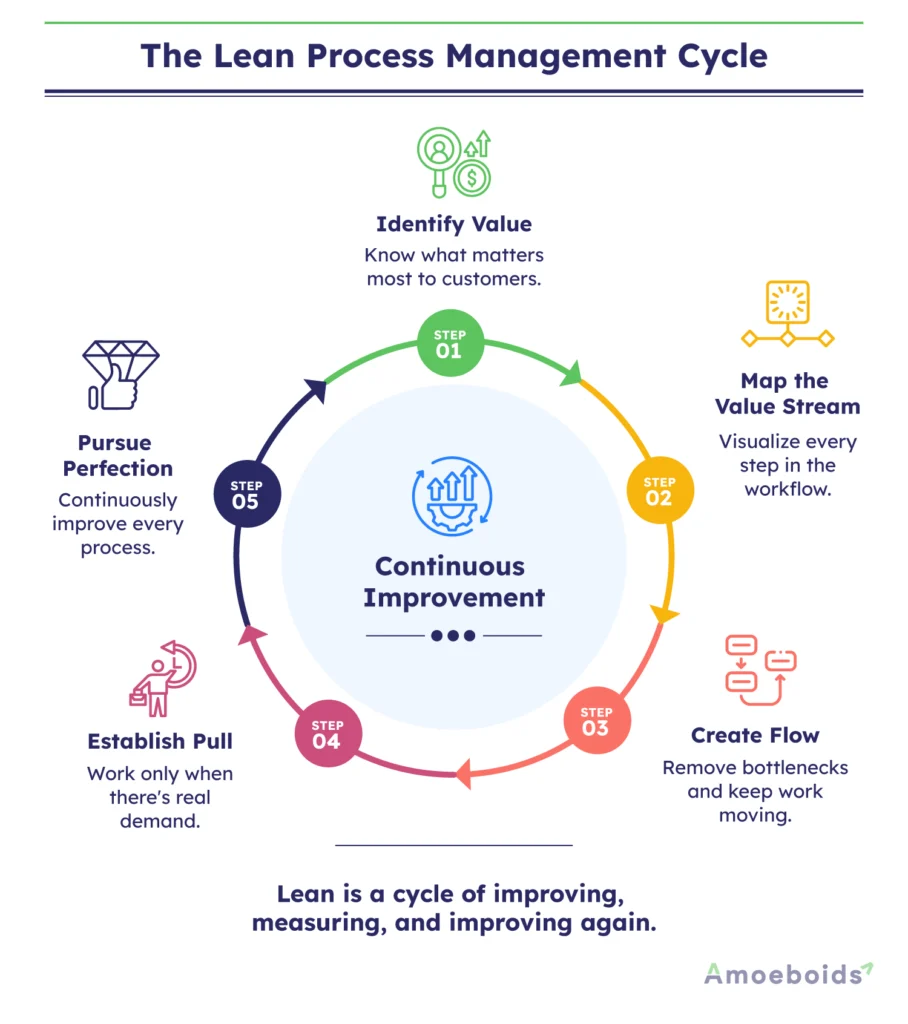
To understand lean process optimization, you need to start with its core principles. These five principles are hands-on practices that help you improve your workflow step by step:
Identify value
Begin by defining what value means to your customer. What are they truly looking for? What exact problem are you solving? Anything that doesn’t directly contribute to that outcome is likely a waste. This step takes active listening, often through real customer feedback and insightful team discussions.
Map the value stream
Lay out your process in front of your team. Every step, from the initial idea to the final delivery, should be visible. You can only spot delays, rework, or tasks that don’t serve a purpose when you see the whole picture. This gives you clarity on where things are going wrong.
Create flow
Now that you’ve mapped your process, work to remove anything that slows it down. You want work to flow freely, without constant interruptions, to achieve better results. That may mean something as simple as improving collaboration between teams with a centralized chat system. Anything that makes progress smooth is worth a shot.
Establish the pull system
What’s the pull system? It means work only starts when there’s a demand for it. Instead of pushing tasks through just to keep everyone busy, you wait until a step is completed before the next step begins. This keeps your workflow balanced and avoids piling on unfinished work. It also helps prevent overproduction, saving you time and effort. You end up building only what’s needed, exactly when it’s needed.
Pursue perfection
Lean process methodology isn’t a one-time effort. It’s a habit of continually seeking better ways to work. When everyone on the team is encouraged to identify and address inefficiencies, the system becomes stronger over time. There’s no finish line here, just a shared commitment to getting better every day.
Together, these five principles provide a clear and practical approach to working. Each of these principles builds on the last to create a system that supports effective lean process optimization.
Types of Waste in Lean Process Improvement (Muda)
All teams have their hidden flaws that silently eat up time, effort, and resources. In Lean process improvement, these non-value-adding actions are called “Muda,” or activities that do not add value to the customer.
- Overproduction: Producing products, features, reports, or information that is not needed often leads to wasted effort, increased costs, and additional work to manage unused outputs.
- Waiting: The time spent waiting for approvals, feedback, resources, or reliance slows progress. Delays cause bottlenecks, lowering productivity and affecting customer satisfaction.
- Transportation and Motion: Moving people, information, or materials when it is not needed has no value. Excessive handoffs, searching for information, and switching systems all consume valuable time.
- Overprocessing and Defects: Doing extra work or fixing errors on a regular basis consumes resources. Quality issues and complex workflows often culminate in rework and customer frustration.
- Inventory and Unused Talent: Excess inventory, unfinished work, and neglected employee skills are all potential sources of errors. Leveraging team expertise and maintaining optimal workloads enhances overall performance and innovation.
Lean Process Improvement Methodology
Great operations do not happen by chance. Lean Process Improvement is a step-by-step guide for identifying flaws, reducing waste, and consistently providing more value with fewer resources.
Identify Value:
Start by understanding what truly matters to your customers. Focusing on value helps teams prioritise meaningful activities and eliminate work that adds little benefit.
Map the Value Stream:
Visualise every step involved in delivering a product or service. This reveals bottlenecks, redundancies, and opportunities to streamline workflows effectively.
Create Continuous Flow:
Remove obstacles that slow work down and interrupt progress. A smooth flow reduces delays, improves performance, and helps teams deliver faster.
Establish Pull-Based Processes:
Produce work based on actual demand, not assumptions. This reduces excess inventory, cuts down on waste, and increases resource usage.
Pursue Continuous Improvement:
Lean is an ongoing journey, not a one-time project. Regular feedback, experimentation, and incremental changes help organizations continuously improve performance and customer satisfaction.
Which Lean Methodology is Best for Your Business?
There is no universal approach to lean. The best methodology is defined by your business goals, team structure, and the problems you are attempting to solve.
Here are five popular Lean approaches and where they work best:
- Lean Manufacturing: Ideal for companies that want to reduce waste, enhance quality, and streamline workflows. Its primary goal is to maximise customer value while using as few resources as possible.
- Lean Six Sigma: Six sigma lean process combines Lean effectiveness with Six Sigma’s data-driven problem-solving approach. It helps organisations reduce defects, improve consistency, and make better operational decisions. Many companies adopt a six sigma lean process framework when they need both waste reduction and measurable quality improvements.
- Kanban Method: Perfect for teams managing regular work and changing priorities. Visual workflows and work-in-progress limits can help boost productivity while avoiding team overload.
- Kaizen: Best for companies looking to promote a culture of continuous improvement. Small and consistent changes made by employees can lead to significant future operational gains.
- Just-in-Time (JIT): Perfect for companies that want to cut down on their inventory cost and waste. Work, materials, or products are delivered only as needed.
Difference between lean process and traditional process management
We know lean process management is the new, better way. But how exactly is it different from conventional methods? Let’s find out with this table:
| Feature | Lean Process Management | Traditional Process Management |
| Primary focus | Removes waste and improves flow | Follows a strict plan and hits milestones |
| Approach towards improvement | Continuous small adjustments | Project-based or periodic, large updates |
| Team involvement | Everyone spots problems and suggests fixes | Management defines and directs |
| Prioritization | Based on customer value | Often based on schedule or budget |
| Adaptability | Quickly shifts based on feedback or demand | Slower, waste is often accepted as part of operations |
The fundamental difference lies in mindset and approach. Traditional management often operates under the assumption that current processes are acceptable and only need minor adjustments.
Lean management questions everything and constantly seeks better ways to deliver value. And today, when all customers want is value and personalization, this philosophical shift decides your team’s success.
Benefits of lean process improvement methodology in healthcare
Lean process improvement might have started in factories, but it also benefits different sectors such as healthcare. Here’s how it makes a difference:
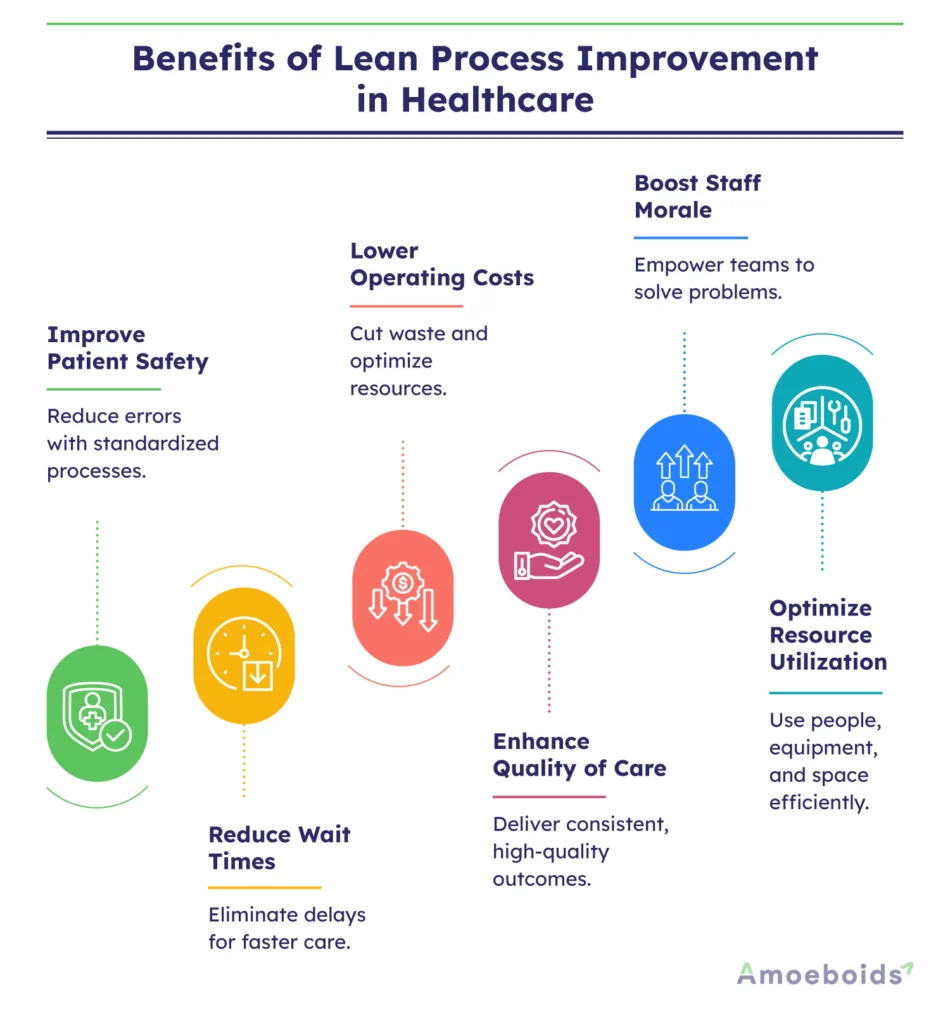
Improves patient safety:
Standardizes procedures and reduces variation, lowering the risk of medical errors.
Reduces patient wait times:
Removes unnecessary steps like repeated form-filling and slow internal communication to improve service.
Lowers operating costs:
Aligns supplies with demand, reduces overstock, and uses just-in-time practices.
Enhances quality of care:
Minimizes rework through clearer processes and better communication and ensures consistent delivery of critical services.
Boosts staff morale:
Involves healthcare workers in problem-solving and gives them more control over daily challenges.
Improves resource use:
Ensures staff, equipment, and space are used where they matter most.
These improvements help healthcare professionals better care for their patients and support a stronger, more efficient healthcare system.
Case Study: Lean process improvement in a healthcare setting
Virginia Mason Medical Center in Seattle is one of the leading lean process improvement examples.
In the early 2000s, they were dealing with high costs, long patient wait times, and inefficient processes. Inspired by Toyota, they created the Virginia Mason Production System to focus on removing waste and improving patient care.
Soon after implementation, their lab test reporting time dropped by over 85 percent. In some areas, productivity went up by 93%. They also reduced labor expenses, including overtime and temporary labor, by $500,000 in just one year. Plus, more innovative use of space helped them avoid spending $11 million on new facilities.
Their story demonstrates how lean methodologies can make healthcare faster, safer, and more successful without compromising quality.
Step-by-Step Guide to Implementing Lean Process Improvement
You don’t need to overhaul the entire business overnight to do Lean. A structured approach can gradually allow teams to begin to adopt Lean principles and deliver measured benefits.
Following these lean process improvement steps helps companies reduce risk while building momentum for long-term change.
- Assess Your Current Processes: Start by documenting how work currently flows through your organisation. With the current state known, you can spot mistakes, delays, and chances to improve.
- Identify Waste and Bottlenecks: Look for activities that consume time and resources without creating customer value. Look at delays, rework, too many approvals, and rash handoffs.
- Set Clear Improvement Goals: Set measurable goals, such as reducing cycle times, enhancing quality, or reducing costs. Clear goals provide direction and help track progress.
- Implement Changes Incrementally: Test improvements on a small scale before implementing them across teams. Small wins boost confidence and reduce resistance to change.
- Monitor, Measure, and Refine: Continuously track performance metrics and ask for feedback from employees and customers. Lean improvement works best when teams regularly evaluate their workflows and improve them.
Practical tools and key techniques to implement lean process improvement methodology
Now that you understand the process, let’s explore some proven lean process improvement techniques that teams use to identify waste and improve performance.
Value stream mapping (VSM)
If you’ve ever attempted to fix a broken process without a comprehensive understanding of it, you know how frustrating that can be. Value Stream Mapping provides a comprehensive view. You lay out every step, from the first customer request to the final delivery.
It shows where value is added and where delays or waste exist. This visibility into your lean process flow helps teams identify bottlenecks and improve how work moves across the company.
The 5 whys
When something goes wrong, don’t settle for the first answer. Ask why multiple times, usually five times, to get to the root cause. This is one of the most effective lean process improvement techniques because it uncovers root causes instead of simply addressing symptoms.
Kanban boards and WIP limits
Kanban is something most teams quickly warm up to. It makes everything visual and just easier to manage. But it is constructive when you introduce WIP (Work in Progress) limits.
It stops the team from taking on too much at once and encourages finishing one thing before starting another. By improving lean process flow, Kanban helps teams maintain focus and deliver work more effectively.
5S methodology
The 5S methodology stands for Sort, Set in Order, Shine, Standardize, and Sustain. This applies to your desk, your team’s shared drive, or even your Jira board.
Once things are in order, people spend less time searching and more time doing meaningful work.
PDCA cycle (Plan-Do-Check-Act)
This is Lean’s go-to method for continuous improvement. You plan a small change, test it, review what worked or didn’t, and then decide whether to roll it out or adjust.
It is one of the easiest ways to build a habit of learning and improving without overwhelming the team. It keeps the momentum going without any big change initiatives.
These tools aren’t complicated. But when you use them regularly, they improve the way your team works.
Common Challenges & How to Overcome Employee Resistance
Even the best Lean initiatives can face resistance. People naturally worry about change, making communication and involvement essential for successful implementation.
- Fear of Job Loss: Employees may assume Lean is about reducing headcount rather than eliminating waste. Clearly communicate that the goal is improving processes, not replacing people.
- Lack of Understanding: Resistance often stems from uncertainty about new methods and expectations. Provide training and practical examples that show Lean’s benefits in everyday work.
- Poor Communication: Change initiatives fail when employees aren’t informed about the reasons behind them. Share goals, progress, and outcomes regularly to build trust and full disclosure.
- Limited Employee Involvement: People support the changes they helped to create. Encourage employees to identify errors, propose solutions, and actively participate in improvement projects.
- Difficulty Sustaining Momentum: Initial excitement may fade if improvements are not reinforced. Celebrate wins. Acknowledge contributions. Make continuous improvement a company habit.
Conclusion
Throughout this guide, we explored what lean process improvement is and what it takes to apply it effectively. By following these lean process improvement steps, teams can systematically reduce waste, improve performance, and create lasting value. It all comes down to building a culture where teams constantly ask, “How can we do this better?” When you focus on eliminating waste, creating value, and improving just a little every day, you commit to long-term impact.
Whether you’re leading a startup or managing a growing product team, Lean gives you the mindset and structure to build more sustainably.
FAQs
Q1. What are the lean process management tools and techniques?
Some of the most useful tools include Value Stream Mapping, the 5 Whys, Kanban boards with WIP limits, the 5S method, and the PDCA cycle. They help you visualize work, identify root causes, stay organized, and improve continuously.
Q2. Why is lean an effective process improvement approach?
It works because it focuses on real customer value and cuts out anything that doesn’t contribute to it. It helps teams work smarter, reduce delays, and improve quality over time.
Q3. What are the 5 lean principles of process improvement?
The five principles are identifying value, mapping the value stream, creating flow, establishing pull, and pursuing perfection. Together, they guide teams in reducing waste and improving efficiency.
Q4. What does a lean process minimize?
A lean process minimizes waste, delays, unnecessary inventory, and rework. It ensures teams focus only on steps that truly add value to the end user.