
What’s shaping your product strategy, long-term business goals or day-to-day customer input? According to a recent ProductPlan report, 51% of companies with over 10,000 employees say business goals and objectives drive their product strategy. On the other hand, 36% of smaller companies (under 20 employees) rely more on customer feedback to guide their decisions.
Both approaches have their place. But if you’re managing a roadmap across multiple sprints and stakeholders, you need a more structured and focused product strategy, and for that, you need to have a couple of good product strategy books in your library.
Reading the best product strategy books is one of the simplest ways to build clarity, confidence, and structure in your process. In this blog, you’ll learn which top books for product managers are worth your time. We’ll break down the core takeaways, who each book is for, and how they help you make better decisions, one sprint at a time.
Introduction to product strategy books
Product strategy books are tools for thinking better. Whether you’re planning a release, prioritizing features, or figuring out what not to build, the right book offers a clear vision.
The best books on product strategy help you step back from daily execution and consider the big picture. They cover how to connect your product vision with business goals, navigate trade-offs, and make decisions that hold up across sprints. And the best ones? They don’t just talk theory. They give you models, examples, and questions that apply directly to your backlog.
For product managers working in Agile environments, these resources can act like a quiet mentor, especially when you’re stuck between stakeholder demands and user expectations.
Books for product managers focused on strategy
Here are some of the best books for product managers who want to sharpen their critical thinking and align product vision with goals:
These product strategy books provide practical frameworks, real-world examples, and proven approaches that help product managers connect vision, execution, and business outcomes.
1. Inspired: How to Create Tech Products Customers Love by Marty Cagan
In this book, Marty Cagan walks you through how leading companies like Google, Amazon, and Netflix build high-performing product teams. You’ll find real examples of how teams validate ideas early, avoid bloated feature sets, and focus on solving real customer problems. There’s also a strong emphasis on culture and why empowered teams build better products.
Ideal for: Product managers working at startups or scaling companies who want to build products customers want without getting lost in the process.
2. Escaping the Build Trap by Melissa Perri
This book is a wake-up call for product managers (PMs) stuck in the cycle of feature shipping with no clear outcomes. Melissa Perri introduces a framework for shifting your team’s mindset from building more to building smarter. She breaks down what a real product strategy looks like, how to create it, and how to measure whether it’s working.
Ideal for: PMs in enterprise or mid-size teams who want to re-center their product practice around value, not volume.
3. The Lean Product Playbook by Dan Olsen
This is a highly practical guide to finding product-market fit through continuous iteration. Dan Olsen’s framework walks you through defining your target customer, identifying underserved needs, creating your value proposition, and testing your MVP with real users. It’s structured like a repeatable process — perfect for Agile teams.
Ideal for: PMs at early-stage startups or in discovery-heavy environments who want a hands-on process to get from idea to impact.
4. Product Roadmaps Relaunched by C. Todd Lombardo, Bruce McCarthy, Evan Ryan, and Michael Connors
Forget those static Gantt charts. This book introduces modern road mapping practices that support Agile delivery. It covers how to communicate roadmap changes, align stakeholders, and connect daily work with a long-term strategy. You’ll find real templates, team stories, and advice for handling pushback from leadership.
Ideal for: PMs managing complex product portfolios or cross-functional initiatives where communication and prioritization are key.
5. Strategize by Roman Pichler
Roman Pichler breaks down the strategic side of product management in a format that’s easy to apply. He introduces tools like product vision boards, GO product roadmaps, and goal hierarchies, giving you a toolkit to shape your product direction and track progress. It’s perfect if you’re looking to build a repeatable planning process.
Ideal for: PMs who want to lead with strategy and need a practical framework to back up their ideas in stakeholder conversations.
Books for product marketing and strategy
Great products also need strong positioning, storytelling, and market understanding. These are some of the top books for product managers who want to study product marketing closely.
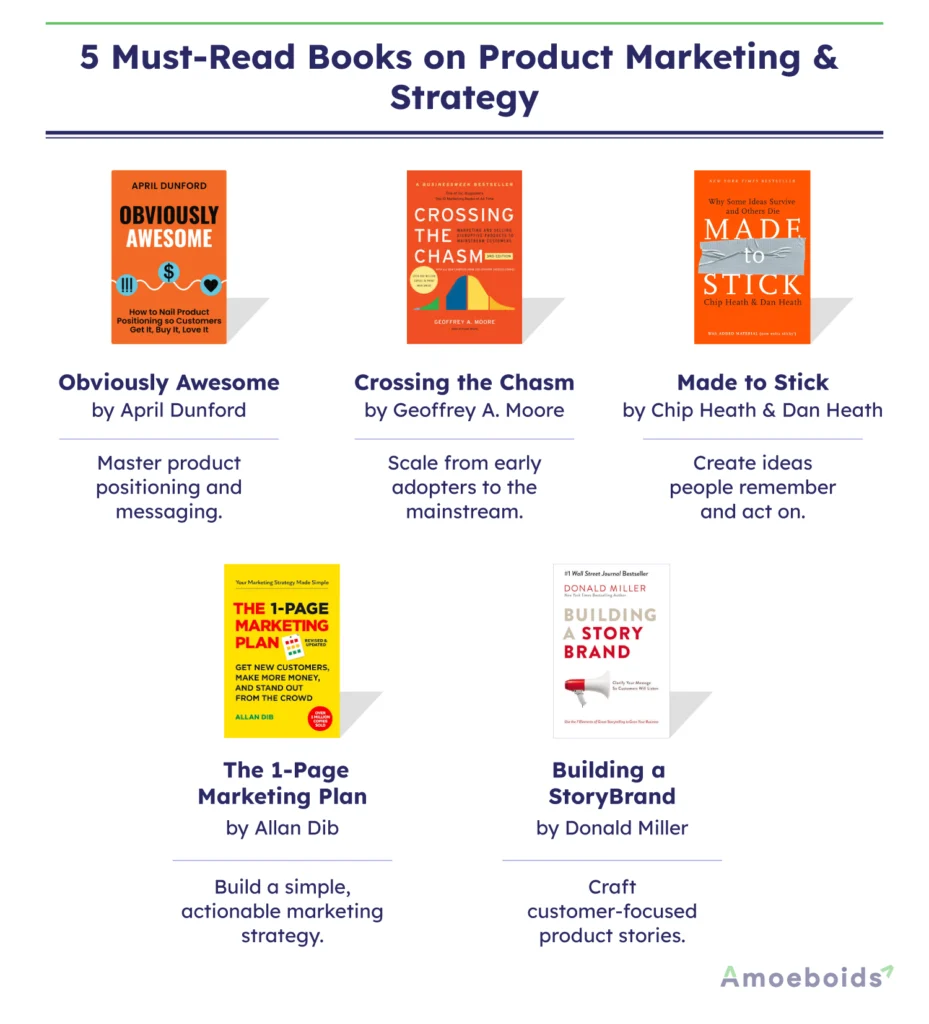
1. Obviously Awesome by April Dunford
This book is a masterclass in product positioning. It teaches through stories, frameworks, and a clear 10-step process. April Dunford shares how to identify the right market context for your product and how that positioning affects everything from messaging to feature prioritization.
Ideal for: PMs launching new features or entering competitive markets, and anyone struggling to explain why their product matters.
2. Crossing the Chasm by Geoffrey A. Moore
A classic in product marketing, this book dives into how tech products move from early adopters to the mainstream. It explains the “chasm” that exists between innovators and the early majority, and how to tailor your strategy, messaging, and features to cross it.
Ideal for: PMs working on B2B or SaaS products who need to scale adoption beyond early users.
3. Made to Stick by Chip Heath & Dan Heath
While not a product-specific book, Made to Stick is essential for learning how to craft ideas that resonate; it’s packed with research-backed principles and examples showing why some ideas spread and others don’t, vital for product managers shaping narratives for users and stakeholders alike.
Ideal for: PMs collaborating with teams on go-to-market efforts or driving adoption for internal tools.
4. The 1-Page Marketing Plan by Allan Dib
This book breaks down marketing strategy into nine simple blocks that fit on one page. While targeted at marketers, it’s incredibly useful for product managers trying to understand how product and marketing intersect, especially when launching new features or driving user engagement.
Ideal for: PMs in small teams or startups who manage both product and go-to-market strategy.
5. Building a StoryBrand by Donald Miller
This book gives a clear method for crafting product stories that focus on the user. It helps PMs and marketers shape messaging that puts the customer at the center of the narrative, making your product feel like a solution, not a feature list. It also talks about the 7-part StoryBrand framework that mirrors a hero’s journey.
Ideal for: PMs involved in product launches, onboarding, or who need to improve how the product is presented to users.
Books on Business Growth & Product-Led Growth
Building a great product is only half the battle. Product managers need to know about growth, customer acquisition, retention, and scaling. These books teach readers how to turn successful products into long-term companies that prioritise customers.
1. Product-Led Growth by Wes Bush
This book explains how companies like Slack, Dropbox, and Zoom are using their products as the primary driver of customer acquisition, conversion, and retention. Wes Bush provides practical frameworks for reducing friction in the user journey and creating experiences that naturally promote adoption.
Ideal for: Product managers working on SaaS or self-service products who want to drive growth through product experience rather than sales and marketing.
2. Hacking Growth by Sean Ellis and Morgan Brown
Written by the creator of the term “growth hacking,” this book outlines a structured process for experimenting, measuring outcomes, and finding feasible growth opportunities. It combines product, marketing, and data into a repeatable framework for growth.
Ideal for: PMs responsible for user acquisition, engagement, and retention metrics.
3. Competing Against Luck by Clayton Christensen
This book introduces the “Jobs to Be Done” framework and explains why customers “hire” products to solve specific problems. Understanding these jobs allows teams to create products that customers actively choose and recommend.
Ideal for: PMs focused on customer research, product discovery, and innovation.
4. The Hard Thing About Hard Things by Ben Horowitz
Ben Horowitz shares hard lessons on founding and growing tech companies through hard times. It covers leadership, making choices, and the realities of growing a business when there are no easy answers.
Ideal for: PMs at fast-growing startups and scale-ups navigating uncertainty and rapid change.
5. Traction by Gabriel Weinberg and Justin Mares
This book introduces 19 different customer acquisition channels and explains how companies can identify which channels are most likely to drive long-term growth. It provides practical examples and testing frameworks that product managers can implement right away.
Ideal for: PMs work on growth initiatives, go-to-market plans, and customer acquisition strategies.
Books on Design & User Experience for Product Managers
Great products aren’t created by accident. They are based on actual user needs, behaviors, and expectations. These books help product managers understand better how users think, decide, and interact with products, helping them build experiences people actually enjoy.
1. The Design of Everyday Things by Don Norman
A timeless classic that explains why some products are intuitive and others cause frustration. Don Norman talks about key design principles that can help product managers understand how users naturally interact with products and systems.
Ideal for: PMs who want to create more user-friendly products and enhance collaboration with designers.
2. Don’t Make Me Think by Steve Krug
This helpful guide focuses on functionality and simplicity. Steve Krug shows how less friction leads to a much better user experience and more adoption.
Ideal for: PMs working on web applications, SaaS products, or customer-facing platforms.
3. Hooked by Nir Eyal
Why do some products become part of our daily routines, while others are forgotten almost as soon as we first try them? Hooked introduces the Hook Model, which outlines how successful products promote engagement and habit formation.
Ideal for: PMs are in charge of retaining users, engaging them, and increasing their number.
4. Sprint by Jake Knapp
This book, based on Google’s design sprint framework, walks readers through a step-by-step process for solving product challenges, testing ideas, and validating solutions in a single week.
Ideal for: PMs involved in product discovery and rapid experimentation.
5. UX Strategy by Jaime Levy
This book links business strategy and user experience. Jaime Levy explains how to combine customer research, product design, and business goals to create market-leading products.
Ideal for: PMs balancing customer needs with business goals.
Books on Leadership & Team Management for Product Managers
Product managers rarely succeed on their own. Leadership skills are key for putting a strategy into action, whether you are influencing stakeholders, working with engineers, or aligning cross-functional teams.
1. Radical Candor by Kim Scott
Kim Scott presents a simple yet effective framework for providing direct and caring feedback. The book teaches leaders how to build trust while maintaining accountability.
Ideal for: PMs leading discussions, managing stakeholders, and navigating difficult conversations.
2. The Manager’s Path by Camille Fournier
This book looks at the transition from individual contributor to leadership roles. It offers practical advice on communication, teamwork, and organizational development.
Ideal for: PMs who want to get ready for senior product or leadership positions.
3. High Output Management by Andrew Grove
This leadership classic, written by a former Intel CEO, covers improving productivity, managing teams well and building repeatable processes for success.
Ideal for: PMs responsible for execution, delivery, and team performance.
4. Turn the Ship Around! by L. David Marquet
Marquet uses real-world leadership examples to show how empowering teams to make decisions results in increased ownership and better outcomes.
Ideal for: PMs looking to build empowered, high-performing teams.
5. Crucial Conversations by Kerry Patterson, Joseph Grenny, Ron McMillan, and Al Switzler
This book teaches how to handle high-stakes discussions where opinions clash and emotions flare, a situation many product managers face.
Ideal for: PMs who frequently negotiate priorities and coordinate multiple stakeholders.
Honourable Mentions — More Books Worth Reading
Some books teach valuable lessons that go beyond product management. These titles touch on strategy, innovation, execution, and leadership from a variety of perspectives and are worth a place on any PM’s reading list.
1. Good Strategy Bad Strategy by Richard Rumelt
Rumelt explains how effective strategies differ from vague aspirations. The book teaches readers how to identify real strategic challenges and focus resources where they are most needed.
Ideal for: PMs responsible for long-term planning and product direction.
2. Playing to Win by A.G. Lafley and Roger Martin
This book, based on a practical strategy framework, shows how successful companies make deliberate decisions about where and how to compete.
Ideal for: PMs are focused on competitive positioning and market expansion.
3. Blue Ocean Strategy by W. Chan Kim and Renée Mauborgne
This book shows how companies can innovate and differentiate themselves to create entirely new opportunities instead of competing in crowded markets.
Ideal for: PMs concentrated on innovation and category development.
4. The Innovator’s Dilemma by Clayton Christensen
A must-read for anyone wanting to understand disruptive innovation and why successful companies often fail to adapt to market shifts.
Ideal for: PMs working in rapidly evolving industries.
5. Measure What Matters by John Doerr
This book explains the Objectives and Key Results (OKR) framework used by leading companies to align teams and track meaningful results.
Ideal for: PMs responsible for setting goals and measuring performance.
What to Read Next Based on Your Experience Level
Not every book has the same value at every stage of your career. Here’s a reading plan based on where you are in your product management journey.
Beginner Product Managers
Start with:
- The Design of Everyday Things
- Don’t Make Me Think
- Hooked
These books help build a strong foundation in user experience, customer behavior, and product thinking.
Intermediate Product Managers
Continue with:
- Sprint
- Radical Candor
- High Output Management
These books help you improve your collaboration, execution, and leadership skills while also increasing team effectiveness.
Advanced Product Managers
Move on to:
- Good Strategy Bad Strategy
- Blue Ocean Strategy
- The Innovator’s Dilemma
These books focus on strategic thinking, market positioning, innovation, and long-term business growth.
The most effective books on product strategy share a common goal: helping product managers balance customer needs, business objectives, and long-term product vision.
Key insights from strategy books
Here are some recurring insights from the best product strategy books:
1. Start with real user problems, not features
Escaping the Build Trap emphasizes that teams often ship features without validating whether they solve a real user need. For HR tech teams, this could mean building a new “recognition badge” system without verifying whether low engagement stems from unclear OKRs, rather than a lack of appreciation tools.
2. A clear product vision anchors sprint conversations
Inspired by Marty Cagan explains how a strong vision helps teams say no to distractions. In SaaS teams, where feature requests flood in from sales and customer success, a well-defined vision ensures roadmap stability.
3. A good strategy helps you say “no” with confidence
Strategize by Roman Pichler explains that without clear goals, everything feels like a priority. In HR tech, this could lead to feature overload, releasing half-baked dashboards or duplicative goal-setting flows.
4. Positioning guides not just messaging, but delivery
In Obviously Awesome, April Dunford shows how poor positioning leads to misaligned product development. For instance, if you’re positioning your SaaS tool as “data-light,” but your roadmap is filled with complex reporting features, you’re drifting from your narrative.
5. Outcome-based roadmaps keep your Agile team focused
Product Roadmaps Relaunched advocates for planning around outcomes like “increase team OKR adoption by 30%,” instead of vague deliverables like “launch OKR feature.” This makes it easier to measure success and course-correct fast.
How to apply strategy knowledge
Now that you’ve seen what the top product strategy books teach, here’s how their lessons play out on real product teams. These aren’t just theoretical concepts; they’ve been used to fix messy backlogs, tighten launch timelines, and help Agile teams get unstuck.
1. Turn product vision into team alignment
After reading Inspired, a product team at a mid-sized HR tech company rewrote their product vision to focus on one clear user persona: HR managers at fast-scaling startups. This simple shift helped them cut low-impact features and guide sprint planning discussions more confidently.
2. Build a healthy “no list”
One SaaS PM, influenced by Escaping the Build Trap, implemented a 15-minute “feature kill session” before each sprint. If a Jira ticket didn’t map to a current OKR, it was parked. Within two quarters, their team cut 20% of non-impactful dev work.
3. Plan around results, not deadlines
Using the guidance from Product Roadmaps Relaunched, a product marketing manager stopped using calendar-based roadmaps and instead grouped work into “themes” like “Improve onboarding completion rate.” This shift helped reduce team stress and led to better cross-functional focus during sprints.
4. Validate before you build
A team building an employee engagement tool leaned on The Lean Product Playbook to structure pre-sprint discovery. They ran five user interviews before committing dev time, which saved two weeks of engineering effort and helped them refine a key feature.
5. Sharpen your message before launch
An HR SaaS team preparing for a major feature launch applied April Dunford’s positioning framework (Obviously Awesome). They rewrote their landing page to highlight the “fastest time-to-OKR setup” angle, which boosted demo signups by 30% post-launch.
6. Track what matters and report it
A senior PM shared that using metrics inspired by Strategize helped their team improve sprint reviews. They started tracking feature adoption post-release using simple KPIs, then shared them via software like Automated Release Notes & Reports for Jira by Amoeboids.
7. Reflect, refine, repeat
After a launch, one product leader shared a short internal newsletter summarizing the objective, result, and key learning from the sprint. It took 10 minutes to prepare using it, and it became a team habit.
Conclusion
The best books for product managers and top product strategy books in this list can help you build better products, make smarter decisions, and grow in your career. These books on product strategy provide frameworks that can improve decision-making, stakeholder alignment, and product success over time. These strategies can help you refine your vision, prioritize your backlog, and even prepare for a launch.
The real value of these books comes from applying what you learn. Start with the one that matches your current goals, put its ideas into practice, and build your product strategy one step at a time.
Try out these strategies with your team, one step at a time. Small changes today can lead to better products tomorrow.
FAQs
Q. What makes a book ideal for product strategy?
A book becomes ideal for product strategy when it offers more than just theory. It should provide clear, actionable frameworks that professionals can apply in real-world settings. Books that connect product vision with execution, backed by relatable examples and strategic context, tend to be the most valuable for product managers.
Q. Which product strategy books should every product manager read?
A wide variety of product strategy books are available for knowledge-seekers across industries and experience levels. Some prominent examples explore topics like building outcome-driven teams, defining product vision, and structuring roadmaps.
Q. What are the best books for understanding product-market fit?
Strategy books share diverse perspectives about product-market fit, covering everything from early-stage discovery to scaling successful offerings. Some highlight customer research and experimentation, while others focus on crossing adoption barriers or fine-tuning product positioning to match real market needs.
Q. Should product managers focus only on strategy, or is there a balance with execution?
While strategy is essential for setting direction, it holds little value if not backed by disciplined execution. The most effective product managers strike a balance, pairing big-picture thinking with the day-to-day agility needed to turn vision into measurable progress.