
Your team has just missed another deadline. Frustrated, you scramble to reshuffle tasks, enforce tighter time management, and push for faster progress. It seems to work for a while—but just as you start to feel optimistic, the same issue crops up again.
Sound familiar? This is a common scenario in project management, where surface-level fixes often fail to address deeper problems. That’s where the 5 Whys technique comes in.
This simple yet effective method helps uncover the root cause of recurring challenges. For instance, while poor time management might appear to be the issue, digging deeper by asking “why” multiple times could reveal underlying problems, such as unclear project specifications or inefficient communication processes.
By identifying the root cause, the 5 Whys method helps you move beyond short-term solutions and implement lasting improvements.
In this article, we’ll explore how the 5 Whys technique can drive smarter decision-making and foster continuous improvement, leading to more efficient, successful projects.
What is 5 whys root cause analysis, and why is it beneficial?
Developed by Sakichi Toyoda, the founder of Toyota Industries, the 5 Whys method became a cornerstone of Toyota’s problem-solving practices. It has since been widely adopted across industries for its straightforward and actionable approach.
The process is simple: ask “Why?” repeatedly—typically five times—until you uncover the root cause of a problem. The iterative nature of this technique helps cut through superficial symptoms to reveal what’s truly causing the issue. Its brilliance lies in its simplicity: it doesn’t require advanced tools or extensive analysis, just a commitment to digging deeper.
Benefits of the 5 whys method
The 5 Whys technique is more than just a problem-solving tool—it’s a mindset that fosters clarity and continuous improvement. Here are some key benefits:
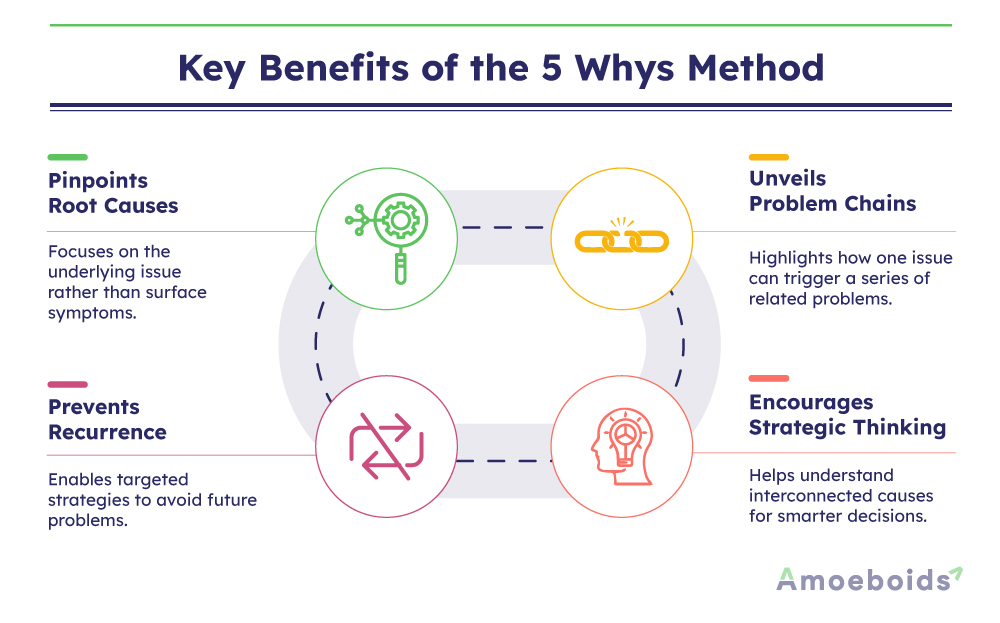
Pinpoints root causes
It identifies the actual cause of a problem rather than just addressing surface-level symptoms.
Unveils problem chains
Exploring connections reveals how one issue can create a cascade of related problems.
Encourages strategic thinking
It builds a clearer understanding of how different causes interconnect, leading to smarter decision-making.
Prevents recurrence
The insights gained enable the creation of targeted strategies to eliminate future bottlenecks or disruptions.
By focusing on the “why” behind a problem, teams can move away from reactive solutions and toward sustainable, long-term fixes.
The simplicity of the 5 Whys method belies its effectiveness. It’s not about asking questions for the sake of it but rather asking the right questions at the right time. When applied consistently, it can transform how organizations approach challenges, ensuring that today’s solutions don’t become tomorrow’s recurring problems.
What is a five whys template?
A Five Whys template is a structured framework that guides teams through the process of identifying the root cause of a problem. It helps maintain focus and clarity while documenting each step of the analysis. This ensures a systematic approach, prevents oversight, and provides a record for future reference.
A typical Five Whys template includes:
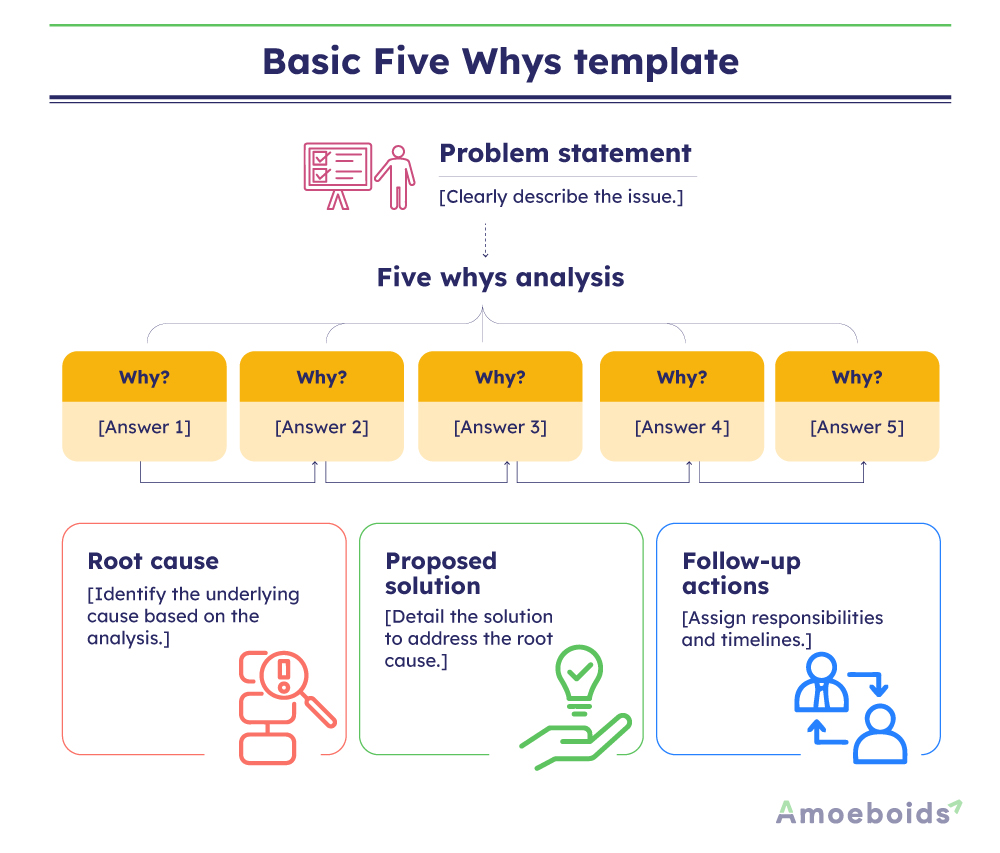
Problem statement
Clearly define the issue to ensure all stakeholders are aligned.
Five whys analysis
Document each iteration of the “Why?” question and its corresponding answer.
Root cause
Summarize the final root cause identified through the analysis.
Proposed solution
Outline actionable steps to address the root cause and prevent recurrence.
Follow-up actions
Record who will implement the solution and by when.
Here’s what a basic Five Whys template looks like:
Problem statement:
[Clearly describe the issue.]
Five whys analysis:
- Why? [Answer 1]
- Why? [Answer 2]
- Why? [Answer 3]
- Why? [Answer 4]
- Why? [Answer 5]
Root cause:
[Identify the underlying cause based on the analysis.]
Proposed solution:
[Detail the solution to address the root cause.]
Follow-up actions:
[Assign responsibilities and timelines.]
Example: Delays in sprint completion
Problem statement: A development team consistently misses sprint deadlines.
Five whys analysis:
- Why did we miss the sprint deadline?
- Tasks were not completed on time.
- Why were tasks not completed on time?
- Developers were unclear about task priorities.
- Why were developers unclear about task priorities?
- There was no detailed sprint planning or backlog refinement session.
- Why was there no detailed sprint planning session?
- The product owner was unavailable due to overlapping commitments.
- Why was the product owner unavailable?
- The organization has no system in place to manage conflicting schedules.
Root cause: Lack of a scheduling framework to prevent overlapping commitments for key stakeholders.
Proposed solution: Implement a shared calendar system and make sprint planning a primary responsibility of the scrum master.
Follow-up actions:
- Action 1: Set up a shared calendar system—[Assigned to: IT team, Deadline: 1 week].
- Action 2: Formalize sprint planning sessions—[Assigned to: Scrum Master, Deadline: Next sprint cycle].
Why use a template?
For teams using Agile, DevOps, or OKRs, a Five Whys template aligns well with iterative improvement processes. It provides a clear framework to ensure that each “why” question digs deeper, helping teams identify actionable solutions without getting sidetracked. By integrating such templates into their workflows, organizations can address systemic issues, reduce recurring problems, and foster a culture of continuous improvement.
Step-by-step process for conducting a 5 whys analysis
Now that you understand the purpose and components of a 5 Whys template, let’s dive into the step-by-step process of applying it. To make this practical, we’ll use an example relevant to many industries: addressing a customer complaint about a delayed order.
#1 Define the problem statement
Start by clearly defining the issue to ensure everyone is aligned.
Example: “A customer reported that their order was delayed by three days.”
This serves as the starting point for the investigation and keeps the analysis focused.
#2 Initiate the first ‘why’
Ask the first “Why?” to identify the immediate reason for the problem.
Example: “Why was the order delayed?”
Answer: “The shipment was dispatched late.”
#3 Unravel successive whys
Continue asking “Why?” for each response to uncover deeper causes.
- Why was the shipment dispatched late?
Answer: “The item wasn’t ready for packing.” - Why wasn’t the item ready for packing?
Answer: “The production schedule was delayed.” - Why was the production schedule delayed?
Answer: “A machine broke down.” - Why did the machine break down?
Answer: “It wasn’t properly maintained.”
#4 Identify the core issue
Stop asking “Why?” once the root cause is clear.
Root cause: Lack of proper machine maintenance.
#5 Develop a corrective plan
With the root cause identified, create a plan to address it and prevent recurrence.
Example actions:
- Implement a regular machine maintenance schedule.
- Assign a dedicated team to oversee adherence to maintenance protocols.
- Train workers to identify and report early signs of machine failure.
By tackling the core issue, the business can enhance operational efficiency, reduce order delays, and improve customer satisfaction.
Best practices to enhance the effectiveness of the 5 whys method
The 5 Whys method is a powerful problem-solving tool, but its success depends on how effectively it’s applied. Following best practices ensures that your analysis is thorough, objective, and productive. Here are key practices that can help you get the most out of the 5 Whys method:
Encourage cross-functional collaboration
Involving team members from different departments can shed light on causes that might not be apparent within a single function. Diverse perspectives lead to deeper insights and more comprehensive solutions.
Adopt data-driven questioning
Avoid assumptions and base each “why” on concrete data. Leveraging logs, reports, and factual evidence validates answers and ensures your analysis is grounded in reality.
Maintain objectivity
Keep the focus on processes, not people. By maintaining neutrality, you create a constructive environment where the team can work together to improve systems and prevent similar issues from occurring.
Adhering to these best practices makes the 5 Whys method an even more effective tool for uncovering root causes and driving meaningful change across your organization.
Common pitfalls in 5 whys analysis
While the 5 Whys method is simple, it’s not immune to mistakes. Failing to apply the method properly can lead to inaccurate conclusions and unresolved problems. Recognizing these common pitfalls and employing strategies to avoid them is key to a successful analysis. Here are some areas to watch out for:
1. Stopping too soon
It’s tempting to stop asking “why” after only a few responses, but this can lead to missed root causes. Keep digging until you’ve fully understood the core issue.
2. Focusing on symptoms
Addressing visible symptoms instead of the underlying causes will only provide temporary relief. Ensure each “why” explores the deeper reasons for the issue.
3. Blaming individuals
The 5 Whys method is about understanding systems, not assigning blame. Focusing on process improvement helps build a culture of problem-solving instead of finger-pointing.
4. Lack of evidence
It’s crucial to back up each answer with data. Without evidence, the analysis can devolve into assumptions that lead to ineffective solutions.
5. Skipping documentation
Documentation is key to preventing confusion and ensuring that the findings are actionable in the future. Be sure to document every step of the process for reference and follow-up.
By being mindful of these common pitfalls and strategies to avoid them, you’ll be able to leverage the full potential of the 5 Whys method and achieve lasting improvements.
Essential tools to support the 5 whys root cause analysis & future trends
Although the 5 Whys method is simple and effective, using the right tools can help streamline the process, improve collaboration, and track long-term improvements. Here are some tools and trends that can enhance your 5 Whys analysis:
1. Digital whiteboards
Digital whiteboards like Confluence Whiteboard allow teams to map out problems and track each “why” visually in real-time, improving collaboration and creativity.
2. Root Cause Analysis (RCA) software
RCA software like Sologic RCA and RCA Fishbone helps structure the process with templates and reporting tools, making it easier to stay on track and document findings.
3. Visualization platforms
Tools like Lucidchart and MindMeister allow teams to create visual diagrams representing causes and their connections, making complex issues easier to understand and solve.
4. Project management tools
Project management tools like Jira and Asana ensure that corrective actions and follow-ups are tracked and assigned to the right team members for accountability and timely resolution.
Integrating these tools with the 5 Whys method can significantly enhance the effectiveness of your analysis, ensuring better collaboration, clearer insights, and more actionable solutions.
Conclusion
For business leaders, solving recurring challenges is not just about resolution—it’s about driving sustainable growth and efficiency.
The 5 Whys technique equips you with a systematic approach to identifying and eliminating organizational issues’ root causes, ensuring long-term success.
To make the 5 Whys technique actionable, clearly define the problem and engage your team to identify the key pain points. Then, ask “why” strategically, using each question to dig deeper and uncover the underlying cause. Finally, implement targeted solutions that address the root cause, eliminating recurring issues and boosting productivity.
Now, consider a recurring challenge within your organization. Apply the 5 Whys technique in your next team meeting and watch how it transforms your problem-solving approach.
What will you uncover and resolve next?