
Let’s imagine a typical SaaS environment. The team has received a new development project. The client and the team are in agreement about the features to be added. However, there is one dilemma. The product manager is unsure how much work can actually be completed within this sprint. Now, the company is unsure whether they have agreed to work on the correct quotation or not. This is where Agile estimation techniques come into the picture.
In simple terms, Agile estimation methods provide a blueprint for estimating the effort required for each task within a sprint. Why is this important? SaaS teams work in a dynamic environment. Priorities and deadlines are constantly shifting in response to client demands. If the sprint manager can’t set realistic goals, the team will quickly burn out. Moreover, it is also essential to provide a realistic deadline to the client, unless you want to lose them due to missed deadlines.
If your SaaS team often goes through this situation, read this article to learn about practical Agile cost estimation techniques to be followed in sprints. Many teams also rely on agile story point estimation to improve sprint accuracy and workload visibility.
What is estimation in Agile?
Agile estimation techniques help teams gauge the effort required for each task. This clarity serves as a fundamental base for sprint planning with realistic goals.
For example, if you’re building a new feature, agile estimation can give you a realistic deadline. Teams can vividly see why there are more efforts involved in building a payment gateway than changing a button color on the dashboard.
However, Agile estimation methods use story points instead of hours to estimate the deadline. Story points indicate the amount of work, complexity, or risk associated with a task. If a task requires in-depth coding or testing, it receives higher points, and vice versa. Many SaaS teams use user story point estimation to compare feature complexity and align sprint expectations.
One thing is worth remembering that Agile estimation is not about perfect accuracy. It only helps in building a shared understanding of the team effort involved. If requirements change, the deadline might also change. Interestingly, most agile estimation techniques also reserve some room for these scenarios. That way, everyone knows what to expect before the sprint begins.
Principles of Agile estimation
Almost all Agile estimation techniques are built upon three core fundamental agile principles.
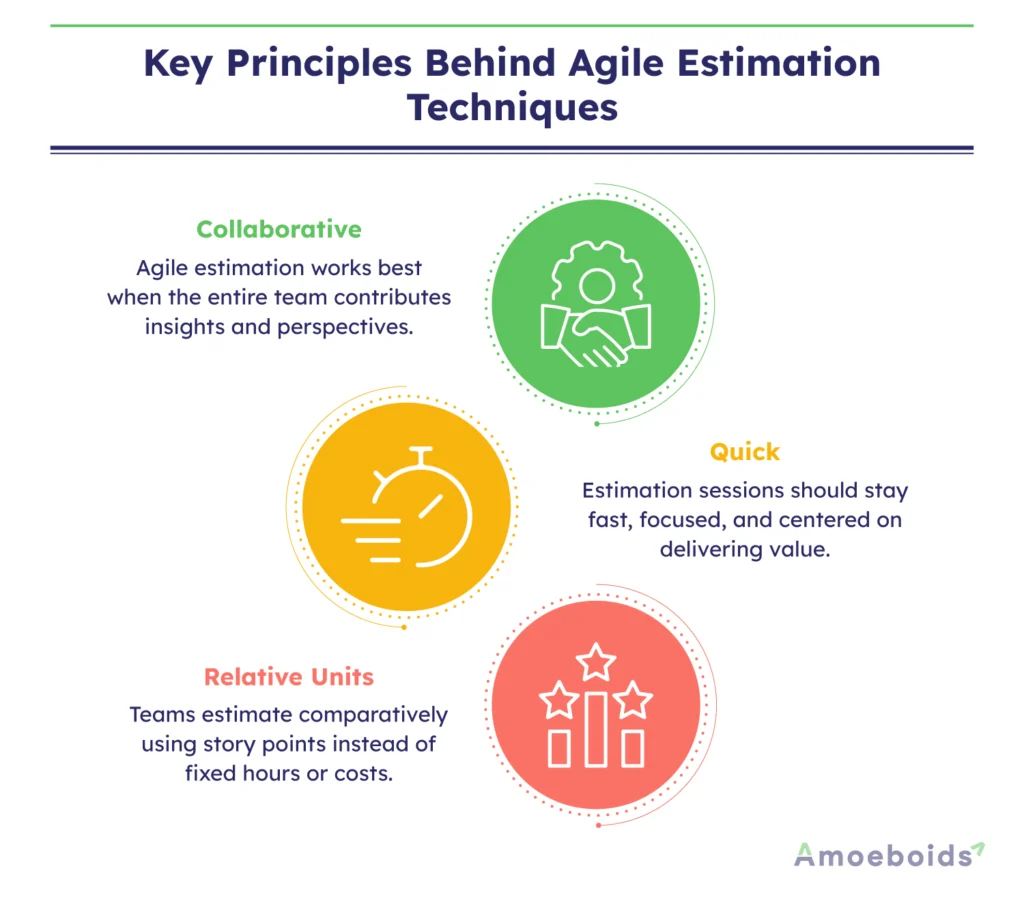
Collaborative
Everyone on the Agile team participates in estimation. Developers, testers, designers, and product owners share their opinions. This teamwork reduces bias and builds ownership. When everyone contributes, no one gets blamed for wrong estimates.
Quick
Agile estimation avoids lengthy, drawn-out discussions. It values progress over prediction. SaaS teams use short sessions to estimate stories, allowing them to focus on what matters—building the product.
Have relative units
Instead of estimating in hours or dollars, teams use story points or similar units of measurement. They compare tasks with each other. For instance, if a data migration task feels twice as tough as a dashboard update, it may get twice the points. This makes estimation faster and more consistent across sprints.
Why estimating Agile projects can be more challenging
In traditional project management, estimation follows a bottom-up approach. Teams plan everything up front. They list all tasks, set timelines, and estimate the cost and hours for each deliverable. Once the plan is ready, the project manager tracks every milestone and ensures the team stays within the schedule.
Agile works differently. Here, the process flips. Instead of detailed upfront planning, Agile uses broad, high-level estimates at the start. As the project moves forward, the team refines these estimates based on new insights.
This flexibility may sound simple, but it can be challenging in practice, especially for teams new to Agile. In SaaS projects, where requirements often evolve in response to user feedback or market trends, these changing inputs make estimation more challenging.
For example, your team might begin by roughly estimating a new onboarding feature. But once customer data shows that users prefer social sign-ins. Now, to boost user engagement, the effort needed changes. That’s when Agile estimation gets tricky. It demands constant review, collaboration, and adjustment.
Unlike traditional planning, Agile estimation is not about perfect predictions. It’s about continuous learning and adaptation as the product grows. Teams often improve development effort estimation by reviewing sprint retrospectives and delivery patterns.
Top 5 Agile estimation techniques
Before choosing an estimation method, consider a few key points:
- Number of tasks or backlog items you need to estimate.
- The size of your team.
- Whether your team works from one place or remotely.
- The tools available for estimation and collaboration.
- The team’s work style and mindset.
Every SaaS team is different. The proper technique depends on how your team works together and how quickly you need the estimates.
1. Three-point estimate
This technique helps remove guesswork and avoid overconfidence. It works well when your team has previously faced estimation issues. Even if the same people are performing similar tasks, results can still vary. Maybe last sprint’s API build went fast, but this time, new dependencies might slow things down.
Method:
Create three values and find their average:
- Optimistic estimate: The best-case scenario.
- Most likely estimate: The expected time.
- Pessimistic estimate: The worst-case scenario.
Example:
Suppose your SaaS team is building a new feature to export reports in CSV format.
- Optimistic (o) = 4 hours
- Most likely (m) = 8 hours
- Pessimistic (p) = 16 hours
The estimated time is:
E = (4 + 8 + 16) / 3 = 9.3 hours
This provides a balanced view and helps plan sprints with greater confidence.
2. Planning Poker
Planning Poker is one of the most consensus-based Agile estimation techniques. You can use it with story points, ideal days, or any other estimating unit. Many Agile teams prefer planning poker estimation because it encourages discussion and shared understanding before sprint planning.
Method:
Each team member has a deck of cards. These cards have numbers (such as 1, 2, 3, 5, 8, 13, etc.) according to the modified Fibonacci sequence. These numbers represent effort or story points. These numbers can mean story points, ideal days, or any other estimating unit.
During the discussion regarding the product feature, everyone secretly picks a card to represent their estimate. Once all cards are revealed, the team discusses any significant differences. The process repeats until the group reaches a shared agreement.
Example:
Imagine estimating the effort required to add two-factor authentication to a client product. During the process, developers draw 8 points, while the QA team votes 5.. The team repeated the process until they achieved consensus on the estimate at 6 points.
This effort estimation technique in agile projects works best when you have small teams (5–8 members) and for up to 10 items at a time.
3. Dot Voting
Dot Voting is fast, visual, and straightforward. It helps teams decide which items need more effort or attention.
Method:
Each team member receives a few dot stickers or votes (often digital, when working remotely). They place their dots next to the backlog items. More dots mean higher effort or complexity. Fewer dots mean the task is small or quick.
Example:
Suppose your SaaS team is estimating UI updates. In that case, most points will likely be allocated to redesigning the dashboard (since it affects multiple modules), while fewer will be allocated to changing font styles. This helps the team focus on high-impact, high-effort tasks first.
4. Random distribution/Ordering protocol
This method helps teams quickly rank tasks by effort or complexity. It works well when you have many backlog items that differ in scope.
Method:
All items are listed in order from easiest to hardest. Each team member takes a turn to move one item up or down based on their judgment. They can also discuss or skip their turn. The activity continues until everyone agrees and passes.
Example:
In a SaaS project, the team might start by ranking tasks like “fixing a billing bug” and “building a new analytics dashboard.” Developers may push the dashboard task higher because it needs design, backend, and API work. The group continues to adjust until the order feels right. This provides a clear picture of task difficulty without requiring hours of debate over numbers.
5. T-shirt sizes
This is one of the fastest and easiest Agile estimation techniques. It helps teams estimate a large number of tasks without getting stuck in the details.
Method:
Tasks are grouped by size, like Extra Small (XS), Small (S), Medium (M), Large (L), or Extra Large (XL). The team discusses each task and categorizes it based on its complexity and effort. Later, if needed, these sizes can be converted into numerical story points. A quick vote can break any tie.
Example:
A SaaS team might mark UI color updates as S, improving API response time as M, and building a new reporting module as L. This gives everyone a sense of scale. The method works well when teams want quick, high-level estimates before deeper sprint planning.
How to choose the best Agile estimation techniques?
Selecting the best agile estimation technique for your team is more important than following trends. Every Agile team operates in a different way, so your strategy should change to fit your workflow.
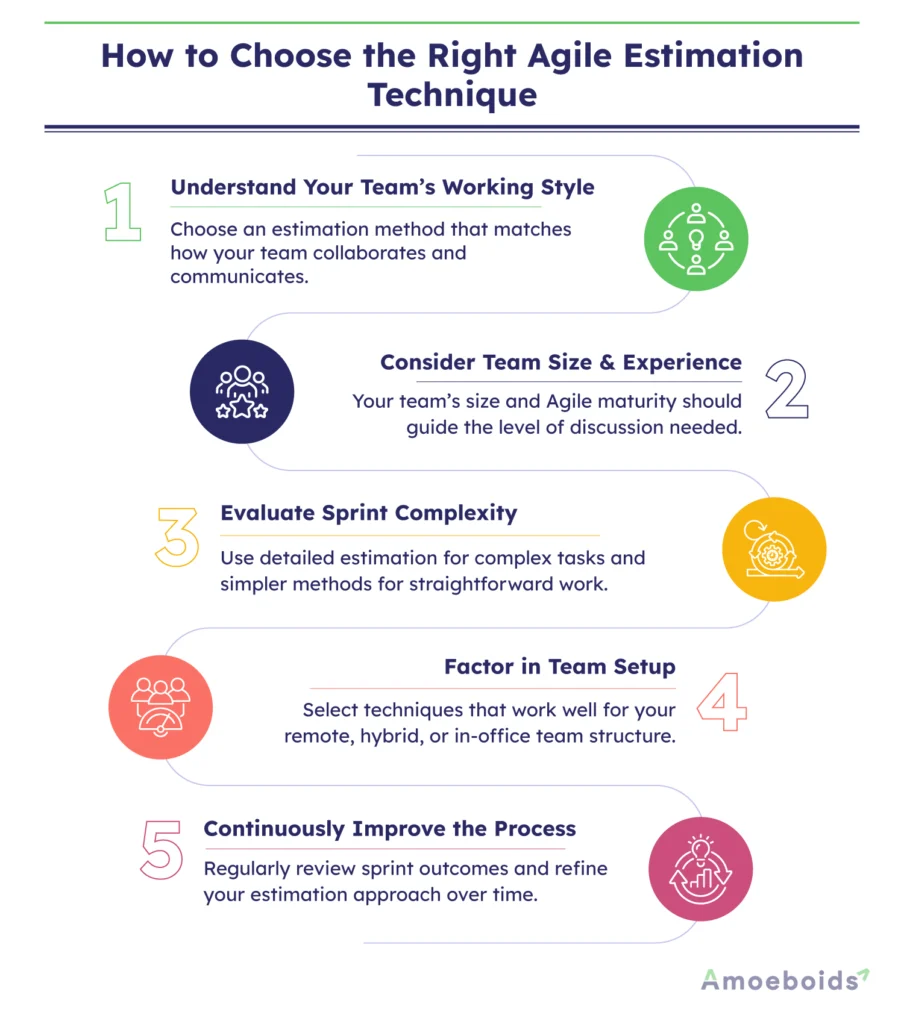
Follow these steps to find the right fit:
- Step 1: Understand your team’s working style: Some teams like discussion-driven methods such as agile estimation poker, and others prefer quicker methods such as T-shirt sizing.
- Step 2: Consider team size and experience: Smaller teams tend to use collaborative scrum estimation techniques such as Planning Poker, and more experienced teams may estimate faster with less discussion.
- Step 3: Evaluate sprint complexity: High-level tasks may need detailed development effort estimation, while simpler tasks can be estimated quickly.
- Step 4: Factor in team setup (remote or co-located): Distributed teams might prefer faster structured methods to save time and avoid long discussions.
- Step 5: Treat estimation as an evolving agile estimation process: Try different techniques, review your sprint results, and improve your process continuously.
Tips on improving your Agile estimation techniques
Accurate story point estimation does not occur overnight. It improves with practice, collaboration, and lifelong learning. Here are some tips to make your estimates more reliable:
- Use past sprints as a reference: Leverage insights from previous sprints to improve story point accuracy. Historical data helps teams make more realistic comparisons.
- Promote discussion: Estimation conversations help identify hidden details, clarify norms, and verify that the team has a shared understanding.
- Break down large user stories: Smaller tasks are easier to estimate and lead to more accurate sizing of effort.
- Maintain consistency in estimation criteria: To avoid confusion and misalignment, ensure that everyone agrees on what a story point represents.
- Revisit and refine estimates regularly: Consider estimation as a process that changes over time. Regular review and feedback improve accuracy over time.
Teams using agile story point estimation and planning poker estimation often enhance collaboration and sprint prediction over time.
Conclusion
Agile estimation techniques allow you to plan and estimate your projects in great detail. When you use agile cost estimation techniques, there is a rare chance that numbers might come back to haunt your bottom line. When teams learn how to estimate work at the product backlog level, clarity comes in. Both the team and the client have insights about delivery that need to be planned with relative estimates.
Most Agile teams count on user story point estimation to improve planning accuracy and maintain realistic sprint commitments.
FAQs
What is the tool used for effort estimation techniques in Agile?
When you leverage effort estimation techniques in agile, you deal with story points instead of hours. Story points act as the primary tool. It’s an abstract unit of measure that quantifies the effort required to deliver a project.
What are user story estimation techniques for agile projects?
A user story is a method of describing the benefit of a feature from the user’s perspective. There are no user story estimation techniques for agile projects. Instead, they are written over cards in a particular format to facilitate planning and discussion. The typical way to write user stories is as follows:
As a < WHO >, I want < WHAT > so that < WHY >.
What’s the difference between affinity mapping and affinity sizing?
Affinity mapping is used to group similar ideas, tasks, or user stories. The aim is to organize information to crack patterns. However, affinity sizing involves reallocating effort to grouped items. The size of the cluster can vary, like T-shirts (XS, S, M, L, or XL).