
It’s month-end, and a key client’s billing portal goes down. Calls start pouring in, but your support team isn’t sure who owns the issue or how quickly it needs resolution. As confusion spreads, so does client frustration. Without a clear SLA, even strong teams can fall short.
A Service Level Agreement (SLA) sets clear expectations about your service delivery style in front of your customers. With a well-defined SLA management system, your support team can confidently spring into action. They know exactly how quickly to respond, the correct escalation process and the commitments made to your clients. As a result, your clients receive timely updates and clear communication, reassuring them that their concerns are being addressed. That’s the power of effective SLA management in action.
However, creating and managing robust SLAs takes more than just engaging efficient customer support agents on the desk. In this article, we will explore what SLA management is, key components of an SLA contract system, understand common challenges and learn how to overcome them to implement SLA management correctly.
Introduction to SLA management
So, what is service level management exactly? You’re expected to deliver consistently and reliably when you offer a service, whether it’s technical support, cloud storage or even internal IT. That’s where SLAs come in. They help you clearly define what services you’ll provide, how fast you’ll respond and what happens if expectations aren’t met. Simply, it sets the ground rules between you and your customer.
They also set forth remedial policies for when requirements are breached. With a proper SLA management system, your team can spring into action and ensure your customers get the support they were promised on time.
Now that you’ve been introduced to SLA management and why it matters, let’s break it down.
Key components of an SLA contract system
An ideal SLA has two main parts: service and management. Let’s see how to leverage them to build a system to measure and improve what you deliver:
1. Service
This part of your SLA outlines what you’re offering. It sets the boundaries so there’s no confusion later. Let’s say you have a SaaS product. Your customers rely on your tool every day. In this case, your SLA might include commitments like:
- Guaranteed uptime (for example, 99.9%)
- Support response times (like replying to high-priority tickets within 2 hours)
- What’s included in the support scope (e.g., bug fixes, but not training on third-party integrations)
But it doesn’t stop there, a well-written SLA should also:
- List service conditions – Are there situations where support won’t be provided? What needs to be in place for your team to deliver the service?
- Define how performance is measured – Do you prioritise tickets based on urgency or impact? Are there service categories that need different handling?
- Mention response and resolution timeframes – Not just how fast you’ll reply, but how quickly you aim to fix things.
- Outline responsibilities on both sides – Your team may need permission to access accounts, or timely input from the client. Be clear about who does what.
Instead of over-promising, set realistic expectations you know you can meet or surpass. Customers are often happier when you surprise them by doing better than expected, not the other way around. Also, include a clear escalation process. If something goes wrong, what steps should be followed? Who should the client contact and how? Laying this out removes guesswork.
When this part is clearly defined, your support team can deliver more consistently, and your clients know exactly where things stand.
2. Management
The second part of the SLA is where things get practical. Management focuses on how the service commitments are tracked, measured and enforced.
Start by asking yourself:
- How will you track whether the SLA is being followed?
- Will you integrate SLA tracking into your helpdesk or CRM system?
- How will you report on performance internally or to the client?
- What happens if you miss a commitment? Are there any penalties or make-goods?
- Who resolves disputes and how?
Many businesses build SLA monitoring into their support tools. When a ticket comes in, it’s automatically tracked based on urgency and expected response time. This keeps your team alert and accountable without needing to micromanage.
After creating a solid SLA, what really matters is how you manage it over time.
Understanding SLA contract management
SLA contract management ensures that your service commitments are followed, tracked, reviewed and improved on a continuous basis.
What does SLA contract management actually involve?
SLA contract management usually includes these key areas:
- Monitoring performance: Tracking how your service teams are doing against your commitments (like response times or uptime).
- Raising alerts when things go off track: To take quick action and prevent customer dissatisfaction.
- Reviewing performance data: Looking at weekly or monthly reports to understand what’s working and what’s not.
- Handling violations: Deciding what happens when SLAs are breached (penalties, internal follow-ups, customer communication etc).
- Updating the SLA when things change: Your service levels may need to evolve with your business or your customer needs.
Let’s say your support team commits to resolving high-priority issues within four hours. If a ticket crosses that limit, your SLA management system should flag it. The manager should know it’s at risk, the agent should get notified and maybe even the customer gets an update. That’s how SLA contract management turns words into action.
What does it look like in everyday work?
Here’s a simple breakdown of what happens behind the scenes:
- A customer raises a support ticket.
- The SLA management system looks at the ticket’s category or priority.
- It assigns a response and resolution time automatically.
- If the agent doesn’t act within the set timeframe, the system notifies a manager or escalates the issue.
- The system logs all this data to be reviewed later.
Over time, these small day-to-day actions add up to big benefits, better response times, improved trust and fewer escalations.
How to get SLA contract management right from the start
Managing SLAs starts with clear documentation. Everyone in your team needs to understand what’s in the SLA and why it matters. Make sure:
- The SLA is visible and easy to find.
- Your team knows the key service goals.
- Everyone understands what happens if targets are missed.
Next, set up your tools correctly. Whether you’re using helpdesk software, spreadsheets or something custom, your system should:
- Assign SLA goals automatically.
- Trigger alerts or escalations for overdue tasks.
- Generate project reports to show how the team is performing.
Note: Don’t forget to review and adjust your SLAs regularly. If your team keeps missing a target, maybe the target is unrealistic, or maybe the process needs improving.
Now that you know how to structure an SLA management system, let’s look at what SLA project management actually does in a business.
Role of SLA project management in business
SLA project management plays a behind-the-scenes but crucial role in shaping your day-to-day business operations. It also has an impact on how it grows in the long run.
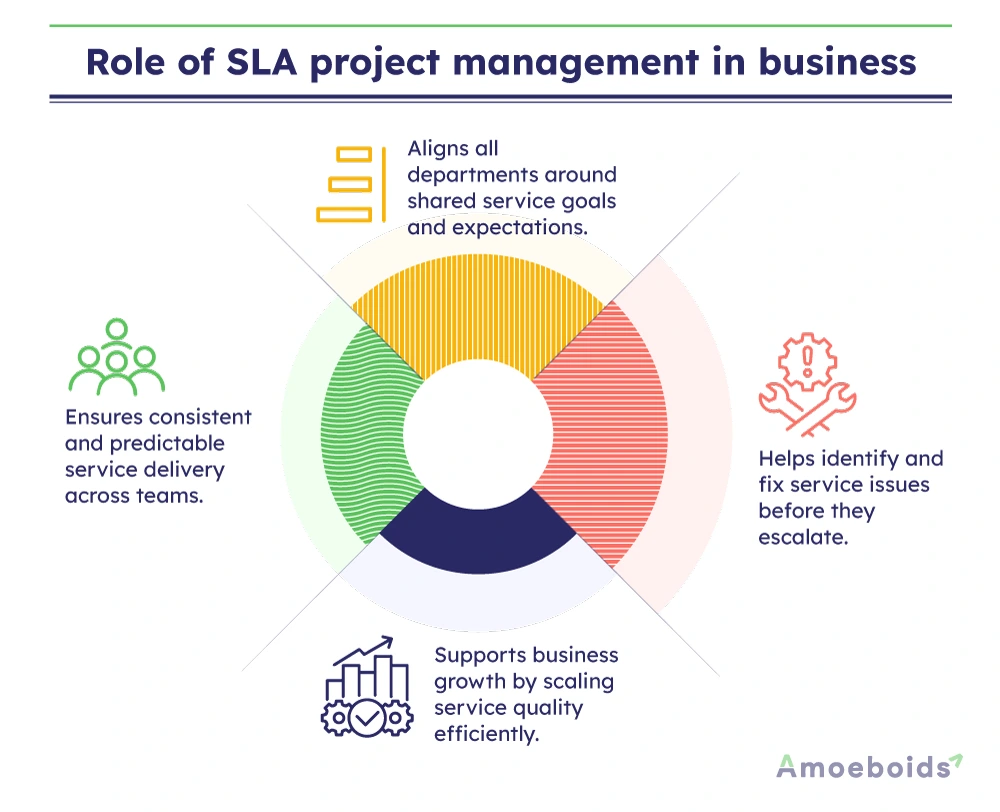
Makes your services predictable and consistent
When you manage SLAs like projects, you stay in control of service quality. You’re building a system where every team knows what to deliver, when to deliver it and how success will be measured. That consistency makes your business reliable in the eyes of your customers and internal teams.
Aligns everyone around shared goals
Without SLA project management, different teams often end up working in silos. Support may promise one thing, while product or engineering delivers something else. But with SLAs, everyone knows the rules and everyone is held accountable. This alignment improves communication and reduces costly misunderstandings.
Helps you catch problems early
SLA project management gives you a clear view of how your services are actually performing, day by day, week by week. Are you meeting resolution times, are certain types of requests taking too long, or are some customers being underserved? When managed well, SLA data helps you fix issues early, before they turn into escalations or lost revenue.
Makes you scalable
As your company grows, so do the expectations. If your service quality doesn’t scale with your customer base, things start slipping through the cracks. SLA project management helps your business scale without losing control. It gives you the structure to maintain service standards even as teams grow, products expand and customer needs become more complex. For instance, any rapidly growing startup has a small customer support team handling all queries personally. As the company acquires more clients, the volume and complexity of support requests increase. SLAs help such companies maintain consistent service quality as their customer base grows.
Despite all these benefits, many businesses run into roadblocks while implementing SLAs. For instance, a company might commit to a two-hour response time but fail to meet it consistently due to unclear internal workflows.
Let’s look at some common challenges that can derail SLA implementation and how to overcome them.
Challenges in SLA management implementation
Theoretically, setting up a SLA project management system seems simple. However, real-world challenges make it much more challenging in practice. Let’s take a look at three major challenges organizations face while implementing and managing SLAs on a daily basis.
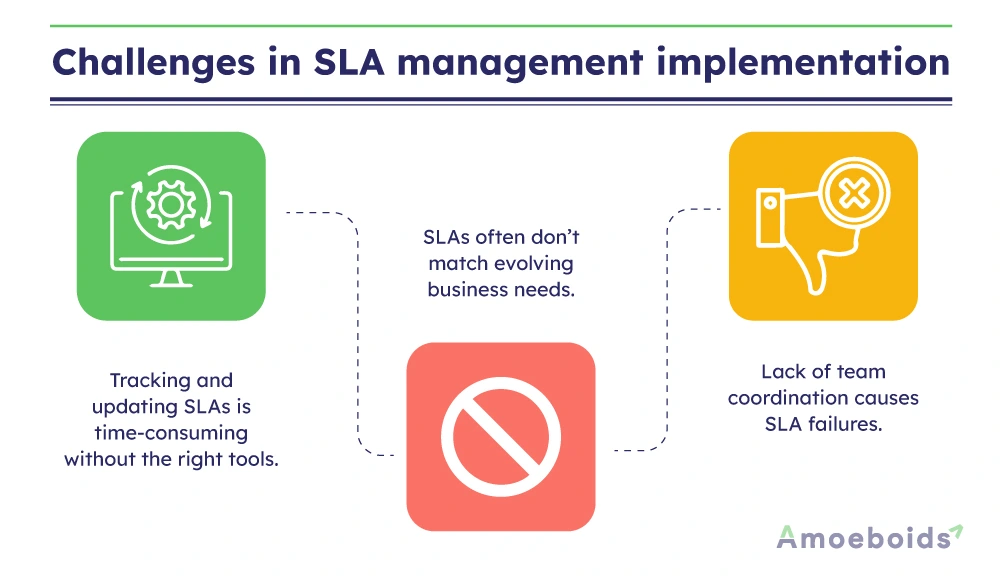
1. SLAs are hard to track and even harder to change
One of the biggest hurdles teams face is monitoring SLA performance in real time. You want to know how you’re doing, but pulling out that data is often a nightmare. Most teams end up digging through raw logs, exporting data, building spreadsheets or writing custom reports just to understand how often they’re hitting or missing their targets. And what if you need to tweak the SLA itself?
However, by leveraging dedicated tools, you can bypass hours of iterative SLA configuration. Tools that allow you to collect valuable insights from key stakeholders, add detailed & customisable information to the tickets and visualise your release plan with various views.
2. SLAs don’t always reflect current business priorities
Many businesses are stuck with outdated SLAs inherited from previous teams or created years ago. Over time, the business grows, customer expectations shift and internal processes evolve but the SLA stays the same.
This disconnect leads to confusion and inefficiency. Your team might be prioritizing low-impact tickets just to hit SLA targets, while high-impact issues wait longer than they should.
3. Lack of cross-team coordination
SLA success often depends on more than one team. Let’s say your support team needs engineering’s help to fix a bug. If engineering doesn’t treat it as a priority or doesn’t know about the SLA, your support team gets stuck. The SLA fails and the customer suffers.
In this regard, Screenjar for Jira, a screen recording tool can help you prevent unnecessary back-and-forths and resolve the support issue in a flash. Customers can record their screens and attach videos directly to Jira tickets or monday.com items. The issue is escalated to the respective departments and gets resolved faster with cross-team coordination.
Conclusion
SLA management is all about creating clear, measurable and actionable agreements to align with your business goals and customer needs. To ensure its effectiveness, you have to start by understanding basic implementation. Aim to keep SLAs flexible, transparent and easy to manage. If managed well, SLA project management strengthens accountability, improves performance and enhances customer trust. However, in the absence of automation, the team may face challenges tracking changes and fixing issues with real-time team collaboration.
FAQs
What is the difference between a KPI and an SLA?
An SLA is a formal agreement that qualitatively and quantitatively mentions the service to be rendered by a vendor to its customers. It measures the level of service provided. On the other hand, a KPI measures the quality of service agreed-upon in terms of growth, revenue and other metrics.
What are the 5 phases of SLA management?
The five important phases of SLA are:
- Defining the service
- SLA creation
- SLA implementation
- Performance monitoring
- Periodic update as needed.
Each step helps you stay aligned with business goals and customer expectations in a structured way.
How to manage SLAs?
First, clearly define expectations of what is service level management. Use the right tools to track performance and adjust SLAs based on feedback or business changes. Always keep the process transparent so everyone knows what’s expected and how it’s going.
How to structure an SLA?
A well-structured SLA includes the scope of service, performance metrics, response and resolution times, roles and responsibilities and escalation procedures. Keep it clear and simple, so everyone, from your team to your customers, knows exactly what to expect.