Imagine a startup team building a new app. They have a great idea and start coding right away. But soon, they realize the features keep changing, deadlines are missed, and the final product doesn’t match what users really need. This is a common problem when there is no clear product development process in place. Without proper steps, even the best ideas can fail because of confusion, wasted resources, and poor planning.
That’s why businesses need a structured approach to guide them from the first idea to a successful launch. Each of the product development phases plays an important role in transforming an idea into a market-ready solution.
In this article, we’ll explain the stages, steps, and the full product development life cycle so you can avoid these mistakes and bring your product to market with confidence.
What is product development?
Product development is the process of creating a new product from scratch and taking it all the way to a successful market launch. As usual, it stems from an idea, followed by recurring brainstorming sessions, until that idea becomes a prototype. From there, the prototype goes through numerous creative but strategic changes until your vision comes to life. However, it requires a clear organizational skill to blend creativity and strategy effectively. Successful product development and engineering require close collaboration between business teams, designers, and developers.
This is where the need for a vetted product development process comes in. The product development cycle includes everything from ideation and validation to launch and constant improvements. What is a product development process? The innovation progresses through a six-step framework to help you standardize and define your work.
Product Development vs. Product Management
Product development and product management are closely related, but not identical. Product management sets out what and why to build, while product development focuses on how to build and deliver it successfully.
| Aspects | Product Development | Product Management |
| Primary Focus | Builds, tests, and delivers the product or features. | Defines the product vision, goals, and overall direction. |
| Key Responsibilities | Turns ideas and requirements into a working product. | Identifies customer needs and decides what should be built. |
| Main Activities | Design, coding, testing, deployment, and maintenance. | Market research, roadmap planning, prioritization, and stakeholder management. |
| Success Measurement | Product quality, functionality, performance, and timely delivery. | Customer satisfaction, business growth, product adoption, and market success. |
| Typical Team Members | Developers, designers, QA engineers, and technical specialists. | Product managers, product owners, business analysts, and stakeholders. |
Product management creates the strategy, and product development implements it. One decides on the destination, and the other plans the route to get there.
What to Consider Before Developing a Product
Building a product is exciting, but rushing through development can waste time, money, and effort. Before you write a single line of code or build a prototype, take a moment to consider a few key questions.
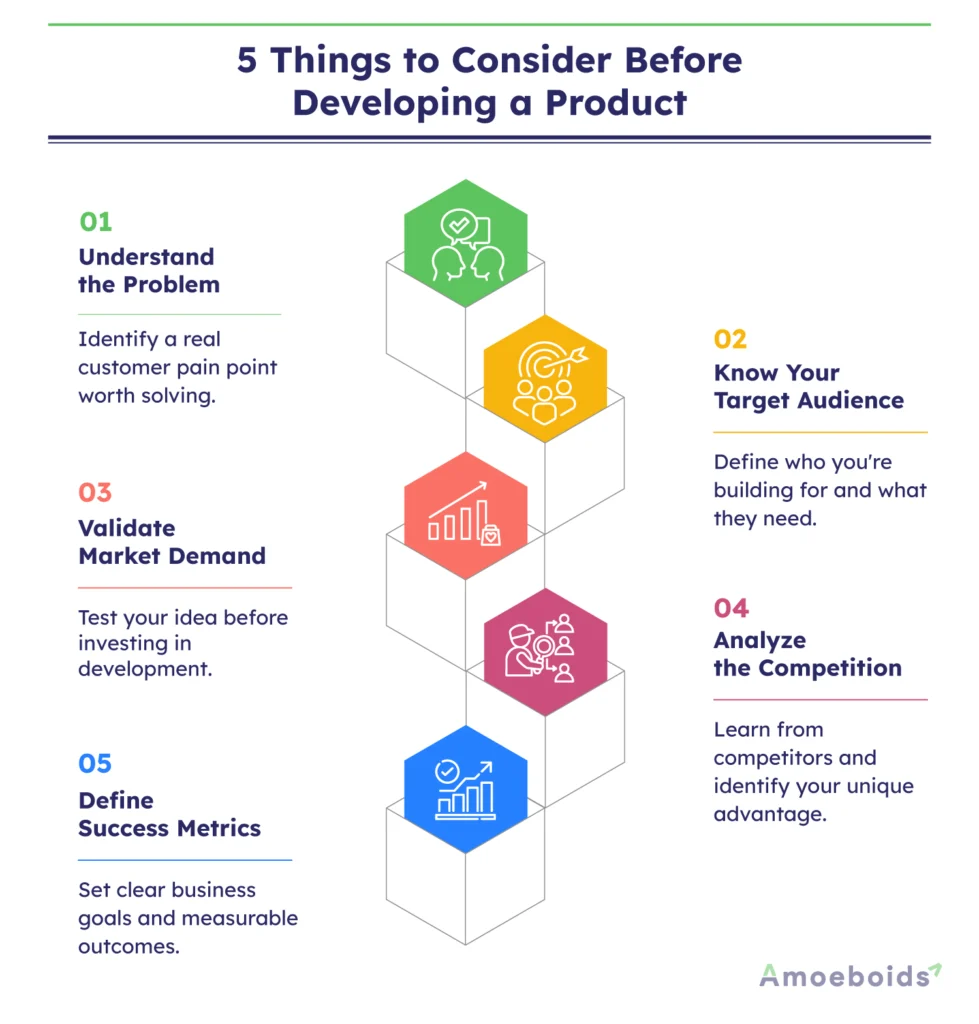
Understand the Problem You’re Solving:
Every successful product begins with an actual problem. Spend time learning about your customers’ challenges and frustrations. If the problem isn’t significant enough, people may not see the point in using your solution.
Know Your Target Audience:
A product can’t be all things to all people. Define who will use your product, what they require, and how they behave. The better you understand your target audience, the more relevant your product will be.
Validate Market Demand:
A great idea does not always make for a successful product. Talk to potential users, do surveys, or build a simple prototype to test interest. Early validation reduces the risk of creating something nobody wants.
Analyse the Competition:
Look at existing market solutions and learn from them. Understanding competitors allows you to identify gaps, avoid common mistakes, and define what makes your product unique and valuable.
Define Success and Business Goals:
Define success before proceeding with development. Clear goals help guide decision-making and ensure that everyone is working toward the same outcome, whether it’s user growth, revenue, engagement, or retention.
Taking the time to answer these questions can save months of rework later. Many teams use product development software to organise ideas, gather feedback, and track progress effectively. A planned product has a much better chance of solving the right problem, delighting customers, and succeeding in the market.
Understanding the different product development stages helps teams move from idea validation to market launch with confidence.
Stages of product development
There are six stages of product development, often referred to as the New Product Development Process or Framework (NPD). These stages are as follows:
1. Ideation
At this stage, the team works on a blank canvas through an unbiased brainstorming session under the supervision of a product manager. There are two ways to lead this stage.
- Conscientious idea management: brainstorming ideas to develop a product that solves a major customer problem your competitors have not touched upon yet
- SCAMPER model: to guide your team through a series of prompts using the SCAMPER technique to brainstorm new features for an existing product
2. Definition
At this stage of the product development process, you resist your urge to jump straight to the product design phase from the ideation phase by proofreading the idea through various metrics. A clear product development strategy helps teams evaluate opportunities and prioritize the most valuable ideas.
- Success criteria: evaluating the impact of the product in the market through KPIs like conversion rate and average order value
- Business analysis: analyzing the product’s distribution, marketing, and sales strategies through competitor analysis
- Unique selling proposition: working on how to make the value proposition better than products from competitors
- Marketing strategy: discussing the merits of each marketing channel, existing campaigns, and potential brand collaborations to support the product launch
3. Prototyping
During the prototyping phase, you will work on specifics like:
- Evaluating and adjusting your product strategy based on feasibility
- Shielding the product launch from potential risks associated with its production
- Begin working through your development plan
- Creating an MVP of your product to quicken the product launch process
Note: MVP stands for minimum viable product, and it’s the outcome of the prototyping stage with basic functionality features. For example, an MVP of your new bike may have a frame, wheels, and a seat, but wouldn’t feature a basket or bell.
4. Initial design
During the initial design phase, all departments collaborate to produce a product mockup as per the MVP prototype. Effective product design and product development work together to ensure the final product is both useful and user-friendly.
The process involves:
- Sourcing materials from various vendors through a properly documented process
- Getting approvals for each stage of the design process from stakeholders through regular communication
- Making necessary revisions to the product design as per the stakeholder feedback
Once the design is approved, it’s time to validate the final testing before launching the product.
5. Validation and testing
To ensure the quality of your product, you first need to validate and test every part of it for numerous issues during development or prototyping. It requires a team effort, including development teams and beta testers, to check the front-end functionalities for any errors.
It’s also important to test your marketing plan to ensure that all campaigns are set up correctly and ready to launch. Once your initial QA is complete, you can start developing the final product and focus on launching it into the market.
6. Commercialization
At this stage, you should focus on how to create and physically release the product into the market. Engage your team in designing the physical product as per the final prototype and MVP iterations. Once the product has been developed, the testing team will run a final functionality test before pushing it into a live state.
Congratulations! You have successfully launched your product. These product development stages create a structured path that reduces uncertainty and improves product success rates. From now onwards, you will continuously monitor important KPIs to receive valuable insights for further modifications.
Product Development Frameworks & Methodologies
Every successful product follows a structured approach to turn ideas into valuable solutions. Product development frameworks and methodologies help keep your team organised, prioritise well and deliver products that truly meet customer needs.
- Agile Development: Agile is about building products in small, manageable stages instead of trying to deliver everything at once. Teams are always gathering feedback, making improvements along the way and rapidly adapting to changing customer needs or market conditions. Agile product development allows teams to respond quickly to customer feedback and changing market demands.
- Lean Product Development: Lean encourages teams to create only what delivers real value to users. By reducing waste, testing assumptions early, and learning from customer feedback, teams can save time, lower costs, and build smarter products.
- Design Thinking: The first step in Design Thinking is to understand the people who will use the product. Teams look into user challenges, brainstorm creative solutions, and test ideas before spending heavily in development to ensure the product solves real-world problems.
- Minimum Viable Product (MVP): An MVP focuses on releasing the most basic version of a product, with only the most important features. This allows teams to quickly validate ideas, collect real-world feedback, and make informed decisions on future development.
- Scrum Framework: Scrum divides large projects into shorter cycles known as sprints. Regular planning, reviews, and team collaboration ensure steady progress while keeping everyone focused on the product’s goals.
Common Challenges in Product Development
Building a great product is exciting, but it rarely goes smoothly. Teams can encounter obstacles that can slow progress, cause confusion, or impact the final outcome if not addressed early on.
One of the biggest challenges in managing product development is balancing customer expectations with business priorities.
- Unclear Requirements: When teams are not 100% clear on what needs to be built, misunderstandings can occur quickly. This often leads to rework, missed expectations, and delays that could have been avoided with better alignment up front.
- Changing Customer Needs: Customer expectations and market trends can change faster than anticipated. While adapting is important, frequent changes without proper planning can make it difficult for teams to stay focused and on track.
- Prioritisation Struggles: Every idea may seem important, but not every feature requires immediate attention. Teams frequently struggle to determine what should be built first, leading to overloaded roadmaps and slower product delivery.
- Communication Gaps: Product managers, developers, designers, and stakeholders each contribute unique perspectives to a project. When communication fails, valuable information is lost, culminating in confusion, duplicated effort, and needless setbacks.
- Balancing Speed and Quality: Teams are frequently under pressure to deliver products quickly and stay ahead of competitors. However, rushing development can introduce bugs and technical issues, so it’s important to strike the right balance between moving quickly and maintaining quality.
Who is part of the product development team?
Though the product manager leads the process, there are many other departments involved. Proper communication between teams is key for effective product development and engineering throughout the product lifecycle. A summary of all departments involved is as follows:
- Product management: To oversee all areas of the product life cycle and maintain communication between various internal and external teams
- Project management: To assist with cross-departmental communication, task delegation, and goal tracking
- Design: To support the visual product concept during the prototyping and designing phase, as per brand guidelines
- Development: Build a new product or add new features to an existing product as per the defined framework
- Marketing: Developing and proofreading new marketing strategies before the product goes live
- Sales: To come up with innovative sales strategies and measure their success metrics to ensure maximum profit
- Senior management: May be required to give final approval before the product goes live
Following proven product development steps helps teams maintain focus and avoid unnecessary delays.
How to create a product development plan
An ideal product development plan follows a structured approach to guide your team through every stage of the product development life cycle. All you need to do is follow these three product development process steps:
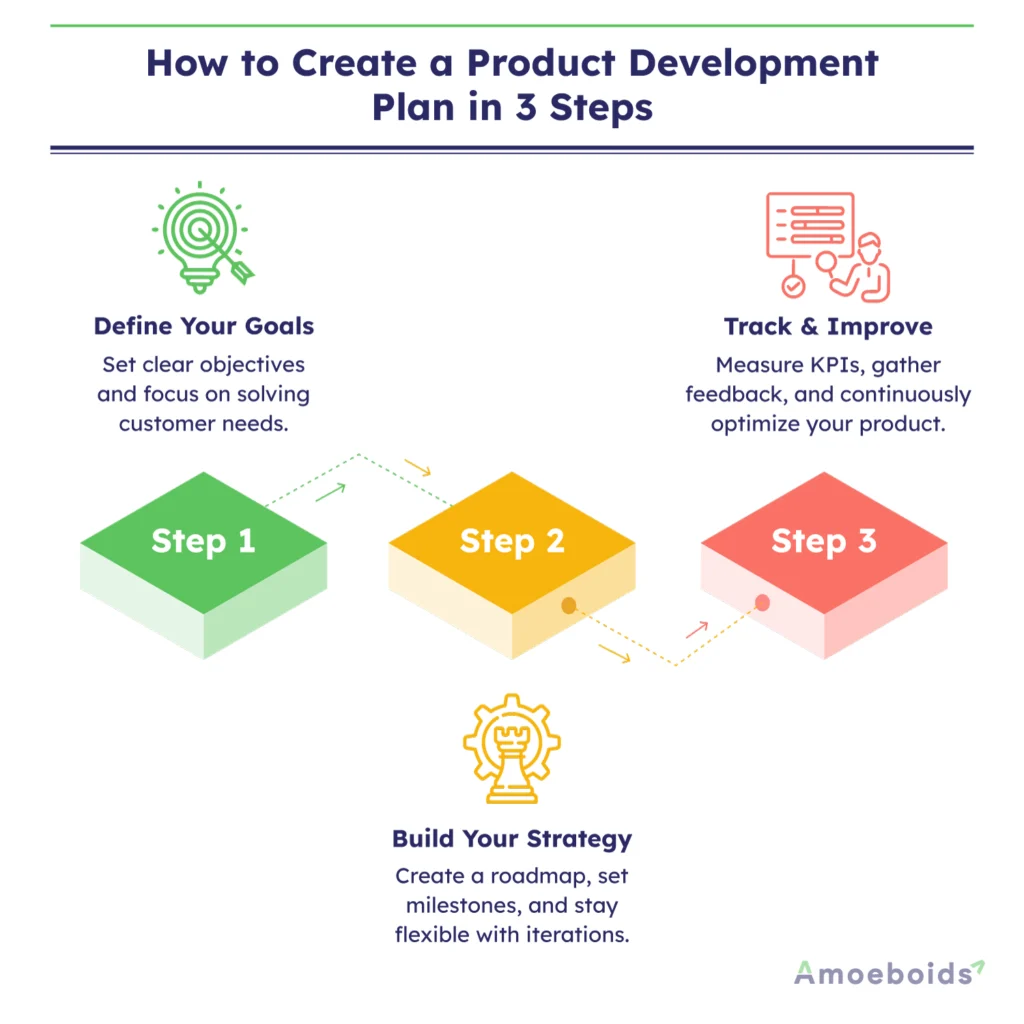
Step 1: Define your goals
Define your core goals for developing this new product. Clear goals help your product development team focus on exactly what is required for your minimum viable product to meet the needs of the target users.
For instance, for a startup developing a time management app, the main goal could be to empower busy professionals to reduce their daily planning time by 20%.
Step 2: Plan the strategy
Develop a detailed plan for each stage of your development. Your product development strategy should align customer needs, business goals, and technical viability. Break it down into several milestones and list the resources required. It requires creating a detailed product roadmap by aligning stakeholders on the overall vision and objectives. However, keep your plan flexible to accommodate changes as and when required. Many companies prefer agile product development because it supports continuous improvement and iterative releases.
That said, consider following agile methodologies with a scope for iterations, allowing you to refine the user experience and functionality based on customer feedback.
For instance, a plan to launch a subscription-based meal kit service may be divided into the following tasks:
- 3-week prototype phase to test packaging options
- 2-month user experience trial with target demographics
- 1-month regional market test to test pricing and demand before a nationwide release
Step 3: Track and adjust
Once the product goes live, constantly monitor KPIs to receive early market red flags, test new ideas, and refine the product in response to changing market needs and valuable customer feedback. A key part of managing product development is continuous monitoring, measurement, and improvement.
For instance, after a beta release, monitor KPIs such as daily active users, session durations, and customer churn to assess the market response. Based on insights, adjust the design to increase retention.
How Long Does Product Development Take?
One of the most common questions in product development is, “How long will it take?” The answer depends on factors like product level, team size, customer feedback, and the development approach being used.
The timeline varies depending on the complexity and length of the product development phases involved.
- Simple Products Can Move Fast: Products with a limited number of features and straightforward functionality can often be developed in a few weeks or months. Since there are few moving parts, teams can focus on building, testing, and launching more quickly.
- Complex Products Need More Time: Products that involve multiple integrations, advanced features, or large user bases usually require a longer development cycle. More planning, testing, and coordination are needed to ensure everything works smoothly before launch.
- Research and Validation Matter: Great products are not built on assumptions alone. Teams need time to understand customer needs, validate ideas, and gather feedback, which may extend timelines but often leads to better results.
- Testing Can’t Be Rushed: Thorough testing helps identify bugs, usability issues, and performance concerns before customers encounter them. Investing time in quality assurance can prevent costly fixes and customer frustration later.
- Product Development Is Ongoing: Launching a product is only the beginning, not the end. Product development is an ongoing process, not a one-time project, with teams getting feedback, deploying improvements, and adding new features.
Product development process examples
With a basic understanding of the six stages of the product life cycle, it is now imperative to analyze some real-world examples of successful product development strategies of two popular startups to inspire your own.
Example 1: How Netflix expanded its service features
Launched in 1997, Netflix was one of the most popular DVD mail-rental businesses. In 2007, the company decided to change its business model and transitioned to a digital rental model with the introduction of streaming media.
Their mission was to include content that increases member engagement and ultimately member retention. They started introducing personalized user profiles for their customers, allowing them to receive suggestions for genres they are interested in and experience content tailored to their tastes. Currently, it is placing a strong focus on developing original content, such as “House of Cards,” launched in 2013. Now, Netflix is the world’s leading streaming entertainment service with over 278 million subscribers in over 190 countries.
Example 2: How Zoom achieved product-led growth
Zoom, which started in 2013, is an excellent example of product-led growth. It follows a business model in which the product itself acquires, expands, converts, and retains users. For users, the product is very easy to use and costs free for up to 100 participants and a maximum of 40 minutes. This allows users to experience the product, earn organic promotion to attract new users, and receive an upgrade to a paid plan.
Measuring success in the product development process
If your team is new to product development, it may feel like an endless decision loop filled with uncertainties. Fortunately, by focusing on the right metrics and feedback loops, you can check if the time, energy, and resources you’ve poured into your idea are actually working. Tracking performance metrics throughout the product development cycle helps teams make data-driven decisions.
1. Track key metrics
To track measurable outcomes, focus on key metrics like:
- Customer satisfaction scores (CSAT): Measures how happy customers are with your product or service
- Net promoter scores (NPS): Show how likely customers are to recommend your product to others
- User retention rates: Tracks the percentage of users who keep using your product over time
- Time-to-market: Measures how long it takes to launch a new feature or product from idea to release
- Iteration cycles: Refers to how quickly teams can build, test, and improve a product
The first three metrics are designed to gauge the market acceptance of your product. The last two will help you measure your plan’s efficiency in overcoming early-stage challenges.
2. Ask customers for feedback
During your beta launch, ask potential customers for their feedback through regular surveys and product reviews. You can also analyze live usage analytics to identify opportunities for improvement. It will provide you with ample opportunities to transform your minimum viable product into a customer-centric final product. Such feedback cycles also provide valuable insights for refining your product marketing strategy.
3. Adjust strategy as you progress
Ever wondered what makes successful startups successful? They continually monitor their KPIs and utilize the insights they collect to identify areas for improvement and tailor plans. They track market share, monitor revenue growth, and analyze feature adoption rates to collect data points to establish well-defined KPIs.
The tool that simplifies product development
In a product development process, each step should involve bespoke team collaboration to complete tasks in an organized and efficient manner. However, keeping your team in sync from initial idea screening to the development phase is not a cakewalk. You might need help along the way. Modern product development software helps teams centralise planning, collaboration, and decision-making in one place.
That’s where the Roadmap & Idea Portal for Jira Service Management from Amoeboids comes in.
The Roadmap portal works in integration with JSM with the following advantages:
- Collect votes and comments on feature ideas
- Organize ideas into tabs (kanban/list) with JQL
- Control who can view, vote, comment, or submit
- Multilingual UI support for global teams
Collaborate with your customers and create a robust product roadmap.
Conclusion
The product development process may look simple on paper, but in reality, it requires constant collaboration, feedback, and alignment across teams. From brainstorming ideas to launching the final product, keeping everyone on the same page is often the most challenging task. Miscommunication or lack of visibility can slow down progress and even derail projects. A systematic product development process helps teams reduce risks, work better together, and deliver products successfully.
That’s where Amoeboids can help. With the Roadmap & Idea Portal for Jira Service Management, you can simplify collaboration and bring structure to your product journey. Collect votes and comments on feature ideas, organize them using Kanban or list views, and manage visibility and permissions with ease. Plus, with multilingual UI support, global teams can work together seamlessly.
Companies that follow structured product development steps are better positioned to innovate, adapt, and deliver successful products that customers value.
FAQs
How does the product development process work?
The process consists of six steps: generating ideas, refining the concept, developing a prototype, creating a sample, testing the idea, and ultimately launching it.
What is the difference between product development and product design?
Product development covers everything from idea to launch. Product design focuses only on how the product looks, works, and feels for users. While product design and product development are closely connected, they focus on different aspects of creating a successful product.
How can businesses streamline the product development process?
They can use agile methods, follow clear templates, and test ideas early. Staying in touch with the team and customers helps avoid delays.
How do companies ensure a smooth transition between stages of product development?
They create a roadmap with clear steps, keep everyone updated, and review progress frequently to address issues promptly.