Launching a new product or service involves a lot of anticipation, exhilaration & feelings of success as well as failure.
We think, even the most innovative products in the world end up in the trash bin if the launch is not well planned & executed. In one of the earlier articles, we have looked at the best practices for a successful product launch. This article adds a layer of execution on those best practices & shares with you an actual checklist. Please do keep in mind that the checklist needs to be tweaked according to your Go to market motion. Using it as is & hoping for miracles won’t get you anywhere.
What is a Product Launch?
First, the basics. Recall how Steve Jobs made it a point to launch the Apple products to a fanfare? Well, that’s a well-executed product launch. So by definition, product launch marks a point in time when the company is officially introducing a new product to the market. A product launch involves various activities, aimed at creating awareness and driving demand among the target audience.
Importance of Product Launch Checklist
A successful product launch requires careful planning, coordination, and execution across multiple departments within an organization.
With a handy checklist, your team will have a roadmap for the entire product launch activities. Such a checklist will ensure cross-team collaboration in a timely & organized way. Checklists allow the target audience to minimize the risk of overlooking crucial steps in the execution. Additionally, a checklist helps teams stay aligned, accountable, and focused on key objectives throughout the launch process.
What to include in a product launch?
A successful product launch requires cross-functional collaboration among product, design, engineering, marketing, sales, support, and operations. Here is a list of things you need to include:
1. Product Readiness
- Start by clearly explaining the main features, including estimates, documentation, and prioritisation.
- To direct design, UX/UI teams should have comprehensive wireframes, user research, and specifications.
- After that, the engineering team develops features in sprints, which are then carefully tested by QA and deployed.
2. Go-to-Market Planning
- Set a firm launch date and communicate it throughout the company.
- Fix the price, the upgrades, and the packaging.
- Create messaging and positioning that resonates with users based on their value.
- Develop a launch communications strategy that includes press releases, blogs, social media, external emails, internal briefings, and landing pages.
- Reach out to the media and analysts with customised briefings and potential customer quotes.
3. Systems & Infrastructure
- You need to update analytics, billing workflows, and finance systems to support the new experience and track success after product launch.
4. Sales & Support Enablement
- Create final product documentation, including FAQs and help guides.
- Provide customer-facing teams and partners with current sales strategies and collateral.
5. Feedback & Continuous Improvement
- To increase success and boost future launches, hold a retrospective, solicit user feedback, identify bugs, and collect testimonials.
10-Step Product Launch Checklist
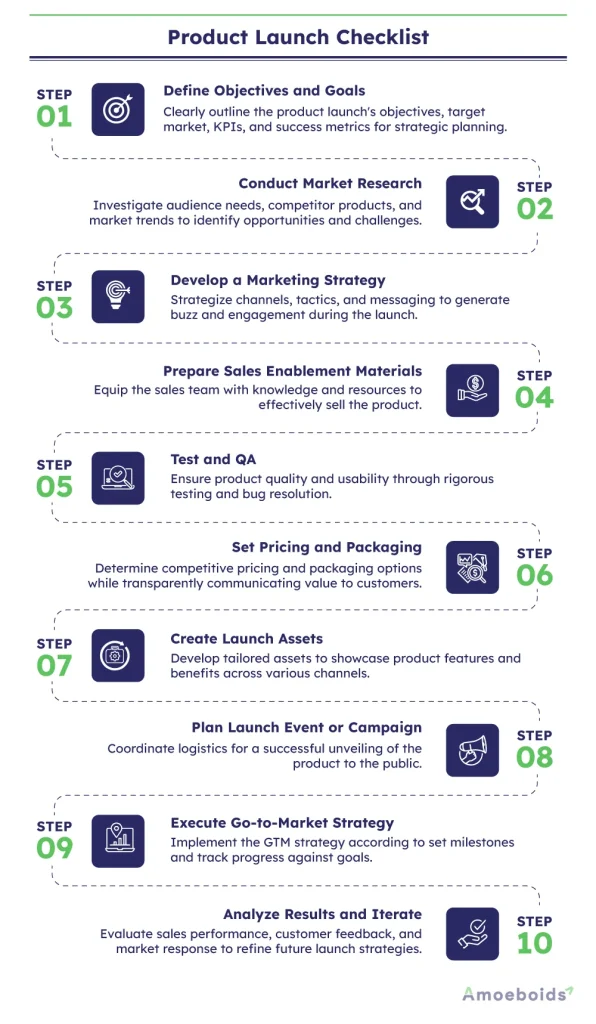
Launching a product is more than just going live; it’s about doing so with purpose, preparation, and clarity. To help you succeed, here’s a 10-step product launch checklist that covers everything from strategy to execution and more.
1. Define Objectives and Goals
- What are you trying to achieve with the launch? Is it an MVP or a full-fledged product? Is it a mature market or an emerging one? Identify & document your objectives and goals of the product launch. Top them up by including target market, key performance indicators (KPIs), and measurable definitions of success & failure.
- Don’t try to aim for a handful of goals in one go. Especially, with limited resources your approach should be to prove false the riskiest elements in your product launch.
2. Conduct Market Research
- Conduct thorough market research but not through emails or unsolicited telephonic conversations. Show up where your target audience is & then conduct your research by ‘observing’ them & assessing their ‘reactions’ to your questions, assumptions.
- Don’t forget to analyze competitors, products in the same space and market trends to identify opportunities and potential challenges.
3. Develop a Marketing Strategy
- Depending on the extent of resource availability, come up with a marketing strategy. It should primarily focus on initial positioning, engagement channels & tactics. All this will come in handy at the time of product launch.
- Don’t stop at the broader documentation. Dive in deeper by creating compelling collateral such as website content, press releases, social media posts, email campaigns, infographics & more.
4. Prepare Sales Enablement Material
- However small & limited your product features are, invest time in developing sales enablement material. This will include product demos, training resources, help documentation. Try to cover all the knowledge & tools that will help your team sell the product.
5. Test and QA
- Extracting the maximum value from the small number of users your product is going to have immediately after the launch is paramount. So ensure that the product they interact with is thoroughly vetted. Not just for functional effectiveness, but also from the design & UX perspective.
- If possible, don’t limited the quality assurance to just the product. Try to test the positioning along with other assumptions that are part of your go to market process.
6. Set Pricing and Packaging
- Product launch should not only about what you have got to offer to the market. But also about how you intend to offer it? As in, how it is packaged? Believe us when we say that the pricing & packaging you come up with is a reflection of your understanding into the target market.
- Don’t make the first timer’s mistake of going too soft on pricing at the time of launch. Understand the value your product has to offer to a specific customer segment & price it accordingly.
7. Create Launch Assets
- While we have already looked at marketing & sales assets/materials in earlier steps – these are assets specific to the launch. They should primarily be geared towards generating intrigue & demand.
- Don’t hesitate to conduct A/B testing with the launch assets. This will allow you to identify the target group that should be in your crosshairs for the initial few days after launch.
8. Plan Launch Event or Campaign
- A launch event doesn’t have to be a costly affair. Rely on something as simple as a LinkedIn live or a Facebook live. Or even a live webinar. Support these launch events through various marketing campaigns.
- Don’t hold back the promotion & try to get as much attendance as possible at the launch events. You can even think about providing discounts or gift vouchers to first x number of registrants.
9. Execute Go-to-Market Strategy
- This is the step where most of the activities ‘specific to your product & market’ will be taken up. These activities should be documented in majority of the earlier steps.
- Don’t forget to keep a tab on the key performance indicators (KPIs) and track progress against goals to measure the effectiveness of the launch strategy.
10. Analyze Results and Iterate
- Analyze the results of the product launch against the backdrop of initial assumptions & expectations. You don’t want to miss out the opportunity to critically assess them & course correct, if necessary.
- Don’t go into analysis-paralysis though. Keep in mind that initially, sample size of the target audience is going to be small. So take the results with a pinch of salt.
Stages of Product Launch
Before launching a successful product, you must follow a standardised process that aligns your concept with market demand, possible outcomes, and customer expectations. Here’s a simple guide for growing your idea into a successful product launch:
Stage 1: Discovering and Analysing Customer Needs – Start by using market research, interviews, and surveys to identify your target audience’s demographics and problems. Understand what they value the most and adjust your strategy accordingly.
Stage 2: Competition Analysis – Check out your competitors to discover what they do well and where they fall short. This helps you identify market gaps and differentiate your offering.
Stage 3: Prototype, Test, and Improve – Create a simple MVP or prototype, then test it with actual users. Use your customer feedback to improve the product’s features, usability, and design.
Stage 4: Analyse the Costs – To ensure the success of your pricing strategy, consider all potential costs, including production, development, marketing, and support.
Stage 5: Plan Pre- and Post-Launch Marketing – Prior to launch, generate buzz through social media, email campaigns, and influencer outreach. After launch, keep users engaged with updates, offers, and support.
Stage 6: Assess Your Supply Chain – Create a long-term supply chain that can scale with demand and deliver consistently.
Stage 7: Launch – Release your product using a collaborative strategy that ensures teams are aligned and ready to respond.
Stage 8: Gather Feedback – After launch, actively collect and analyse user feedback to improve and guide future iterations.
Managing a Product Launch
Managing a product launch involves coordinating cross-functional teams, adhering to timelines, and interfacing with various stakeholders, including customers. The activity itself demands high energy & commitment. Make one or more people accountable with various steps, depending on the size of your launch.
A well-executed product launch can propel your business forward and establish a strong foothold in the market. Use the above checklist as the basis of your own version of the product launch checklist. Share it internally & crowdsource the checklist items. However, be careful it is not too detailed or prescriptive to leave some room open for creativity. Remember to stay agile, adapt to feedback, and continuously iterate on your launch approach to drive ongoing growth and innovation.
Best Practices for Product Launch
A successful product launch requires strategy and consistency, not just timing. Here are four best practices for ensuring your product launch impact.
- Know Your Audience Deeply: Get to know your customers’ needs, difficulties, and motivations by looking into their demographics.
- Build Anticipation Early: Create and post teasers, previews, and exclusive early access campaigns months before the launch.
- Market Across Multiple Channels: Use social media, email, influencer collaborations, and public relations outreach to reach your target audience wherever they are.
- Test and Retest Relentlessly: Continuous testing across devices, browsers, and updates contributes to product reliability.
Conclusion
A product launch isn’t merely a date on the calendar, it’s the result of careful planning, intensive study, collaboration, and strong execution. This 10-step product launch checklist provides you with a planned but flexible roadmap to follow, in addition to the stages and best practices covered.
Every step, from identifying market needs to post-launch iteration, is significant to ensure that your product not only launches but lands in the market with an impact.
Don’t wing your next product launch. Implement this checklist, customise it to your needs, and execute with confidence.
Do you want to streamline your launch process even further?
Check out the tools that will automate your release workflows and help you achieve success faster.
FAQs
What’s the ideal time to launch a new product?
The best time to launch a new product is when market demand has been validated, competition has been researched, and your product launch checklist is completed. Align the schedule with when your target audience is most active. A solid product launch strategy ensures readiness. The ideal time to launch a new product is influenced by trends, team readiness, and seasonality.
Who is involved in a product launch team?
Product managers, marketing, sales, customer service, designers, and engineers are all part of a product launch team. Collaboration ensures that the product launch checklist is completed and that messaging, branding, and technical support are in sync. A good product launch template makes it easier to assign roles, resulting in a more timely and successful product launch.
How do you measure the success of a product launch?
Success is evaluated using KPIs such as user adoption, sales, churn rate, and customer feedback. A strong new product launch strategy includes these metrics in your product launch plan. Track performance with tools and a product launch checklist to ensure that every aspect of product launch has a significant impact.
What role does customer feedback play post-launch?
Customer feedback after launch helps to guide iteration, identify user experience issues, and validate your new product launch strategy. Use these insights to improve features and messaging. Add follow-up actions to your product launch checklist. A good product launch template includes feedback loops in your launch strategy to ensure long-term success and customer satisfaction.