
Plans change. Priorities shift. Stakeholders push new features. And suddenly, your neatly defined timeline is working against you. That’s where a flexible Agile roadmap makes all the difference. Not a static plan that gathers dust, but a living document that adapts to change without losing direction.
According to a McKinsey study, 70% of transformations fail because of poor execution and unclear direction. And if you’ve ever built a roadmap that looked solid on slide decks but crumbled mid-sprint, you know exactly what that feels like.
In this blog, you’ll learn how to build an Agile roadmap step by step. You’ll also walk away with real-world examples, practical tips, and the Agile roadmap tools that help you stay on track.
Agile roadmap explained
An Agile roadmap serves as your team’s compass. It doesn’t lock you into exact dates or deliverables months in advance. Instead, it outlines where you’re going and how you’ll get there.
For example, you’re building a mobile fitness app. A traditional roadmap might say: “Release meal planner feature by October 15.” But an Agile roadmap would frame it as:
Q4 Goal: Improve user retention by helping users track nutrition
Initiative: Build and test a basic meal planner
Next Steps:
Sprint 1: Gather user feedback on eating habits
Sprint 2: Build a wireframe
Sprint 3: Release MVP for beta testers
This way, you focus on outcomes rather than just deadlines. You’re flexible with the “how”, but clear on the “why”. It keeps your team aligned with product goals, while still allowing room to respond to feedback or blockers.
Unlike rigid timelines, an Agile roadmap is well-suited for fast-moving environments, especially when paired with Agile roadmap tools that help track initiatives and dependencies across teams.
Agile roadmap planning
Start the Agile roadmap planning by defining your product vision. What problem are you solving? Who are you building for? From there, break that vision into high-level goals or epics. These act as the foundation for your roadmap.
Here’s how most product teams do it:
1. Start with goals, not features
Don’t kick off your roadmap by listing what features you’ll build. That’s a recipe for reactive planning. Start by asking: What are we trying to achieve?
For example:
- “Increase daily active users in Q3”
- “Boost onboarding completion rate by 20%”
- “Make it easier for users to share reports”
These goals help anchor your roadmap around business outcomes, rather than just a list of features.
2. Break down goals into epics
Once goals are clear, translate them into epics (big tasks or goals in Agile that are broken down into smaller, manageable pieces called user stories). For instance, to “boost onboarding completion rate,” your epics might include:
- Redesign welcome screens
- Add a guided tour
- Improve first-task success flow
Each epic should link back to a real user pain point. If it doesn’t, it probably doesn’t belong on the roadmap.
3. Prioritize based on value and effort
Not every epic deserves your team’s attention right now. You need a system to decide what’s worth doing first. Popular models include:
- RICE (Reach, Impact, Confidence, Effort): Good for product-led growth teams.
- MoSCoW (Must-have, Should-have, Could-have, Won’t-have): Helpful when juggling stakeholder expectations.
- Value vs. Complexity Matrix: Quick and visual.
The goal is to focus on work that’s high-impact, relatively low-effort, and moves your key metrics.
4. Keep timelines loose
Instead of boxing yourself into hard dates, organize initiatives around time horizons:
- Now: Actively being worked on
- Next: Planned for the upcoming sprints
- Later: On the radar, but not yet committed
This approach, adopted by many modern product teams, helps you focus without pretending to predict the future.
Marty Cagan, in his book Inspired, also emphasizes that strong product teams “don’t just deliver features — they deliver outcomes.” Your roadmap should reflect that mindset.
Agile roadmap tools
Agile roadmap tools will help you in visualizing your product strategy, which in turn keeps everyone aligned without micromanaging every sprint. Here are a few worth considering:
1. Amoeboids Roadmap & Idea Portal
If you’re looking for something built for real-world Agile teams, this is it. The Roadmap & Idea Portal by Amoeboids is designed to do more than just show what’s “in progress.” It helps you:
- Capture ideas directly from users and internal teams
- Link those ideas to roadmap initiatives
- Prioritize features based on demand
- Share public or private roadmaps to build trust with stakeholders
What sets it apart? It connects the dots, which makes it easy to turn input into actionable outcomes. It’s especially powerful for product teams already working inside Jira, since it integrates smoothly into existing workflows.
2. Aha!
A veteran in the product roadmapping space, Aha! gives you plenty of customization. It’s great for top-down planning, especially when you want a detailed view of the strategy. It’s commonly used by product managers who need both a high-level strategy view and a way to organize multiple initiatives across teams.
3. Productboard
Productboard makes it easy to collect feedback, map features to user needs, and prioritize accordingly. It’s visually sleek and great for PMs managing a high volume of input. It’s helpful when aligning product decisions closely with customer needs.
4. Trello, Notion, or ClickUp
If you’re just getting started, these tools can be leveraged to create basic roadmaps. They’re simple, flexible, and low-cost. They offer customizable boards, tags, and timelines, making them great for visual planning. They’re best suited for teams seeking a simple structure without excessive process overhead.
From building your first Agile roadmap example to scaling across multiple teams, the right tool can keep everyone focused and informed.
Agile roadmap example
Let’s say your product team is working on a team collaboration app. The goal is to improve the in-app messaging experience over the next quarter. Instead of setting a fixed delivery date for each feature, you will build an Agile roadmap focused on outcomes.
Product goal (Q3):
Improve real-time communication for distributed teams
Key epics:
- Build inline replies for group threads
- Add read receipts for messages
- Improve push notification settings
- Refactor the message sync API for better performance
Initiatives by time horizon:
| Now | Next | Later |
|---|---|---|
| Research push notification issues | Prototype read receipts | Explore integrations with Slack & MS Teams |
| Start building inline replies | Run user testing for inline replies | Investigate emoji reactions |
Sprint-level breakdown (for ‘inline replies’ epic):
- Sprint 1: Design and validate UX with users
- Sprint 2: Develop backend logic for threaded replies
- Sprint 3: Integrate with frontend and QA
- Sprint 4: Beta release to selected users
This Agile roadmap example helps everyone stay focused on the problem being solved. It also gives room for learning. If feedback from Sprint 2 suggests changes, the team can adjust without derailing the rest of the roadmap.
Agile implementation roadmap
Here’s how your team can effectively implement an Agile roadmap in day-to-day work.
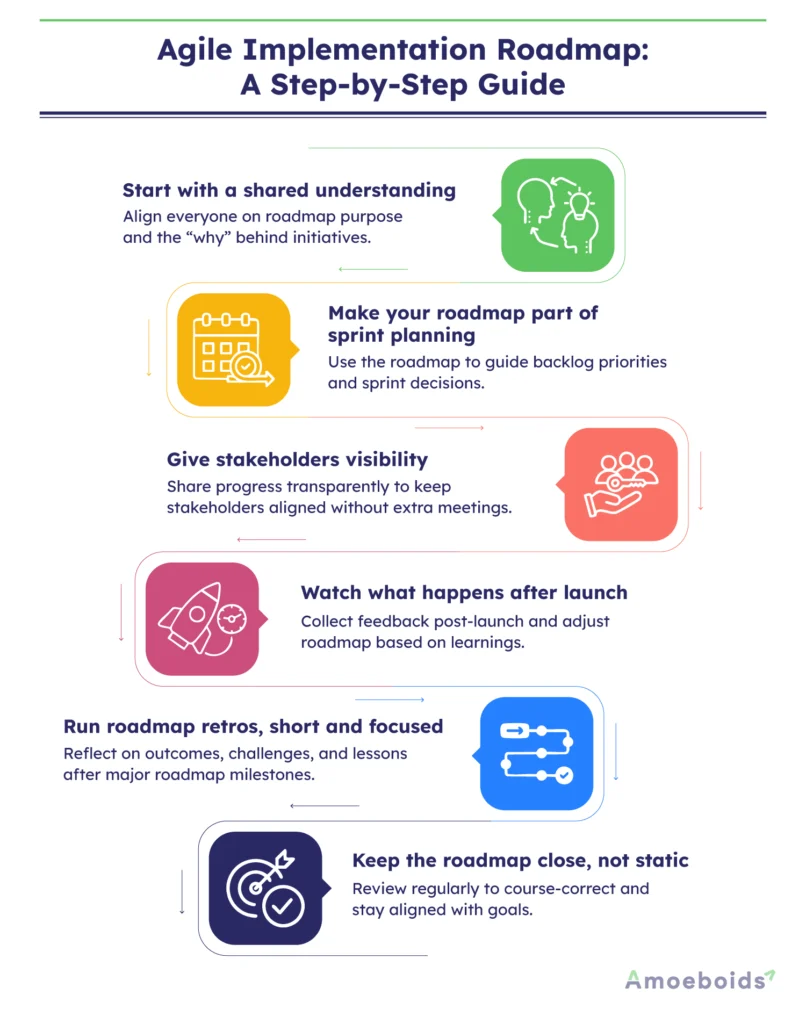
1. Start with a shared understanding
Before you jump into tasks and deadlines, get everyone on the same page. Walk the team through the roadmap. Explain the “why” behind each initiative. This is how you get people to care about what they’re building.
2. Make your roadmap part of sprint planning
Don’t let the roadmap sit in a slide deck collecting dust. Pull it into every planning session. Let it guide your backlog discussions. What’s next? What can wait? Use it to connect sprint work to long-term goals.
3. Give stakeholders visibility
Nobody wants more meetings. Ensure Stakeholders can see what’s in progress now, what’s upcoming, and what has already changed. But they do want to know what’s going on. Sharing regular updates through your existing workflow keeps everyone aligned without adding extra calls or interruptions.
4. Watch what happens after launch
This part is often skipped. Pause and collect feedback. What are users saying? What’s working? What’s not landing? Update the roadmap accordingly.
5. Run roadmap retros, short and focused
After every major push, take a beat and reflect. Did the outcomes match what you set out to do? What slowed you down? What surprised you? Capture the learnings before moving on to the next phase.
6. Keep the roadmap close, not static
Build a habit of checking in on the roadmap every few sprints. Even a 10-minute glance during grooming can help course-correct before things drift too far.
The goal isn’t to “follow the plan.” It’s to use the plan to keep moving in the right direction and achieve the ultimate objective.
Best practices for Agile roadmapping
- Tie every roadmap item to a clear outcome. Focus on what value it delivers, whether it’s improving retention, reducing churn, or increasing feature adoption.
- Keep the scope flexible, but stay firm on the product vision. The “what” might change, but the “why” should remain consistent.
- Prioritize based on evidence. Use real user feedback, product metrics, and team input to guide decisions. Tools like Amoeboids’ roadmap & Idea Portal make this easier by connecting ideas to real customer input.
- Balance short-term work with long-term goals. Use time horizons like Now–Next–Later or themes by quarter to avoid focusing only on the immediate sprint.
- Communicate changes clearly and with context. If anything goes wrong, explain the reasoning behind it. Transparency helps maintain alignment.
- Adjust the level of detail based on who’s viewing it. Leadership needs strategic overviews. Delivery teams need execution-ready details. Select Agile roadmap tools that effectively support all views.
Conclusion
A fixed roadmap doesn’t hold up in Agile teams. Things change fast, and your roadmap needs to keep up. The goal isn’t to predict everything in advance but to give your team a clear direction, room to adapt, and space to learn along the way.
Focus on the goals that matter. Break them down into manageable pieces. Continue to review what’s working and adjust as needed. That’s what a real Agile roadmap looks like.
You don’t need a perfect roadmap. You need one that works. Start with what you have, implement what you’ve learned, and refine as you go. That’s how teams build momentum.
FAQS
Q. How is Agile roadmap planning different from traditional planning?
Traditional planning sets fixed deadlines and detailed feature lists upfront, often months in advance. Agile roadmap planning, on the other hand, focuses on desired outcomes and stays flexible, allowing teams to adjust direction based on feedback, learnings, and changing priorities.
Q. What tools are best for creating an Agile roadmap?
The best Agile roadmap tools are the ones that support continuous feedback, collaboration, and transparency. Solutions like Amoeboids’ roadmap & Idea Portal, Aha!, and Productboard help product teams collect ideas, prioritize work, and keep stakeholders informed.
Q. Who is responsible for maintaining an Agile roadmap?
The product manager usually owns the Agile roadmap, but it’s not a solo effort. Designers, engineers, marketing, sales, and even customer support teams contribute regularly to keep the roadmap accurate, realistic, and aligned with both business goals and user needs.
Q. How often should an Agile roadmap be updated?
Every few sprints or after key milestones is a good rule of thumb. An Agile roadmap should reflect your latest priorities and discoveries, so keeping it updated ensures the team stays focused and stakeholders have a clear view of what’s coming next.