Ever wondered how software can make decisions and take actions on its own, without needing a human to click every button? That’s the magic of AI agents. From virtual assistants that schedule meetings to systems that reroute deliveries in real time, AI agents are quietly transforming how work gets done. But what exactly is an AI agent, and how is it different from regular software?
An AI agent can work as a smart assistant that knows what needs to be done and can take action without requiring constant human intervention. Though it sounds exciting, it is important to understand what an AI agent is and how it works to acknowledge its potential in expanding your business horizons.
What is an AI agent?
An AI agent is a software program that can autonomously act to complete tasks without requiring a human in the loop. An agent in AI is built to perceive its environment, make decisions, and take actions independently. An intelligent agent in AI can analyse information, adapt to changing situations, and make decisions that support a specific goal. AI agents utilize advanced natural language processing and machine learning techniques to process information from their environment to choose between available options. Unlike regular software that just follows simple instructions, an AI agent can adjust its actions and use gathered data to meet predetermined goals. This dynamic ability makes AI agents powerful tools for any organization that wants to work smarter. Agents in AI are predominantly used in software development, coding tools, virtual chats and online shopping platforms.
Let’s take an example of a conversational AI agent such as a virtual assistant. It answers customer queries and learns to solve problems based on every interaction. A logistics company can use such an AI agent to manage shipments, predict delays and automatically adjust delivery routes without manual intervention.
Are all AI agents the same? No, they come in different types, with unique capabilities depending on the complexity and type of task.
Key characteristics of AI agents
AI agents are more than just instruction-following devices. They can understand goals, make decisions, take action, and learn from interactions to complete tasks with little human intervention.
- Goal-Oriented: AI agents aim to achieve a specific goal, such as answering a question, scheduling a meeting, or resolving a problem.
- Autonomous: Once given a task, they can work independently without needing constant guidance at every step.
- Context-Aware: AI agents are able to understand context, user preferences, and information available to provide more relevant responses and actions.
- Decision-Making Ability: They are able to review different choices, select the most appropriate one, and adapt their strategy if needed.
- Continuous Learning and Improvement: Many AI agents learn over time from past interactions and feedback and become more intelligent and effective.
How do AI agents work?
AI agents function by following a simple cycle of understanding, thinking, and acting. First, they collect data from users, systems, or the environment. They then analyse the information, understand the goal, and decide on the best course of action.
They can use available tools, access data, perform tasks, and respond based on the situation. After taking action, they review the outcomes and make adjustments as needed. This ability to observe, decide, and act allows AI agents to perform tasks more independently, making them useful for everything from customer service to business automation.
Choosing the right type of AI agent depends on the problem you are trying to solve and the level of intelligence required.
Types of agents in AI
AI agents can be categorized based on their decision-making processes, their intended purpose and how they arrive at outcomes. Types of agents in AI can range from simple rule-based systems to advanced learning systems powered by large language models (LLMs) that adapt and improve over time. Below, we will discuss five unique types of AI agents to help you determine which is the best fit for your business needs. Each type of AI agent offers unique capabilities, making it suitable for different business and operational needs.

1. Simple reflex agents
Simple reflex agents react directly to what they sense without using memory or thinking about past experiences. They work on a simple if-then rule. If something happens, then act in a certain way. They are like thermostats that turn on the heating when the room gets too cold. As they don’t have any analytical capabilities, these agents only work well in environments where everything is fully visible and predictable.
Simple reflex AI agents examples: Vacuum cleaning robots, thermostats, automatic doors, traffic light control
2. Model-based reflex agents
Model-based reflex agents can react and also build a small memory of what’s happening around them. They use this saved memory to make better decisions when the environment changes or information is missing. They constantly update their internal model with new information to act even when they can’t see everything at once.
Model-based reflex AI agents examples: Robotics, gaming AI, autonomous vehicles, industrial automation
3. Goal-based agents
Goal-based agents react, remember and plan. These agents are driven by a goal and they think through the best actions to reach it. A goal-based agent in AI evaluates different options before choosing the action that best supports its objective. The structure of such agents in AI is programmed to evaluate different choices and pick the one that moves them closer to their goal. That’s why goal-based agents are much more flexible and powerful than simple reflex agents.
Goal-based AI agents examples: Roomba, Rovo agents in Atlassian Jira (a project management software), video game AI
4. Utility-based agents
Utility-based agents work based on goals but also choose the best possible way to achieve them. They measure the degree of satisfaction or utility with each possible outcome before taking action. So, they evaluate several factors like speed, cost or satisfaction.
Utility-based AI agents examples: Controlling robots in various tasks, navigation in autonomous vehicles, performance optimization in games
5. Learning agents
You must have noticed how Amazon recommends products based on your recent research. That’s where learning agents in AI is in action. They learn from experience and get better over time without being reprogrammed. They can adjust to new situations, improve their performance and even create better strategies as they gather more data.
Learning agents usually combine elements from the other agent types but stand out because of their ability to grow and evolve based on what they learn.
Learning AI agents example: Personalized recommendations in e-commerce sites and streaming platforms, forecasting in financial trading, patient health data monitoring
Next, let’s look at some real-world examples to help you see how AI agents are already being used today.
Benefits of AI agents
AI agents are changing the way work gets done by taking care of repetitive tasks and supporting smarter decision-making. They allow teams to work more smoothly, respond faster, and concentrate on activities that provide real value.
- Save Time and Effort: AI agents can automate repetitive and time-consuming tasks like data entry, scheduling, and report generation. This reduces the manual work and makes it possible for the staff to spend more time on strategic and creative work.
- Boost Productivity: AI agents can perform many tasks at the same time and without pause. This enables teams to work faster and stay productive even during busy times.
- Boost Accuracy: By following predefined rules and analysing data consistently, AI agents help reduce human errors. This leads to more consistent and high-quality results across business processes.
- Provide Faster Responses: AI agents can process data and respond to questions or requests in real time. This improves customer experiences and allows teams to make quicker decisions.
- Scale Operations Easily: As company demands increase, AI agents can handle more tasks without requiring significant increases in staff or resources. This makes it easier for companies to expand operations while maintaining productivity.
Looking at real-world examples of AI agents makes it easier to understand how they solve everyday business challenges.
AI agents examples
AI agents can encompass a wide range of functions beyond NLP. Different types of AI agents are being utilized in a variety of industries and roles. Let’s look at some real-life AI agent examples to understand how they quietly make things faster, easier and smarter.
1. Chatbots and virtual assistants
Any support bot or chatbot you see on a website is a simple or model-based agent. They answer your questions based on set rules or memory. More advanced assistants like Siri, Alexa, or Google Assistant are also AI agents in action. A conversational AI agent can answer questions, guide users through processes, and provide instant support across multiple channels.
2. Recommendation systems
When Netflix suggests a new show or Amazon recommends a product, you are being served by a learning agent. They track your behavior to improve their predictive power to impress you better next time. A learning agent in AI continuously improves recommendations by analysing user behaviour and preferences.
3. Self-driving cars
Autonomous vehicles like Tesla’s self-driving system use a mix of model-based, goal-based and learning agents. They sense the environment, make quick decisions and adjust routes for safe travels. Such agents constantly learn from every drive to improve future performance.
4. Smart home devices
Smart thermostats like Nest don’t just turn the heat on and off. They learn your habits over time when you come home, when you sleep and adjust the temperature automatically to maximize comfort and save energy. This is another great example of a learning agent at work.
5. Fraud detection systems
Banks and financial companies use AI agents to detect suspicious transactions. These agents learn the normal spending patterns of customers and raise an alert when something unusual happens, like a sudden expensive purchase in a different country.
6. Robotics in warehouses
In big warehouses like the ones owned by Amazon, robots act as a goal-based agent in AI, selecting the most efficient path to complete tasks. They move around, pick up packages and transport them efficiently based on real-time goals like order priority and optimal routes.
Now that you’ve seen where AI agents are already making a difference, let’s go deeper into how they are structured and built to do these amazing things.
Challenges and limitations
AI agents have many benefits, but they are not perfect. Understanding their limitations allows companies to use them more effectively and set reasonable expectations.
- Dependence on Data Quality: AI agents can only make decisions based on the data they receive. If the data is incomplete, out of date, or inaccurate, the results may be unreliable.
- Limited Human Judgment: AI agents are great at data processing but may fail in circumstances that require compassion, ethics, or complex human reasoning. Human oversight is still important for important decisions.
- Security and Privacy Concerns: AI agents often work with large amounts of data, including sensitive information. Companies must ensure proper security measures are in place to protect user privacy.
- Implementation Costs: Developing and deploying AI agents may require investment in technology, training, and maintenance. Smaller companies may need to carefully evaluate the costs and benefits.
- Risk of Errors and Bias: AI agents can mistakenly reflect biases found in training data. Regular monitoring and updates are required to ensure fair and accurate results.
Multi-agent systems
Sometimes a single AI agent is not enough to solve a complex task. Multi-agent systems consist of multiple AI agents that collaborate to solve problems more efficiently.
- Collaborative Problem Solving: Different agents can concentrate on various aspects of a task. Working together, they can achieve faster and better outcomes.
- Specialised Roles: You can design each agent to have a specific responsibility such as research, analysis, or communication. This specialisation will improve general performance.
- Better Scalability: Multi-agent systems can handle larger workloads by distributing them among multiple agents. This makes it easier for companies to manage growing demand.
- Improved Flexibility: If one agent encounters an issue, another can step in to help. This makes the system more sensitive to changes in the situation.
- Enhanced Efficiency: Multiple agents can work at the same time rather than waiting for one task to finish before beginning another. This speeds up routine tasks and increases productivity.
How to implement AI agents?
Adopting new technology is not enough to successfully implement AI agents. A clear plan ensures the agents deliver real business value.
- Define Clear Goals: The first step is to define the problem your AI agent will address. Clear goals make it easier to measure success and pick the right solution.
- Choose the Right Tools and Platforms: Choose technologies that fit your business needs and existing systems. The right platform can help with development and future scaling.
- Prepare High-Quality Data: AI agents work best when they have access to accurate and relevant data. Investing in clean and organised data pays huge dividends in performance.
- Test and Refine Regularly: Start small with pilot projects before deploying AI agents throughout the organisation. Continuous testing helps identify issues and performance over time.
- Monitor and Maintain Performance: AI agents require regular updates and monitoring to stay effective. Regular maintenance ensures that they continue to provide accurate and reliable results.
Future of AI agents
AI agents are evolving rapidly and are expected to play an even bigger role in our daily lives and workplaces. Their capabilities will continue to expand as technology advances. The future intelligent agent in AI will be capable of handling more complicated workflows with minimal human involvement.
- More Autonomous Decision-Making: Future AI agents will be able to handle increasingly complex tasks with less human intervention. This will allow organizations to automate more workflows and processes.
- Deeper Integration with Business Systems: AI agents will be integrated seamlessly into tools, platforms, and applications throughout organisations. This will open the door for smoother workflows and better collaboration.
- Greater Personalisation: Future agents will gain a better understanding of user preferences, behaviors, and needs. This will allow for more tailored experiences for customers and employees.
- Smarter Collaboration Between Agents: Multi-agent systems will improve, allowing agents to better coordinate and share data. This will boost problem-solving abilities and productivity.
- Wider Adoption Across Industries: AI agents will be a standard part of daily life in healthcare, finance, education, and retail. Their growing capabilities will open up new opportunities for innovation and growth.
Structure of agents in AI
There are different types of agents in AI, but all have been built around a basic structure to mimic human consciousness. Let’s break it down to see how it all fits together.
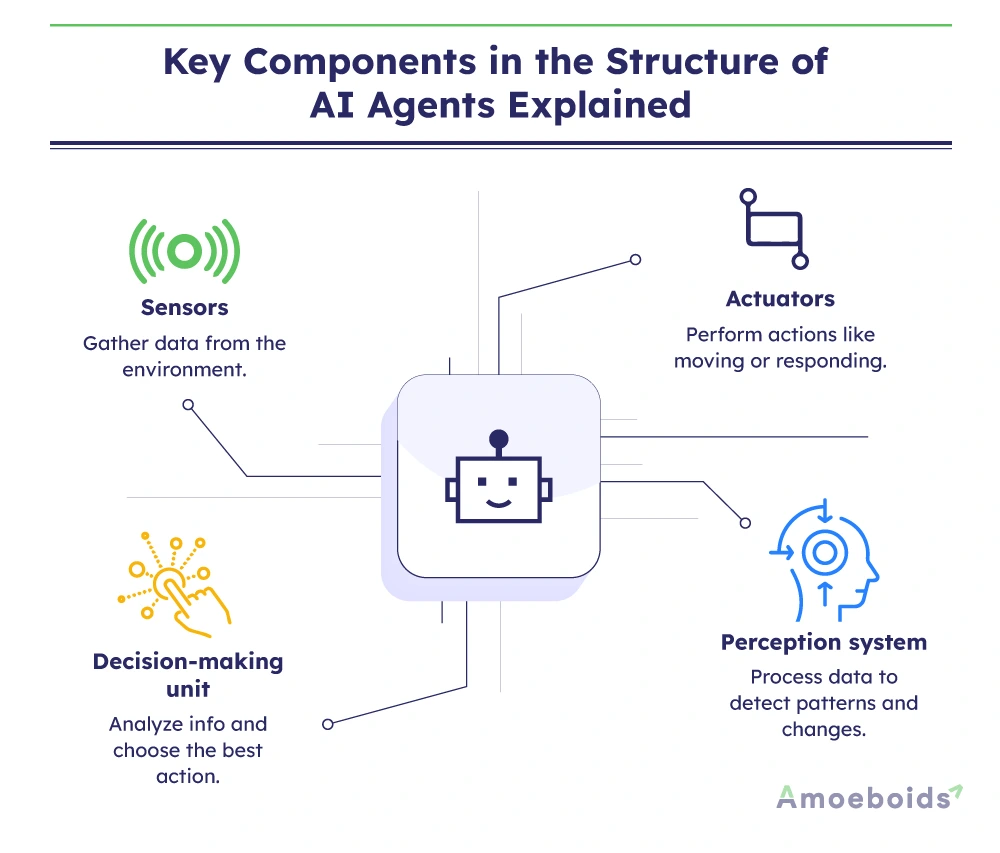
The structure of agents in AI can be divided into four key components:
1. Sensors
Think of sensors as the agent’s eyes and ears. Sensors collect information from the environment. For example, a robot vacuum uses cameras and proximity sensors to “see” furniture and walls. Similarly, a chatbot uses your typed questions as input data.
2. Perception system
Once the sensors collect information, the agent needs to make sense of it. This is where the perception system comes in. It processes the raw data and identifies patterns, changes or important elements. Without perception, the agent would have no understanding of what’s happening around it.
3. Decision-making (reasoning) unit
This is the brain of the agent. After understanding the situation, the agent must decide what to do next. It might follow simple rules (“If obstacle, turn left”) or complex logic (like evaluating multiple possible actions to choose the best one). Some advanced agents even predict what might happen next before acting.
4. Actuators (action mechanism)
After deciding what to do, the agent needs to act. Actuators are what make something happen. For a robot, actuators could be motors that move its wheels. For a software agent like a recommendation engine, the “action” could be displaying a product you might like.
Conclusion
Agents in AI are changing the way businesses work. These agents are aiding organizations in making quicker decisions, offering better services and running operations more smoothly without constant human supervision.
Understanding the structure of agents in AI and the different types available gives you a huge advantage. This clarity will help you choose the right AI agent for smarter customer service, faster logistics and more personal experiences for your users than before. These examples of AI agents show how the technology is already creating value across industries. Try to learn more about them to stay one step ahead of your competitors and build a wholesome product strategy for your business.
FAQs
How are AI agents used in customer service?
AI agents in customer service help you handle customer queries faster and more accurately. They can chat with customers, solve problems, offer solutions and even guide them through processes, all without needing a human every time.
What industries benefit from AI agents?
Almost every industry can benefit from AI agents. Whether you’re in retail, healthcare, finance, manufacturing or logistics, AI agents help you speed up operations, offer better services and make smarter business decisions based on real-time data.
What is the difference between an AI agent and a human agent?
An AI agent works automatically based on the information it receives, while a human agent relies on experience, emotions and judgment. AI agents are faster, available 24/7 and great at handling repeat tasks without getting tired.
What are the advantages of using AI agents in business?
AI agents can boost your efficiency, save time, lower costs and improve customer experiences. They help you make better decisions, automate boring tasks and focus more on the parts of your business that really need a human touch.