Standing out in the market, competing with a sea of products is a herculean task. Creating a value proposition is how you start tackling it.
A well-articulated value proposition does not stop at highlighting the benefits of your product or service but goes a step further to differentiate your brand from competition.
We’ve created this ultimate guide to help you craft a compelling value proposition. Let us jump right in.
What is a Value Proposition?
A value proposition is a clear statement that explains how your product solves a problem while delivering specific benefits & convinces customers to choose your product over competitors.
If we were to shorten this definition of value proposition, it is the primary reason a prospect should buy your product or service.
According to Marc Benioff, the legendary Salesforce founder – “In the tech sector, a strong value proposition is your North Star. It guides your product development, customer support, and marketing to ensure that you stay relevant and valuable”.
But why is value proposition so important?
The Significance of Value Proposition
A value proposition ends up being a cornerstone in all your messaging & customer interactions.
A well written value proposition helps expedite your journey to product market fit (PMF) or helps sustain it if already achieved. It outlines the special advantages that your product offers to your intended market.
Customers get a direct answer to their ‘What’s in it for me?’ question through the value proposition. This value proposition provides an explanation of why selecting your product is preferable to that of the competitors. It showcases the key advantages and reasons why your offering is attractive to the target customer segment.
In a nutshell, a well-crafted value proposition helps
- Differentiate from competitors
- Attract the right customers
- Increase conversion rates
- Enhance marketing efforts
Elements of a Strong Value Proposition
A strong value proposition typically includes the following elements:
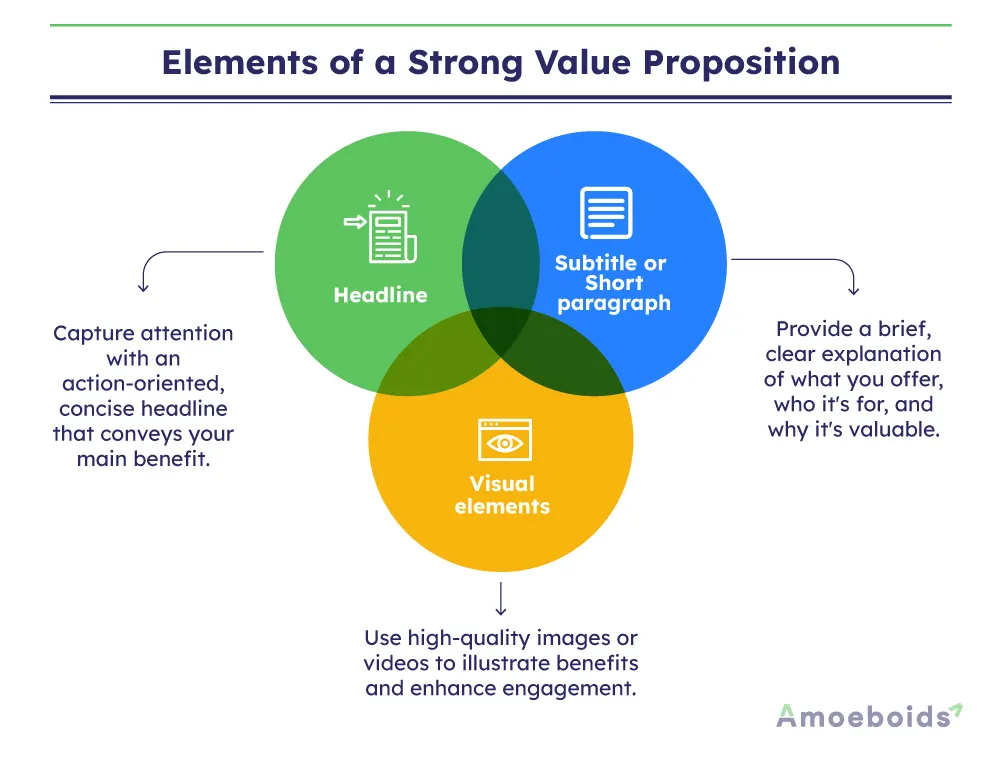
- Headline – This is the first thing people see, so it is usually the most emphatic part.
The headline captures attention and conveys the main benefit of your product or service in a clear and concise manner. A powerful headline can instantly communicate the essence of your unique value proposition, enticing potential customers to learn more.
Consider using action-oriented language in your headline to create a sense of urgency or excitement. The goal is to immediately grab the reader’s attention and make them want to explore further.
- Subtitle or Short paragraph – This section provides a brief explanation of what you offer, who it’s for, and why it’s valuable. It complements the headline and provides additional context. This section acts as a bridge, guiding the reader from the headline to the more detailed information that follows.
Be extra cautious that this section does not become too verbose. It should remain clear and to the point. Core purpose of this section is to reinforce the main benefit stated in the headline and offer a glimpse into the broader value your product or service provides.
- Visual elements – Images or videos can enhance your value proposition by illustrating its benefits and making it more engaging. Visuals help convey your message faster and more effectively. They can also evoke emotions and create a more memorable impression on your audience.
Consider using high-quality images or short videos that showcase your product in action or demonstrate its benefits. Visual elements should complement the headline & the subtitle, providing a holistic view of your unique value proposition.
Frameworks to Help you Craft a Compelling Value Proposition
We will learn all the steps needed to create a compelling value proposition in the next section. But before that learning about the frameworks that will assist in the process will be of great help. So here goes:
Jobs to be done
The Jobs to Be Done (JTBD) framework focuses on understanding the tasks or “jobs” that customers are trying to accomplish with your product or service.
Instead of focusing on demographic data, JTBD looks at the functional, emotional, and social needs of the customers. It helps you identify the specific problems your product solves and how it fits into the customer’s life, guiding the development of solutions that truly meet their needs.
Value proposition canvas
The Value Proposition Canvas is a tool used to ensure that a product or service is positioned around what the customer values and needs.
It consists of two parts: the Customer Profile and the Value Map.
The Customer Profile details the customer’s jobs, pains, and gains, while the Value Map outlines how your product’s features, pain relievers, and gain creators align with these customer aspects.
This framework helps you create a compelling value proposition that directly addresses the needs and desires of your target audience.
Steps to Craft a Compelling Value Proposition
While we outline the steps to write a compelling value proposition below, see these steps in light of the examples in the next section. That will add more meaning to these simple bullet points.
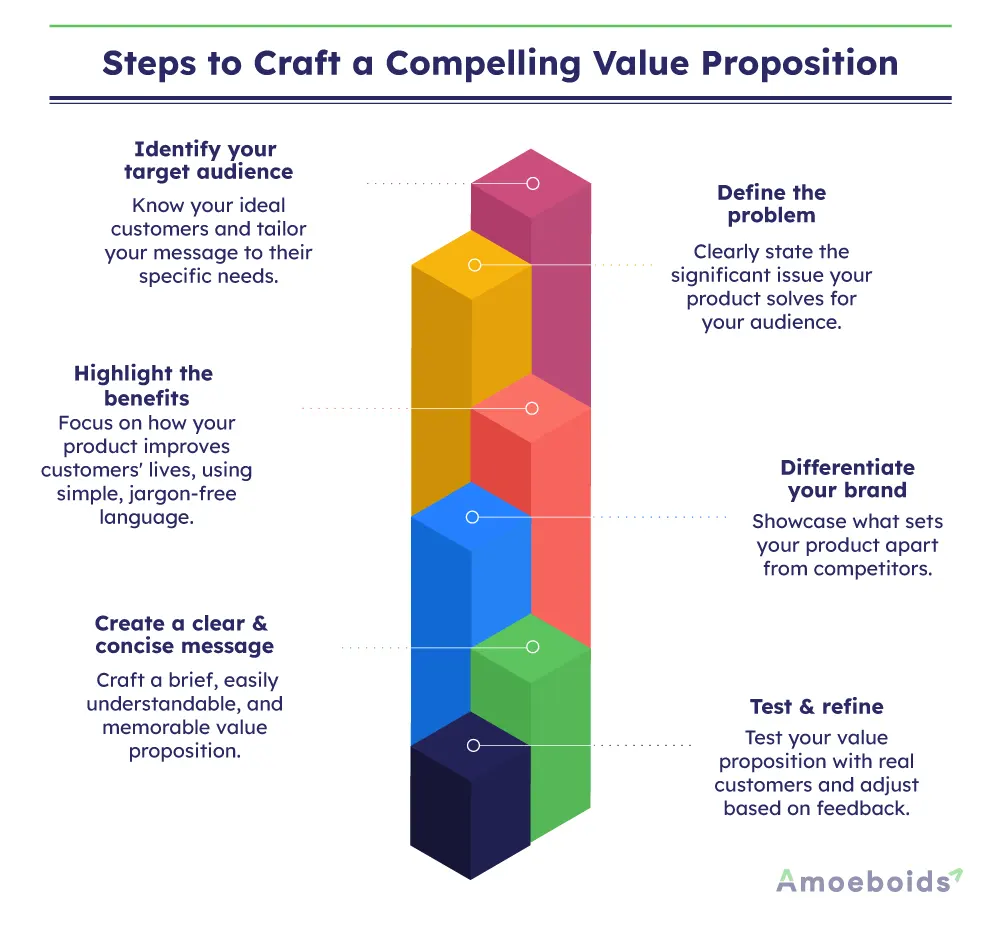
- Identify your target audience – Start by pinpointing who your ideal customers are. Understand their demographics, behaviors, and pain points. Knowing your audience inside out helps tailor your message to resonate with their specific needs and preferences.
- Define the problem – Clearly articulate the problem your product or service solves. This step is crucial because a compelling value proposition addresses a real and significant issue that your target audience faces. The more precise and relatable the problem, the more your audience will feel understood.
- Highlight the benefits – Focus on the benefits your product offers, not just the features. Explain how your product or service makes life easier, better, or more enjoyable for your customers. Use simple, jargon free language to communicate these benefits.
- Differentiate your brand – Identify what sets your product or service apart from the competition. This could be a unique feature, a superior benefit, or a distinct approach to solving the problem. Your unique selling points (USPs) are what make your value proposition stand out.
- Create a clear & concise message – Craft a message that is easy to understand and memorable. Keep it brief. It should not take more than 10 seconds for anyone to read & understand your value proposition.
- Test & refine – Once you have your initial value proposition, test it with real customers. Gather feedback and make necessary adjustments. Refining your message based on customer insights ensures that it truly resonates and drives the desired response.
Value Proposition Examples
Here are a few examples of value propositions. Read & understand them in the context of previous sections. Observe how each one of them have the key elements we’ve identified above & how they have followed the steps.
Dollar Shave Club
“A great shave for a few bucks a month.”
That’s the straightforward value proposition of Dollar Shave Club.
Note how it emphasizes affordability, convenience, and quality, appealing directly to their target audience’s needs.
This value proposition effectively addresses the common pain point of expensive and inconvenient shaving products.
Atlassian Intelligence
“Transform teamwork with human-AI collaboration.”
This is for one of the AI products from Atlassian. You can count the words literally on a single hand. That showcases how concise & to the point value propositions create the most impact. In fact, this product’s entire messaging surrounds this value proposition & seems to be an important element of their Go-to-market (GTM) strategy.
Notion
“Write. Plan. Organize. With a little help from AI”
Notion does a great job of succinctly portraying the values their product has to offer. It cleverly also uses the subtitle to highlight AI capabilities.
FAQs
- Who is involved in creating the Value proposition?
- Typically, this responsibility lies with Product marketing, Marketing & Product management executives. Any individuals who have deep understanding of the customers can assist in creating the value proposition.
- Does a Value proposition change in the life of a product?
- Yes, of course. As the product moves through its lifecycle & as the target market evolves – so does the value proposition.
- Where can I find Value proposition for a product or service?
- While there won’t be any outward facing documentation from companies around their value propositions, looking at a product’s website & specifically the banner will give you some ideas. This is since the entire messaging usually revolves around the value proposition.