According to a study on generative AI usage, skilled professionals experienced a performance boost of nearly 40% when working with well-crafted AI interactions. However, many product managers still struggle to harness that potential. Writing vague prompts or using AI without direction leads to undesirable and unusable results. It slows down sprint planning and confuses your product roadmap. That’s why AI prompt mastery matters.
In this blog, you’ll discover what an AI prompt is, understand its meaning in your world, dive into AI prompt examples for product managers, and pick up practical best practices and common mistakes so you can walk away with real strategies to make prompts work for you.
What is an AI prompt?
As Glean puts it, “Prompts are instructions or inputs given to an AI system to elicit a specific response.” A prompt provides context, intention, and direction so the AI understands what you’re asking for and why.
Think of a prompt like a user story. You don’t just say, “Write text.” Instead, you guide with context and constraints: “As a user, I want to…” or “Generate three feature ideas for improving onboarding based on this feedback.” The clearer the prompt, the more relevant the output will be. A vague request, such as “Tell me about our product,” is like a user story without acceptance criteria—you’ll likely receive a generic response.
Why specificity matters
In product management terms, strong prompts resemble refined backlog items: clear in scope, tied to outcomes, and ready to translate into sprint tasks. Prompt engineering is like grooming—iterating until the AI produces exactly what you need.
AI prompts in product management
An AI prompt translates intent into actionable outputs that AI tools can deliver. Like a backlog item with a story, context, and acceptance criteria, a well-crafted prompt saves time and sharpens recurring tasks such as market research, competitor analysis, or sprint planning.
For example:
- “Summarize this customer feedback” may return a long, unfocused paragraph.
- “Summarize this customer feedback into three key themes, each with one example quote” produces concise, ready-to-use insights for sprint planning.
In practice, an AI prompt is the bridge between product goals and AI’s capabilities. Whether drafting PRDs, writing Jira tickets, or refining roadmaps, clear prompts function like Agile grooming: the more precise you are upfront, the smoother execution becomes.
Why do product managers need AI prompts?
Product managers juggle research, stakeholder communication, and sprint planning under time pressure. Well-written AI prompts for project managers can lighten that load in very real ways:
- Faster customer feedback analysis
- Turn long surveys or support tickets into 3–4 actionable insights.
- Helps prioritize features based on real user pain points.
- Sharper user stories and acceptance criteria
- Convert vague ideas into structured backlog items.
- Ensures clarity for dev teams without hours spent rewriting.
- Data-driven decision support
- Use prompts to summarize competitor reports or market trends.
- This tool cuts research time while keeping your roadmap informed.
- Efficient communication with stakeholders
- Draft status updates, meeting summaries, or roadmap briefs in minutes.
- Saves time and keeps communication crisp and professional.
- Support in sprint rituals
- Generate retrospective talking points or daily standup summaries.
- Ensures discussions stay focused on outcomes, not noise.
- Boost in productivity and focus
- A McKinsey study found teams using AI tools could complete tasks up to 60% faster.
- For PMs, that’s time back for strategy instead of admin work.
That’s how the right prompts make your day-to-day tasks easier. Let’s look at some examples you can use right away.
Best practices for writing effective AI prompts
When you get the desired output from your prompt, you know it’s good. For product managers, effective prompts mean faster feedback analysis, clearer user stories, and better stakeholder communication. They also reduce the risk of vague or unusable results, saving you time during sprints. A well-structured prompt can turn hours of research or backlog grooming into minutes of usable insight.
Here are some best practices to ensure your AI prompts consistently deliver useful results:
1. Be specific and contextual
The more context you provide (scope, format, audience), the better the output.
Bad prompt: “Summarize this feedback.”
Good prompt: “Summarize this feedback into three key pain points with supporting customer quotes.”
2. Use role-based framing
This aligns the output to your use case instead of generic text. AI responds well when you tell it who to act as.
Example: “Act as a product manager preparing for a sprint review. Summarize these sprint outcomes in bullet points for executives.”
3. Set clear boundaries
Define length, style, or format. Prevents bloated outputs that you’d otherwise need to edit down.
Example: “Write a one-paragraph status update under 150 words, focusing only on risks and next steps.”
4. Iterate like you do in Agile
Don’t expect the first prompt to be perfect. Refine, test, and improve.
Example: Start with “Summarize this competitor report.” Refine to “Highlight three strengths and three weaknesses in this competitor’s pricing strategy.”
5. Reuse templates
Save prompts that work for you as reusable templates for backlog refinement, roadmap drafts, or retrospectives.
Example: Keep a “customer feedback → sprint insights” template handy for every sprint.
6. Combine AI with human judgment
Prompts aren’t a replacement for your product instincts. Use them to speed up work like summaries and formatting, but apply your own judgment when it comes to prioritization and decision-making.
7. Test for clarity across stakeholders
If a stakeholder can’t understand the AI-generated output, refine the prompt.
Example: “Write this roadmap update as if for a non-technical executive audience. Keep jargon minimal.”
Knowing the best practices is one step; the next is having tools and templates that make it easier to apply these prompts.
Common mistakes to avoid in Al prompting
Here are the most common pitfalls product managers face when writing AI prompts, and how to steer clear of them:
- Being too vague
If you are writing a vague and generic prompt, expect a subpar output, which might not even fulfill your objective in the first place.
Fix: Add context to the prompt. For example, who the summary is for, what length you want, and what insights you need.
- Overloading the prompt
Long instructions confuse AI just like they confuse the developers.
Fix: Break your request into smaller, sequential prompts (just like breaking an epic into stories).
- Ignoring role-based framing
Without telling AI the perspective to adopt, you often get unfocused responses.
Fix: Be explicit about the role and audience. For example: “Act as a product manager preparing a roadmap update for executives. Write three bullet points that highlight progress, risks, and next steps in simple business language.”
- Not setting constraints
Asking without boundaries leads to outputs that are too long, too technical, or too casual.
Fix: Define tone, format, and length. “Write under 200 words, bullet points only, non-technical language.”
- Treating the first draft as final
Many PMs accept the first output and move on, only to realize later that it doesn’t fit their needs.
Fix: Iterate. Refine prompts like you refine backlog items. Small tweaks make a big difference.
- Skipping verification
AI outputs can hallucinate facts or make incorrect assumptions.
Fix: Cross-check important details like competitor data, user insights, or market stats, before presenting them.
- Over-reliance on AI
Some PMs try to outsource all thinking to prompts, leading to outputs that lack product vision or context.
Fix: Use AI to speed up repetitive tasks, but keep strategy and prioritization firmly human-driven.
Avoiding these mistakes will ensure your prompts generate desired outputs.
Examples of AI prompts for product managers
Well-crafted prompts are specific, actionable, and outcome-oriented. Here are some AI prompt examples you can adapt to fit different parts of your product workflow:
1. Customer feedback analysis
Instead of spending hours reading tickets, you get actionable insights you can plug straight into sprint planning. Some examples are:
- “Summarize the following customer feedback into three key pain points with example quotes. Suggest one product improvement for each theme.”
- “Classify this feedback into positive, negative, or neutral. Provide a one-line explanation for each classification.”
- “Analyze this feedback from enterprise users and highlight any blockers related to onboarding or integrations.”
2. Backlog refinement
Treat AI as your backlog assistant — it won’t replace prioritization, but it can sharpen scope and save time. These include:
- “Rewrite this vague feature idea into a clear user story with acceptance criteria.”
- “Break down this epic into smaller user stories that can be completed in a two-week sprint.”
- “List five edge cases for this feature and convert them into testable acceptance criteria.”
3. Competitor and market research
This helps when you need quick talking points before a meeting with stakeholders. For example:
- “Compare the onboarding flows of [Competitor A] and [Competitor B]. Highlight strengths, weaknesses, and opportunities in bullet points.”
- “Summarize the top three trends in SaaS product roadmaps for 2025 from this report.”
- “Extract the key differentiators from this competitor’s product launch press release and suggest how we can position against them.”
4. Product roadmap support
This makes your roadmap less about “features” and more about “value delivered.” Typical prompts are:
- “Draft a one-page roadmap overview for the next two quarters. Group initiatives by themes, and include expected outcomes.”
- “Generate three roadmap options (aggressive, balanced, conservative) for launching [feature]. Show the pros and cons of each.”
- “Summarize this list of initiatives into OKRs that can be tracked quarterly.”
5. Sprint rituals
Saves you from spending time reformatting notes, allowing you to focus on decisions instead of documentation. These include:
- “Summarize yesterday’s standup notes into three bullet points: what was done, what’s in progress, what’s blocked.”
- “Suggest five retrospective discussion points based on these sprint notes.”
- “Turn this sprint review transcript into a highlighted email for stakeholders.”
6. Stakeholder communication
The difference between scrambling before a meeting and showing up prepared often comes down to prompts like these. Consider the following:
- “Draft a concise status update for executives: highlight progress, risks, and next steps in under 150 words.”
- “Write a stakeholder email explaining the delay of [feature]. Keep the tone professional, empathetic, and solution-oriented.”
- “Create a one-slide summary for leadership based on these sprint outcomes.”
7. Strategy and vision work
These AI prompt examples will provide product managers with a scalable approach to handling repetitive tasks, allowing them to focus more on strategy, customer empathy, and stakeholder alignment. Samples are:
- “Generate three positioning statements for our product targeting SMBs in the HR tech market. Keep them under 20 words each.”
- “Summarize this analyst report into three strategic opportunities and three threats relevant to our product line.”
- “Draft a vision statement for the next 18 months, based on these high-level objectives.”
These examples are powerful, but they work best when written with care. Next, let’s go over the practices that make prompts effective.
AI Prompts for Customer Insights & Market Research
Smart AI prompts help teams to understand customer behavior, market trends, and buyer expectations without spending hours on manual analysis. The pointers show how AI enhances product research and critical thinking.
- Understand Customer Problems: Some of the best ai prompts can quickly identify recurring customer issues from reviews, surveys, and support conversations.
- Track Industry Trends: Using ai prompts for product managers allows teams to accurately analyse competitor strategies, market trends, and changing customer expectations.
- Organise User Feedback: Different ai prompt ideas can categorise feedback into categories like feature requests, functionality issues, and customer satisfaction insights.
- Study Competitor Strategies: AI can compare prices, features, positioning, and customer experiences to help make better product and market decisions.
- Create Research Summaries: AI tools can reduce lengthy reports and scattered insights into concise summaries that teams can understand.
AI Prompts for Roadmap Planning & Prioritization
The following pointers describe how AI prompts can effectively simplify roadmap planning, feature prioritisation, and long-term product strategy decisions.
- Rank Product Features: Some of the top ai prompts can prioritise features by customer value, urgency, business impact, and development effort.
- Align Business Objectives: Using the best prompts for product managers allows teams to connect roadmap priorities with company goals and customer expectations.
- Evaluate New Ideas: Before teams begin development, AI can compare product concepts, identify feature gaps, and assess risks.
- Improve Sprint Planning: Teams can use smart AI suggestions to properly balance workloads, manage relationships, and create realistic delivery timelines.
- Simplify Stakeholder Communication: AI-generated roadmap summaries help stakeholders understand project priorities, milestones, and planning decisions.
AI Prompts for Competitive Analysis
Competitive analysis using the best ai prompts allows product teams to more effectively review competitor strategies, market positioning, customer expectations, and feature gaps.
Teams can rapidly compare pricing models, evaluate product strengths, examine customer reviews, and spot new market trends with the help of ai prompts for product managers.
Different ai prompt ideas help you easily develop short competitor summaries and quickly spot important industry trends. They also allow product teams to make better planning decisions without spending too much time on manual research and analysis.
AI Prompts for Stakeholder Communication & Collaboration
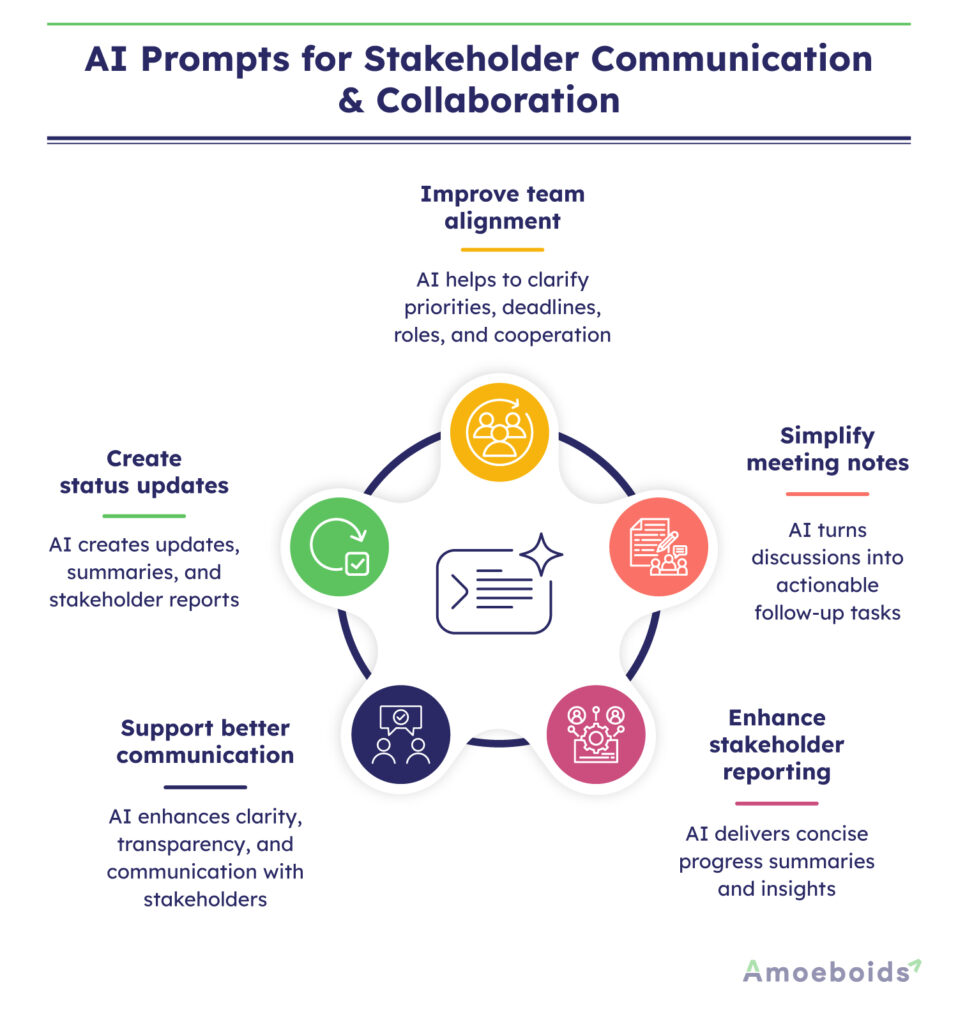
The pointers below showcase how AI prompts enhance team communication, reporting, collaboration and stakeholder updates.
Create Status Updates:
Some of the best ai prompts can rapidly produce brief project updates, meeting summaries, and stakeholder reports.
Improve Team Alignment:
Using top ai prompts helps teams communicate priorities, timelines, and responsibilities more clearly across departments.
Simplify Meeting Notes:
Various ai prompt ideas can help turn lengthy discussions into action items, decisions, and follow-up tasks to improve collaboration.
Enhance Stakeholder Reporting:
Smart prompts help teams easily create clear progress summaries, milestone reports, and project insights.
Support Better Communication:
AI-generated summaries reduce confusion, increase clarity, and keep stakeholders informed throughout the project’s lifecycle.
AI Prompts for Data-Driven Decision Making
Here are the pointers that explain how AI prompts help teams in evaluating data, spotting trends, and making smarter business decisions.
- Analyze Performance Metrics: Using ai prompts for product managers allows teams to better understand KPIs, customer behavior, and product performance.
- Identify Business Trends: Some of the best prompts for product managers can reveal patterns, growth opportunities, and dynamic market demands in a flash.
- Simplify Data Interpretation: AI can simplify complicated reports, spreadsheets, and dashboards so that teams can understand them more easily.
- Support Strategic Planning: Smart prompts help companies evaluate risks, forecast outcomes, and enhance future product and business planning decisions.
- Improve Decision Accuracy: AI-generated insights reduce error, improve data analysis, and allow teams to make more confident decisions.
Tools and templates
The right tools make it easier to put AI prompts into action. Here are some trusted options that product managers can use to speed up research, planning, and communication:
| Tool/Template | Description |
|---|---|
| Amoeboids Automated Release Notes & Reports App | Amoeboids’ Automated Release Notes & Reports App for Jira lets you set default or custom prompts within Jira to generate release notes via AI. You can control tone, length, language, input sources (like JQL filters), and then review, modify, and publish outputs. It’s a strong example of AI-assisted documentation automation, though not prompt-specific — it does support prompt-style input within the tool. |
| Productboard AI Prompt Templates | Productboard offers ready-made templates for product managers. They help with tasks like drafting PRDs, doing research, and writing updates for stakeholders. Each template follows a clear structure, so prompts stay focused and useful. |
| Glean’s 25 AI-Powered Prompt Library | Glean provides a library of 25 prompts. These cover common PM needs like customer insights, roadmap planning, and decision-making. You can customize them and use them in your daily workflow. |
| Team-GPT: 17 ChatGPT Prompts for Product Managers | Team-GPT shares 17 prompts designed for product work. They cover market research, idea generation, and roadmap planning. The list was updated recently, so it feels current and practical. |
| GitHub: Dean Peters’ Product Manager Prompts Repository | Dean Peters created an open-source library on GitHub. It includes prompts for user stories, Jobs-to-be-Done, and stakeholder alignment. You can copy, paste, and adapt them to your tools. |
| Peter Yang’s Collections | Peter Yang shares prompts he uses as a PM. They focus on conducting interviews, gathering feedback insights, and reviewing strategies. His approach follows a simple loop: understand, identify, execute. |
| Pendo: Five Essential AI Prompts for PMs | Pendo highlights five practical prompts. They focus on tasks like feedback analysis and stakeholder updates. These are simple to use and fit directly into PM workflows. |
Conclusion
You don’t have to learn every other new AI tool out there to write great AI prompts. You just need to sharpen your existing skills with any one tool of your choice. We have learned what AI prompts mean in a product management context, including real-world examples you can copy-paste, best practices for writing them, tools and templates to lean on, and common mistakes to avoid.
Try out the techniques mentioned above, test a few templates, and don’t hesitate to copy-paste prompts from the examples we shared. Adjust them for your backlog, roadmap, or sprint rituals and see how much time you win back. The more you experiment and improve your prompts, the better results you’ll get. Start small, refine, and let AI take care of the repetitive tasks so you can focus on building great products.
FAQS
Q. How can AI prompts help product managers?
AI prompts help product managers save time on repetitive tasks, such as summarizing customer feedback, drafting user stories, and preparing stakeholder updates. By giving clear instructions, they make AI outputs more actionable and relevant to day-to-day product workflows.
Q. What are the best AI prompts for product management tasks?
The best AI prompts are those that add context, constraints, and clarity. For example: “Rewrite this feature idea into a user story with acceptance criteria” or “Summarize this competitor report into three opportunities and three risks for our roadmap.”
Q. Is prompt engineering necessary for product managers?
Prompt engineering isn’t mandatory, but it’s becoming a valuable skill. Knowing how to structure prompts, just like grooming a backlog, helps PMs get higher-quality outputs and reduces rework. It’s less about coding and more about clear communication.
Q. Why should product managers use AI prompts?
AI prompts provide PMs with a scalable approach to managing research, documentation, and communication, while maintaining strategic focus. They turn AI into a practical assistant, helping PMs stay ahead on insights and spend more time driving product vision.