
Your SaaS company just launched a new client portal after weeks of long hours and caffeine. But instead of appreciation, the client looks disappointed. The design team says development went off track. Developers blame shifting requirements. The project manager is stuck in the middle. Deadlines missed. Budgets blown. Trust is fading fast.
Organising a kickoff meeting for a project can help your company avoid this negative situation. It’s not just a meeting. It’s the foundation of every successful project. It brings the client and your team on the same page from day one. As a result, confusion gives way to collaboration.
In this article, learn what goes into a project kickoff meeting and how it is beneficial.
What is a project kickoff meeting?
Every project involves teamwork. However, misunderstandings can sometimes arise during a collaborative project workflow. That’s why a kickoff meeting is important. The purpose of a project kickoff meeting is to align every stakeholder before execution begins. It includes everyone involved in the project from the start and clarifies their roles, responsibilities, and deliverables from day one.
For instance, let’s say you are building a new HR analytics dashboard.
In the kickoff meeting:
● The product manager explains the goals
● The client shares their expectations
● The development team discusses strategies to deliver it on time
There are four major elements of a project kickoff meeting that help teams maintain clarity:
● Project objectives: Problems to be solved and key milestones to be achieved
● Scope and timeline: Features or deliverables with their expected date of delivery
● Roles and responsibilities: Assigning tasks for each team member to avoid misunderstanding
● Communication plan: Figuring out the smartest way to keep everyone informed about the project’s progress
Next, let’s take a look at a project kickoff meeting example for more clarity.
What is the purpose of a kickoff meeting?
The single most important purpose of a kickoff meeting is to ensure that everyone involved in the project is clear about its requirements and possible outcomes. That involves the client, too. Here are some important kickoff meeting objectives every team should focus on:
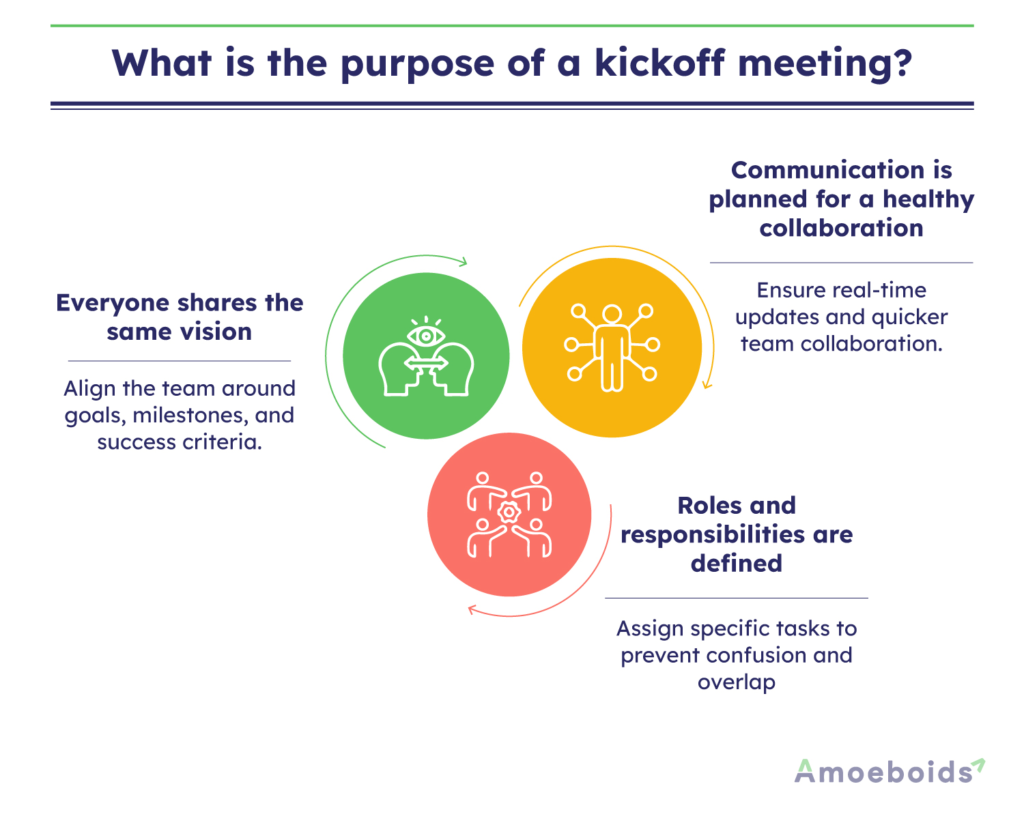
Everyone shares the same vision
The primary purpose of the meeting is to bring all members involved in the project onto the same page. So, the project manager takes the lead. They discuss the ultimate project goal and the number of milestones it will take to reach there. The discussion continues until everyone in the team, from clients to developers, agrees on what success means.
Roles and responsibilities are defined
After the milestones are clear, the project manager assigns tasks. Each department knows what to deliver at each stage. This avoids confusion and overlap later. Everyone leaves the meeting knowing exactly what to do.
Communication is planned for a healthy collaboration
Communication here doesn’t merely mean sharing updates through Slack, Jira, or email. Rather, it aims to communicate faster to resolve critical queries before they escalate further. Most importantly, how to keep everyone in the loop on every project update in real time. This clearly defines the kickoff meeting purpose and ensures smooth collaboration throughout the project lifecycle.
So far, we have understood the purpose of a project kickoff meeting. Let’s learn about its benefits in the next section.
Why should you have a project kickoff?
SaaS projects involve cross-team collaborations. Sometimes, they are from different time zones. Then there is a client whose requirements change dynamically. In such cases, a project kickoff meeting can help you. Properly planning a project kickoff meeting helps teams avoid confusion, improve accountability, and build stakeholder confidence.
1. Prevent confusion
An engaged kickoff meeting clears confusion before the project begins. Any confusion about deliverables, timelines, or duties is addressed promptly. Finally, everything is documented and stored in a central dashboard. That clarity drastically reduces unwanted reworks and missed deadlines.
2. Boost stakeholder confidence
Imagine you’re presenting a new analytics dashboard project to a client. You clearly explained how the team will follow the software product roadmap through deliverables. Now, the client immediately feels confident in your process. That’s how a well-structured kickoff can demonstrate to stakeholders that you have things under control.
3. Build momentum and excitement
Kickoffs create energy. They help teams see the “why” behind their work and how their contribution impacts the bigger picture. Let’s say your SaaS team has come up with fresh ideas about building a new employee engagement module. The kickoff can highlight how it can help HR leaders improve retention and culture.
Explaining this shared purpose will keep everyone engaged till the end of the sprint cycle.
Types of kickoff meetings
Kickoff meetings can be external, internal, or agile in nature. Let’s understand how they differ from each other:
Depending on the project complexity, teams may also conduct a pre-kickoff meeting internally before involving clients or stakeholders.
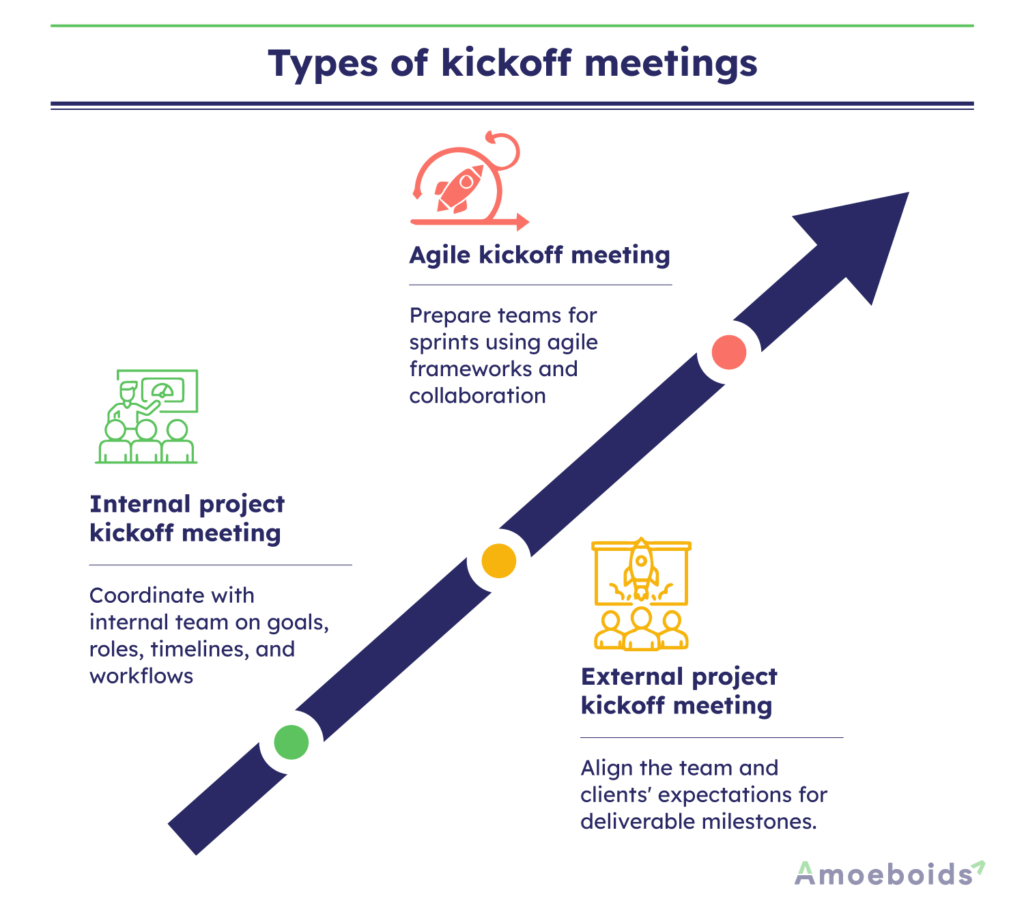
Internal project kickoff meeting
This is an in-house kickoff meeting without clients. The aim is to keep everyone clear about the project goals, deadlines, roles, and workflows. If there is any confusion, the manager clears it right there to avoid wasting time on this in the external kickoff meeting.
External project kickoff meeting
This meeting includes both your internal team and the client. The project manager explains how the team will meet their expectations. Unless the client has any queries, both parties agree on deliverables, communication frequency, and key milestones.
Agile kickoff meeting
Most teams follow Agile project frameworks, such as Scrum or Kanban. For them, an agile kickoff meeting is necessary before starting a major initiative. It also happens when the team has recently welcomed many new faces. The team’s coach can decide whether to include or not stakeholders and part-time members, depending on the necessity.
Project kick-off meeting with your team vs. with customers or clients
A project kickoff may or may not involve the client (or customers). Depending on whether the meeting is internal or external, the elements of discussion can vary, as shown in the table below:
| Aspect | Internal kickoff meeting | Client/Customer kickoff meeting |
|---|---|---|
| Purpose and focus | To prepare your team for execution. | To clarify clients/customers about project outcomes |
| Tone and communication style | An informal yet in-depth discussion about possible risks, blockers, and technical challenges | More formal tone to ensure transparency, confidence, and professionalism |
| Agenda topics | Milestones, roles, sprint plan, risk, and communication flow. | Goals, deliverables, timelines, and feedback process. |
| Participants | Project manager, developers, designers, and product owners. | Internal team, client reps, account managers, key stakeholders. |
| Output | Clear internal action plan and task assignments | Shared understanding of goals, timelines, and client involvement |
Example of a project kickoff meeting agenda
This is a project kickoff meeting agenda template for a SaaS company building an HR analytics dashboard for a mid-sized client. The meeting lasted 60 minutes and included the project manager, product owner, tech lead, designer, QA lead, and client representatives.
The project manager started the meeting by welcoming everyone and setting a positive tone. Each person introduced their role. A short icebreaker helped the teams connect quickly.
Next, the product owner explained why the dashboard was needed. The client shared key goals, including automating HR reports and reducing manual work. Everyone agreed on success metrics, such as saving 40% of reporting time.
The tech lead described the main modules. These included performance analytics, attrition tracking, and attendance visualization. The team discussed what features would go live first and what would come later.
The project manager outlined roles and responsibilities. Developers would handle integrations. Designers would deliver wireframes. The client’s IT team would share data access.
After that, the team reviewed the timeline as part of the project kickoff meeting agenda discussion. They planned three sprints for integration, design, and testing. Possible risks, such as data delays, were discussed.
The meeting ended with a brief discussion on communication. The team decided to streamline communication through Jira and Confluence. The team also discussed responsibilities and follow-up activities required after kickoff meeting sessions to maintain alignment. The project manager concluded the meeting by outlining action items and next steps. The result was clear direction, shared goals, and a motivated team ready to begin.
If you have never conducted such a meeting before, consider using project kickoff templates for assistance. They are free and readily available online.
Conclusion
The outcome of a SaaS project depends on clarity about goals and expectations. That’s where a successful project kickoff meeting becomes necessary. When everyone begins with a kickoff meeting, team collaboration reaches its maximum beauty. Even the client gets peace of mind. There are not going to be any odd surprises. If you are feeling overwhelmed, consider using free project kickoff templates available online for assistance.
FAQs
What is the purpose of the kickoff?
When teams are unclear about their roles or clients have different expectations than the results produced, the project fails. A kickoff meeting is the medium for explaining the project’s scope, milestones, and deliverables. Any doubt regarding any aspect of the project, whether from the client or the team, is addressed immediately. These discussions ensure the team understands the kick off meeting objectives clearly before execution begins.
How long is a project kickoff meeting?
A kickoff meeting usually lasts between sixty to ninety minutes. However, its duration completely depends upon how long it takes to bring everyone onto the same page.
Who attends a project kick-off meeting?
Anyone directly or indirectly contributing to the project should be invited to this meeting. This includes all project team members and the client as well.