When it comes to managing workflows, there’s no shortage of methodologies out there. From traditional project management to more flexible systems, everyone claims to have the blueprint for success. But at the end of the day, how do you choose the right one for your team or organization?
Think of it like picking the perfect workout plan. You won’t see great results if you choose something that doesn’t align with your goals or your team’s strengths. Methodologies like Agile and Scrum work wonders for the right teams, but the real challenge is knowing how to implement them and when to adjust.
In this blog, we’ll help you explain two of the most popular approaches, Agile and Scrum, and break down the difference between Agile and Scrum so you can choose the one that fits your team’s needs best.
What is Agile project management?
Agile project management is a flexible, iterative method that helps you adjust to changes quickly. Instead of setting a fixed plan, you work in short cycles, regularly review progress, and adjust tasks based on new information. Before going further, it helps to understand what is Agile vs Scrum at a high level: Agile is the philosophy, and Scrum is one way to practice it.
For example, your development team might hold weekly check-ins to reassess priorities, making it easier to handle unexpected customer feedback or technical issues. This continuous cycle of planning and feedback has been shown to boost productivity by more than 14.9%. When you use this method, you’re constantly fine-tuning your process to improve efficiency.
Agile methodologies have also seen the following results as per the latest studies:
- Agile projects have a 64% success rate, compared to a 49% success rate for projects using the Waterfall methodology.
- Companies that adopt Agile report an average 60% growth in revenue and profit.
- Agile teams are 25% more productive and 50% faster to market than non-Agile teams.
- Only 9% of Agile projects fail, compared to 29% of Waterfall projects.
- 98% of companies report increased success after adopting Agile.
When Should You Use Agile?
Not every project requires a strict plan, and Agile excels in these situations. It is ideal for projects that evolve over time, allowing teams to adapt quickly and without disrupting progress. Agile is also a good option for developing a new product or feature. Customer feedback informs the next steps, allowing teams to continuously improve.
It is ideal for teams that prefer more independence. Agile encourages teams to structure their work and work together smoothly instead of following strict workflows.
Agile is especially useful when time to market is highly important. Teams can launch faster, learn from users, and enhance over time. It’s also a good fit for long-term projects where priorities are likely to change. Agile helps teams adapt and keep their plans in sync with current goals.
What is Scrum project management?
Scrum is a specific framework within the Agile methodology. It organizes work into sprints, typically lasting two to four weeks, during which your team completes a set of tasks. In a scrum setup, you assign roles like Scrum Master and Product Owner and hold daily stand-up meetings to ensure everyone is aligned. This is where agile project management vs Scrum starts to look different in practice, since Scrum adds structure that Agile alone doesn’t require.
For instance, your marketing team might break down a campaign into weekly sprints with clearly defined tasks and review sessions at the end of each sprint. This structured approach makes it easier to monitor progress and resolve issues quickly, providing a predictable rhythm for your workflow. The scrum methodology has many benefits, highlighted by the following statistics:
- 78% of Scrum users would recommend the methodology to colleagues.
- Teams using Scrum report being 3 to 4 times more productive, with the best Scrum teams being up to 8 times more productive.
- Scrum teams have a 250% higher work quality compared to teams without Scrum, significantly reducing defect density.
- 85% of teams say their work life has improved because of Scrum.
But adopting Scrum also comes with its own set of challenges, including:
- Processes and practices (46%)
- Cultural clashes (43%)
- Organizational resistance to change (42%)
So how do you go about choosing the right solution? The answer is simple: by understanding the stark differences between the two methodologies and how you can use them to improve your workflow management.
When Should You Use Scrum?
Sometimes structure isn’t limiting, it’s just what a team needs to stay on track. This is when Scrum typically produces the best outcomes.
- Your project has a defined scope, and you require consistent checkpoints to track progress. The sprint cycles of Scrum make it easier to plan for deadlines.
- If your team is large or cross-functional, having clear roles can help prevent confusion about who owns what. Scrum’s defined roles ensure accountability in every sprint.
- Stakeholders want regular updates and visibility into what has been accomplished. Scrum reviews and retrospectives keep everyone in the loop without additional meetings.
- You work on a product that gets a steady stream of incremental improvements. Scrum divides large goals into manageable and trackable pieces.
- Your team has a history of scope creep and requires more defined boundaries. Scrum’s time-boxed sprints naturally limit how much can change mid-cycle.
History of Agile and Scrum
Agile didn’t appear out of nowhere, it grew from decades of frustration with rigid, plan-heavy project management. During the 1990s, software teams discovered that Waterfall caused delays and outdated products because requirements were fixed too early.
In 2001, a group of seventeen software developers met in Utah and published the Agile Manifesto, a short document outlining four core values and twelve guiding principles.
The Agile vs. Scrum conversation begins here, as the manifesto introduced Agile principles without prescribing a single framework or method.
Jeff Sutherland and Ken Schwaber formalised Scrum in the early 1990s, prior to the Agile Manifesto. When the manifesto was released, Scrum was already widely used, making it one of the first and most popular frameworks for implementing Agile principles.
The difference between Agile vs. Scrum
Imagine that you’re managing a software project and need to choose a method to keep your team on track. You’ve heard that Agile and Scrum both emphasize quick iterations and frequent team communication, yet you’re not quite sure which fits your style best.
Agile is a broad project management philosophy built on a set of guiding principles that promote flexibility, continuous improvement, and regular feedback. It’s like having a flexible playbook where adjustments can be made on the fly.
On the other hand, Scrum is a specific framework within the Agile umbrella comprising scheduled bursts of activity and defined roles for those involved. This structure can be compared to following a detailed recipe; it instructs you exactly what to do per a schedule.
Look at the table for a better understanding of Agile methodology vs Scrum:
| Agile | Scrum |
| The philosophy is centered on adaptability and continuous improvement. | A specific framework with defined roles and time-boxed sprints. |
| Planning is ongoing and fluid, adapting to change throughout the project. | Detailed sprint planning occurs at the start of each cycle, with fixed deliverables. |
| Encourages self-organizing teams without strict role definitions. | Involves defined roles like Scrum Master and Product Owner, which adds clarity but reduces flexibility. |
| Regular check-ins as needed, flexible feedback loops. | Daily stand-ups, sprint reviews, and retrospectives ensure periodic, scheduled feedback. |
| High adaptability to changing requirements, ideal for projects with unpredictable demands. | More rigid due to fixed sprint durations; adjustments happen between sprints rather than during. |
| It offers continuous improvement and adaptability, leading to an increase in productivity. | Provides a clear structure and accountability, making progress measurable and consistent. |
| It can lead to ambiguity in task ownership and challenges in tracking progress without strict guidelines. | It may feel too structured and inflexible for teams needing to adjust rapidly to changes. |
When you’re managing a software project, choosing the right process can be a real balancing act. One day, you might feel like you’re in a freeform brainstorming session where every idea flows naturally – this is Agile.
Another day, you might need a clear roadmap with set checkpoints and roles – this is where Scrum comes into play. Understanding the agile and scrum difference can help you decide the right timing and situations to apply them.
Which Comes First, Scrum or Agile?
Many people believe Scrum and Agile were introduced together, but the order is important for knowing how they interact with one another.
Scrum was born before the Agile Manifesto, but Agile was the first to name the broader movement as a formal philosophy. When the manifesto came out in 2001, existing frameworks like Scrum became practical ways to apply the values of Agile rather than being created for it.
History clearly shows what is the difference between Agile and Scrum: Scrum is a framework that is based on the Agile philosophy.
Today, you can think of it like this: Agile is the goal, the set of values and principles you strive for. Scrum, along with Kanban and other tools, can help you get there.
Can You Use Agile Without Scrum?
Yes, and many teams do just that. Agile is a mindset, not a rigid process, so it can take many forms. Knowing the agile vs scrum difference matters here, since plenty of teams stay fully Agile without ever adopting Scrum’s structure.
- You can use Kanban instead, which uses visual boards to manage continuous workflow without sprint cycles or defined roles. It still sticks close to Agile principles.
- Lean methodology is another Agile-aligned option that focuses on reducing waste and maximizing value delivered to customers. There are no Scrum ceremonies required here.
- Extreme Programming, or XP, is a way to apply Agile values and practices to software development, like pair programming. It completely avoids the sprint structure of Scrum.
- Some teams have their own hybrid process, taking daily check-ins or iterative planning but with no formal Scrum roles. This is still considered agile practice.
- Smaller teams may even informally adopt basic Agile practices like weekly retrospectives but never assign a Scrum Master. Throughout, the underlying principle is adaptation.
How to Implement Scrum Using Agile Methodology
If you’ve decided Scrum is the right fit, here’s how teams usually implement it while adhering to Agile principles. Seeing the difference in Agile and Scrum play out here is useful, since Scrum gives Agile values a concrete, repeatable structure.
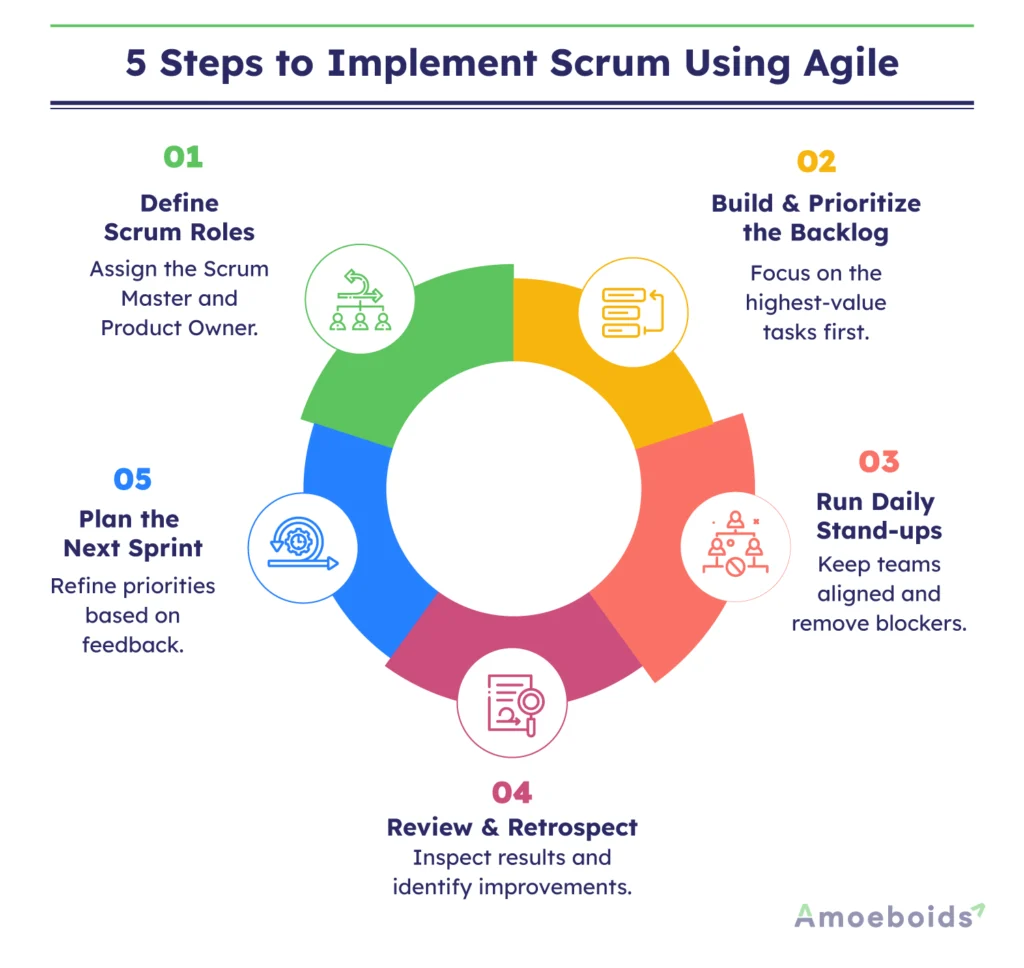
- Start by clearly defining the Scrum Master and Product Owner roles, creating a strong foundation for effective Scrum implementation.
- Divide your project into a prioritised backlog of tasks, and then focus your first sprint on the highest-value items. Keep each sprint to two or four weeks.
- Hold daily stand-up meetings to maintain communication and identify roadblocks promptly. These brief check-ins highlight Agile’s focus on continuous feedback.
- Each sprint concludes with a review session to show completed work to stakeholders. Follow it with a retrospective to discuss what can be improved.
- Adjust planning and priorities for your next sprint based on feedback from every retrospective. This keeps your Scrum process true to the core Agile values.
Agile & Scrum Certifications
Certifications can help validate your skills and build credibility if you’re serious about effectively applying these frameworks. Here are some of the best-known options to consider.
- The PMI Agile Certified Practitioner (PMI-ACP) covers multiple frameworks such as Scrum, Kanban, and Lean. It’s a good fit if your company combines approaches rather than committing to just one.
- The Certified ScrumMaster (CSM) from Scrum Alliance is specifically focused on running sprints and facilitating Scrum ceremonies. It’s one of the most well-known entry points into Scrum.
- The Professional Scrum Master (PSM) from Scrum.org confirms similar skills through a rigorous, assessment-based exam. Many employers regard it as a more difficult version of the CSM.
- The Certified Scrum Product Owner (CSPO) is geared toward those managing backlogs and priorities rather than facilitating sprints. It’s ideal if your role leans more toward product strategy.
- The Disciplined Agile Scrum Master (DASM) certification blends Scrum knowledge with broader Agile decision-making skills. It suits professionals handling Agile project management vs. Scrum facilitation day to day.
Decide on Agile vs. Scrum and propel your projects forward
Consider a scenario where you’re launching a new feature for your SaaS product. If customer feedback is rapidly changing and you need to adjust priorities frequently, Agile’s fluid nature can help you pivot quickly. However, if your team needs a clear, week-by-week roadmap with specific roles and deadlines to manage a complex product update, Scrum might be the better choice.
Choosing between Agile and Scrum depends on your project needs and team dynamics. Agile offers the freedom to adapt as circumstances change, while Scrum gives you a structured approach with clear roles and scheduled checkpoints. By understanding the agile vs scrum difference, you can select the process that best fits your workflow, ensuring you keep projects on track and your team productive.
FAQs
Is Scrum a part of Agile?
Scrum is one of several ways to implement Agile principles, which is a common starting point for anyone exploring the difference in Agile and Scrum. While Agile is a broad philosophy focused on adaptability and continuous improvement, Scrum provides a specific framework with defined roles and time-boxed sprints.
Which comes first, Scrum or Agile?
Agile is the overarching methodology that emphasizes flexibility and iterative progress. Scrum is a framework within that methodology, meaning that you first adopt Agile principles and then choose Scrum as one way to put those principles into practice.
Is Jira Agile or Scrum?
Jira supports both Agile and Scrum. It offers flexible options for you to implement whichever approach fits your team’s needs. You can use Jira to manage Agile workflows or set up Scrum boards with sprint planning and daily stand-ups.
What is the key difference between Agile and Scrum?
The main difference lies in the structure. So, what is the difference between Agile and Scrum? Agile is a broad approach focused on continuous improvement and adaptability, while Scrum breaks work into set periods called sprints, with specific roles and regular meetings to track progress. This clear division of tasks and time makes Scrum a more structured implementation of Agile principles.