Scroll through LinkedIn, Instagram, or X, and you will see that AI is everywhere. You know, it’s pretty remarkable to think about how we’ve begun using AI tools to sort out our emails, summarize those long reports we dread, or even have real conversations with various AI chatbots.
What once felt like something out of science fiction is now a regular part of our lives. So, what does AI automation mean, and why is it so crucial in today’s world?
What is AI automation?
Artificial Intelligence (AI) is transforming industries. Unlike traditional automation, which follows set rules, AI process automation is a bit smarter. Thanks to machine learning and data analysis, it learns, adapts, and improves over time.
Take, for instance, an AI chatbot on an online shopping site. It can handle customer inquiries, learn from past interactions, and deliver hyper-personalized responses over time. You might feel you are conversing with a human customer service agent all this while. This ability to adapt and evolve is what sets AI automation apart and in demand today.
How does AI automation work?
When you first look at AI process automation or how these AI tools change and adjust, it can feel almost magical. How does it know what we want? Artificial intelligence functions through advanced technologies, including Machine Learning (ML), Natural Language Processing (NLP), and Robotic Process Automation (RPA). These technologies serve as AI’s foundational support systems, enabling it to learn, understand, and execute tasks in ways that resemble human methods.
Let’s break down how AI process automation works.
- Analyzing data: First, the system analyzes all that data to find patterns and trends, similar to discovering hidden treasures in a bunch of ordinary rocks.
- Learning: Now, when it comes to learning and adapting, it’s pretty cool. Once those patterns are spotted, the machine learning models tweak their algorithms each time they encounter new data. It’s almost like they’re picking up new skills while learning on the job.
- Analysis: Then, we’ve got decision-making. This is where things get really fascinating. RPA and AI automation models can actually make decisions based on the analysis without needing a human to jump in and guide them. After the decisions are made, the system doesn’t just sit there; it kicks into gear and automates various tasks, like answering customer questions, detecting fraud, or even managing inventory.
- Improving: And guess what? It doesn’t just stop at doing its job. Thanks to these feedback loops, AI keeps improving, like a never-ending journey of learning and getting better at what it does. It’s almost like it’s on a constant quest for self-improvement.
Take, for instance, your personalized Netflix recommendations. The system analyzes user behavior, refines its suggestions based on past interactions, and personalizes content for millions of viewers daily.
Key benefits of AI automation
AI is no longer a future dream; it is happening now. With AI making headlines daily, it is clear that businesses across industries are reaping its benefits. For instance, banks use AI-driven fraud detection systems to analyze real-time transactions, preventing suspicious activities and boosting security.
Here is what makes AI automation so valuable:
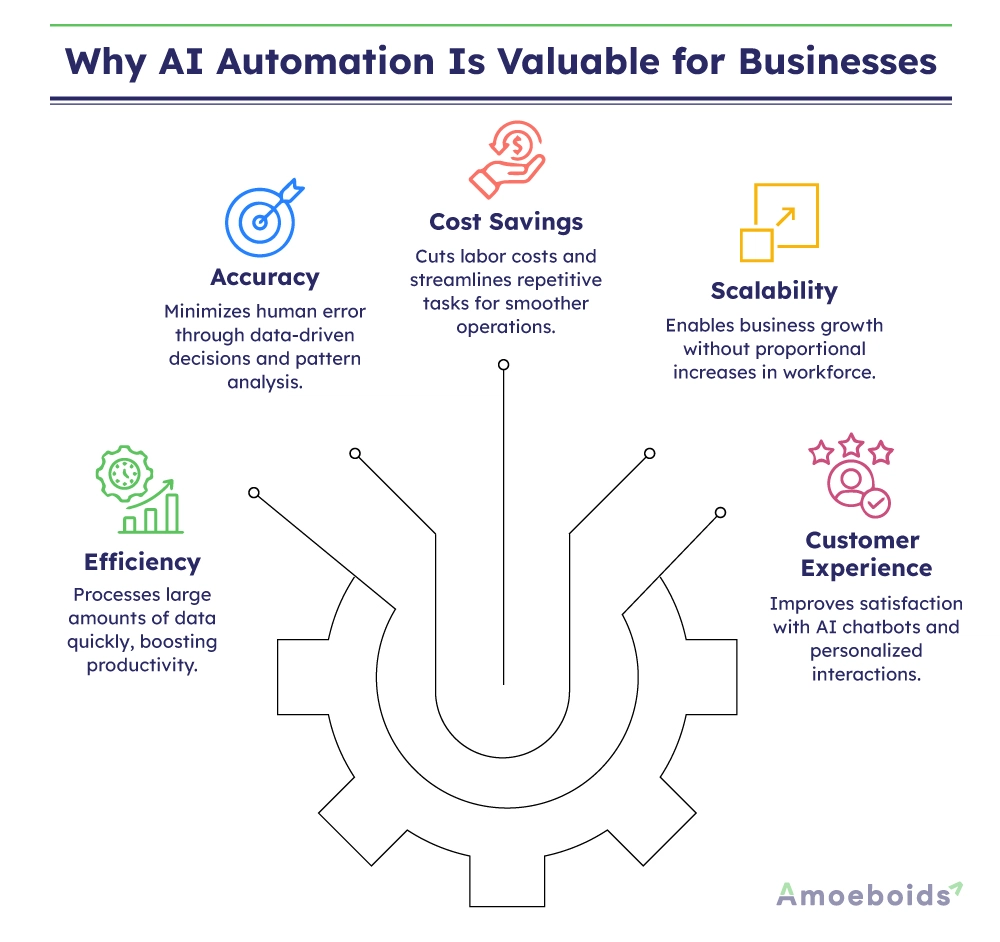
- Efficiency: AI can handle loads of data and get things done quicker than people. This means a serious boost in productivity and efficiency.
- Accuracy: AI shines here. It helps reduce errors by analyzing data and picking up on patterns to make decisions.
- Cost Savings: Due to AI, businesses are cutting labor costs. By automating boring, repetitive tasks, they’re also reducing mistakes and smoothing workflows.
- Scalability: AI automation makes it possible for companies to grow their operations without needing to hire more and more people.
- Customer experience: AI-driven chatbots and personalized recommendations enhance user satisfaction.
The Business Impact of AI Automation
AI automation changes the way companies operate, increasing productivity, decision-making, growth, and overall competitiveness.
- Operational effectiveness: AI automation performs repetitive tasks faster than employees. Teams concentrate on strategic activities, which reduces delays and boosts overall business productivity dramatically.
- Better decision-making: Companies plan their actions using predictive insights and real-time data analysis. Leaders quickly adapt to shifting market conditions and spot trends early.
- Cost optimisation: AI automation helps to reduce manual effort and human error in everyday operations. Companies save resources and costs while maintaining steady output without increasing the workforce size.
- Customer experience: Personalised recommendations, chatbots, and faster responses enhance interactions. Higher satisfaction boosts customer retention and long-term brand loyalty.
- Business capacity: AI can manage more work without slowing down or needing more staff, helping companies grow while keeping service fast and reliable.
- Risk management: AI detects anomalies, fraud patterns, and operational issues at an early stage. Timely alerts and findings benefit companies in avoiding losses and executing regulations effectively.
Common use cases of AI automation
AI automation is being used by people, businesses and industries alike. From healthcare and education to retail and agriculture, nearly every industry is now influenced by AI automation.
For instance, the automobile industry is applying AI automation in autonomous cars to scan the road conditions, make decisions for driving in real time, and improve vehicle safety.
Here are some additional applications of how various industries are utilizing AI:
- Healthcare: AI performs administrative work, diagnoses illness via image analysis, and tailors care for patients.
- Retail/E-commerce: Chatbots, recommendation systems, and inventory management are made efficient by AI.
- Finance: AI interprets market patterns, trades automatically, and detects fraud more effectively.
- Manufacturing: AI-driven robots optimize production through preventative maintenance to eliminate machine breakdowns.
- Workplace productivity: Existing workforce is benefiting from various AI tools and techniques to minimize repetitive and redundant work such as going through reports, composing emails, etc. to save time and provide error-free output.
How Do AI Agents Differ from Traditional Automation Tools?
AI agents and traditional automation tools both help to automate tasks. However, they work in very different ways.
Rule-Based vs Intelligent Execution
Automation that is traditional follows set rules. It works exactly how it was meant to. This is great for tasks that don’t change very often and have to be done over and over again. AI agents, on the other hand, can think beyond fixed rules. They adjust based on the situation.
Learning and Improvement
Traditional automation doesn’t learn. If something changes, humans must modify the rules. AI agents learn from historical and real-time data. They gradually improve accuracy and reduce the need for manual corrections.
Decision-Making Ability
If traditional tools aren’t programmed to handle unexpected situations, they can’t. AI agents can look at a situation, handle exceptions, and make decisions on their own without needing help from people all the time.
Flexibility in Use Cases
Traditional automation is best suited for structured, predictable back-office tasks. AI agents can change more easily. They can deal with customers, changing workflows, and hard tasks.
In simple terms, traditional automation does what it’s told. AI agents know what’s going on.
How AI Automation Is Expanding Enterprise Capabilities
AI automation helps companies operate more smoothly and efficiently. It extends business capabilities beyond manual limitations and promotes data-driven growth.
- AI automation can quickly handle large amounts of enterprise data, allowing teams to generate insights and make more strategic business decisions.
- It allows personalised customer experiences across platforms, improving engagement, retention, and overall service quality across platforms.
- Automated workflows reduce human effort in operations, freeing employees to concentrate on innovation and high-value tasks.
- AI allows predictive analytics for demand forecasting, risk detection, and cross-departmental planning.
- Enterprises can scale operations smoothly without hiring more people by using intelligent automation systems to handle larger workloads.
How to Assess Readiness for AI Automation Adoption
Before putting AI automation into action, companies should make sure they are ready. A thorough readiness assessment makes sure that the project is successful and helps avoid wasting money. Find tasks that need to be done over and over, make sure the data is correct, see how well the systems work together, and show employees how to use AI tools properly.
Make sure your business has clear goals, security standards, and rules for how it should be run. Properly checking readiness makes AI work better, saves time, and stops confusion or tools that aren’t used.
Key Strategies for Successfully Implementing AI Automation
Adoption of technology alone is lacking for effective AI automation. A structured implementation approach offers increased ROI and smoother team adoption.
- Start with high-impact use cases: Start by automating repetitive and measurable tasks with AI. Early outcomes boost team confidence, show value, and reduce opposition to digital transformation initiatives.
- Prepare clean and structured data: AI systems require accurate and organised data. Proper preparation improves predictions, reduces errors, and maintains automation consistency across workflows.
- Train employees to use AI: Teach employees how to use AI tools. The right training makes it more likely that people will use intelligent automation systems, work together, and make decisions.
- Monitor and optimise continuously: Track performance using analytics and feedback loops. Continuous monitoring helps refine automation models, enhance performance, and maintain long-term business productivity.
What Should You Look for in AI Automation Technology?
Choosing the appropriate AI automation technology is important for long-term digital transformation success. Businesses should assess platforms based on reliability, security, and future capacity, in addition to features.
- The platform should seamlessly integrate with existing software and workflows, avoiding operational disruption during deployment.
- Strong data protection and regulatory alignment are required to protect sensitive business information.
- The technology should clearly show how decisions are created to improve stakeholder trust.
- The solution must be able to handle increasing workloads and provide flexible options for expanding business operations.
When you choose the right platform, you can be sure of a better return on your investment and consistent performance. A carefully chosen solution makes the company more reliable, productive, and able to grow over time.
Challenges and limitations of AI automation
Like any technology, AI automation comes with its own set of issues and drawbacks. First off, there’s the high initial investment. You see, diving into AI automation can be expensive. It usually requires a lot of upfront investment for things like infrastructure and training.
Then, there’s the fear of job displacement. A lot of employees are worried that AI might take over their jobs, leaving them without work. That concern makes people hesitate to embrace this technological shift.
Next up on the list are data and security risks. Since AI deals with a ton of personal information, keeping everything secure can be a real challenge.
And let’s not forget about bias in AI models. If AI isn’t trained the right way, it can pick up on biases from the data it learns from. Take facial recognition AI, for instance. It’s been under the microscope a lot lately because of bias issues that lead to misidentifications.
Finally, there’s the matter of regulatory compliance. Companies have to wade through a bunch of complicated legal rules to make sure they’re using AI correctly.
Future trends in AI automation
AI is easily accessible to anyone with internet access, and the future of AI automation holds exciting, limitless possibilities. Saying up to date on the upcoming trends is important for businesses and individuals to remain competitive, ethical, and adaptable. Here are some key developments shaping the future of AI automation:
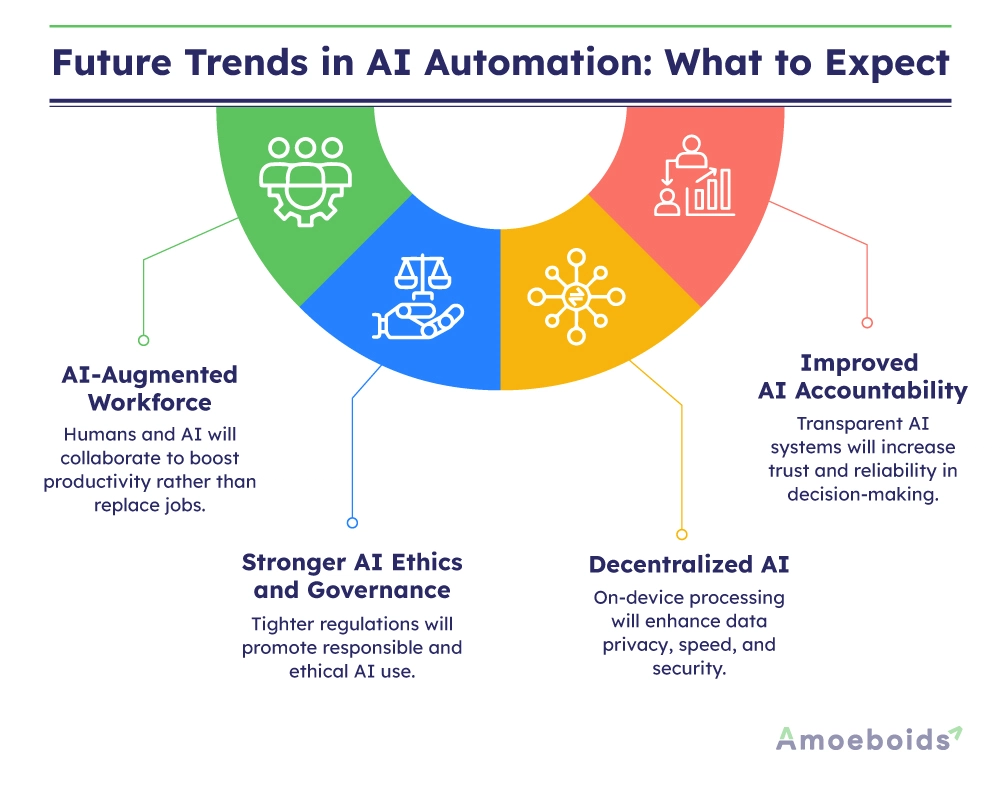
- AI-augmented workforce: AI will work along with humans, instead of replacing us, improving productivity rather than replacing jobs.
- Stronger AI ethics and governance: Stricter regulations will ensure that AI is developed and deployed ethically.
- Decentralized AI: AI processing will take place directly on devices rather than relying on cloud computing, improving speed and privacy.
- Improved AI accountability: AI decision-making will become more transparent and accountable to build trust and reliability.
Picture a world where your personal assistant, powered by AI, just seems to get you. It knows what you need, schedules your meetings, and can even whip up emails based on how you usually work. Sounds pretty convenient, right?
Conclusion
AI is changing the way we work and operate. While there are several ways when it comes to saving time and boosting productivity, AI is proving to be one of the most effective. Its adoption is making businesses more efficient, cost effective, and let’s be honest, better at customer service.
There are still obstacles such as protecting data, ethical issues, and helping the workforce adjust to so many changes and as AI continues to develop it will be even more integrated into the artificial world of reality, changing everything in its path.
FAQs
In what ways is AI automation different from conventional automation?
Well, traditional automation usually follows specific rules that are pre-set and can’t really change. But with AI automation, it’s a whole different ball game—it learns, it adapts, and it actually gets better at doing the same task over time.
What industries benefit the most from AI automation?
Some big players benefiting from AI automation are in healthcare, finance, manufacturing, retail, and customer service. Due to AI technologies, these sectors are really seeing some positive changes!
Can AI automation replace human jobs completely?
AI process automation takes over menial, repetitive tasks, but in doing so, it generates new work that humans need to carry out to enhance collaboration with automation systems.
In what ways can AI automation compromise security and safety?
With the implementation of systems powered by AI, organizations and people could fall victim to several cyber vulnerabilities, hacked data, and risks of prejudice, which makes having strong security measures a must.,